Same $5 Rate, Bill Differs by 30%, OpenAI Exec: Token Pricing Is Never Directly Comparable

marsbitPublished on 2026-08-19Last updated on 2026-08-19

Abstract

Here is a summary of the article in English: **Title: Priced at $5, Bills Vary by 30%. OpenAI Executive: Token Prices Are Not Directly Comparable** A key takeaway from OpenAI's Codex lead, Tibo, is that a "token" is not a standardized unit for comparing AI model costs, akin to grams or kilowatt-hours. He uses an analogy: two identical pizzas priced per slice can yield different total costs depending on how they're cut. Similarly, different models use different "tokenizers" to segment text, meaning the same input text can produce vastly different token counts. For instance, the same text was tokenized as 766 tokens by GPT-5.6 Sol and 1170 tokens by Claude Opus 5—a 34.5% difference—despite both models advertising the same input price of $5 per million tokens. This discrepancy arises because each company trains its own tokenizer based on its training data, affecting how common or rare word combinations are split. The problem isn't cross-vendor only. Even Anthropic warns that its newer models (Claude 4.7+) use a different tokenizer, producing roughly 30% more tokens for the same text than earlier versions, so cost estimates shouldn't be reused across model generations. Bill differences stem from four main factors: 1) Tokenizer efficiency (input token count), 2) Caching (e.g., GPT-5.6 Sol offers a much lower cache input rate), 3) Output pricing (which can outweigh input savings in agent workflows), and 4) Context length pricing tiers (e.g., GPT-5.6 Sol charges double the inpu...

The same piece of text, fed to two models, gets tokenized into 766 tokens by one, and 1170 by the other.

The person presenting these numbers is Tibo, head of OpenAI Codex.
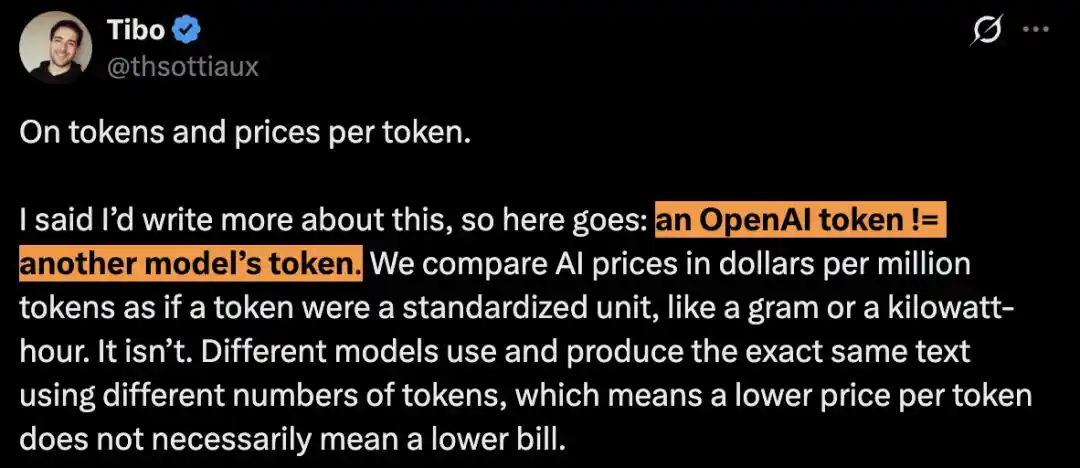
His exact words: One OpenAI token is not equal to another model's token. A lower price per token does not necessarily mean a lower bill.

Everyone is comparing prices using 'dollars per million tokens,' treating tokens as if they were a standard unit like grams or kilowatt-hours, but they are not.

To make it easier to understand, he told a pizza story.

Two identical pizzas.

The first shop cuts it into 8 slices, each costing $2. The second shop cuts it into 16 slices, each costing $1.25. The second shop's sign says it's cheaper, but the whole pizza costs $20, while the first only costs $16.

He added: Your stomach doesn't care how many slices you just ate.

Each slice is cheaper, but the whole pie is more expensive. Different cutting methods render unit prices incomparable.

A token is the smallest unit of billing for a model; you can think of it as the model's 'knife technique' for slicing text.

The same sentence, sliced with different techniques, yields a different number of pieces. You are charged for the number of pieces. More pieces mean a higher bill.

This comparison covered English, technical text, multilingual content, and numbers.

GPT-5.6 Sol's tokenizer used 766 tokens, while Claude Opus 5's estimate was 1170 tokens.

For the same text, GPT-5.6 Sol's 'knife technique' produced 34.5% fewer pieces.

And both companies' input price is $5 per million tokens.

The unit price is identical, but with 30% fewer pieces, the input cost is also 30% lower.

That's where the trouble lies.

If even 'how big is a token' can't be aligned between two companies, then does that widely circulated API price comparison table everyone shares daily still count?

Same Text, Two Different Counts? Why?

This is because the unit 'token' simply lacks a unified measurement standard.

Each vendor trains its own tokenizer, deciding how finely to fragment the text.

Common words are swallowed whole by the tokenizer; rare words can be split into three or four pieces.

English provides the clearest example. Words like 'the,' 'and,' 'is' appear constantly, so the tokenizer gives each a dedicated ID—one word, one token.

For a longer word like 'unbelievable,' it gets split into 'un,' 'believ,' 'able'—one word occupying three tokens.

The principle is simple: tokenizers are derived from statistical analysis of training data. Frequent combinations get their own slot. The rest have to be pieced together from fragments.

So 'how many tokens in a passage' essentially asks 'how common are the things in this passage within this company's training corpus.'

And English prose happens to be the content category with the *least* variation. For code, JSON, long number strings, the differences between how two companies slice them will only be greater.

Even Within One Company, Old and New Models Can't Share Counts

This isn't a problem unique to one company.

Anthropic's own documentation is explicit: Token counts are estimates; the actual number of input tokens used when creating a message may vary slightly.

They even provide a specific figure.

Models from Claude 4.7 onwards use a new tokenizer; the same input text generates approximately 30% more tokens compared to earlier models, with the exact increase depending on content and workload type.
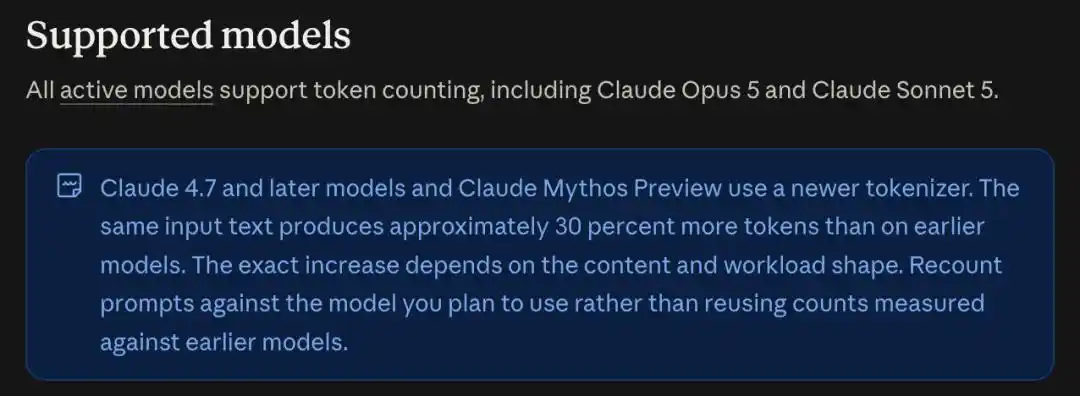
Anthropic Official Docs: Claude 4.7+ models use a new tokenizer; the same text yields ~30% more tokens; don't reuse counts measured on older models.

The same company, the same text, yields 30% more after a model generation change.

Therefore, the official advice is: to know the difference for your workload, measure the same request against both models and compare the returned `input_tokens`.

Don't use token counts measured on early models to estimate costs.

Counts can't be reused even between two generations of the same company's models. So cross-vendor price comparison using 'price per million tokens' is even less standardized.

Same $5 Rate, Bills Differ in Four Places

Same unit price, same input—where exactly do the bill differences come from?

First, the tokenization efficiency mentioned above. The same text, different number of tokens, multiplied by the same unit price, naturally leads to different costs.

Second, caching.

GPT-5.6 Sol's cached input price is $0.50 per million tokens, only one-tenth of the standard input price. For workloads with many repeated prefixes, this alone can restructure the entire bill.

Third, output.

GPT-5.6 Sol's output is $30/million tokens, while Claude Opus 5 starts at $25.

In real-world agent workflows, output tokens often carry more weight than input.

Meaning, the 34.5% saved earlier might very well be given back here.

Fourth, the most easily overlooked, is stated right on OpenAI's own model page. For GPT-5.6 Sol, when input exceeds 272K tokens, the *entire request's* input is billed at 2x the rate, and output at 1.5x.
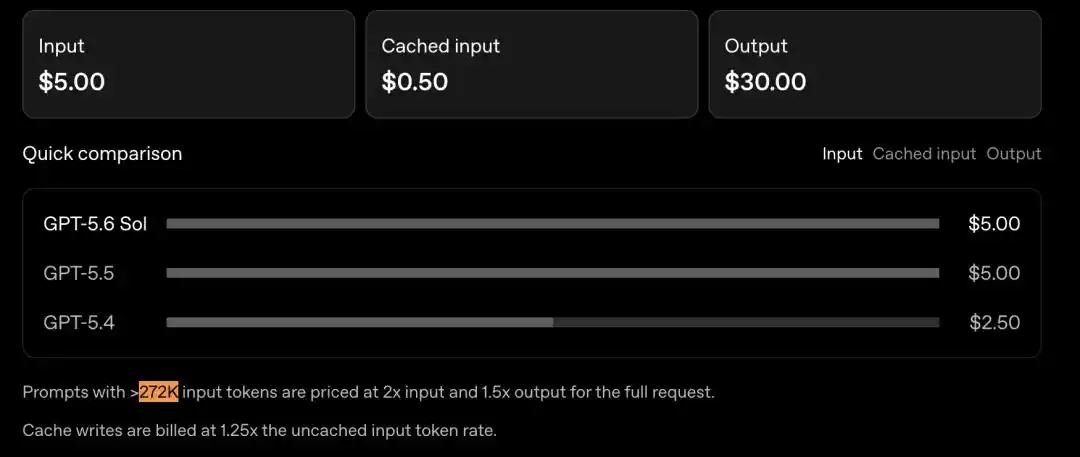
GPT-5.6 Sol Official Model Page: Input $5, Cached Input $0.50, Output $30. The fine print below states the premium rate rules for exceeding 272K.

It's not the portion exceeding the limit that's charged more; the *entire request* is subject to the higher multiplier.

The same piece of code, if you ask about it within a 270K token context versus a 280K token context, the unit price jumps a tier.

This limit comes from the official pricing page itself. Longer context windows mean attention and GPU memory costs rise faster; long context has never been free.

The Million-Token Window Is Open, Money Flows Out Gradually

Tibo later posted a second thread, teaching how to manually max out the context window in Codex.

Open ~/.codex/config.toml, add three lines before any section headers:

model = "gpt-5.6-sol"

model_context_window = 1000000

model_auto_compact_token_limit = 900000

First line selects the model, second line raises the context budget to 1 million tokens, third line triggers auto-compaction around 900K tokens, leaving some margin.

Save, restart the client, start a new session for the config to take effect.

For those not wanting to change defaults, you can also temporarily override for a single CLI session:

codex -m gpt-5.6-sol

-c model_context_window=1000000

-c model_auto_compact_token_limit=900000

Both keys can be found in the Codex official configuration reference, with the described effects.

`model_context_window`: The number of context window tokens available for the current model.

`model_auto_compact_token_limit`: Threshold for triggering automatic history compaction.

But the documentation only defines the keys' meanings; it doesn't list the '1M/900K' values as universal recommendations.

Tibo himself added at the end of his post: The defaults are carefully tuned.

So why do so many people want to change them manually?

A user's test report on GitHub explains the reason.
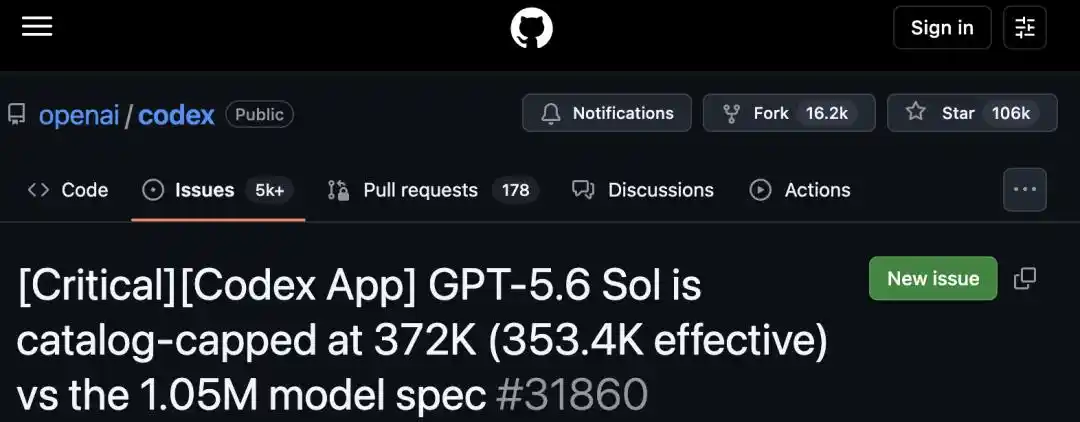
This test report in the openai/codex repo: Codex dir caps window at 372K, effective 353.4K, while model specs state 1.05M

Under a specific version of the Codex client and a ChatGPT Pro account, the model directory listed the window for gpt-5.6-sol as 372K, with 95% utilization yielding 353.4K usable. The official model page states 1.05M.

Bought a million-token window, usable window shrinks to one-third.

This report has clear version and account restrictions and shouldn't be taken as the current state for all users. Tibo's config post was published later.

Also, clarification: Changing the config to 1 million does not instantly incur a 1 million token charge. Billing is always based on actual processing volume.

But pushing the compaction threshold to 900K means a long session will carry increasingly long history forward, re-processing that history in each subsequent request.

The larger the window, the later the compression, the more likely a request hits that 272K premium threshold.

In short dialogues, tokenizer differences are a matter of decimal points. When a session stretches to hundreds of thousands of tokens, with history repeatedly carried along, multiplied by a higher pricing tier, those decimal point differences move to the integer column.

Money isn't spent all at once; it accumulates round by round.

The Next Unit Is 'Per Successful Outcome'

There's another line in Tibo's thread, overshadowed by the numbers: What truly matters is the cost per successful outcome.

He also gave the method. Benchmarks can be a starting point, but to truly know which is more expensive, you need to run your own tasks.

This line shifts the anchor point for price comparison. From 'price per million tokens' to 'total cost to complete the same task.'

To find out which of two vendors is actually cheaper for you, test it yourself.

Take the same raw text, same language mix, same tool definitions, call both vendors' official counting APIs to get the real token counts, factor in cache hits, output length, reasoning length, and long-context multipliers, and finally compare who costs less to get the job done.

Tokenization efficiency is just the first link in this chain. A model with more efficient tokenization, if its reasoning is verbose or requires more retries, can still end up with a higher bill.

The question going forward shouldn't be how much per million tokens, but how much to fix this bug.

References:

https://x.com/thsottiaux/status/2089082893804896524?s=20

https://x.com/thsottiaux/status/2088866513008873560?s=20 https://github.com/openai/codex/issues/31860

This article is from the WeChat public account "New Zhiyuan," author: ASI Apocalypse

Trending Cryptos

Related Questions

QAccording to the article, why is comparing the price per million tokens between different AI models not an accurate way to determine cost?

AComparing the price per million tokens is inaccurate because a 'token' is not a standard, universal unit of measurement. Different models use different 'tokenizers' to split text, meaning the same input text can be cut into a different number of tokens by different models. A lower price per token does not guarantee a lower total bill if one model's tokenizer produces significantly more tokens for the same work.

QWhat is the 'pizza analogy' used in the article to explain the token pricing issue?

AThe pizza analogy compares two identical pizzas. One shop cuts it into 8 slices at $2 per slice (total $16), while another cuts it into 16 slices at $1.25 per slice (total $20). The second shop advertises a cheaper price per slice, but the whole pizza costs more. Similarly, your 'stomach' (the task) doesn't care how many slices (tokens) it took, only the total cost.

QWhat are the four main factors listed in the article that can cause cost differences even when the listed input price per token is the same?

AThe four main factors are: 1) Tokenizer efficiency (how many tokens the same text is split into). 2) Caching (lower prices for repeated input prefixes). 3) Output pricing (models have different output token prices). 4) Context length surcharges (e.g., GPT-5.6 Sol applies a multiplier to the entire request's price if the input exceeds 272K tokens).

QWhat key metric does OpenAI's Tibo suggest is more important than 'price per million tokens' for comparing model costs?

ATibo suggests that the more important metric is the 'price per successful outcome.' The true cost should be measured by how much it costs to complete a specific task or solve a particular problem with a model, factoring in all elements like tokenizer efficiency, output verbosity, and retries, not just the raw token price.

QWhat does the article reveal about token count consistency even within the same company's model family?

AThe article reveals that token counts are not consistent even within the same company's models. Anthropic's documentation states that Claude 4.7 and later models use a new tokenizer that generates approximately 30% more tokens for the same input text compared to their earlier models. Therefore, token counts from one generation cannot be reused to estimate costs for another.

Related Reads

CryptoQuant Noted a Signal of a Bitcoin Reversal

CryptoQuant has highlighted a potential reversal signal for Bitcoin, suggesting the bearish phase might be nearing its end as on-chain metrics show initial signs of spot demand recovery. Their analysis indicates that the 30-day spot demand metric has recovered from -206,000 BTC in late July to approximately -5,000, close to turning positive for the first time since February 2026. Historically, such a reversal has been followed by a median 60-day price gain of 18.1%, with a win rate of 78% (increasing to 87% when valuations are depressed). However, they caution that this is a favorable sign, not a guarantee. Analysts from Bitfinex Alpha note that two of three conditions for a sustainable Bitcoin recovery are already met: improved Federal Reserve rate expectations and relatively accommodative financial conditions, thanks to easing inflation and reduced odds of a near-term rate hike. The missing third catalyst is a capital rotation from traditional markets (like stocks and AI infrastructure) into cryptocurrencies. If this occurs, Bitcoin could reclaim $70,000. Conversely, continued negative flows might see support tested around $57,000. Current headwinds include significant weekly outflows from US spot Bitcoin ETFs (roughly $385 million) and reduced stablecoin supply. Wintermute offers a more cautious outlook, pointing to the same large ETF outflows and ongoing miner selling pressure. They note that Bitcoin has failed to rally despite the improved Fed outlook, which is typically bullish for risk assets. As an example, they cite miner Riot Platforms, which sold a substantial portion of its Bitcoin reserves in Q2 as its mining cost (~$91,000 per BTC) remains far above the current market price, forcing sales for liquidity. This combination of ETF outflows and miner selling is suppressing new demand.

cryptonews.ru3m ago

CryptoQuant Noted a Signal of a Bitcoin Reversal

cryptonews.ru3m ago

Is a Strong Ruble Good? Not for the Budget: Treasury Already Short 1.5 Trillion

The Russian budget has lost about 1.5 trillion rubles in revenue since the start of 2026 due to the ruble being stronger than the government's planned exchange rate. The budget was based on an average annual rate of 92.2 rubles per US dollar, but the actual average for the first seven and a half months was just 76.9 rubles. This discrepancy creates a significant shortfall, as every ruble of appreciation against the dollar reduces annual budget revenues by 140–160 billion rubles. When accounting for oil and gas revenues, the sensitivity is even higher, with potential annual losses reaching up to 2.5 trillion rubles. So far this year, the budget has already missed out on roughly 1.7 trillion rubles. The ruble's exchange rate has shown considerable volatility in 2026, ranging from a low near 71 rubles per dollar in May to over 85 rubles by mid-August. Despite this recent weakening, the year's average remains well below the budget target, creating a structural deficit in oil and gas revenues. Forecasts suggest the final average rate for 2026 will be around 80–82 rubles, which would result in a budget shortfall of about 1.6 trillion rubles. A strong ruble reduces import costs and inflation but also cuts the ruble earnings of exporters and threatens the funding of social obligations. The gap between the planned and actual rate is attributed not only to oil price dynamics but also to the fiscal rule mechanism, which can influence the currency's direction. The Ministry of Finance recently halted foreign currency sales under this rule, removing dollar supply from the market and contributing to pressure on the exchange rate. The budget policy is now forced to adapt to a stronger ruble than originally planned.

cryptonews.ru4m ago

Is a Strong Ruble Good? Not for the Budget: Treasury Already Short 1.5 Trillion

cryptonews.ru4m ago

Robinhood CEO: The Tokenization Wave of U.S. Stocks is Coming, America Must Not Be Left Behind

We are at the early stage of a global supercycle for asset tokenization, a transformative force reshaping finance. Robinhood has actively expanded this frontier outside the US, recently launching Robinhood Chain, a public EVM chain designed for Real World Assets (RWA) and focused on stock tokens. It enables global users to access over 190 US stocks backed 1:1 by underlying securities. However, a key gap remains: these tokenized stocks are not yet available within the United States itself. In the US, the debate around stock tokenization centers on its practical value, given existing low-cost access to equities. Critics question the need, but this misses the core innovation: tokenizing premium financial assets to make them portable, programmable, self-custodied, and tradable 24/7 within an open financial ecosystem. This is more than moving stocks onto a blockchain; it's rebuilding the foundational infrastructure of asset ownership. For US investors, this new infrastructure offers three core advantages: 1. **Real-time clearing and settlement**, enhancing market resilience by eliminating the systemic risks and capital burdens inherent in the traditional T+2/T+1 settlement cycle, as starkly revealed during events like the GameStop volatility. 2. **Native 24/7 trading capability**, allowing all investors to manage risk and react to global news outside standard market hours, a tool previously largely accessible only to institutions. 3. **Greater user control and portability of assets**, enabling instant transfers between platforms and into DeFi. This self-custody model fosters competition among service providers and unlocks new use cases like lending and using tokens as collateral. Realizing these benefits in the US requires more than technology; it necessitates modernizing a century-old securities regulatory framework built for legacy infrastructure. Policymakers must act swiftly to adapt rules for this new paradigm while preserving investor protections. Other jurisdictions are advancing, and the US risks being left behind in shaping the future of asset ownership—a future largely built around American assets and innovation. Tokenizing publicly traded stocks is just the beginning, paving the way for broadening access to other asset classes like private equity. US investors deserve to participate in this innovation.

marsbit39m ago

Robinhood CEO: The Tokenization Wave of U.S. Stocks is Coming, America Must Not Be Left Behind

marsbit39m ago

BIT Trading Moment: BTC Buying Pressure Rises but Bearish Sentiment Remains Strong, 50-Month EMA Difficult to Break, SK Hynix Attempts to Stabilize Memory

BIT Trading Hours: BTC Buying Rebounds but Bearish Sentiment Persists; 50-Month EMA Presents Resistance; SK Hynix Attempts to Stabilize the Memory Sector. Bitcoin briefly reclaimed $65,000, its first time since August 10th, showing a temporary decoupling from traditional risk assets pressured by soaring long-term U.S. Treasury yields. Key support is seen at $62k-$63k, with resistance near the 50-month Exponential Moving Average around $65.4k. While on-chain data indicates recovering spot demand, potentially signaling a local bottom, the options market remains skewed bearish. BIT analysis notes significant downside risk remains if historical bear market patterns repeat, with a potential drop to ~$45.5k. Global equity markets faced intense selling pressure, driven by a bond market storm. The U.S. 30-year yield hit a multi-year high above 5.33%, raising global funding costs. The AI sector was at the epicenter of the sell-off, with the Philadelphia Semiconductor Index plunging ~5% as investors questioned the sustainability of massive AI capital expenditures amid high debt costs. Storage stocks like Micron led declines. SK Hynix's announcement of a major share buyback provided some stability to the memory sector during after-hours trading. However, most tech stocks remained under pressure. In Asia, South Korean and Japanese indices fell sharply, heavily impacted by chip stock declines. Chinese robotics company Unitree Tech had a volatile market debut on Shanghai's STAR Market, soaring over 600% at one point before paring gains, making its founder a billionaire. Despite this individual success, the broader robotics sector in A-shares sold off heavily. Key upcoming events include the U.S. 20-year Treasury auction and the release of the Federal Reserve's July meeting minutes, which will be crucial tests for bond market stability and monetary policy expectations.

marsbit41m ago

BIT Trading Moment: BTC Buying Pressure Rises but Bearish Sentiment Remains Strong, 50-Month EMA Difficult to Break, SK Hynix Attempts to Stabilize Memory

marsbit41m ago

Trading

Spot

Hot Articles

How to Buy BILL

Welcome to HTX.com! We've made purchasing Billions Network (BILL) simple and convenient. Follow our step-by-step guide to embark on your crypto journey.Step 1: Create Your HTX AccountUse your email or phone number to sign up for a free account on HTX. Experience a hassle-free registration journey and unlock all features.Get My AccountStep 2: Go to Buy Crypto and Choose Your Payment MethodCredit/Debit Card: Use your Visa or Mastercard to buy Billions Network (BILL) instantly.Balance: Use funds from your HTX account balance to trade seamlessly.Third Parties: We've added popular payment methods such as Google Pay and Apple Pay to enhance convenience.P2P: Trade directly with other users on HTX.Over-the-Counter (OTC): We offer tailor-made services and competitive exchange rates for traders.Step 3: Store Your Billions Network (BILL)After purchasing your Billions Network (BILL), store it in your HTX account. Alternatively, you can send it elsewhere via blockchain transfer or use it to trade other cryptocurrencies.Step 4: Trade Billions Network (BILL)Easily trade Billions Network (BILL) on HTX's spot market. Simply access your account, select your trading pair, execute your trades, and monitor in real-time. We offer a user-friendly experience for both beginners and seasoned traders.

3.3k Total ViewsPublished 2026.05.07Updated 2026.06.02

How to Buy BILL

Discussions

Welcome to the HTX Community. Here, you can stay informed about the latest platform developments and gain access to professional market insights. Users' opinions on the price of BILL (BILL) are presented below.

活动图片