Ripple’s XRP Ledger Records Over 20% Surge In This Metric That Puts It Against Bigger Players

bitcoinistPublished on 2026-06-10Last updated on 2026-06-10

Abstract

Ripple's XRP Ledger (XRPL) saw its stablecoin supply surge by 22% in a week, reaching $762 million and ranking it as the 15th largest blockchain by this metric. This significant increase in liquidity and on-chain activity, which saw over $142 million flow into the network in seven days, stands in contrast to declines on Ethereum and Tron. Analysts view the growth as a sign of rising adoption and capital inflows for payments and DeFi. Despite this positive development, XRP's price remains under pressure, trading around $1.1 with recent losses. However, some analysts remain optimistic for a future price rally, citing potential catalysts like regulatory clarity.

Ripple’s XRP Ledger (XRPL) has recorded a massive 22% surge in stablecoin activity as new data reveals a sharp increase in liquidity over the past week. Analysts say this growth positions XRPL among the top blockchains, signaling rising adoption and capital inflows despite declines in its price action.

Ripple’s XRP Ledger Stablecoin Supply Jumps 22%

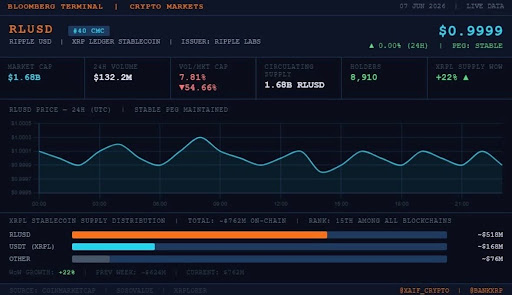
The XRP Ledger is seeing renewed growth and interest, with new on-chain data showing a significant rise in stablecoin volume. Market analyst Xaif Crypto shared on X that XRPL’s stablecoin supply has increased by approximately 22% in just one week, reaching a total of $762 million on-chain. He noted that the figure now ranks the XRP Ledger as the 15th largest blockchain by stablecoin supply, suggesting that liquidity is increasingly flowing into the network.

Notably, the latest growth comes as stablecoins continue to play a key role in blockchain ecosystems, often serving as a measure of available liquidity and network activity. According to Xaif Crypto, the recent increase highlights the growing movement of capital into XRPL as its stablecoin market expands.
XRP Ledger

XRP advocate Diana also commented on the latest milestone. She stated that the 22% increase suggests that more than $142 million had entered the XRP Ledger within seven days. Diana contrasted this performance with that of larger blockchain networks.

According to the data she shared, Ethereum’s (ETH) stablecoin supply fell 2.05% over the same period, while Tron (TRX) recorded a 0.51% decline. In comparison, XRPL posted a 22.87% increase, making it one of the strongest performers among major blockchain networks during the week.

The recent growth also extends beyond the seven-day timeframe. Diana noted that stablecoin liquidity on the XRP Ledger has more than doubled over the last 30 days, suggesting that the latest spike was part of a broader expansion trend.

This increase in supply indicates that XRPL is attracting a large share of stablecoin liquidity, enabling the network to compete more fiercely with top blockchain players in the market. Moreover, it suggests growing adoption and confidence as more users or institutions use the blockchain for payments and DeFi-related activities.

Update On The XRP Price Action

On the price action front, XRP is still trading lower, with volatility and selling pressure adding to its already fragile market structure. CoinMarketCap data shows that XRP’s price is currently standing around $1.1, down by another 5% in the past 24 hours and about 10% over the past week.
Source: X

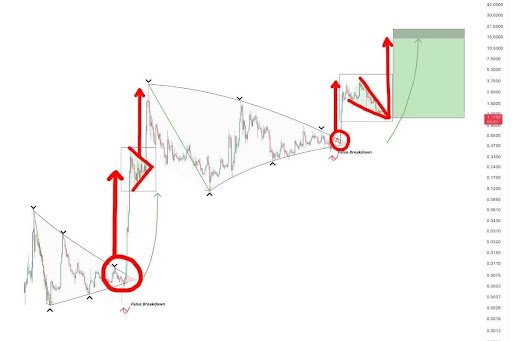
Despite its weak performance, analysts remain optimistic about XRP’s future price action, with some pointing to the upcoming CLARITY Act as the next catalyst that could trigger a massive surge in the cryptocurrency. Market analyst Tom has forecast a rally toward a range as high as $15-$18 for XRP after the crypto bill passes and institutional adoption of the cryptocurrency accelerates. He noted that this projected surge would represent a more than 1,100% gain in the XRP price from current levels.

Price continues downward trend | Source: XRPUSDT on Tradingview.com

Trending Cryptos

Related Questions

QWhat significant increase in metric was recorded on Ripple's XRP Ledger according to the article?

AThe article states that Ripple's XRP Ledger (XRPL) recorded a massive 22% surge in stablecoin supply and activity over a one-week period.

QWhat was the total stablecoin supply on the XRP Ledger after the 22% increase, and how does this rank the network?

AAfter the 22% increase, the total stablecoin supply on XRPL reached approximately $762 million. This figure ranks the XRP Ledger as the 15th largest blockchain by stablecoin supply.

QHow did XRP Ledger's stablecoin supply growth compare to Ethereum and Tron's performance during the same period?

ADuring the same period, Ethereum's (ETH) stablecoin supply fell by 2.05% and Tron's (TRX) recorded a 0.51% decline. In contrast, XRPL posted a 22.87% increase, making it one of the strongest performers among major blockchains that week.

QWhat does the surge in stablecoin liquidity on XRPL indicate according to analysts cited in the article?

AAnalysts say the surge indicates growing adoption and confidence in the network. It suggests that more users or institutions are using XRPL for payments and DeFi-related activities, and it positions the ledger to compete more fiercely with top blockchain players.

QDespite the positive on-chain metric, what is the current state of XRP's price action, and what future catalyst do some analysts point to?

AXRP's price is trading lower, down about 5% in 24 hours and 10% over the past week. However, some analysts remain optimistic, pointing to the potential passage of the CLARITY Act as a future catalyst that could trigger a massive surge in the cryptocurrency's price.

Related Reads

After six years of pie-in-the-sky fundraising, 90% of funds used to replenish cash flow: The illusion and reality of L'CI Technology's silicon carbide "industrialization"|TMTPost Deep Dive

After six years and raising approximately 3.2 billion yuan through two private placements, Luxshare Technology has officially terminated its two major SiC wafer projects. Only about 7.75% of the raised funds were actually invested in SiC construction and R&D, with the remaining 90% redirected to replenish working capital and repay loans. Despite previous ambitious plans for a 10-billion-yuan SiC industrial park and public assurances of progress, the company's actual SiC capacity remains unclear, with its subsidiary recording significant losses. The article details a pattern of chasing market trends, from electric vehicles and photovoltaics to the current focus on SiC. However, its SiC entry was late; while peers like Tianke Heda and Tianyue Advanced have moved from mass-producing 6-inch to 8-inch and even 12-inch wafers, Luxshare is still struggling with its 6-inch plans and now promises to develop larger sizes with its own funds. Key concerns include unclear disclosures about the status of its chief scientist, Chen Zhizhan, and significantly lower R&D investment compared to competitors. Financially, since its 2011 IPO, the company has raised over 7 billion yuan but generated only 221 million yuan in cumulative net profit. Meanwhile, the controlling shareholder family has cashed out nearly 2 billion yuan since 2018. The article positions Luxshare as a case study of a listed company focused more on financing and capital operation around hot topics than on substantive industrial development.

marsbit11m ago

After six years of pie-in-the-sky fundraising, 90% of funds used to replenish cash flow: The illusion and reality of L'CI Technology's silicon carbide "industrialization"|TMTPost Deep Dive

marsbit11m ago

ChatGPT Finally Can 'Search Itself': Nearly Four Years of Conversations, Retrieved with One Click

ChatGPT, nearly four years old, has long lacked a functional way for users to search their own accumulated history. This changed on July 14th, when OpenAI launched a comprehensive "Unified Search" feature across all platforms and plans. This new search allows users to find and instantly access past conversations, uploaded documents, generated images, and projects within their own ChatGPT account, all from a single sidebar entry. This update signifies a major shift in ChatGPT's role, transforming it from a transient chat tool into a personal knowledge base or "file system" for users' AI-generated content. It completes a critical missing piece as OpenAI expands ChatGPT's capabilities with features like Projects, Memory, Work, and Sites, aiming to make it a central hub for work and creativity. The ability to easily retrieve years of personal data makes that data more valuable as a unique, irreplaceable asset in the AI era. However, it also highlights the increasing weight and potential sensitivity of this data, given default settings that allow conversations to be used for model training and legal precedents involving user logs. While a significant improvement over the previous ineffective search, this move is seen as addressing an industry-wide oversight. As the competition between AI assistants (ChatGPT, Gemini, Claude) moves beyond raw model power, the new battleground is becoming which platform can best organize, retain, and leverage the valuable data co-created by users and AI.

marsbit19m ago

ChatGPT Finally Can 'Search Itself': Nearly Four Years of Conversations, Retrieved with One Click

marsbit19m ago

7-Year-Olds Starting Companies? 9-Year-Olds Making Movies? Post-90s Parents Are Raising 'AI Prodigies'

"AI Genius Kids: A New Wave or a Parental Anxiety Trap?" The article examines the recent surge in AI-focused educational camps and programs in China, heavily marketed to parents of young children with sensational claims like "7-year-olds start companies" and "9-year-olds make movies." These programs promise rapid, practical AI skills—from creating agents and business plans to generating content—often for significant fees, capitalizing on parental anxieties about the AI-dominated future. It contrasts this trend with earlier, more foundational AI education, arguing current offerings prioritize superficial, immediate application over deep learning. The author critiques this approach as premature for children still in basic education, suggesting it fosters a shortcut mentality and may even teach improper use, like using AI to cheat on homework. The driving force behind this trend is identified as the profound anxiety of the current generation of parents—largely professionals in tech or related fields—who are witnessing firsthand how AI disrupts and replaces jobs. This workplace fear translates into a desperate desire to equip their children with perceived competitive advantages from an extremely young age, viewing AI proficiency as a magical key to success. The piece also casts a skeptical eye on the phenomenon of real "AI child prodigies," citing examples like Australian teen Alby Churven, whose ventures attract media buzz but little serious investment. It suggests that beyond the hype, the business world remains wary of child-led enterprises. True advancement, the article implies, still relies on solid, traditional education and foundational knowledge, not just early exposure to tools. Ultimately, it frames the AI camp boom less as a legitimate educational movement and more as a reflection of societal pressure and a potentially expensive exploitation of parental fears in a rapidly changing technological landscape.

marsbit23m ago

7-Year-Olds Starting Companies? 9-Year-Olds Making Movies? Post-90s Parents Are Raising 'AI Prodigies'

marsbit23m ago

Trading

Spot

Hot Articles

Discussions

Welcome to the HTX Community. Here, you can stay informed about the latest platform developments and gain access to professional market insights. Users' opinions on the price of S (S) are presented below.

活动图片