Rezolve Ai Launches SQD Revenue Model to Power Enterprise Blockchain Data Services

TheNewsCryptoPublished on 2025-12-29Last updated on 2025-12-29

Abstract

Rezolve Ai (NASDAQ: RZLV) has announced the launch of Revenue Pools by its subsidiary SQD Network, designed to support enterprise blockchain data services for major clients like Deutsche Telekom, Morpho, and PancakeSwap. The model requires large customers to pay subscription fees for data access, while SQD token holders can temporarily lock their tokens to support infrastructure capacity. In return, participants receive a share of revenue in stablecoins. This approach aims to align customer usage with network economics, reduce token circulation through buybacks and lockups, and strengthen long-term sustainability. SQD tokens are traded on exchanges like Coinbase and Binance. The initiative is expected to scale with growing corporate demand.

Today, Rezolve Ai (NASDAQ: RZLV), the industry leader in Agentic Commerce and AI-powered customer engagement, made an announcement about the launch of Revenue Pools by its wholly owned subsidiary, SQD Network. These Revenue Pools are intended to satisfy the growing demand from major business and institutional clients.

SQD offers high-performance blockchain data services to big worldwide corporations, such as Deutsche Telekom and leading DeFi protocols like Morpho and PancakeSwap. These protocols’ platforms are built to demand continuous, large-scale access to real-time and historical data. SQD’s services are provided to these enterprises.

The Revenue Pool approach of SQD is intended to support SQD’s infrastructure capacity directly by user payments as customer usage develops. This will reinforce SQD’s long-term sustainability and ensure that customer usage and economics are aligned.

What the Initiative Does in Simple Terms

To have access to its data services, large clients are required to pay subscription fees.

For SQD to be able to provide such service on a large scale, they need to commit their infrastructure capacity.

Holders of SQD Tokens have the ability to temporarily lock their SQD tokens in order to assist in supporting that capacity.

The holder retains ownership of the tokens even when they are locked, since they cannot be sold or relocated.

The participants, who are paid in stablecoins, may get a percentage of the payments made by consumers. This fraction may be split with the participants.

Customers are the ones that pay for the service, and those who contribute to its maintenance may be eligible for a portion of the revenue that it produces.

Why This Matters for the SQD Ecosystem

Considering that blockchain data is becoming more mission-critical across company operations, payments, analytics, and enterprise systems, infrastructure economics are becoming an important consideration.

Additionally, the Revenue Pool model of SQD includes additional aspects that investors normally associate with more established platforms, including the following:

  • Utilization of tokens based on demand, given that tokens are being locked to enable live services.
  • A reduction in the circulation of supplies via the use of protocol buybacks and temporary lockup.
  • Rather than relying on continual token issuance, operations that are supported by customers’ contributions.
  • There should be a more direct connection between corporate adoption and the activities that occurs on the underlying network.

The purpose of these dynamics is to increase the link between the utilization of the SQD network and the function of the SQD token within that ecosystem throughout the course of time; nevertheless, there is no warranty provided about the performance of the token in the future.

Market Accessibility

Currently, the SQD token may be traded on a number of prominent digital asset exchanges, including as Coinbase and Binance. These exchanges have the ability to offer market players with liquidity and price discovery. Trading in SQD tokens is not something that Rezolve Ai sponsors, endorses, or promotes in any way.

Leadership Commentary

“As enterprise customers place more reliance on SQD’s data services, it becomes essential that infrastructure capacity is supported by real usage and real payments,” said Dmitry Zhelezov, CTO of SQD Network. “SQD’s Revenue Pools are designed to formalize that link between demand, capacity and network economics.”

“We believe public-market investors increasingly look for technology platforms where growth is supported by durable, usage-based economics,” said Daniel M. Wagner, Chairman and CEO of Rezolve Ai PLC.

“This type of model is designed to reflect the direction in which we believe digital infrastructure is maturing toward greater discipline, transparency and alignment with real customer demand.”

Designed to Scale with Demand

SQD’s Revenue Pool launch will begin with a restricted capacity initially, and it is anticipated that the capacity will gradually increase as the utilization of the platform by corporate customers increases. It is predicted that the existing customer incentive systems would, for the most part, maintain their stability during the transition.

SQD is positioned its network to fulfill the long-term demands of big, established clients while simultaneously strengthening the economic underpinnings that lie behind that expansion. This is accomplished by integrating infrastructure support with customer-funded economics.

With a focus on improving customer engagement, operational efficiency, and revenue development, Rezolve Ai (NASDAQ: RZLV) is a market leader in artificial intelligence-powered solutions because of its expertise in these areas. In the globe, the Brain Suite is the first business artificial intelligence platform that was designed specifically for Agentic Commerce. It provides cutting-edge capabilities that make use of artificial intelligence to facilitate search, transaction, fulfillment, and personalization on a worldwide scale. You may get further details by going to www.rezolve.com.


TagsAltcoinBlockchain

Trending Cryptos

Related Questions

QWhat is the purpose of SQD's newly launched Revenue Pools?

AThe Revenue Pools are designed to support SQD's infrastructure capacity through direct user payments as customer usage grows, reinforcing long-term sustainability and aligning customer usage with economics.

QHow do SQD Token holders participate in the Revenue Pool model?

AHolders can temporarily lock their SQD tokens to help support infrastructure capacity. They retain ownership of the locked tokens and may receive a percentage of customer payments in stablecoins.

QWhich major companies and protocols are mentioned as clients of SQD's blockchain data services?

ASQD provides services to major worldwide corporations like Deutsche Telekom and leading DeFi protocols such as Morpho and PancakeSwap.

QWhat are some key economic benefits of the Revenue Pool model for the SQD ecosystem according to the article?

AKey benefits include demand-based token utilization, reduced supply circulation through protocol buybacks and temporary lockup, customer-funded operations instead of constant token issuance, and a direct link between corporate adoption and network activity.

QOn which digital asset exchanges can the SQD token currently be traded?

AThe SQD token can be traded on prominent digital asset exchanges including Coinbase and Binance.

Related Reads

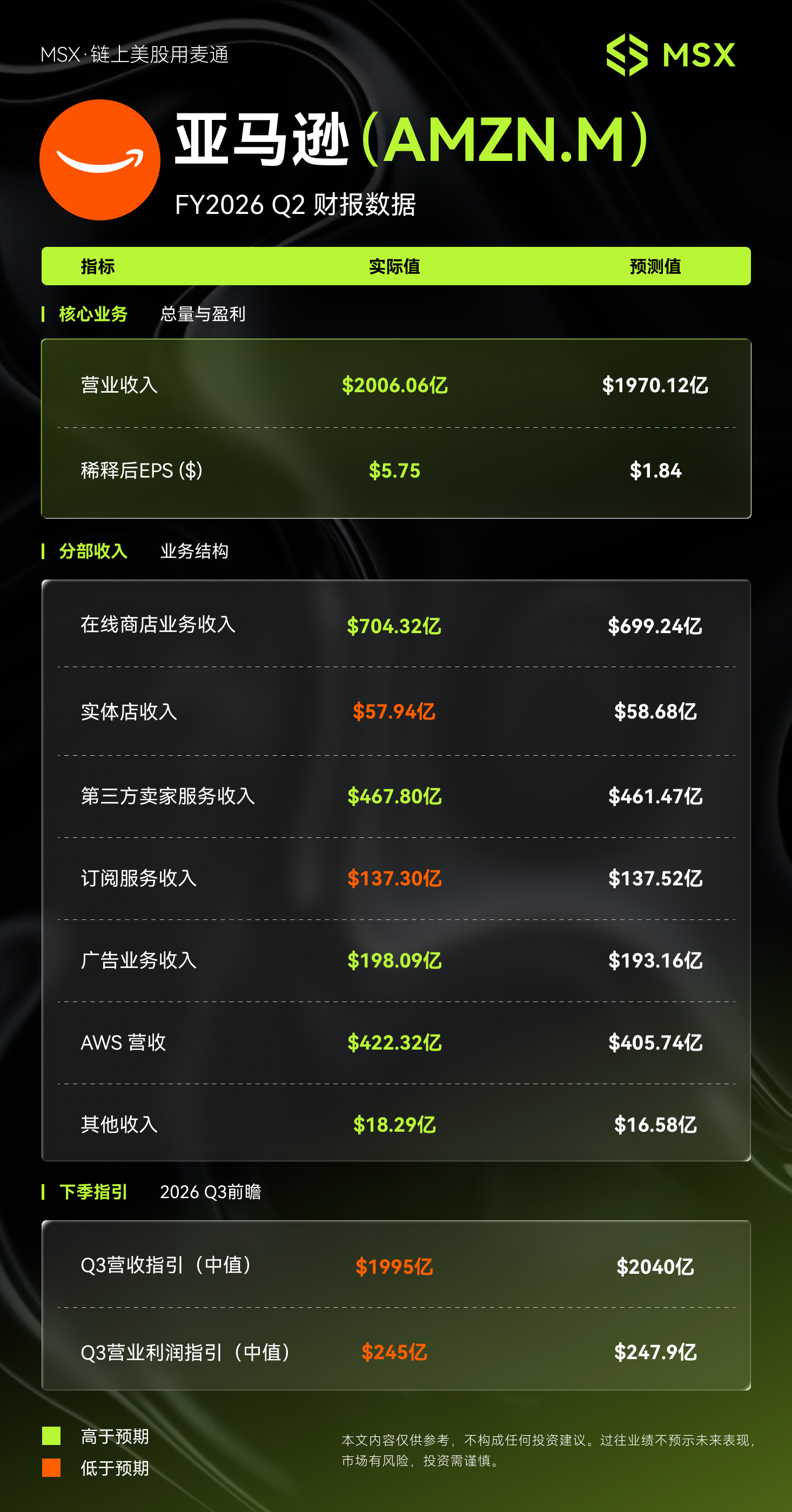
MSX US Stock Daily Insight: Amazon 2026 Q2 Earnings: AWS Records Fastest Growth in Five Years

**MSX Daily US Stock Observation: Amazon's Q2 2026 Earnings: AWS Achieves Fastest Growth in Five Years** Amazon's latest quarterly results exceeded expectations, driven by a strong performance from its cloud computing unit. The company reported revenue of $200.66 billion, surpassing estimates of approximately $197 billion. The key highlight was Amazon Web Services (AWS), which generated $42.232 billion in revenue, surging 37% year-over-year. This marked the segment's fastest growth pace in 18 quarters, indicating robust demand for cloud services. Reported Earnings Per Share (EPS) of $5.75 significantly exceeded the $1.84 forecast. However, this figure included a substantial one-time, non-operating gain of $53.4 billion, primarily from the revaluation of Amazon's investment in AI company Anthropic. Excluding this item, core operating profit was $27.461 billion, a strong increase of 43% compared to the same period last year. Despite the positive results, Amazon provided guidance for the upcoming third quarter that fell short of market expectations. The company's revenue guidance midpoint is $199.5 billion, below the consensus estimate of around $204 billion. Operating profit guidance of $24.5 billion also slightly missed expectations of approximately $247.9 billion. Furthermore, Amazon raised its forecast for full-year capital expenditures to $220 billion, citing rising memory chip costs, which weighed on investor sentiment regarding future profitability. In summary, Amazon's quarter showcased accelerating momentum in its core AWS business. The underlying operational profit growth remains solid. However, cautious forward guidance and increased investment spending present key areas for monitoring in the coming quarters, as the market assesses whether the current growth phase will translate into sustained profit margin expansion.

Odaily星球日报3m ago

MSX US Stock Daily Insight: Amazon 2026 Q2 Earnings: AWS Records Fastest Growth in Five Years

Odaily星球日报3m ago

Cyclical Stock or Growth Stock? Coinbase's Q2 Earnings Report Reveals 'Valuation Disagreement'

Coinbase's Q2 2026 financial results revealed a mixed performance, reigniting debate over whether the company should be valued as a cyclical stock tied to crypto markets or a growth stock with future potential. Total revenue missed expectations at $1.22 billion, down 19% year-over-year. Transaction revenue fell to $599 million, with retail crypto spot trading revenue dropping 30% to $452 million, back to 2023 levels. The company reported a net loss of $359 million, marking its third consecutive quarterly loss. Despite CEO Brian Armstrong's positive commentary on metrics like a 10.3% overall crypto trading market share and 106% growth in prediction markets, the market reacted negatively, with shares dropping over 5% after-hours. A key issue is the decline in core retail trading. While Coinbase touted record market share, this figure includes derivatives and new products. Its traditional crypto spot trading share is likely shrinking. New ventures like prediction markets, while growing, contributed less than $30 million, insufficient to offset the core revenue decline. The valuation debate hinges on perspective. As a cyclical stock, Coinbase remains deeply tied to the crypto bear market, with user attrition and competitive pressures justifying a lower valuation. The company's strategy appears focused on surviving until the next bull cycle. Viewed as a growth stock, however, Coinbase shows promising diversification. Subscription and service revenue reached $555 million, nearly matching transaction revenue. Stablecoin revenue, its second-largest source at $292 million, remains strong through its partnership with Circle. Critically, Coinbase is positioning itself as a leader in the emerging on-chain "agent economy." Over 90% of agent-based stablecoin transactions occur on its Base network, which it believes could handle trillions in future agent transactions. The recent acquisition of Deribit also aims to boost its international derivatives offering. In summary, Coinbase's present struggles are clear, but its future hinges on whether its investments in revenue diversification, stablecoins, and the agent economy can ultimately transform its business model and justify a growth premium.

Odaily星球日报23m ago

Cyclical Stock or Growth Stock? Coinbase's Q2 Earnings Report Reveals 'Valuation Disagreement'

Odaily星球日报23m ago

Global Market Share Survey: Japanese Firms Lead in Semiconductor Materials

Global Market Share Survey: Japanese Firms Lead in Semiconductor Materials According to the 2025 "Major Goods and Services Market Share Survey" by Nikkei, Japanese companies maintain strong positions in semiconductor-related materials. In silicon wafers, Shin-Etsu Chemical ranks first with a 26.3% share, followed by SUMCO at 17.8%. Together, they hold 44.1% of the market, widening their lead over competitors from Taiwan, Germany, and South Korea. In photoresists, Tokyo Ohka Kogyo, JSR, and Shin-Etsu Chemical occupy the top three spots, with a combined share of 60.5%. Despite their strength in materials, Japanese firms have a weaker presence in core semiconductor segments like DRAM and NAND flash memory, where South Korean and U.S. companies dominate. For instance, SK Hynix and Samsung lead in DRAM, while China’s CXMT doubled its share to 6% in 2025. The semiconductor market is projected to grow rapidly, with WSTS forecasting a 90% increase to $1.5112 trillion by 2026. Major players like Samsung, SK Hynix, and Micron are making massive investments to expand capacity. To maintain their edge in materials, Japanese companies must similarly commit to large-scale, risk-taking investments. In contrast, Japan’s automotive sector shows stagnation. Toyota remains the global leader but with only a slight share increase to 12.3%, while Japanese brands are absent from the top five in the EV market. In shipbuilding, Imabari Shipbuilding rose to third place globally with a 7.2% share, benefiting from large container ship deliveries. However, Chinese and South Korean firms dominate the sector, holding the top two positions. Japan aims to revitalize its shipbuilding industry through government and corporate efforts, targeting a near doubling of output by 2035. Addressing labor shortages and adopting advanced technologies like physical AI will be critical for competitiveness.

marsbit48m ago

Global Market Share Survey: Japanese Firms Lead in Semiconductor Materials

marsbit48m ago

Trading

Spot

Hot Articles

How to Buy SQD

Welcome to HTX.com! We've made purchasing Subsquid (SQD) simple and convenient. Follow our step-by-step guide to embark on your crypto journey.Step 1: Create Your HTX AccountUse your email or phone number to sign up for a free account on HTX. Experience a hassle-free registration journey and unlock all features.Get My AccountStep 2: Go to Buy Crypto and Choose Your Payment MethodCredit/Debit Card: Use your Visa or Mastercard to buy Subsquid (SQD) instantly.Balance: Use funds from your HTX account balance to trade seamlessly.Third Parties: We've added popular payment methods such as Google Pay and Apple Pay to enhance convenience.P2P: Trade directly with other users on HTX.Over-the-Counter (OTC): We offer tailor-made services and competitive exchange rates for traders.Step 3: Store Your Subsquid (SQD)After purchasing your Subsquid (SQD), store it in your HTX account. Alternatively, you can send it elsewhere via blockchain transfer or use it to trade other cryptocurrencies.Step 4: Trade Subsquid (SQD)Easily trade Subsquid (SQD) on HTX's spot market. Simply access your account, select your trading pair, execute your trades, and monitor in real-time. We offer a user-friendly experience for both beginners and seasoned traders.

5.0k Total ViewsPublished 2025.06.14Updated 2026.06.10

How to Buy SQD

Discussions

Welcome to the HTX Community. Here, you can stay informed about the latest platform developments and gain access to professional market insights. Users' opinions on the price of SQD (SQD) are presented below.

活动图片