Retail’s Last Stand: The Crypto -$209B Liquidity Trap That Smart Money Refuses to Touch

bitcoinistPublished on 2026-02-19Last updated on 2026-02-19

Abstract

The crypto market is experiencing sustained selling pressure, shifting into a defensive phase after the late-2025 rally. Bitcoin has declined significantly from its all-time high, while altcoins show extreme weakness. On-chain data from CryptoQuant reveals a five-year extreme in altcoin selling pressure, with a cumulative Buy/Sell Difference of -$209 billion (excluding Bitcoin and Ethereum) over the past 13 months. This indicates persistent net selling rather than short-term volatility, suggesting a market struggling to absorb excess supply. Retail activity has faded, and "smart money" has rotated away from altcoins, with little institutional accumulation. Recovery is unlikely until new buyers return decisively, leaving altcoins at risk of further downside or prolonged consolidation.

The crypto market continues to face sustained selling pressure, with sentiment increasingly shaped by caution and, in some segments, outright panic. After the strong rally that culminated in late 2025, price action across major digital assets has shifted into a defensive phase. Bitcoin, for example, is currently trading near $68,800, a significant decline from its all-time high above $125,000 recorded in October 2025. This retracement has coincided with broader weakness across altcoins, where volatility and liquidity conditions remain fragile.

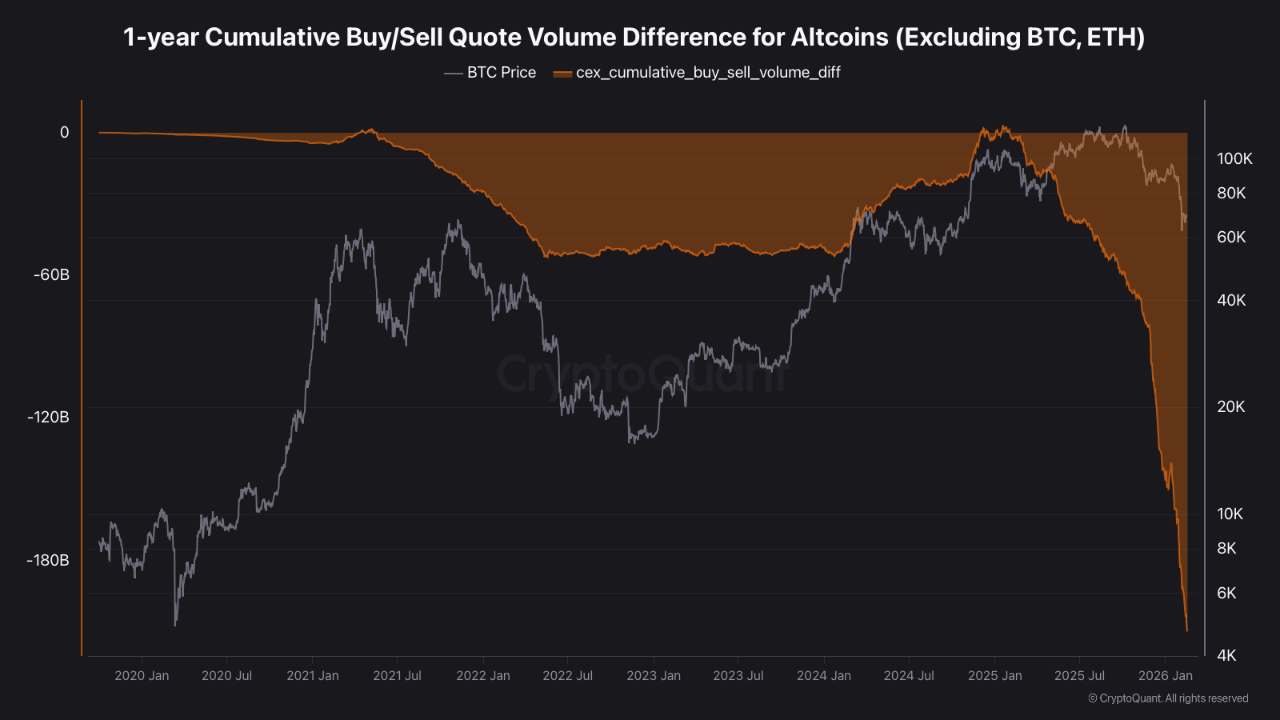
Recent on-chain analysis from CryptoQuant highlights the scale of this shift. According to the report, altcoin selling pressure has reached a five-year extreme, reflected in a cumulative Buy/Sell Difference of approximately -$209 billion when excluding Bitcoin and Ethereum. Notably, as recently as January 2025, this metric was close to neutral, indicating a balance between demand and supply. Since then, however, flows have moved consistently in one direction, pointing to persistent distribution rather than episodic selling.

Such prolonged imbalance typically signals structural repositioning rather than short-term volatility alone. While this does not automatically confirm a prolonged bear phase, it suggests the market is still absorbing excess supply. Investors, therefore, remain focused on liquidity trends, macro conditions, and whether demand can stabilize in the coming months.

Sustained Outflows Point To Weak Altcoin Demand

According to the analyst, recent on-chain data suggest a structural shift in crypto market participation rather than a temporary pullback. Retail activity appears to have faded significantly, while capital traditionally categorized as “smart money” has largely rotated away from altcoins. Notably, there are currently few signs of meaningful institutional accumulation across the altcoin segment, reinforcing the perception of reduced risk appetite.

1-Year Cumulative Buy/Sell Quote Volume Difference for Altcoins | Source: CryptoQuant

The cumulative Buy/Sell Difference for altcoins excluding Bitcoin and Ethereum has reached approximately -$209 billion over the past 13 months. Importantly, this figure reflects persistent net selling on centralized exchange spot markets rather than isolated liquidation events. The continuous nature of these outflows distinguishes the current phase from typical short-lived corrections driven by leverage flushes or episodic panic.

Such sustained distribution implies that liquidity support from marginal buyers has weakened considerably. In practical terms, this does not automatically signal a market bottom; instead, it indicates a period in which demand has yet to re-establish equilibrium with supply.

Historically, recovery phases tend to begin only after new buyers return decisively. Until that shift materializes, altcoin price action may remain subdued, with consolidation or further downside risk still plausible.

Related Questions

QWhat is the current state of the crypto market according to the article, and what is Bitcoin's price mentioned?

AThe crypto market is facing sustained selling pressure with sentiment shaped by caution and panic. Bitcoin is currently trading near $68,800, a significant decline from its all-time high above $125,000 in October 2025.

QWhat key on-chain metric from CryptoQuant highlights the extreme selling pressure in altcoins, and what is its value?

AThe key metric is the cumulative Buy/Sell Difference for altcoins excluding Bitcoin and Ethereum, which has reached approximately -$209 billion, indicating a five-year extreme in selling pressure.

QHow does the article characterize the nature of the current altcoin outflows compared to typical market corrections?

AThe article states that the outflows are persistent and represent a structural shift with consistent net selling on centralized exchanges, distinguishing them from typical short-lived corrections driven by leverage flushes or episodic panic.

QWhat two major groups of market participants have reduced their activity in the altcoin market, as per the analysis?

ARetail activity has faded significantly, and capital traditionally categorized as 'smart money' has largely rotated away from altcoins.

QWhat does the article suggest is necessary for an altcoin market recovery to begin?

AThe article suggests that a recovery phase tends to begin only after new buyers return decisively to the market to re-establish equilibrium between demand and supply.

Related Reads

Uncovering the Truth About Agent Commerce, Payments, and Infrastructure

Decoding Agent Commerce, Payments, and Infrastructure: The Reality Over the past year, I've been building infrastructure for the Agent economy, engaging with major players like Stripe, Visa, Coinbase, Google, and dozens of startups. A clear conclusion emerges: true, large-scale demand does not yet exist. Startups face structural challenges. Data points illustrate this gap. Stripe's Agent commerce platform has over 1,000 merchants but only single-digit transacting agents. Visa's Agent payment token requires 9-month KYC and a $250M revenue threshold, accessible only to giants like Amazon. On-chain analysis reveals actual daily Agent transaction volume is around $17k, half of which are test transactions. The article analyzes four potential markets: **1. Agent-to-Merchant (A2M):** Current AI shopping UX is often inferior to traditional e-commerce for visual, comparison-heavy purchases (clothing, electronics). Chat interfaces are a step back. Real merchant interest is defensive "Agent Engine Optimization," fearing future obsolescence, not current demand. Potential exists in high-frequency, low-decision purchases (e.g., food delivery) or simplifying terrible UX (complex checkouts, non-native shoppers), but these require massive consumer distribution channels dominated by giants like DoorDash and Amazon. **2. Agent-to-API (A2A):** Developers already have subscriptions and billing for core APIs (compute, data). The argument for micro-payments via crypto for sub-dollar API calls is addressed by pre-paid balances today. The deeper issue is supplier resistance; major SaaS firms rely on enterprise contracts, not fractional cent pricing. Opportunity lies in the long tail of niche services, but this is a smaller market catering to developers, a historically low-paying group. **3. Agent-to-Agent (A2A):** This remains a theoretical long-term vision with near-zero current transaction volume. It involves unique challenges: discovery, trust, negotiation, dispute resolution. When it materializes, it will require a fundamentally new settlement infrastructure for high-speed, variable-value, multi-party transactions. It's a real long-term bet, but not the current market. **4. Agent-to-Finance (A2F):** This is the only category with existing, paying demand. Integrating AI into financial workflows (trading, portfolio management) is a natural evolution and enables new capabilities like autonomous rebalancing. However, competition favors incumbents with regulatory licenses, compliance infrastructure, and existing client relationships. **The Real Issue:** Why is infrastructure still being built? Incumbents can afford long-term bets, and payment companies see every problem as a nail for their payment hammer. However, payment is just one piece. The core challenge is *coordination*—orchestrating work between Agents and humans, verifying outcomes, and settling results. Payment is part of settlement, which is part of coordination. Companies that solve the coordination problem will subsume payments, not the other way around. Startups lack the infinite runway of giants and must find today's real market, which, after a year of exploration, lies outside these four categories—in an area with real, growing, and underserved activity.

marsbit3h ago

Uncovering the Truth About Agent Commerce, Payments, and Infrastructure

marsbit3h ago

Trading

Spot
Futures

Hot Articles

Discussions

Welcome to the HTX Community. Here, you can stay informed about the latest platform developments and gain access to professional market insights. Users' opinions on the price of S (S) are presented below.

活动图片