Recap: Here’s how Bitcoin, Ethereum, Solana, and XRP ETFs performed this week

ambcryptoPublished on 2026-04-06Last updated on 2026-04-06

Abstract

The week of March 30th to April 2nd saw mixed performance across major ETF products. Spot Bitcoin ETFs recorded significant volatility, with inflows of $69.4M and $117.5M on March 30th and 31st, led by ARKB and IBIT respectively. However, outflows of $173.7M occurred on April 1st, before a modest $9M inflow on April 2nd. Bitcoin's price dipped to $65,000 but recovered to $66,937. Spot Ethereum ETFs began with inflows of $5M and $31.2M, but shifted to outflows of $7.1M and $71.2M on April 1st and 2nd. ETH's price rose from $1,958 to $2,043. Solana ETFs saw outflows of $6.2M on March 30th, zero flows the next two days, and a small $0.9M inflow on April 2nd. SOL's price remained around $79–$80. XRP ETFs experienced consistent outflows, ending the period with a minor $64.6K inflow. XRP held around $1.30 with high volatility. Overall, ETF flows reflected uncertain investor sentiment amid ongoing market volatility.

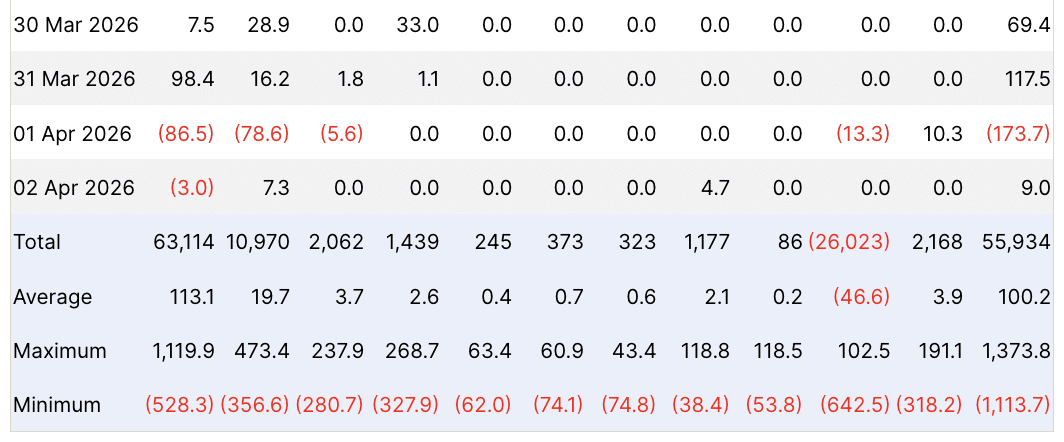
The last week of March and the start of April saw mixed sentiment in the ETF space. Looking at the performance of the Spot Bitcoin [BTC] ETF, it saw inflows worth $69.4 million on the 30th of March, in which Ark Invest’s ARKB contributed $33 million.

Then, on the 31st of March, BTC ETFs saw inflows worth $117.5 million, in which BlackRock’s IBIT led the way, with $98.4 million.

However, things flipped on the 1st of April, wherein BTC ETFs recorded outflows worth $173.7 million, in which BlackRock’s IBIT saw maximum outflows worth $86.5 million.

Source: Farside Investors

The trend turned positive on the 2nd of April yet again, as the BTC ETF saw inflows worth $9 million, wherein Fidelity’s FBTC saw $7.3 million in inflows.

This coincided with Bitcoin seeing a drop to $65,000 on the 30th of March, but at press time, it was changing hands at $66,937.05.

How did the Spot Ethereum ETF perform?

Moving forward, Spot Ethereum ETFs saw inflows worth $5 million on the 30th of March, in which Fidelity’s FETH saw inflows worth $10.6 million. The next day, the ETH ETF saw inflows worth $31.2 million, wherein BlackRock’s ETHA was worth $24.7 million.

However, on the first day of Q2, inflows turned to outflows. As of the 1st of April, the ETH ETF recorded outflows worth $7.1 million, in which BlackRock’s ETHA witnessed outflows worth $32.3 million.

On the 2nd of April, the ETH ETF saw $71.2 million in outflows, in which BlackRock’s ETHA faced maximum outflows worth $46.7 million.

This comes as ETH’s price was trading at $1,958 on the 30th of March, but at press time it stood at $2,043.42.

Solana and XRP ETF analysis

Now, when it comes to the Solana ETF, it too saw a rollercoaster ride. On the 30th of March, it recorded outflows worth $6.2 million, with Bitwise’s BSOL seeing the highest outflows worth $6.2 million.

Meanwhile, on the 31st of March and the 1st of April, the SOL ETF saw zero flows. Lastly, on the 2nd of April, SOL ETFs saw inflows worth $0.9 million, wherein Fidelity’s FBTC was the only one to see inflows worth $0.9 million.

Zooming out, SOL price was trading at $80.01 on the 30th of March, whereas at press time it was $79.73.

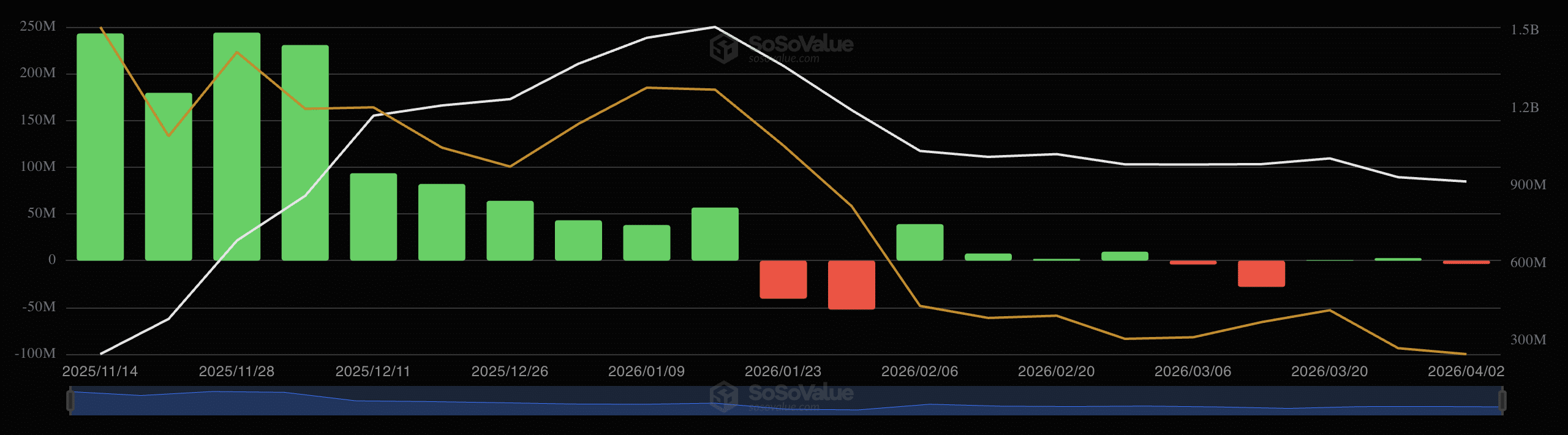
Lastly, XRP ETFs saw outflows worth $2.31 million on the 30th of March. Then on the 31st of March, it saw zero inflows.

Source: SoSoValue

Moving forward to the 1st of April, XRP ETFs saw outflows worth $1.32 million, and on the 2nd of April, they saw inflows of $64.6K. Meanwhile, XRP’s price was trading at $1.30, and at press time, it was at the same level, facing high volatility in the past week.


Final Summary

  • As 2026 transitions from Q1 to Q2, the ETF space is showing confused investor sentiment, juggling between inflows and outflows
  • The price action of all the tokens is also mirroring the ETF flow analysis, showing that volatility is in full force.

Related Questions

QWhat was the total inflow amount for Spot Bitcoin ETFs on March 30th and 31st combined?

AThe total inflow for Spot Bitcoin ETFs on March 30th and 31st combined was $186.9 million ($69.4 million + $117.5 million).

QWhich specific ETF product saw the largest single-day outflow for Ethereum ETFs and on what date did this occur?

ABlackRock's ETHA saw the largest single-day outflow for Ethereum ETFs, worth $46.7 million, on April 2nd.

QHow did the Solana ETF's flow activity change from March 30th to April 2nd?

AThe Solana ETF started with outflows of $6.2 million on March 30th, had zero flows on March 31st and April 1st, and ended with a small inflow of $0.9 million on April 2nd.

QWhat was the net flow result (inflows minus outflows) for XRP ETFs across the entire reported period?

AThe net flow for XRP ETFs across the entire period was negative, with total outflows of approximately $3.57 million ($2.31M + $1.32M - $0.0646M).

QDespite the mixed ETF flows, what was the general price trend for Bitcoin and Ethereum from March 30th to the time the article was written?

ABoth Bitcoin and Ethereum's prices increased from March 30th to the press time. Bitcoin rose from $65,000 to $66,937.05, and Ethereum rose from $1,958 to $2,043.42.

Related Reads

Day 6 of the rsETH Incident: DeFi United Secures Approximately $100 Million in Intentional Commitments, but a $50 Million Gap Remains

On April 18, Kelp DAO’s rsETH LayerZero bridge was exploited, resulting in the unauthorized minting of 116.5k rsETH (approx. $292M). The attacker borrowed around $190M on Aave V3. The Arbitrum Security Council froze 30,766 ETH linked to the incident. DeFi United, a cross-protocol rescue initiative led by Awe, was formed to cover a total shortfall of 112.2k rsETH ($258M). As of April 24, several protocols have pledged around $100M in support, though most commitments are still under DAO voting or discussion. Key pledges include: - Golem: 1,000 ETH ($2.3M) - Aave founder Stani Kulechov: 5,000 ETH ($11.5M) - EtherFi: up to 5,000 ETH ($11.5M) - Lido: up to 2,500 stETH ($5.75M), contingent on full coverage - Mantle: proposed a $69M loan to Aave DAO under specific terms The remaining shortfall is estimated at $50M. Aave’s treasury and safety module (~$236M combined) can cover the worst-case bad debt scenario ($230M). Three potential loss distribution paths were outlined by DefiLlama’s 0xngmi: 1. Uniform 18.5% haircut for all rsETH holders: Aave bad debt ~$216M 2. Only protect Mainnet, abandon L2: bad debt up to $341M 3. Repay only pre-attack holders: technically difficult, ~$91M net loss KelpDAO has not yet announced a specific plan. The success of DeFi United depends heavily on KelpDAO’s final decision on loss allocation.

marsbit3m ago

Day 6 of the rsETH Incident: DeFi United Secures Approximately $100 Million in Intentional Commitments, but a $50 Million Gap Remains

marsbit3m ago

Kicked Out of PayPal, Musk Aims for a Comeback in the Crypto Market

Elon Musk's X (formerly Twitter) has launched its "Smart Cashtags" feature, generating approximately $1 billion in trading volume within days of its April 2026 pilot launch. The feature allows users to click on stock or crypto tickers (or even full Solana token contract addresses) in posts to view real-time price charts and discussions without leaving the app. Initially available to iPhone users in the US and Canada, with a partnership in Canada enabling direct trading via the Wealthsimple app. This move is part of Musk's broader "Everything App" vision, spearheaded by the upcoming X Money platform. Analysts, such as Mizuho's Dan Dolev, see this as a potential disruptor to the US payments market, even prompting a downgrade of PayPal's stock. X Money's beta offers services like 6% APY on deposits, cashback, and P2P transfers, with speculation it may later incorporate crypto trading and stablecoin settlements for faster transactions. However, the ambitious plan faces significant regulatory scrutiny. Senator Elizabeth Warren has questioned the sustainability of the high 6% yield and raised concerns over X's banking partner, Cross River Bank, which has a history of regulatory violations. Additional risks involve the "GENIUS Act," which may create loopholes for stablecoin issuance without full FDIC insurance coverage, potentially leaving users unprotected. The integration of social trading on a platform with over 500 million users could inject new liquidity and retail interest into the crypto market. Yet, it also amplifies risks like herd mentality and the blurring of lines between entertainment and financial speculation. Musk's return to finance, after his ouster from PayPal, hinges on balancing innovation with regulatory compliance.

marsbit2h ago

Kicked Out of PayPal, Musk Aims for a Comeback in the Crypto Market

marsbit2h ago

Trading

Spot
Futures

Hot Articles

What is $BITCOIN

DIGITAL GOLD ($BITCOIN): A Comprehensive Analysis Introduction to DIGITAL GOLD ($BITCOIN) DIGITAL GOLD ($BITCOIN) is a blockchain-based project operating on the Solana network, which aims to combine the characteristics of traditional precious metals with the innovation of decentralized technologies. While it shares a name with Bitcoin, often referred to as “digital gold” due to its perception as a store of value, DIGITAL GOLD is a separate token designed to create a unique ecosystem within the Web3 landscape. Its goal is to position itself as a viable alternative digital asset, although specifics regarding its applications and functionalities are still developing. What is DIGITAL GOLD ($BITCOIN)? DIGITAL GOLD ($BITCOIN) is a cryptocurrency token explicitly designed for use on the Solana blockchain. In contrast to Bitcoin, which provides a widely recognized value storage role, this token appears to focus on broader applications and characteristics. Notable aspects include: Blockchain Infrastructure: The token is built on the Solana blockchain, known for its capacity to handle high-speed and low-cost transactions. Supply Dynamics: DIGITAL GOLD has a maximum supply capped at 100 quadrillion tokens (100P $BITCOIN), although details regarding its circulating supply are currently undisclosed. Utility: While precise functionalities are not explicitly outlined, there are indications that the token could be utilized for various applications, potentially involving decentralized applications (dApps) or asset tokenization strategies. Who is the Creator of DIGITAL GOLD ($BITCOIN)? At present, the identity of the creators and development team behind DIGITAL GOLD ($BITCOIN) remains unknown. This situation is typical among many innovative projects within the blockchain space, particularly those aligning with decentralized finance and meme coin phenomena. While such anonymity may foster a community-driven culture, it intensifies concerns about governance and accountability. Who are the Investors of DIGITAL GOLD ($BITCOIN)? The available information indicates that DIGITAL GOLD ($BITCOIN) does not have any known institutional backers or prominent venture capital investments. The project seems to operate on a peer-to-peer model focused on community support and adoption rather than traditional funding routes. Its activity and liquidity are primarily situated on decentralized exchanges (DEXs), such as PumpSwap, rather than established centralized trading platforms, further highlighting its grassroots approach. How DIGITAL GOLD ($BITCOIN) Works The operational mechanics of DIGITAL GOLD ($BITCOIN) can be elaborated on based on its blockchain design and network attributes: Consensus Mechanism: By leveraging Solana’s unique proof-of-history (PoH) combined with a proof-of-stake (PoS) model, the project ensures efficient transaction validation contributing to the network's high performance. Tokenomics: While specific deflationary mechanisms have not been extensively detailed, the vast maximum token supply implies that it may cater to microtransactions or niche use cases that are still to be defined. Interoperability: There exists the potential for integration with Solana’s broader ecosystem, including various decentralized finance (DeFi) platforms. However, the details regarding specific integrations remain unspecified. Timeline of Key Events Here is a timeline that highlights significant milestones concerning DIGITAL GOLD ($BITCOIN): 2023: The initial deployment of the token occurs on the Solana blockchain, marked by its contract address. 2024: DIGITAL GOLD gains visibility as it becomes available for trading on decentralized exchanges like PumpSwap, allowing users to trade it against SOL. 2025: The project witnesses sporadic trading activity and potential interest in community-led engagements, although no noteworthy partnerships or technical advancements have been documented as of yet. Critical Analysis Strengths Scalability: The underlying Solana infrastructure supports high transaction volumes, which could enhance the utility of $BITCOIN in various transaction scenarios. Accessibility: The potential low trading price per token could attract retail investors, facilitating wider participation due to fractional ownership opportunities. Risks Lack of Transparency: The absence of publicly known backers, developers, or an audit process may yield skepticism regarding the project's sustainability and trustworthiness. Market Volatility: The trading activity is heavily reliant on speculative behavior, which can result in significant price volatility and uncertainty for investors. Conclusion DIGITAL GOLD ($BITCOIN) emerges as an intriguing yet ambiguous project within the rapidly evolving Solana ecosystem. While it attempts to leverage the “digital gold” narrative, its departure from Bitcoin's established role as a store of value underscores the need for a clearer differentiation of its intended utility and governance structure. Future acceptance and adoption will likely depend on addressing the current opacity and defining its operational and economic strategies more explicitly. Note: This report encompasses synthesised information available as of October 2023, and developments may have transpired beyond the research period.

363 Total ViewsPublished 2025.05.13Updated 2025.05.13

What is $BITCOIN

Discussions

Welcome to the HTX Community. Here, you can stay informed about the latest platform developments and gain access to professional market insights. Users' opinions on the price of BTC (BTC) are presented below.

活动图片