Qubic Says Dogecoin Mining Build Is Underway, Revives 51% Attack Fears

bitcoinistPublished on 2026-01-23Last updated on 2026-01-23

Abstract

Qubic has announced the development of a Dogecoin mining integration after a community vote selected DOGE. This move transitions the project from its previous "attention" narrative around Monero into implementation, raising renewed concerns about 51% attacks. Qubic emphasized that integrating ASIC hardware into its useful Proof-of-Work (uPoW) model requires significant engineering and protocol work, but could bring scale by incorporating Dogecoin's large mining economy. The announcement revisits security debates sparked in August 2025 when Qubic claimed a Monero "takeover demonstration" with over 51% hashrate dominance, though subsequent research found its control peaked at 23–34%. Unlike Monero's CPU-based mining, Dogecoin uses Scrypt and has merged mining with Litecoin, making a brute-force 51% attack economically challenging. Research firm 21Shares estimated it would cost billions in hardware and millions daily in electricity. A more plausible risk is Qubic incentivizing existing Scrypt miners to redirect hashpower through its system—a "vampire mining" approach.

Qubic says it is now building a Dogecoin mining integration, a step that moves the project’s post-Monero “attention” narrative into an implementation phase and reopens a familiar set of security questions around majority-hashrate risk.

In an X post shared Thursday, Qubic wrote: “The community didn’t hesitate. The vote was decisive: DOGE won with 301 votes. This isn’t a plug-and-play upgrade. Integrating ASIC hardware into uPoW requires real engineering, deep protocol work, and time to do it right. But the upside is significant. DOGE represents one of the largest and most established mining economies in crypto. Bringing it into Qubic’s useful Proof-of-Work model extends uPoW beyond theory, into scale. [...] Development is underway. This is just the beginning of what is to come.”

Could Dogecoin Suffer A 51% Attack?

The announcement lands with baggage. In August 2025, Qubic ran what it publicly described as a Monero “takeover demonstration,” claiming it had achieved “over 51% hashrate dominance” during parts of the experiment and reporting a brief chain disruption that included a six-block reorganization and orphaned blocks.
That episode became a lightning rod for the broader PoW security debate: how quickly external incentives can concentrate hashpower, and how markets react when “51%” enters the conversation.

Subsequent research challenged the strongest interpretation of those claims. A December 2025 paper reconstructing Qubic-attributed activity on Monero describes the operation as an advertised “selfish mining campaign,” finding Qubic’s hashrate share rising into the 23–34% range in detected intervals, while “sustained 51% control is never observed.”

Dogecoin’s mining economy is structurally unlike Monero’s CPU-oriented RandomX landscape. Dogecoin uses Scrypt and has, since 2014, supported merged mining alongside Litecoin, an architecture that has historically helped bolster its security budget by tapping into a broader Scrypt ASIC miner base.

That hardware reality is central to Qubic’s own messaging. The project said “integrating ASIC hardware into uPoW requires real engineering, deep protocol work, and time to do it right,” explicitly acknowledging that this is not a simple pool launch.

It is also where most of the immediate 51% attack fears run into friction. In an August 2025 research note, published when Qubic first began floating Dogecoin as the “next” network after Monero, 21Shares argued that a brute-force Dogecoin majority would be economically prohibitive, estimating that Qubic would need to match and then exceed roughly 2.78 PH/s, implying about $2.85 billion in hardware plus roughly $2.5 million per day in electricity (before logistics).

The more plausible risk vector, if any, is not Qubic buying its way to majority hashrate, but whether it can engineer incentives and integrations that convince existing Scrypt ASIC operators to route meaningful hashpower through a Qubic-mediated setup, an approach 21Shares characterized as “vampire mining.”

At press time, DOGE traded at $0.12521.
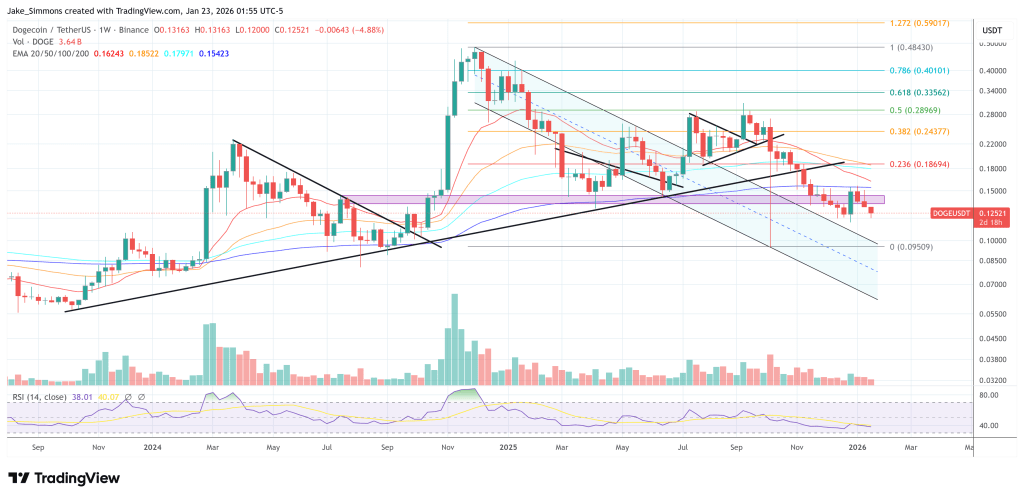
DOGE price, 1-week chart | Source: DOGEUSDT on TradingView.com

Related Questions

QWhat is Qubic currently building and which cryptocurrency does it involve?

AQubic is currently building a Dogecoin mining integration.

QWhat security concern is reignited by Qubic's announcement of Dogecoin mining integration?

AThe announcement reignites fears of a potential 51% attack on the Dogecoin network.

QWhat was the outcome of Qubic's previous 'takeover demonstration' on the Monero network according to subsequent research?

ASubsequent research found that Qubic's hashrate share on Monero reached 23-34% in detected intervals, but sustained 51% control was never observed, challenging the strongest claims of the demonstration.

QWhy does 21Shares argue that a brute-force 51% attack on Dogecoin would be economically prohibitive for Qubic?

A21Shares argued it would be economically prohibitive because Qubic would need to acquire roughly $2.85 billion in hardware and spend about $2.5 million per day on electricity to match the required hashrate.

QWhat is the more plausible risk vector for a Dogecoin 51% attack, as opposed to a brute-force approach?

AThe more plausible risk vector is not a brute-force purchase of hardware, but rather Qubic engineering incentives to convince existing Scrypt ASIC operators to route their hashpower through a Qubic-mediated setup, an approach termed 'vampire mining'.

Related Reads

First Day Review of "Musk's WeChat" XChat: Even Worse Than Expected

Elon Musk's much-anticipated "WeChat-like" app, XChat, has officially launched after multiple delays. The initial review reveals a product that falls short of expectations, offering an experience largely similar to X Platform's (formerly Twitter) direct messages, despite being marketed as an encrypted communication tool. Key observations from the first-day test include: 1. The app's promoted "end-to-end encryption" and its claimed relation to Bitcoin's architecture were criticized by experts as a superficial attempt to capitalize on crypto buzz, with no real technical connection. 2. Musk's vision of an ad-free "secure communication system" is technically met, but only because the app is currently extremely basic, featuring only a single chat interface. 3. A promised anti-screenshot feature appears inconsistent; it works in X Platform group chats but fails within the XChat app itself, where screenshots still capture avatars. 4. The app supports 45 languages and has a 16+ age rating, indicating a broader tolerance for content compared to WeChat's 13+ rating. 5. A puzzling login process requires users to verify the email associated with their X account. 6. The touted encryption" feels minimal in practice, with its presence only indicated by a simple "Encrypted - Yes" label on messages. 7. Disappearing message timers for groups can be set from 5 minutes to 4 weeks, with the timer starting upon being read by a user. 8. Group invite links are shared with X Platform groups. 9. Group size limits are planned to be increased, aiming for 1000 members, a move that has drawn user criticism. 10. The app offers 8 different colored icons, and its chat bubbles are notably similar to WeChat's. Message deletion options mimic Telegram's. Crucially, many pre-announced features like importing X contacts, integrating Grok AI, X Money payments, and Cashtags are not yet available. The initial release is seen as a bare-bones and underwhelming first step.

Odaily星球日报18m ago

First Day Review of "Musk's WeChat" XChat: Even Worse Than Expected

Odaily星球日报18m ago

DeepSeek No Longer Wants to Focus Only on Large Models

DeepSeek, a leading Chinese AI company, has released its new model series DeepSeek-V4, featuring two versions: the high-performance V4-Pro with 1.6 trillion parameters and the cost-efficient V4-Flash. Both support 1 million token context windows and use Mixture-of-Experts (MoE) architecture to improve efficiency. The company continues its strategy of offering competitive pricing, with input tokens priced as low as ¥0.2 per million tokens. A key revelation is DeepSeek’s explicit link between future price reductions and the mass availability of Huawei’s Ascend 950 AI chips in the second half of the year. This signals a strategic shift from relying solely on algorithmic and engineering optimizations to integrating domestic computing power into its core cost structure. DeepSeek has adapted its inference system to run efficiently on both NVIDIA GPUs and Huawei NPUs, potentially challenging NVIDIA's CUDA ecosystem dominance. Concurrently, DeepSeek is reportedly seeking significant external investment, with a pre-money valuation of around ¥300 billion. This move highlights growing pressures in scaling compute infrastructure, retaining top talent—amid recent departures of key researchers—and accelerating commercialization efforts. The company has also updated its consumer app with tiered model access, indicating a stronger product focus. The V4 release underscores that China's AI competition is evolving beyond pure model capability into a broader contest involving compute supply chains, engineering systems, financing, and talent strategy.

marsbit46m ago

DeepSeek No Longer Wants to Focus Only on Large Models

marsbit46m ago

Trading

Spot
Futures
活动图片





