Pope Takes Stage with Anthropic: A Guide to the Vatican's First AI Encyclical

marsbitPublished on 2026-05-26Last updated on 2026-05-26

Abstract

On May 25, 2026, Pope Leo XIV released the Vatican's first AI-focused encyclical, "Magnifica Humanitas: Safeguarding Humanity in the Age of Artificial Intelligence." Choosing this name explicitly connects the document to Pope Leo XIII's response to the Industrial Revolution, framing AI as a similarly transformative shift. The Pope argued AI must be "disarmed," comparing its potential dangers to nuclear weapons, and called for governance beyond tech companies and market forces. Significantly, the launch featured Anthropic co-founder Christopher Olah, who described AI models as "grown" from human language and reflecting human emotions, yet not fully understood by their creators. He acknowledged commercial pressures on labs and stated fundamental questions—like ensuring AI benefits poor nations, defining human flourishing, and understanding what we are creating—require input from philosophy and religion. The encyclical warns that universal prosperity from AI is an "illusion" without deliberate design. Citing a century-old observation that humanity is ill-trained to wield great power, it argues we must learn to use AI before it controls us. The Church offers no technical solutions but claims its millennia of wisdom on human dignity is essential to ensure AI serves, rather than dominates, human conscience and prosperity.

Editor's Note: On May 25, 2026, the Vatican released Pope Leo XIV's first encyclical, 'Magnifica Humanitas: Guarding Humanity in the Age of Artificial Intelligence.' The timing of this document, coinciding with the 135th anniversary of Pope Leo XIII's 'Rerum Novarum,' is clearly not coincidental. If 'Rerum Novarum' was the Catholic Church's response to the Industrial Revolution, then 'Magnifica Humanitas' is seen as the Church's formal stance on the AI era.

What is most noteworthy about this release is not just the Pope comparing AI to nuclear weapons and calling for 'AI to be disarmed,' nor is it just the presence of Anthropic co-founder Christopher Olah on stage at the Vatican. It is the first time that religion, philosophy, and a cutting-edge AI lab have stood so directly before the same question: As AI transforms labor, warfare, wealth distribution, and human self-understanding, are technology companies and market competition alone sufficient to determine its future?

This article outlines the 11 most significant details from this event: from the historical metaphor behind the name 'Leo XIV' to how the Church once again responds to a major technological shift following the Industrial Revolution, nuclear weapons, and the climate crisis; from Olah's description of AI models as 'grown from human language' to his admission that AI labs cannot answer alone questions such as how poor countries can benefit, what human flourishing means, and what exactly we are creating.

Original text follows:
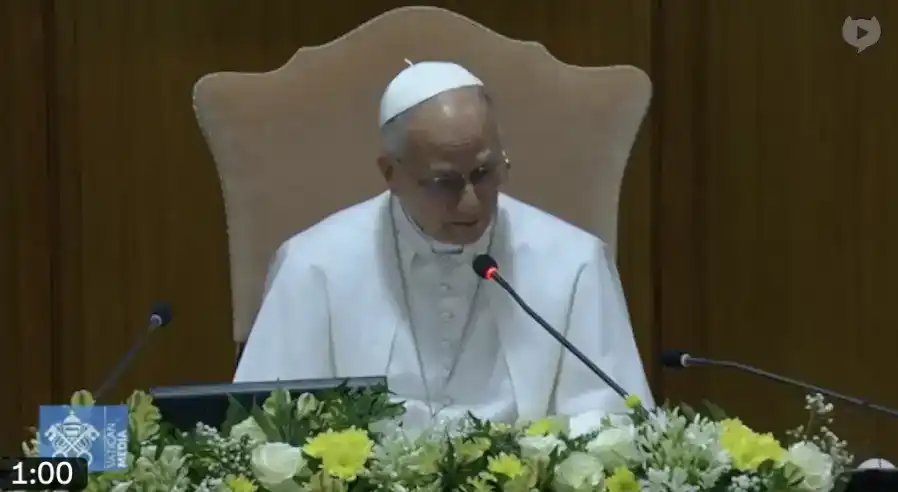
The Pope and the Anthropic co-founder just stood together at the Vatican to release 'Magnifica Humanitas'—the first official doctrinal document on artificial intelligence in Catholic history.

Yes, you read that correctly. The entire release ceremony lasted two hours.

Here are the key points of note:

1. This is the most significant response from the religious world to AI to date. A Pope typically issues only a handful of such weighty formal documents during his entire pontificate. That one of them is specifically about AI itself shows that the Church is viewing the coming changes with the utmost seriousness.

2. A small but significant detail is this Pope's deliberate choice of the name 'Leo XIV.' The last Pope named Leo was Leo XIII in 1891. His most famous act was writing the Catholic Church's response to the Industrial Revolution. Choosing the same name again today is a very clear signal: this Pope sees AI as a new Industrial Revolution.

3. Whenever a major technology reshapes human society, the Catholic Church responds. In 1891, they responded to the Industrial Revolution with 'Rerum Novarum'; in the 1960s, when nuclear weapons threatened the world, they wrote 'Pacem in Terris'; in 2015, climate change and runaway technology issues gave rise to 'Laudato Si'.' Now, it is AI's turn, with the document titled 'Magnifica Humanitas.' Such documents are not common.

4. The Pope's core statement is: 'AI needs to be disarmed.' He effectively places AI in the same category as nuclear weapons. He stated that the Church spent decades promoting nuclear disarmament because such technology is too dangerous to be held by only a few. Now, he believes AI has entered the same class of problem.

5. Anthropic co-founder Christopher Olah, on stage at the Vatican, told the Pope that Anthropic's own research teams constantly find things inside AI models that 'mirror joy, satisfaction, fear, sorrow, and unease.'

6. Olah reframed the nature of AI: these things are not simply manufactured; they are more like something that 'grows.' They are trained on systems roughly mimicking the human brain's structure and fed almost everything humans have ever written. In his own words: 'They are made of us, and of our language.' He also stated that even the people building these systems do not fully understand what is happening inside them.

7. Olah publicly admitted that all AI labs, including Anthropic, face pressures that may conflict with 'doing the right thing': the commercial pressure to keep releasing products, competitive pressure from other labs, and the older forces of arrogance and ambition. His proposed solution: we urgently need external critics with no vested interests to directly point out problems when labs go astray.

8. Olah believes there are three huge questions that AI labs cannot answer alone, and the world needs religion and philosophy to engage with:

How do we ensure poor countries genuinely benefit from AI?
In this new world, what does human flourishing actually mean?
And what exactly are these things we are creating?

9. One of the sharpest lines in the entire encyclical is: 'The promise of automatic and universal prosperity often proves in the end to be an illusion.' In other words, the belief that AI will automatically make everyone rich is itself an illusion. Someone must actually design a system to share the technological dividends.

10. The Pope also quoted a century-old statement: 'Modern man is not yet well-trained in the good use of power.' These words come from a theologian in the 1920s. Almost the entire encyclical revolves around a core argument: before this power begins to dominate us, we must first learn how to use it.

11. The Pope repeatedly emphasized that he does not hold the technical answers. But he stated that the Church possesses millennia of wisdom concerning 'what it means to be human,' and this wisdom is precisely what is most lacking in the current AI development process. He concludes by writing that this technology should serve 'human flourishing and human dignity, not the control of human conscience.'


Related Questions

QWhat is the title of Pope Leo XIV's first AI-related encyclical and what is its significance?

AThe encyclical is titled 'Magnifica Humanitas: Safeguarding Humanity in the Age of Artificial Intelligence.' Its significance lies in it being the Catholic Church's first formal doctrinal document addressing AI, signaling the Church's high level of seriousness about the impending technological changes and positioning it as a response to the AI era, analogous to the Church's response to the Industrial Revolution.

QWhy did the Pope choose the name 'Leo XIV' and what historical parallel is it drawing?

AThe Pope chose the name 'Leo XIV' as a direct historical parallel to Pope Leo XIII, who authored the encyclical 'Rerum Novarum' in response to the Industrial Revolution in 1891. This choice signals that Pope Leo XIV views AI as a new industrial revolution, a transformative technological shift demanding a formal response from the Church.

QWhat core statement did Pope Leo XIV make regarding AI, and to what other technology did he compare it?

APope Leo XIV's core statement was that 'AI needs to be disarmed.' He explicitly compared AI to nuclear weapons, arguing that like nuclear technology, AI is too dangerous to be left solely in the hands of a few, and the world needs collective governance and restraint over its development and deployment.

QWhat did Anthropic co-founder Christopher Olah admit about the pressures facing AI labs, and what solution did he propose?

AChristopher Olah admitted that AI labs, including Anthropic, face significant pressures from commercial needs for continuous product releases, competition from other labs, and fundamental human arrogance and ambition, which may conflict with 'doing the right thing.' He proposed that the solution is the urgent need for external critics without vested interests who can point out problems when labs go astray.

QAccording to the article, what three major questions did Olah state that AI labs cannot answer alone, requiring input from religion and philosophy?

AChristopher Olah stated that AI labs cannot answer these three major questions alone: 1) How do we ensure poor countries truly benefit from AI? 2) What does human flourishing mean in this new world? 3) What exactly are we creating with these systems? He argued that addressing these profound questions requires the engagement of religion and philosophy.

Related Reads

BTC Thrice Rejected at $80,000 Threshold, HYPE Reaches New Highs Signaling Opportunity | Guest Analysis

**Bitcoin (BTC) Struggles at $80k; HYPE Reaches New Highs | Key Analysis & Strategy** Bitcoin faces continued resistance in the $78.5k - $79.5k zone after failing to sustain a break above its daily chart rising channel. It has retreated to the channel's midline. A failure to hold here could see a test of the $73.5k - $75k support area. The 4-hour chart shows a complex corrective structure. The strategy is neutral for mid-term positions. For short-term trading, two scenarios are outlined: **A)** Selling on a failed rally into the $78.5k-$79.5k resistance, and **B)** Selling on a confirmed breakdown below the $73.5k-$75k support, both with tight risk management. Meanwhile, **HYPE** has posted consecutive highs. The 4-hour chart indicates its current uptrend may be weakening near $65, with models showing potential bearish divergence. The view is that a short-term top could be forming. The strategy advises against chasing the rally and instead looking for a potential long entry on a pullback to the $47.5 - $50 support zone, provided clear reversal signals appear. Last week, a disciplined short BTC trade based on model signals yielded a 2.78% profit. The article emphasizes that all analysis is for informational purposes only and not investment advice, highlighting the importance of strict stop-loss discipline and dynamic position management in a volatile market. *(Note: The text references proprietary models like the "Price Difference Trading Model" and "Momentum Quantification Model" for generating trade signals.)*

marsbit39m ago

BTC Thrice Rejected at $80,000 Threshold, HYPE Reaches New Highs Signaling Opportunity | Guest Analysis

marsbit39m ago

Tether's New Business: Helping Small Countries Issue Stablecoins

Tether has announced a partnership with the Georgian government to issue GEL₮, a Lari-pegged stablecoin, aiming to reduce costs, accelerate settlements, and promote cross-border payments. This move is part of Tether's broader strategy to establish a replicable, standardized business of issuing sovereign currency-backed stablecoins for smaller nations, alongside its flagship USDT and other regional offerings like MXNT (Mexican Peso) and CNHT (Offshore Yuan). Georgia represents an ideal test case due to its high reliance on remittances (~15% of GDP), established digital asset regulatory framework aligned with U.S. standards, and prior engagement with Tether. The country gains accelerated internationalization of its currency by accessing Tether's global distribution network and liquidity pools, where GEL₮ can be swapped directly with assets like USDT. For Tether, the immediate financial gain from Georgia's small market is minimal. The true value lies in creating a template. Successfully navigating the compliance, reserve, and redemption processes for GEL₮ allows Tether to replicate this model swiftly for other nations with similar profiles, such as Azerbaijan or Nigeria. The deeper strategy involves subtly integrating these national currencies into an informal USDT-anchored dollar system, positioning Tether as the essential routing infrastructure. This partnership highlights a potential new model: the outsourcing of sovereign currency globalization to private stablecoin issuers. It offers smaller states a faster path to digital currency integration than developing a Central Bank Digital Currency (CBDC). However, it raises significant questions about monetary sovereignty, financial stability risks, and increased dependency on a private entity. If more countries adopt this model in the coming year, Tether could evolve from a stablecoin issuer into a unique, cross-sovereign financial infrastructure service provider.

marsbit43m ago

Tether's New Business: Helping Small Countries Issue Stablecoins

marsbit43m ago

Notion CEO: AI companies should be a 'Jazz Band,' and I am a 'Refounder'

Notion CEO Ivan Zhao, in a recent podcast, shared his journey of twice rebuilding the company from near-collapse and now applying the same "Refounder" mindset to reshape the 1000-person organization in the AI era. He argues that AI has commoditized technical capability (Capability). True talent now hinges on Taste (judgment/values) and Agency (proactive drive), necessitating a shift in hiring—e.g., hiring more juniors for curiosity and having sales candidates demonstrate work upfront. Zhao envisions the company as a "Jazz Band"—agile and improvisational—versus a rigid "Marching Band." This is reflected in an engineering "dumbbell" structure (super juniors + top-tier seniors, with middle layers compressed), dissolving the CMO role to let teams operate directly, and integrating entrepreneurs via acquisitions to lead their expertise areas. Notion has abandoned traditional long-term product roadmaps, planning only conservatively for finances while adopting a week-by-week, improvisational approach to product strategy, as longer plans proved futile during rapid AI shifts. He concludes that while human nature and roles remain constants, companies must rewrite their approaches to hiring (valuing Taste/Agency over Capability), organizational design (reducing roles focused on coordination/execution), and planning (embracing flexibility). Modern knowledge work, being only ~150 years old, is ripe for reinvention.

marsbit44m ago

Notion CEO: AI companies should be a 'Jazz Band,' and I am a 'Refounder'

marsbit44m ago

BTC Faces Triple Resistance at $80,000 Milestone, HYPE Hits New Highs Signaling Potential | Invited Analysis

This weekly analysis maintains a structured framework, focusing on Bitcoin (BTC) and HYPE, dissecting their multi-timeframe price action to identify key support and resistance zones and formulate actionable trading plans. The previous week's short position on BTC yielded a 2.78% gain, reinforcing the "signal-driven, disciplined" approach. For Bitcoin, the core scenario revolves around the battle between the 78,500–79,500 USD resistance zone and the 73,500–75,000 USD support area. The daily chart shows BTC within a rising channel; a failure to hold support at the channel's midline could lead to a test of the lower boundary. The 4-hour chart details an 8-segment corrective structure from the 82,850 USD high. Two short-term strategies are proposed: (A) Selling on a failed rally into the 78.5k-79.5k zone, with a stop above 80,600, or (B) Selling a confirmed breakdown below the 73.5k-75k support, with a stop above 76,500. Medium-term positioning remains neutral. For HYPE, the 4-hour chart indicates a five-wave advance from the May 14th low, now showing potential exhaustion and a top warning signal near 65 USD. The core view is to watch for a potential short-term peak formation. The recommended strategy is to avoid chasing the rally and instead look for a long setup upon a pullback to the 47.5–50 USD support zone, provided clear stabilization and model confirmation signals appear. The report concludes with a detailed review of the prior BTC short trade, executed based on model signals and candlestick patterns, and reiterates strict risk management rules, including immediate stop-loss placement and trailing stops to protect profits. All analysis is presented as a personal trading log, not investment advice.

Odaily星球日报54m ago

BTC Faces Triple Resistance at $80,000 Milestone, HYPE Hits New Highs Signaling Potential | Invited Analysis

Odaily星球日报54m ago

Trading

Spot
Futures

Hot Articles

Discussions

Welcome to the HTX Community. Here, you can stay informed about the latest platform developments and gain access to professional market insights. Users' opinions on the price of S (S) are presented below.

活动图片