Pi Network Price Forecast for August 2026: Will the August 11th Deadline Become a Catalyst for PI's Recovery?

cryptonews.ruPublished on 2026-07-30Last updated on 2026-07-30

Abstract

Pi Network Price Forecast for August 2026: Will the August 11 Deadline Catalyze a Recovery? Pi Network (PI) traded at $0.0830 on July 30, up 1.13%, attempting to stabilize above its all-time low. The price is rebounding from the lower Bollinger Band around $0.07172. All key EMAs (20, 50, 100, 200-day) remain in a downtrend above the current price, with the 20-day EMA at $0.08810 acting as the first significant resistance level to confirm a recovery. August presents two key narratives. First, the Pi Core Team launched Protocol 26 with a hard deadline of August 11 for all node operators to upgrade; failure to do so results in disconnection. This is the final precursor to Protocol 27, a major technical upgrade planned for 2026. Second, a community debate challenges the widespread "GCV" (Global Consensus Value) concept, with a member stating there is no official GCV mechanism and that Mainnet apps price services independently. This could pressure price if holders selling on disillusionment. The 10-day price forecast table suggests a range of $0.072-$0.095 for early August amid Protocol 26 deadline pressure, $0.080-$0.110 in mid-August post-deadline clarity, and $0.085-$0.125 in late August, pending broader crypto market direction. The bullish case requires smooth Protocol 26 migration, clear Protocol 27 announcement, resolution of the GCV debate without major holder exits, and a close above the 20-day EMA. The bearish scenario involves node upgrade difficulties, GCV-related s...

Pi Network is trading at $0.0830 on July 30, up 1.13%, attempting to hold above the all-time low after the launch of Protocol 26 with a hard deadline of August 11 for all node operators. August begins with two parallel narratives moving in opposite directions: the network completing its final scheduled protocol sequence, and the community grappling with whether its most prevalent price notion has any official basis.

PI Price Forecast August 2026: 10-Day Forecast Table

Period Price Range Outlook
August 1-10 $0.072 — $0.095 Protocol 26 — deadline pressure; node migration activity; low volume environment
August 11-20 $0.080 — $0.110 Clarity post-deadline; Protocol 27 announcement expected; Potential volatility
August 21-31 $0.085 — $0.125 End-of-month resolution; broader crypto macro in September sets direction

PI lacks a multi-year history for seasonal patterns to rely on, having been listed on exchanges in February 2025. It can be observed that PI peaked around $3 in February 2025 and has continued to decline in a steady downtrend each subsequent month.

PI Bounces from Record Low Zone, But Every EMA is Rolling Down
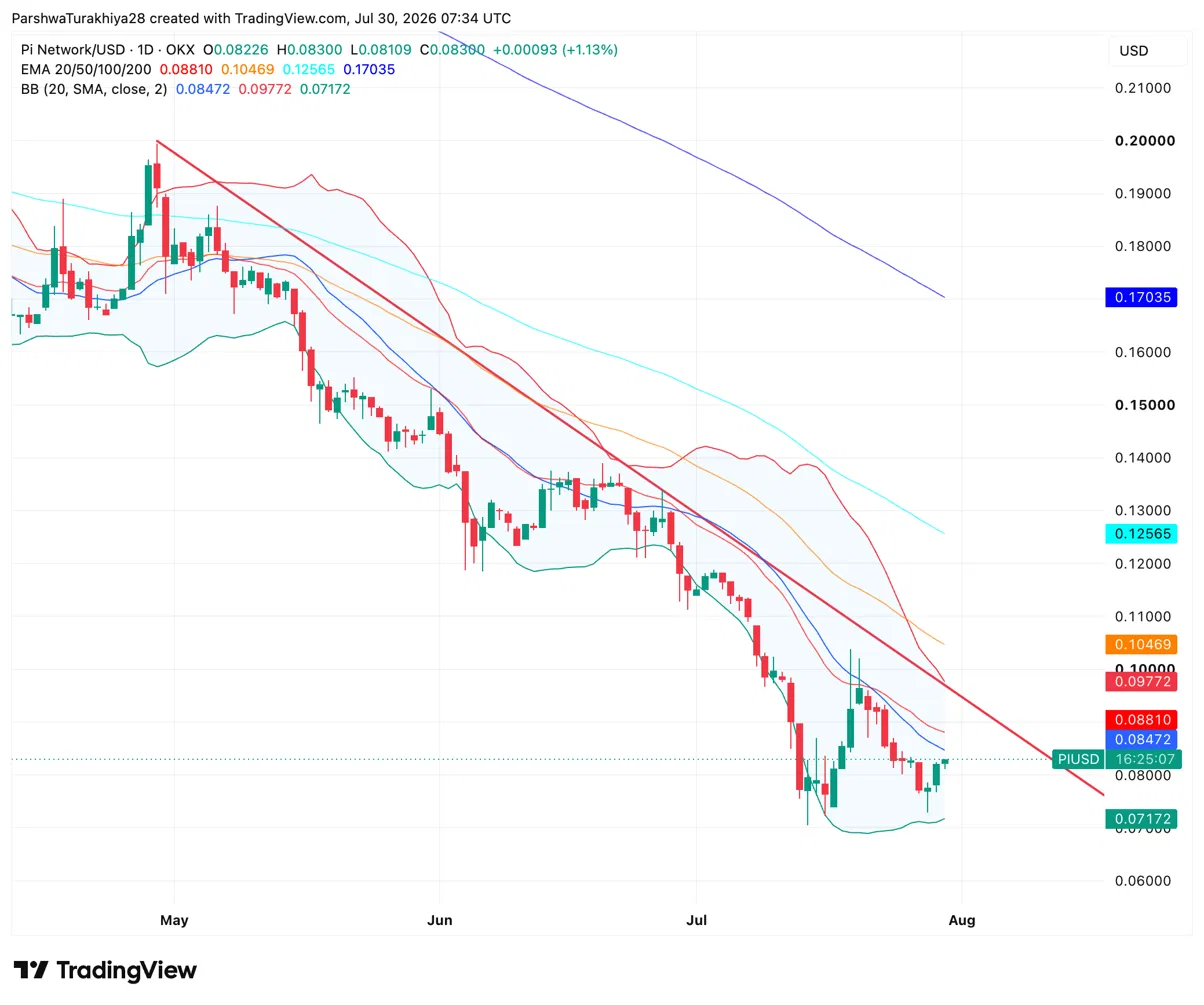
PI 1D Price Movement (Source: TradingView)

The daily chart shows PI bouncing from the lower Bollinger Band zone at $0.07172 after hitting an all-time low in mid-July around $0.0700. Today's 1.13% session marks the second consecutive green day from this base, but the recovery has yet to reclaim a significant level. The Bollinger Middle Band at $0.08472 is the first target, sitting just above the current price of $0.0830.

All four EMAs continue to trend downwards below the current price. The nearest ceiling is the 20-day at $0.08810, followed by the 50-day at $0.10469, the 100-day at $0.12565, and the 200-day at $0.17035. The upper Bollinger Band at $0.09772 marks the outer boundary of any short-term bounce. A sustained close above the 20-day EMA at $0.08810 will be the first signal of the all-time low being firmly established. Until that happens, the bounce remains unconfirmed.

What Are the Key Support and Resistance Levels for PI in August?

Resistance

  1. $0.08472 — Bollinger Middle Band, first ceiling for any recovery
  2. $0.08810 — 20-day EMA, must close above for confirmation of a return
  3. $0.09772 — upper Bollinger Band, outer limit of short-term range
  4. $0.10469 — 50-day EMA, extended resistance

Support

  1. $0.08109 — today's session low
  2. $0.07172 — Lower Bollinger Band and absolute low zone
  3. No established support below $0.07172

Protocol 26 Launched with Hard August 11 Deadline

The Pi Core team launched Protocol 26 on the Mainnet on July 30, instructing all node operators to complete the update by August 11. Operators who do not migrate by this date will be immediately disconnected from the Mainnet, according to the team's announcement. The update process is described as taking less than five minutes for most operators, though the team warned against launching the migration across all nodes simultaneously.

Protocol 26 is the ninth protocol update in Pi's recent sequence and the final precursor to Protocol 27, which the team has termed a technical transition in its 2026 roadmap. Together, these two releases are expected to fully update the Mainnet with the latest protocol capabilities.

The GCV Debate Is Now a Direct Clash with Community Expectations

لا يوجد GCV في نظام Pi Network
وجميع التطبيقات الموجودة في Mainnet كلها تسعر خدماتها كما تشاء ومن غير GCV.
انظروا ماذا يوجد في Pi Domain ال Pi الموجود في الCEXs هو نفسه المعدن داخل المحافظ.
يجب إنقاد مجتمع GCV من هذه الأوهام لأنهم عطلوا عقولهم و عطلوا النظام.#Web3‌‌ #fypシ゚ pic.twitter.com/PZsEo9rlL0

— k90 (@Kader6171) July 29, 2026

Community member Kader6171 stated on July 30 that there is no GCV mechanism anywhere within the Pi Network system. All Mainnet applications price their services independently, without a mandatory GCV standard. The post called on the GCV community to abandon what it called illusions, paralyzing thinking and hindering ecosystem development.

GCV—the idea that Pi's value could be determined through community collective agreement rather than market activity—has circulated since the network's early days. Kader6171's argument is a standard counter: a cryptocurrency's value is determined by utility, trading volume, developer adoption, and market confidence, not community consensus. The Pi Core team has not yet responded.

The price risk is evident. If a significant portion of the holder base has been holding PI in anticipation of a valuation based on GCV without official backing, any shift in that belief becomes selling pressure. The size of this segment determines the impact's significance.

PI Price Forecast August 2026: Upside and Downside Targets

  • Positive Case: Protocol 26 migration concludes without hitches by August 11, Protocol 27 is announced with clear timelines, the GCV debate concludes without major holder flight, and PI closes above the 20-day EMA at $0.08810 as the completion of the protocol roadmap draws fresh attention to the network heading into September.
  • Negative Case: Node operators struggle with the August 11 deadline, the GCV debate accelerates sales by disappointed holders, the 775.8 million PI scheduled for unlocking by December continues supply pressure, and PI retreats to the lower Bollinger Band zone at $0.07172 or sets a new all-time low below it, as August macro conditions maintain risk-off sentiment.
end-content

Trending Cryptos

Related Questions

QWhat is the core dual narrative mentioned at the start of the article regarding the Pi Network in August 2026?

AThe dual narrative is the network completing its final scheduled protocol sequence (with Protocol 26) while the community grapples with whether its most common price idea, the Global Consensus Value (GCV), has any official basis.

QWhat is the hard deadline for node operators in August 2026 according to the article, and what protocol is it for?

AThe hard deadline is August 11, 2026, for all node operators to complete the migration to Protocol 26. Operators failing to update by this date will be disconnected from the Mainnet.

QWhat does the community member Kader6171 claim about the Global Consensus Value (GCV) in the Pi Network?

AKader6171 claims that there is no GCV mechanism anywhere in the Pi Network system. They state that all Mainnet applications price their services independently without a mandatory GCV standard, and they urged the GCV community to abandon what they called illusions.

QAccording to the article's technical analysis, what needs to happen for the PI price to signal a confirmed bottom?

AA sustained daily close above the 20-day EMA at $0.08810 is needed to signal a confirmed bottom. Until that happens, any price bounce remains unconfirmed.

QWhat are the potential positive and negative catalysts for PI price in August 2026 as outlined in the article's price forecast?

APositive catalysts: Smooth completion of Protocol 26 migration by the Aug 11 deadline, announcement of Protocol 27 with clear timelines, GCV debates ending without major holder exodus, and price closing above the 20-day EMA. Negative catalysts: Node operators struggle to meet the deadline, GCV debates accelerate sales from disappointed holders, the planned unlocking of 775.8M PI tokens exerts supply pressure, and the price falls back to or below the Bollinger Band low of $0.07172.

Related Reads

Bernstein Reveals Details of Core Scientific's $14 Billion Deal with AMD

Analysts from Bernstein revealed details of a deal between Core Scientific and AMD with a potential total value of over $14 billion. According to the report, initial contracts for 530 MW of capacity could generate this revenue over 15 years, with AMD acting as a credit guarantor for part of the bitcoin miner's infrastructure. The partnership, announced on July 28, has the potential to allocate up to 2.5 GW of data center capacity for AI. Bernstein broke down the 530 MW into 377 MW of direct triple-net lease for AMD and 152 MW for an unnamed cloud provider backed by AMD's credit. This structure is seen as lowering financing costs and counterparty risk. AMD also received warrants to buy 30 million Core Scientific shares at $23.47 each, which vest upon reaching the 2.5 GW target. Average annual revenue from the deal is estimated at around $0.9 billion, or about $1.8 million per megawatt, which is 5-25% below recent AI hosting deals by other miners. However, the 377 MW triple-net lease for AMD carries a margin close to 100%. Core Scientific expects capital expenditures for the deal to be $11-12 million per MW, totaling about $6 billion. Bernstein views this partnership as a new phase in the transformation of former bitcoin miners into AI infrastructure operators, with AI chipmakers like AMD now acting as direct anchor tenants. Recent similar deals include Hut 8 allocating 704 MW to a tenant believed to be Nvidia, and AMD reserving 200 MW with Riot Platforms. Core Scientific also paid Block $41.9 million to terminate a mining chip supply contract as part of its accelerated diversification into AI.

cryptonews.ru51m ago

Bernstein Reveals Details of Core Scientific's $14 Billion Deal with AMD

cryptonews.ru51m ago

Trading

Spot

Hot Articles

Discussions

Welcome to the HTX Community. Here, you can stay informed about the latest platform developments and gain access to professional market insights. Users' opinions on the price of S (S) are presented below.

活动图片