Peter Brandt Says Bitcoin is Heading to $42K – Has $SUBBD’s Time Arrived?

bitcoinistPublished on 2026-02-06Last updated on 2026-02-06

Abstract

Veteran trader Peter Brandt predicts Bitcoin could drop to $42,000, a 50% correction from recent highs, citing "campaign selling" and buyer exhaustion. This potential downturn may trigger capital rotation into utility-driven crypto sectors less tied to macro finance. SUBBD Token ($SUBBD) is highlighted as a project positioned to benefit from this shift. It targets the $85 billion creator economy by integrating AI tools—like personal assistants and voice cloning—to reduce intermediary fees and improve creator profitability. The platform uses $SUBBD for transactions and governance, offering a revenue-based model instead of pure speculation. The presale has raised over $1.4 million, with tokens priced at $0.05749. Staking offers a 20% APY, incentivizing holders and reducing sell pressure. This utility-focused approach may attract investors seeking yield and real-world use cases during Bitcoin's volatility.

Trusted Editorial content, reviewed by leading industry experts and seasoned editors. Ad Disclosure

Quick Facts:

  • ➡️ Peter Brandt’s warning of a Bitcoin drop to $42,000 suggests a potential major correction driven by “campaign selling” and buyer exhaustion.
  • ➡️ A 50% drawdown in $BTC would likely trigger a capital rotation into utility-driven sectors less correlated with macro finance.
  • ➡️ SUBBD Token uses AI tools to disrupt the $85B creator economy, offering a revenue-based alternative to speculative assets.
  • ➡️ With over $1.4M raised and a 20% APY staking option, the project is attracting investors seeking yield and utility during market uncertainty.

Veteran trader Peter Brandt isn’t known for mincing words. His latest analysis?

It sent a distinct chill through a market that was just starting to feel invincible. By suggesting Bitcoin ($BTC) is merely a ‘hop, skip, and jump’ away from the $42,000 level, Brandt isn’t just calling for a correction.
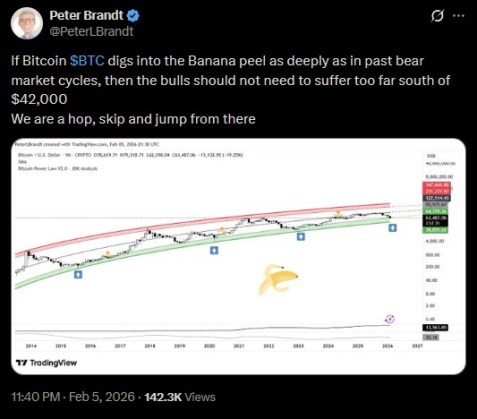
He’s outlining a brutal 50% drawdown from the highs. Brandt’s proprietary ‘factor’ trading methodology, for those not glued to the charts, relies on classical principles where multi-month patterns signal buyer exhaustion.

That prediction matters for market structure. A retreat to $42,000 would wipe out months of institutional accumulation, resetting the board to mid-2024 levels.

Brandt specifically flags ‘campaign selling’, large entities distributing holdings into rallies, as a precursor to these capitulation events.

Sure, ETF inflows have provided a floor, but technical structures don’t care about BlackRock’s balance sheet. If supports at $85,000 and $72,000 buckle, the air pocket down to the low $40k region looks ominously empty.

Smart money rarely sits in cash during a downturn. It rotates. When the ‘store of value’ asset gets shaky, capital historically flows toward utility-driven projects with uncorrelated growth narratives. This flight to quality tends to favor sectors with tangible revenue models, specifically the Web3 creator economy.

As Bitcoin faces a potential stress test, investors are scrutinizing SUBBD Token ($SUBBD). The project is merging AI utility with the $85B content creation industry, positioning itself as a hedge against macro volatility.

AI-Powered Revenue Models Offer Stability Amidst Volatility

While Bitcoin remains tethered to Fed policy and liquidity cycles, the creator economy runs on a different fuel: user engagement. The sector is valued at nearly $85B, yet it’s plagued by rent-seeking intermediaries extracting up to 70% of earnings.

SUBBD Token ($SUBBD) steps in not merely as a speculative asset, but as the transactional backbone designed to dismantle those fees.
The core idea? Using AI to reclaim profitability.

By integrating features like an AI Personal Assistant for automated interactions and AI Voice Cloning, the platform slashes the admin overhead that burns out influencers. Plus, tokenization allows for immediate, transparent payments, solving the ‘net-60’ terms that plague traditional Web2 platforms (a nightmare for creators).
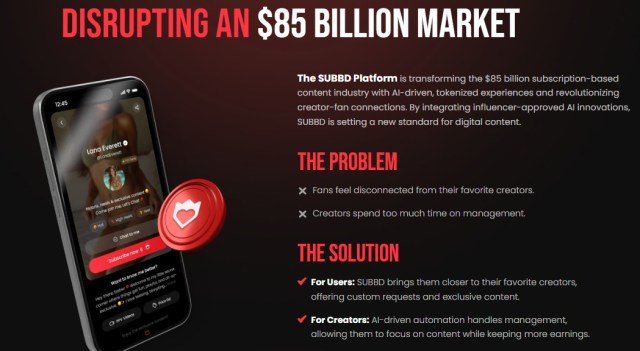
For investors, this represents a pivot from ‘number go up’ speculation to ‘revenue share’ mechanics. If the platform captures even a fraction of market share from legacy giants, demand for $SUBBD, needed for governance and settlement, could decouple from broader crypto trends.

EVM-compatible smart contracts ensure this isn’t a walled garden; it’s a composable part of the wider Ethereum ecosystem.

By allowing creators to mint token-gated content, SUBBD Token effectively turns every creator’s fanbase into a decentralized liquidity pool. That stabilizes the economy with real-world transaction volume rather than just trading speculation.

Get your $SUBBD here.

Presale Data Signals Appetite for High-Yield Utility

The market’s appetite for this utility-first approach is quantifiable. According to the official presale data, SUBBD Token ($SUBBD) has already raised $1.4M, a figure suggesting smart money is positioning itself before the public listing.

With tokens currently priced at $0.05749, early entrants are buying into a valuation based on platform growth rather than hype cycles.
Then there’s the staking architecture, a critical defense against the volatility Brandt predicts.
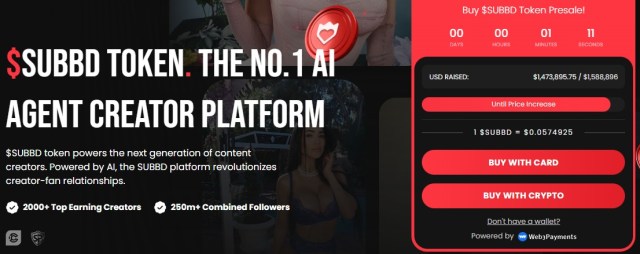
Stakers can lock tokens to earn a fixed 20% APY during the first year. This incentive structure does two things: it removes circulating supply (reducing sell pressure) and rewards believers willing to wait for the platform’s full deployment.

It aligns with a broader shift in allocation strategies. As traders brace for “campaign selling” in major caps, rotating into presales with double-digit APYs offers a defensive maneuver.

The SUBBD Token model, combining yield with access to exclusive ‘HoneyHive’ content, creates a sticky ecosystem where the token has actual velocity, not just speculative noise.

Explore the $SUBBD presale now.

Disclaimer: This article is for informational purposes only and does not constitute financial advice. Cryptocurrency investments, including presales, carry inherent risks, and market predictions by analysts like Peter Brandt are subject to change based on real-time data.

Editorial Process for bitcoinist is centered on delivering thoroughly researched, accurate, and unbiased content. We uphold strict sourcing standards, and each page undergoes diligent review by our team of top technology experts and seasoned editors. This process ensures the integrity, relevance, and value of our content for our readers.

patrubogdan

Follow

Full Profile

Related Posts

Bitcoin ETFs See $434M in Outflows as $BTC Tests $60K Support – Can Bitcoin Hyper Take Over?

Bitcoin’s Crash Triggered IBIT’s Biggest Trading Day, as $HYPER Keeps Pumping

ETH Down to $1.8K – Will It Keep Crashing and Will LiquidChain Explode in 2026?

Winklevoss‑Backed Gemini Cuts Up To 25% Of Staff, Exits UK, EU, And Australia

New Virginia Bill Allows the State to Invest in Bitcoin, Signaling Institutional Shift for Bitcoin Hyper

Tether Pours $150M in Gold.com as $LIQUID’s Presale Turns Heads

Related Questions

QWhat is Peter Brandt's prediction for Bitcoin's price and what is the reasoning behind it?

APeter Brandt predicts Bitcoin is heading to $42,000, which would represent a roughly 50% drawdown from its highs. His analysis, based on his proprietary 'factor' trading methodology and classical charting principles, points to 'campaign selling' (large entities distributing their holdings into rallies) and signals of buyer exhaustion as precursors to this potential major correction.

QAccording to the article, where might capital flow if Bitcoin experiences a significant downturn?

AThe article suggests that during a Bitcoin downturn, 'smart money' would not sit in cash but would instead rotate into utility-driven projects with uncorrelated growth narratives. This 'flight to quality' would favor sectors with tangible revenue models, specifically mentioning the Web3 creator economy as a potential beneficiary.

QWhat problem does the SUBBD Token aim to solve in the creator economy?

ASUBBD Token aims to disrupt the $85 billion creator economy, which is plagued by rent-seeking intermediaries that can extract up to 70% of creators' earnings. It seeks to dismantle these high fees by providing a transactional backbone for immediate, transparent payments and by using AI tools to reduce administrative overhead for content creators.

QWhat are some key features and financial incentives of the SUBBD Token project mentioned in the article?

AKey features include AI tools like a Personal Assistant and Voice Cloning to help creators, and token-gated content. Financial incentives include a successful presale that has raised over $1.4 million and a staking program that offers a fixed 20% APY for the first year, which helps reduce circulating supply and rewards long-term holders.

QHow does the article position SUBBD Token in relation to potential volatility in major cryptocurrencies like Bitcoin?

AThe article positions SUBBD Token as a potential hedge against macro volatility in cryptocurrencies like Bitcoin. It argues that because its value is tied to utility and revenue share in the creator economy—a sector fueled by user engagement rather than Fed policy—demand for its token could 'decouple from broader crypto trends' and offer stability during market uncertainty.

Related Reads

From Subsidies to Token-Based Pricing to Price Cuts: Is OpenAI Sparking a Price War? Is the Inflection Point for Token Economics Nearing?

The commercialization of generative AI is facing a critical inflection point as a potential price war looms. According to The Wall Street Journal, OpenAI is considering a significant cut to its token fees to compete with rival Anthropic, signaling a shift from a growth-at-all-costs model focused on token consumption. This move comes as both companies, reportedly losing billions on compute, prepare for IPOs, and as enterprise customers face "bill shock" from switching to usage-based token billing. Reports indicate poor ROI, with one analysis finding only 18 cents of every dollar spent on AI tokens generates user-facing value. The industry's initial phases—from flat-rate subscriptions to aggressive subsidies—have given way to a reckoning with real costs. Analysts debate the future: some predict a bifurcation between premium, high-cost models for complex tasks and cheaper alternatives for routine work, while others believe overall spending will still rise as agentic AI increases tokens per task. Notably, Chinese model DeepSeek's low-cost API is gaining traction with U.S. enterprises, adding competitive pressure. The core challenge is redefining value beyond token volume ("tokenmaxxing") toward measurable productivity ("valuemaxxing"), as the entire AI value chain, from cloud providers to chipmakers, feels the ripple effects of unsustainable pricing.

marsbit5m ago

From Subsidies to Token-Based Pricing to Price Cuts: Is OpenAI Sparking a Price War? Is the Inflection Point for Token Economics Nearing?

marsbit5m ago

Trading

Spot
Futures

Hot Articles

Discussions

Welcome to the HTX Community. Here, you can stay informed about the latest platform developments and gain access to professional market insights. Users' opinions on the price of S (S) are presented below.

活动图片















