Pentagon Pizza Index Soars 1250%: Who Will Be the Next Venezuela?

marsbitPublished on 2026-01-07Last updated on 2026-01-07

Abstract

The Pentagon Pizza Index, an unconventional but historically reliable indicator of US military activity, has surged by 1250% in the past 48 hours, sparking global attention. This spike, nearly double the increase observed before the recent Venezuela operation, suggests the US is planning new military action. The index, which tracks pizza delivery orders near the Pentagon, originated in 1990 when a local pizzeria owner noticed a correlation between large orders and imminent military crises, such as the Iraq invasion of Kuwait. The logic is simple: during high-pressure situations, Pentagon staff work long hours and order cheap, convenient pizza. Following the successful capture of Venezuelan President Maduro on January 3, 2026, which was preceded by a similar pizza order surge, the current unprecedented increase has led to speculation about potential next targets. The Trump administration's "Don-roe Doctrine" signals a reinforced Monroe Doctrine for the MAGA era, with Trump asserting US dominance in the Western Hemisphere. Potential targets identified include Greenland, with prediction markets showing a 38% probability of US control; Cuba, after 32 Cuban officers died in the Venezuela operation; Colombia, directly threatened by Trump; and Iran. Meme and prediction markets are already reacting, with tokens like PPW surging 78.20% and markets pricing in increased probabilities of military action against these nations.

Author|jk

On January 7, 2026, an intelligence indicator that seems absurd but has repeatedly proven effective has drawn global attention. According to social media monitoring, the volume of pizza orders near the Pentagon has surged by 1250% in the past 48 hours, a figure nearly double the 700% increase seen on the eve of the military action in Venezuela. This is the "Pentagon Pizza Index," a remarkable indicator, and its underlying implication is that the United States is brewing new military operations.

Pizza Orders and Military Intelligence?

The concept of the Pentagon Pizza Index dates back to 1990, when Frank Meeks, the owner of a Domino's Pizza franchise in the Washington area, noticed a peculiar phenomenon: on the evening of August 1, 1990, the Central Intelligence Agency ordered a record 21 pizzas, and the next day, Iraq invaded Kuwait.

Moreover, this pattern has recurred repeatedly:

  • Before the Panama action in December 1989, order volume surged from 30-35 to over 100;
  • During President Clinton's impeachment hearings and the Iraqi "Desert Fox" operation in December 1998, extra cheese pizza orders from the White House increased by 32%.

The logic behind this is very simple: during high-pressure crisis moments, Department of Defense (now the Department of War, renamed by Trump) staff often need to work 16-20 hours consecutively, and pizza is cheap, filling, and convenient for delivery, making it the preferred choice for overtime meals.

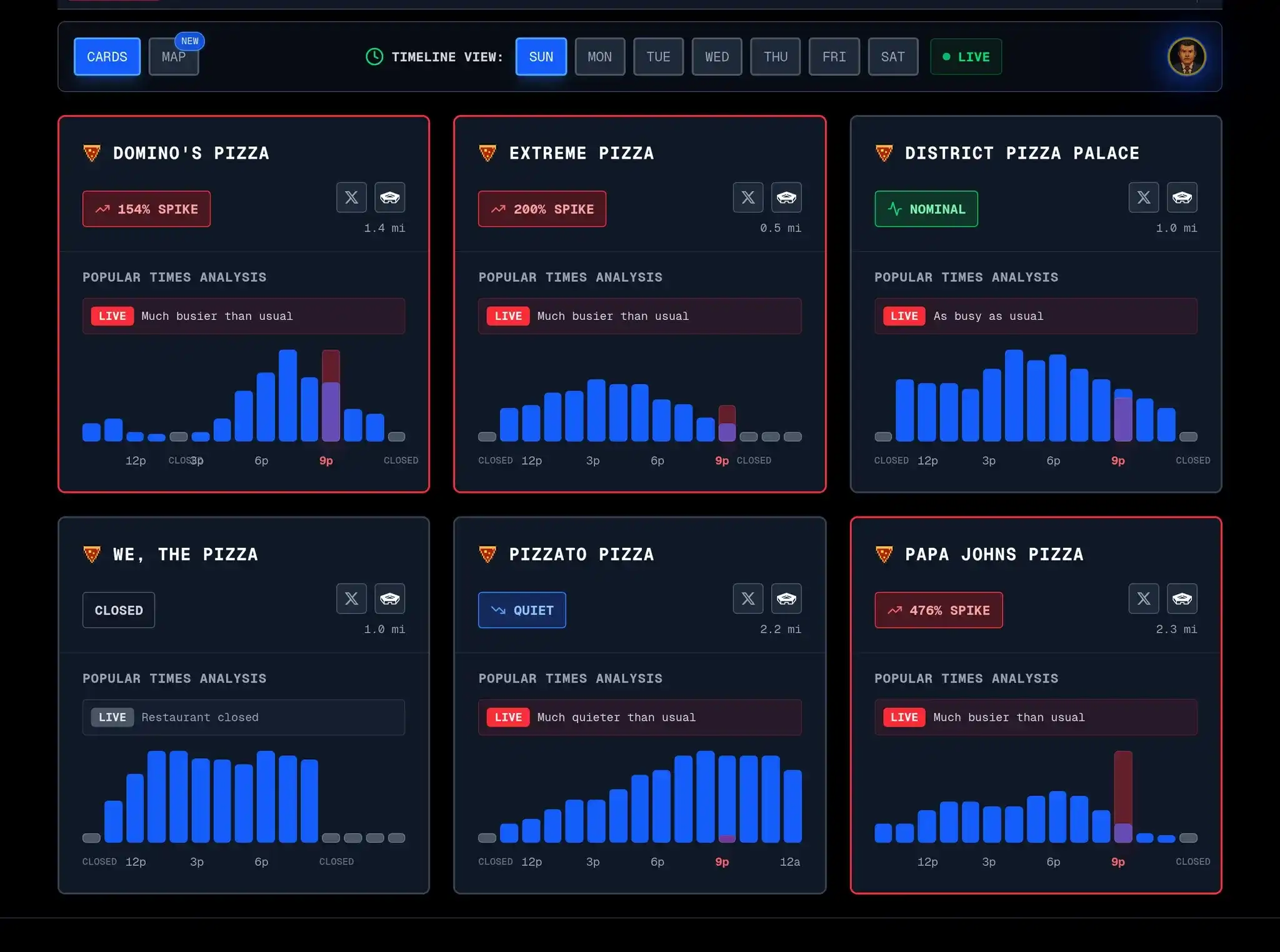
Today, there are dedicated websites online that monitor six pizza shops near the Pentagon in real-time, including Papa John's and Domino's. Currently, this website is showing crazy multiples, ranging from 150% to 1250%.
What About Before the Venezuela Action?

In the early hours of January 3, 2026, U.S. forces launched a raid in Caracas, the capital of Venezuela, successfully capturing President Maduro and his wife. Hours before the operation, the Papa John's pizza shop near the Pentagon was unusually busy.

This was not a sudden military action either; the U.S. had been building up a massive military presence in the Caribbean since August 2025: August: The USS Iwo Jima amphibious assault ship group arrived; November: The USS Ford aircraft carrier strike group arrived; A total of approximately 15,000 U.S. military personnel, marking the largest military deployment in the region in generations. Thus, Pentagon staff worked overtime, causing all nearby pizza shops to work overtime as well.

A 1250% Surge: Who Is the Next Target?

The latest data from Sunday evening shows that activity at the Papa John's pizza shop 2.3 miles from the Pentagon surged by 476%, while the closer Extreme Pizza saw a 200% increase. The peak increase of 1250% compared to the low set a new historical record.

The Trump administration has stated that this is part of its "Don-roe Doctrine." This is a metaphor for a modernized version of the 19th-century Monroe Doctrine, an advanced version of MAGA. Trump declared on Saturday: "American dominance in the Western Hemisphere will never be questioned again."

Based on the latest statements from Trump and his senior officials, the following countries and regions may become the next targets:

  • Greenland: Trump emphasized the U.S. needs Greenland to ensure national security. Prediction markets show the probability of the U.S. "controlling any part of Greenland" has risen from less than 20% last week to 38%. The Danish government is currently in "full crisis mode."
  • Cuba: Secretary of State Rubio warned that the Cuban government "is in big trouble." He noted that Maduro's bodyguards were Cuban, and 32 Cuban officers were killed in the Venezuela operation. Trump stated: "Cuba looks like it's about to collapse."
  • Colombia: Trump directly threatened: "Colombia is also very sick, run by a sick man who likes to make cocaine and sell it to the United States, and he won't be doing that much longer." When asked if military action was being considered, Trump replied: "Sounds good."
  • Iran: After Trump threatened to "hit Iran hard," prediction markets indicate a 54% probability that Iran's Supreme Leader Khamenei will be ousted before next year.

How Are These Countries Responding?

Colombian President Petro has adopted a tough stance. He was said to have stated in November 2025: "Brother, if you want to put me in jail, see if you can." Recently, he announced that any commander who prefers the American flag over the Colombian flag would be immediately dismissed from the army.

The Cuban government has already held two days of national mourning for the 32 officers killed in the Venezuela operation, clearly remaining highly alert to Rubio's warnings.

Meme and Prediction Markets: Already One Step Ahead

When it comes to such events, meme markets and prediction markets are always the quickest to move.

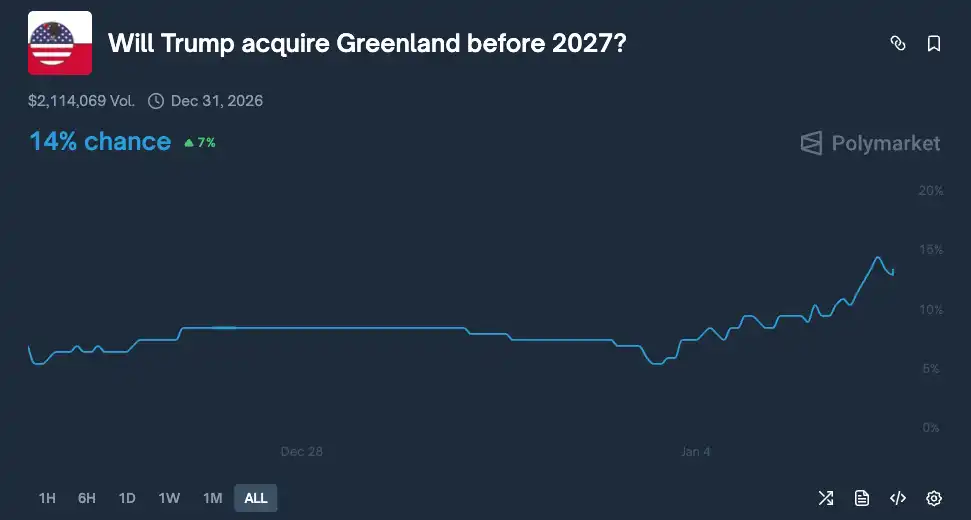
On Polymarket, the market for "Trump 'acquiring' Greenland by 2027" is highly sensitive. The probability in this market rose from about 7% on December 28 to the current 14%, a gain of 7 percentage points, with trading volume exceeding $2.1 million. This increase coincided with the timing of the Venezuela operation.

The "U.S. will strike Cuba by xx date" market shows a tiered probability distribution: only 2% before January 31, 8% before March 31, but jumps to 20% by the end of the year. The loss of 32 Cuban officers in the Venezuela operation could be a trigger for U.S. action.

The "U.S. will strike Colombia by xx date" market exhibits a more aggressive probability curve: 3% by the end of January, 7% by the end of March, 15% by the end of the year.
Simultaneously, related memes have already emerged, such as Pentagon Pizza Watch (PPW); this is a logo featuring a glowing pizza hovering above a green pentagon, adorned with missile elements.
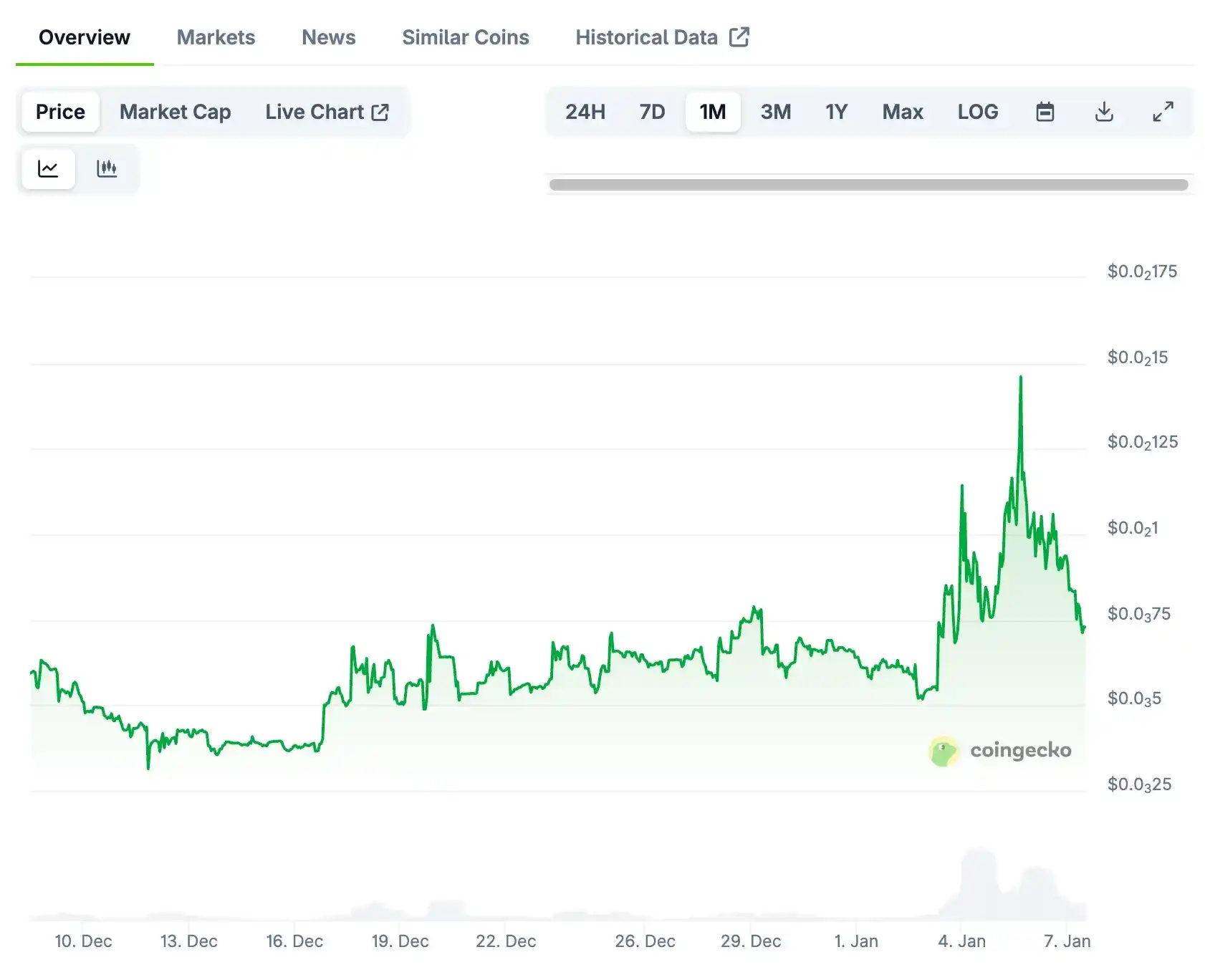
Judging by market performance, PPW saw a 78.20% gain in one week, with a 24-hour trading volume of $114,369, ranking 3689th in market capitalization.

Here, we strongly recommend reading this Odaily article: "When War is Settled Before the News: How Prediction Markets 'Priced' the Maduro Capture Operation 6 Days Early."

Related Questions

QWhat is the Pentagon Pizza Index and what does it indicate?

AThe Pentagon Pizza Index is an informal intelligence indicator that tracks the surge in pizza orders near the Pentagon. A significant increase suggests that U.S. military personnel are working extended hours, often indicating imminent military action or a high-stakes crisis.

QWhich countries are mentioned as potential targets for U.S. military action based on the article?

AThe article mentions Greenland, Cuba, Colombia, and Iran as potential targets for U.S. military action, based on statements from Trump and senior officials.

QWhat historical events are cited where the Pentagon Pizza Index proved accurate?

AHistorical events include the 1990 Iraq invasion of Kuwait, the 1989 Panama action, and the 1998 'Desert Fox' operation in Iraq, all preceded by notable spikes in pizza orders near the Pentagon.

QHow did prediction markets react to the increased Pentagon Pizza Index and recent events?

APrediction markets showed increased probabilities for U.S. actions, such as a rise from 7% to 14% for Trump 'acquiring' Greenland by 2027, and significant trading volumes reflecting heightened expectations of military strikes.

QWhat was the significance of the 1250% increase in the Pentagon Pizza Index mentioned in the article?

AThe 1250% increase was a record-high spike, nearly double the surge observed before the Venezuela operation, suggesting the U.S. might be planning a major military action, potentially targeting countries like Greenland, Cuba, Colombia, or Iran.

Related Reads

Ethereum's 11th Year: Why Is This Year Particularly Crucial?

Ethereum's 11th year proved pivotal, marked by a dual evolution in its technical roadmap and organizational structure. The year saw the completion of the Fusaka upgrade, introducing PeerDAS to make data availability sampling more efficient and laying groundwork for future L2 scaling. This was followed by a significant reorganization of the Ethereum Foundation (EF). The EF downsized, redefining its core mandate around user sovereignty and CROPS principles, while spinning off key functions. Independent entities like Ethlabs (non-profit R&D), Ethereum Institutional (institutional onboarding), and EthSystems (institutional privacy solutions) now operate separately. Technologically, the community debated a bold, long-term vision outlined in Justin Drake's "Lean Ethereum" proposal and the collaborative "Strawmap." These point toward a "third major iteration" for Ethereum, targeting goals like faster finality (~1 second), gigagas-scale L1 throughput, teragas-scale L2 capacity, post-quantum cryptography, and protocol-level privacy. Data underscores Ethereum's dominant position: its L1 still holds roughly half of all stablecoin value, leads in tokenized Real-World Assets (RWA), and commands over 55% of total DeFi TVL. While L2s now handle over 10x more transactions than the mainnet, high-value assets remain concentrated on L1. The launch of Robinhood Chain, an EVM-compatible L2 for stock tokens, signals growing institutional adoption. The immediate roadmap includes the Glamsterdam upgrade (featuring ePBS for in-protocol proposer-builder separation and Block Access Lists for parallelism), potentially followed by Hegotá focusing on anti-censorship via FOCIL. In summary, Ethereum's 11th year was defined by setting ambitious technical foundations for its next decade and restructuring its core development ecosystem to be more modular and sustainable, all while maintaining its role as the leading settlement layer for decentralized finance and assets.

marsbit6m ago

Ethereum's 11th Year: Why Is This Year Particularly Crucial?

marsbit6m ago

Notable Forecast from an Analytical Company Regarding Bitcoin (BTC): After This Date, a New Bull Season Could Begin!

Bitcoin continues to trade sideways around $64,000 amid ongoing uncertainty regarding U.S. monetary policy and geopolitical risks in the Middle East. As BTC struggles for direction, an analyst predicts the next major uptrend could commence after the U.S. midterm elections. João Wedson, founder and CEO of crypto analytics firm Alphractal, revisited the connection between Bitcoin's price movements and the U.S. election calendar in his latest analysis. Wedson claims that analyzing past market cycles reveals similar patterns in Bitcoin's price behavior, particularly around U.S. midterm and presidential elections. Historically, Bitcoin has faced headwinds leading up to midterms but tends to recover once election-related uncertainty subsides. Based on historical data, Bitcoin entered bear markets roughly a year before past midterm elections, only to initiate prolonged bull markets after the elections concluded. In some cycles, price bottoms formed just days before the vote, while in others, the low occurred immediately after. The analyst also noted presidential elections have a distinct impact: Bitcoin experiences strong rallies each time a president wins re-election and approaches the peak of its main cycle shortly after the presidential inauguration. As an example, Wedson pointed to XRP, which began a sharp rise on the day Donald Trump won the 2024 election and reached a local peak on January 20, 2025, his inauguration day.

cryptonews.ru21m ago

Notable Forecast from an Analytical Company Regarding Bitcoin (BTC): After This Date, a New Bull Season Could Begin!

cryptonews.ru21m ago

Lummis: The CLARITY Act mechanism "is not working" as the Senate drags its feet

U.S. Senator Cynthia Lummis has argued that the current regulatory framework for digital assets is inadequate, harming industry, investors, and regulators alike. She is urgently pushing for the Senate to pass the Digital Asset Market Clarity Act (H.R. 3633/CLARITY Act) before the August recess, warning the current momentum for the bill is a unique opportunity this decade. The legislation aims to divide oversight between the SEC and CFTC. Time is running out, as the Senate must act before its August 8th recess. Delays would push the debate to September, further squeezing the legislative calendar before the midterm elections. Forecasting platforms now estimate only a 30% chance of the bill becoming law in 2026, a sharp drop from over 80% in February. Passage requires 60 votes, meaning at least seven Democrats must join Republicans, a task complicated by Democratic opposition. Key objections from figures like Senator Elizabeth Warren center on concerns the bill could weaken oversight of decentralized finance (DeFi) and consumer protection, potentially endangering the financial system. Over 200 crypto industry organizations, including Coinbase and Ripple, are lobbying for a vote, arguing continued uncertainty drives innovation and jobs overseas. Lummis contends the bill's custody and disclosure rules are precisely the consumer protections needed to close existing loopholes. The bill's fate now hinges on whether Senate Majority Leader John Thune schedules a vote this week or delays it until the fall session, where it would face an even more constrained political environment.

cryptonews.ru22m ago

Lummis: The CLARITY Act mechanism "is not working" as the Senate drags its feet

cryptonews.ru22m ago

Trading

Spot
活动图片