Paraguay Plans First State-Run Bitcoin Mining Project

bitcoinistPublished on 2026-03-04Last updated on 2026-03-04

Abstract

Paraguay's state power utility ANDE has signed a memorandum of understanding with crypto infrastructure firm Morphware to explore a state-run Bitcoin mining operation. This marks a shift from hosting private miners to a utility-controlled model. The partnership will analyze using seized mining equipment—reportedly around 30,000 units—to monetize underutilized electricity. An initial pilot may deploy 1,500 confiscated ASICs near existing substations. ANDE would own and operate the miners, while Morphware provides technical support. The initiative aims to turn idle energy into revenue while aligning with national energy and digital infrastructure strategies.

Paraguay’s state power utility ANDE has signed a memorandum of understanding with crypto infrastructure firm Morphware, setting up a formal cooperation framework that explicitly includes exploring Bitcoin mining as a national-level opportunity tied to the country’s energy and digital infrastructure strategy. The move matters because it signals a shift from Paraguay merely hosting private miners to the state evaluating a more direct, utility-controlled model.

Morphware framed the MoU as a starting point for “analysis and development of initiatives related to digital assets, advanced processing infrastructure, and strategic energy driven technology opportunities in Paraguay,” with Bitcoin mining positioned as one candidate use case inside that broader mandate.

The company said the agreement creates an “official path” for technical evaluation and project development “under Paraguay’s legal and regulatory framework,” language that reads less like a one-off pilot announcement and more like a governmental process being put on rails.

In Morphware CEO Kenso Trabing’s telling, the economic logic is straightforward: put stranded or underutilized electricity to work, and keep the deployment inside regulated sites controlled by the utility.

“ANDE has unlocked a powerful new asset, and Morphware is here to turn that asset into a new revenue engine for Paraguay. By redeploying Bitcoin miners on regulated, utility controlled sites, we can transform unused electricity into productive compute that serves both the Bitcoin network and the global AI economy,” Trabing wrote. “This is what the future of midstream electricity looks like: grids that do not just deliver power, but own a stake in the digital infrastructure they enable.”

The reference to “midstream electricity” and “productive compute” is doing double duty. It links Bitcoin mining to a more general pitch: high-density power-to-compute infrastructure that can, in theory, flex between mining and adjacent workloads, particularly as the “AI data center” narrative continues to bleed into the public-market mining story globally.

Seized Bitcoin Miners Enter The Conversation

While Morphware’s statement did not publish deployment numbers, the MoU language about “redeploying” miners arrives amid an enforcement backdrop: Paraguay has been seizing ASIC hardware tied to alleged illegal operations. Trabing told Bitcoin Magazine that ANDE is exploring turning seized equipment into Paraguay’s first government-run Bitcoin operation in partnership with Morphware.

According to Trabing, the Paraguayan government is currently holding around 30,000 seized Bitcoin miners, many of them taken from facilities accused of electricity theft or tariff fraud.

“They’re literally stacked to the ceiling,” Trabing told Bitcoin Magazine, describing government warehouses filled with idle ASIC machines. “They have no experience mining Bitcoin. Our role is an advisory role.”

Morphware’s proposal, now formalized in the memorandum with ANDE, is to redeploy those machines at utility-controlled sites rather than leaving them idle. The initial phase would reportedly involve around 1,500 confiscated miners, installed near existing electrical substations where infrastructure already exists to handle large energy loads.

Under the structure being discussed, ANDE would retain ownership of the machines and operate the sites directly, while Morphware would provide technical guidance and training for utility staff. The company’s role, according to Trabing, is primarily operational support rather than revenue participation. “This is about regulated, utility-controlled sites,” he said. “Not people hiding in the countryside.”

At press time, BTC traded at $68,644.
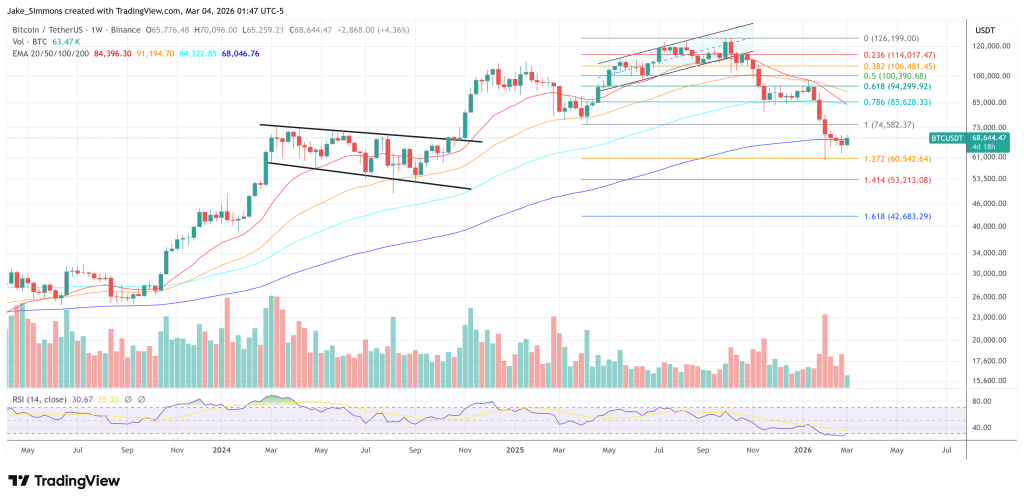
BTC must close above the 200-week EMA, 1-week chart | Source: BTCUSDT on TradingView.com

Trending Cryptos

Related Questions

QWhat is the main purpose of the memorandum of understanding between Paraguay's ANDE and Morphware?

AThe MoU establishes a formal cooperation framework to explore Bitcoin mining as a national-level opportunity tied to Paraguay's energy and digital infrastructure strategy, moving from hosting private miners to evaluating a state-controlled model.

QHow does Morphware's CEO justify the economic logic of this state-run Bitcoin mining project?

AKenso Trabing states the logic is to utilize stranded or underutilized electricity by redeploying Bitcoin miners on regulated, utility-controlled sites, transforming unused power into productive compute that generates revenue and serves both the Bitcoin network and the global AI economy.

QWhat specific source of mining hardware is being considered for the initial phase of this project?

AThe initial phase plans to use approximately 1,500 confiscated Bitcoin miners that were seized by the Paraguayan government from facilities accused of electricity theft or tariff fraud.

QWhat role will Morphware play in this partnership with ANDE?

AMorphware will serve in an advisory and operational support role, providing technical guidance and training for utility staff, rather than participating directly in revenue sharing.

QHow does the project connect Bitcoin mining to broader technological trends according to the article?

AThe project frames Bitcoin mining as part of a 'midstream electricity' concept and high-density power-to-compute infrastructure that can flex between mining and adjacent workloads, linking it to the growing global narrative of AI data centers.

Related Reads

Double Long Hynix ETF Plummets, Halved and Halved Again

On July 29th, shares of South Korean semiconductor firm SK Hynix plummeted over 19% intraday, marking its largest single-day drop on record. The Hong Kong-listed "CSOP SK Hynix Daily Leveraged (2x) Product" (Stock Code: 07709) tumbled more than 28% intraday before closing 13.99% lower at HK$32.70. This leveraged product, designed to deliver twice the daily return of SK Hynix, has seen a catastrophic decline of over 80% from its June 25th high of HK$193.65, far exceeding the underlying stock's roughly 50% drop from its peak. Its assets under management have shrunk dramatically, falling over 70% from a high of HKD 130 billion in June to approximately HKD 31.9 billion. This steep sell-off occurred despite SK Hynix reporting stellar Q2 2026 earnings, with revenue and operating profit surging 257% and 557% year-over-year, respectively. However, the results fell short of market expectations. Analysts cited concerns about potential oversupply from expansion and noted that long-term supply agreements for its high-bandwidth memory (HBM) chips might limit near-term price increases. In response to heightened volatility and regulatory changes, the product's issuer, CSOP Asset Management, announced a transition to a "flexible leverage mechanism" starting August 3rd. Under new Hong Kong SFC rules, the fund's daily leverage multiplier can now be dynamically adjusted between 1.1x and 2x (or -1.1x to -2x for inverse products) based on market conditions, moving away from a fixed 2x target. The fund's name will also be changed to clarify its nature as a daily trading tool unsuitable for long-term holding. Experts warn that this change means investors can no longer assume constant 2x returns and must check the disclosed leverage ratio daily.

marsbit12m ago

Double Long Hynix ETF Plummets, Halved and Halved Again

marsbit12m ago

A7 Discusses Accumulated Experience in Using Stablecoins

The Russian State Duma and Federation Council have passed the "Law on Digital Currencies and Digital Rights," which is set to expand the use of stablecoins in cross-border trade settlements starting September 1, 2026. According to the Bank of Russia, exporters and importers will be able to use cryptocurrency in international payments, both directly and through intermediaries, while domestic crypto payments will remain largely prohibited. Company A7, which facilitates operations with the A7A5 stablecoin—Russia's first ruble-pegged stablecoin classified as a Digital Financial Asset (DFA)—commented on the development. Oleg Ogienko, Director of Government Relations and International Affairs for the A7A5 project, stated that while digital asset settlements are still a new practice for many firms, A7 has already accumulated significant expertise in legal documentation, compliance, currency control, and working with infrastructure participants. He added that A7 will continue to apply this expertise for client operations after the law takes effect and will adapt its business processes as the Central Bank issues further regulations. A7 is a Russian international settlement system established in 2024 with participation from PSB Bank. It facilitates cross-border payments and supports foreign trade operations for Russian businesses. Its key instrument, the A7A5 stablecoin, operates on the Tron and Ethereum networks with a market capitalization exceeding $567 million and is circulated in Russia as a DFA via the "Token" platform.

cryptonews.ru26m ago

A7 Discusses Accumulated Experience in Using Stablecoins

cryptonews.ru26m ago

Trading

Spot

Hot Articles

What is $BITCOIN

DIGITAL GOLD ($BITCOIN): A Comprehensive Analysis Introduction to DIGITAL GOLD ($BITCOIN) DIGITAL GOLD ($BITCOIN) is a blockchain-based project operating on the Solana network, which aims to combine the characteristics of traditional precious metals with the innovation of decentralized technologies. While it shares a name with Bitcoin, often referred to as “digital gold” due to its perception as a store of value, DIGITAL GOLD is a separate token designed to create a unique ecosystem within the Web3 landscape. Its goal is to position itself as a viable alternative digital asset, although specifics regarding its applications and functionalities are still developing. What is DIGITAL GOLD ($BITCOIN)? DIGITAL GOLD ($BITCOIN) is a cryptocurrency token explicitly designed for use on the Solana blockchain. In contrast to Bitcoin, which provides a widely recognized value storage role, this token appears to focus on broader applications and characteristics. Notable aspects include: Blockchain Infrastructure: The token is built on the Solana blockchain, known for its capacity to handle high-speed and low-cost transactions. Supply Dynamics: DIGITAL GOLD has a maximum supply capped at 100 quadrillion tokens (100P $BITCOIN), although details regarding its circulating supply are currently undisclosed. Utility: While precise functionalities are not explicitly outlined, there are indications that the token could be utilized for various applications, potentially involving decentralized applications (dApps) or asset tokenization strategies. Who is the Creator of DIGITAL GOLD ($BITCOIN)? At present, the identity of the creators and development team behind DIGITAL GOLD ($BITCOIN) remains unknown. This situation is typical among many innovative projects within the blockchain space, particularly those aligning with decentralized finance and meme coin phenomena. While such anonymity may foster a community-driven culture, it intensifies concerns about governance and accountability. Who are the Investors of DIGITAL GOLD ($BITCOIN)? The available information indicates that DIGITAL GOLD ($BITCOIN) does not have any known institutional backers or prominent venture capital investments. The project seems to operate on a peer-to-peer model focused on community support and adoption rather than traditional funding routes. Its activity and liquidity are primarily situated on decentralized exchanges (DEXs), such as PumpSwap, rather than established centralized trading platforms, further highlighting its grassroots approach. How DIGITAL GOLD ($BITCOIN) Works The operational mechanics of DIGITAL GOLD ($BITCOIN) can be elaborated on based on its blockchain design and network attributes: Consensus Mechanism: By leveraging Solana’s unique proof-of-history (PoH) combined with a proof-of-stake (PoS) model, the project ensures efficient transaction validation contributing to the network's high performance. Tokenomics: While specific deflationary mechanisms have not been extensively detailed, the vast maximum token supply implies that it may cater to microtransactions or niche use cases that are still to be defined. Interoperability: There exists the potential for integration with Solana’s broader ecosystem, including various decentralized finance (DeFi) platforms. However, the details regarding specific integrations remain unspecified. Timeline of Key Events Here is a timeline that highlights significant milestones concerning DIGITAL GOLD ($BITCOIN): 2023: The initial deployment of the token occurs on the Solana blockchain, marked by its contract address. 2024: DIGITAL GOLD gains visibility as it becomes available for trading on decentralized exchanges like PumpSwap, allowing users to trade it against SOL. 2025: The project witnesses sporadic trading activity and potential interest in community-led engagements, although no noteworthy partnerships or technical advancements have been documented as of yet. Critical Analysis Strengths Scalability: The underlying Solana infrastructure supports high transaction volumes, which could enhance the utility of $BITCOIN in various transaction scenarios. Accessibility: The potential low trading price per token could attract retail investors, facilitating wider participation due to fractional ownership opportunities. Risks Lack of Transparency: The absence of publicly known backers, developers, or an audit process may yield skepticism regarding the project's sustainability and trustworthiness. Market Volatility: The trading activity is heavily reliant on speculative behavior, which can result in significant price volatility and uncertainty for investors. Conclusion DIGITAL GOLD ($BITCOIN) emerges as an intriguing yet ambiguous project within the rapidly evolving Solana ecosystem. While it attempts to leverage the “digital gold” narrative, its departure from Bitcoin's established role as a store of value underscores the need for a clearer differentiation of its intended utility and governance structure. Future acceptance and adoption will likely depend on addressing the current opacity and defining its operational and economic strategies more explicitly. Note: This report encompasses synthesised information available as of October 2023, and developments may have transpired beyond the research period.

1.1k Total ViewsPublished 2025.05.13Updated 2025.05.13

What is $BITCOIN

Discussions

Welcome to the HTX Community. Here, you can stay informed about the latest platform developments and gain access to professional market insights. Users' opinions on the price of BTC (BTC) are presented below.

活动图片