Erebor, the digital bank co-founded by tech entrepreneur Palmer Luckey and backed by billionaire Peter Thiel, has secured a $4.35 billion post-money valuation after raising $350 million in a funding round led by Lux Capital, according to Axios sources.
The valuation milestone, which underscores growing institutional appetite for banking models tailored to crypto, AI and stablecoin-friendly customers, comes as Justice Department regulators take swift steps toward chartering the company.
Erebor recently received preliminary conditional approval from the US Office of the Comptroller of the Currency (OCC), a key regulatory hurdle toward becoming a fully licensed bank.
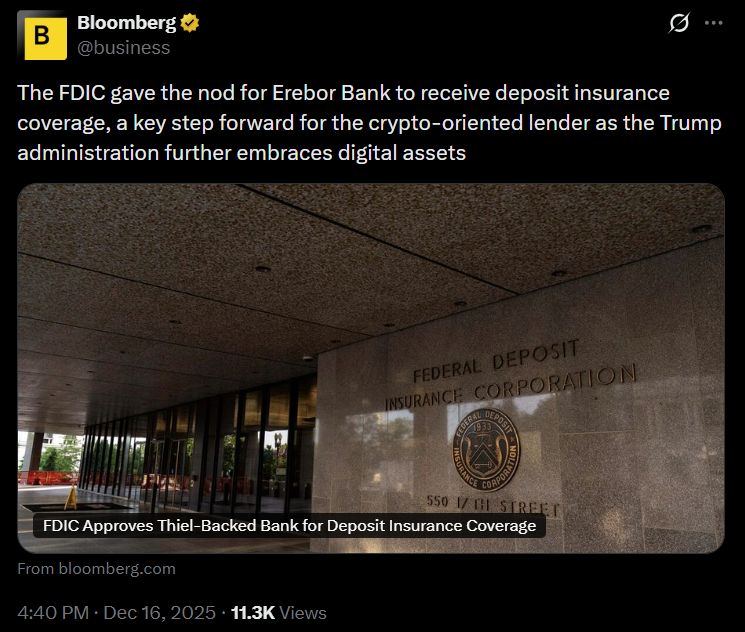
Last week, Erebor’s deposit insurance application was approved by the Federal Deposit Insurance Corporation, which is valid for 12 months and will expire if the bank is not formally established or the FDIC doesn’t grant an extension.
As Axios reported, investors in the latest funding round include new participants alongside earlier backers such as Founders Fund, Haun Ventures and 8VC. The company’s valuation reflects heightened enthusiasm for financial institutions that blend traditional banking services with digital asset infrastructure.
Luckey first rose to prominence as the founder of Oculus VR, the virtual reality headset company acquired by Facebook, and later as a co-founder of Anduril Industries, a defense contractor.
Erebor emerged from stealth in mid-2025 as a response to banking sector gaps, particularly for startups and crypto ventures, that widened after the 2023 collapse of Silicon Valley Bank (SVB).
SVB, once the primary banking partner for many venture-backed technology companies, failed in March 2023 after rapid interest-rate hikes eroded the value of its long-term securities and sparked a depositor run, leading to one of the largest bank failures since the 2008 financial crisis.
Related: Crypto Biz: Peter Thiel eyes the SVB throne
Digital asset banking services emerge in the wake of regulatory clarity
Erebor is among a growing cohort of digital asset-focused companies pushing into the banking sector, alongside crypto exchange Coinbase, stablecoin issuer Circle and payment company Ripple Labs, which have sought national trust charters or similar approvals from the OCC.
Such applications are typically aimed at expanding digital-asset custody and settlement services and, in Coinbase’s case, bridging traditional financial infrastructure with onchain finance by operating under a federal banking framework.
The applications come amid a renewed push for regulatory clarity in the United States following the election of US President Donald Trump. The shift has included the approval of key stablecoin legislation and the emergence of a long-awaited crypto market structure bill, which, despite delays, has fueled optimism across the digital asset industry.
Meanwhile, David Sacks, Trump’s crypto and AI czar, wrote Monday that the Securities and Exchange Commission and the Commodity Futures Trading Commission are expected to issue “clear regulatory guidelines for cryptocurrencies.”
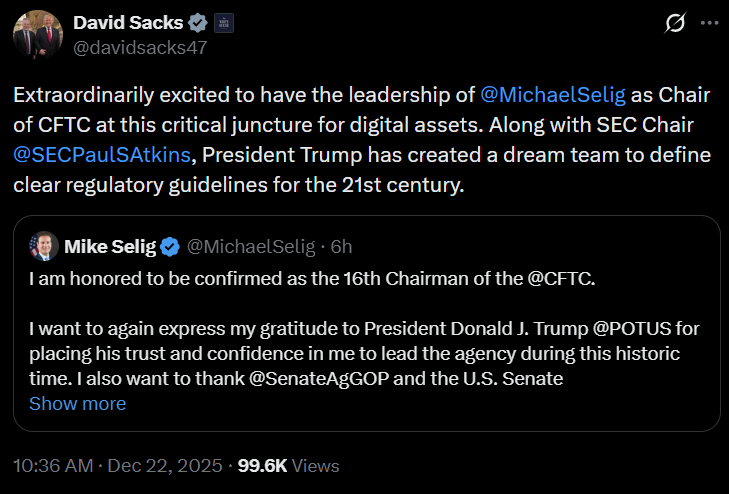
His comments followed developments at the CFTC, including leadership changes involving Mike Selig, underscoring expectations of a more defined regulatory framework for digital assets.
Related: Crypto CLARITY Act set for Senate markup in January, Sacks says