Only Work 2 Hours a Day? This Google Engineer Uses Claude to Automate 80% of His Work

marsbitPublished on 2026-04-15Last updated on 2026-04-15

Abstract

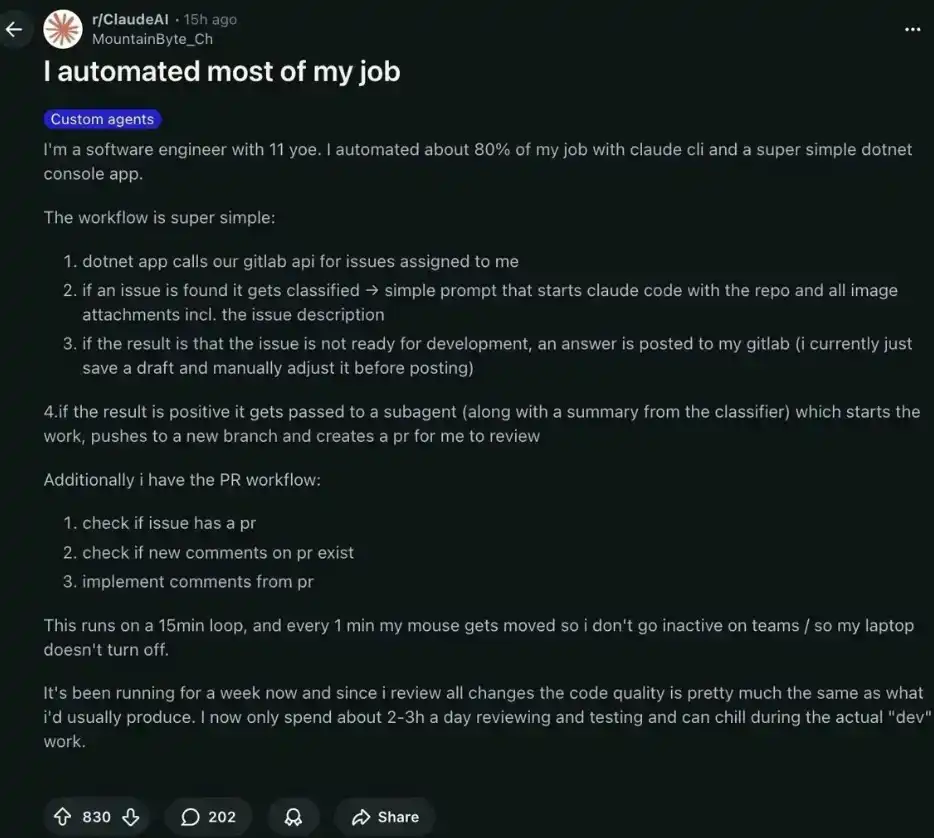
A Google engineer with 11 years of experience automated 80% of his work using Claude Code and a simple .NET application, reducing his daily work from 8 hours to just 2–3 hours while generating $28,000 in monthly passive income. The key to this transformation lies in three core elements: First, using a structured CLAUDE.md file based on Andrej Karpathy’s principles—Think Before Coding, Simplicity First, Surgical Changes, and Goal-Driven Execution—reduces Claude’s rule violations from 40% to just 3%. Second, the "Everything Claude Code" system acts as a full AI engineering team, with 27 pre-built agents for planning, reviewing, and executing tasks across multiple AI platforms. Third, a hidden token consumption issue in Claude Code v2.1.100 was identified, where 20,000 extra tokens were silently added, diluting instructions and reducing output quality. A quick fix using npx downgrades the version to avoid this. The automated system enables code generation, testing, and review to run autonomously in 15-minute cycles. The engineer now only reviews output, saving 5–6 hours daily. The setup takes less than 20 minutes, and the return on time investment is significant—potentially saving $10,000–$12,000 monthly for those valuing their time at $100/hour. The article emphasizes that managing AI systems, not just using them, is the new critical skill, enabling a shift from doing work to overseeing automated processes.

Editor's Note: As "AI writing code" gradually becomes an industry consensus, what truly changes productivity is not the model itself, but how you set rules for the model, organize workflows, and embed it into a sustainable operating system.

Starting from a simple CLAUDE.md file, to multi-agent collaboration, and then to an automated development loop, this method transforms the development process from a "dialogue between humans and AI" into "managing an AI engineering team." In this process, errors are constrained upfront, workflows are structured, and code generation, testing, and review are gradually taken over by the system instead of being manually executed.

More notably, the article also reveals a neglected detail: in long contexts and complex systems, model behavior is not entirely controllable. Whether it's hidden token consumption or diluted instructions, they can invisibly affect output quality. This makes "how to manage AI," rather than just "how to use AI," the new core competency.

At this point, developers no longer focus on coding but instead work around rule design, workflow scheduling, and result validation. Those who have completed this step first have already started shifting from "doing things personally" to "letting the system do things for them."

Below is the original text:

A Google engineer with 11 years of experience automated 80% of his work using Claude Code and a simple .NET application.

Now, he only works 2-3 hours a day instead of the original 8 hours. The rest of the time, he is basically in a "relaxed" state, with the system running on its own, generating $28,000 in passive income for him each month.

What he has mastered is precisely that set of methods you haven't yet learned.

Part 1—Writing CLAUDE.md According to Karpathy's Principles

Andrej Karpathy—one of the world's most influential AI researchers—once systematically summarized the most common mistakes large language models make when writing code: over-engineering, ignoring existing patterns, and introducing unnecessary additional dependencies that no one asked for.

Someone compiled these observations into a unified CLAUDE.md file.

The result: this project gained 15,000 stars on GitHub in a week. In a sense, it can be said that 15,000 people changed their way of working because of it.

The core idea is actually very simple: if errors are predictable, they can be prevented in advance with clear instructions. Just by placing a markdown file in the code repository, you can provide Claude Code with a complete set of structured behavioral rules, thereby unifying decision-making and execution across the entire project.

Inside this file, there are mainly four core principles:

· Think Before Coding → Avoid wrong assumptions and overlooked trade-offs
· Simplicity First → Avoid over-engineering and bloated abstractions
· Surgical Changes → Avoid modifying code that no one asked to change
· Goal-Driven Execution → Test first, then validate against clear success criteria

It doesn't rely on any framework, nor does it require complex tools—just one file can change Claude's behavior at the project level.

The real difference is:

· Without CLAUDE.md: Claude violates specifications about 40% of the time
· Using Karpathy's CLAUDE.md: Violation rate drops to about 3%
· Setup time: Only 5 minutes

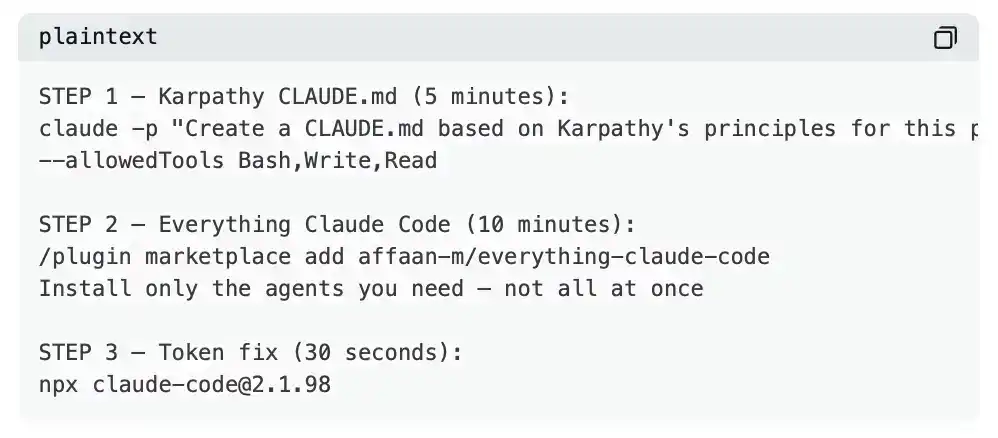
Command to automatically generate your own CLAUDE.md file:

claude -p "Read the entire project and create a CLAUDE.md based on:
Think Before Coding, Simplicity First, Surgical Changes, Goal-Driven Execution.
Adapt to the real architecture you see." --allowedTools Bash,Write,Read

It replaces this kind of Claude: over-engineering simple tasks, introducing unrequested dependencies, and even arbitrarily modifying files that shouldn't be touched.

Part2 Everything Claude Code: A Complete Engineering Team in a Repository

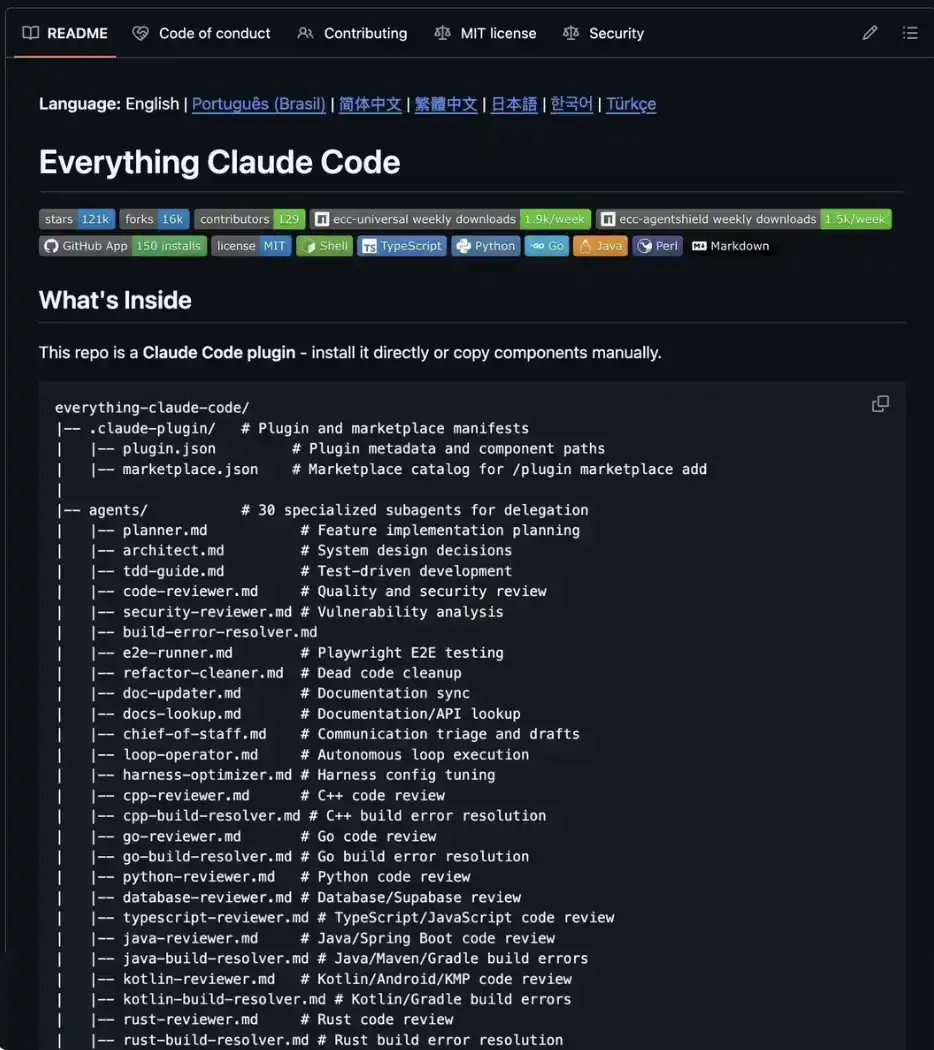
Everything Claude Code (Over 153,000 stars on GitHub)

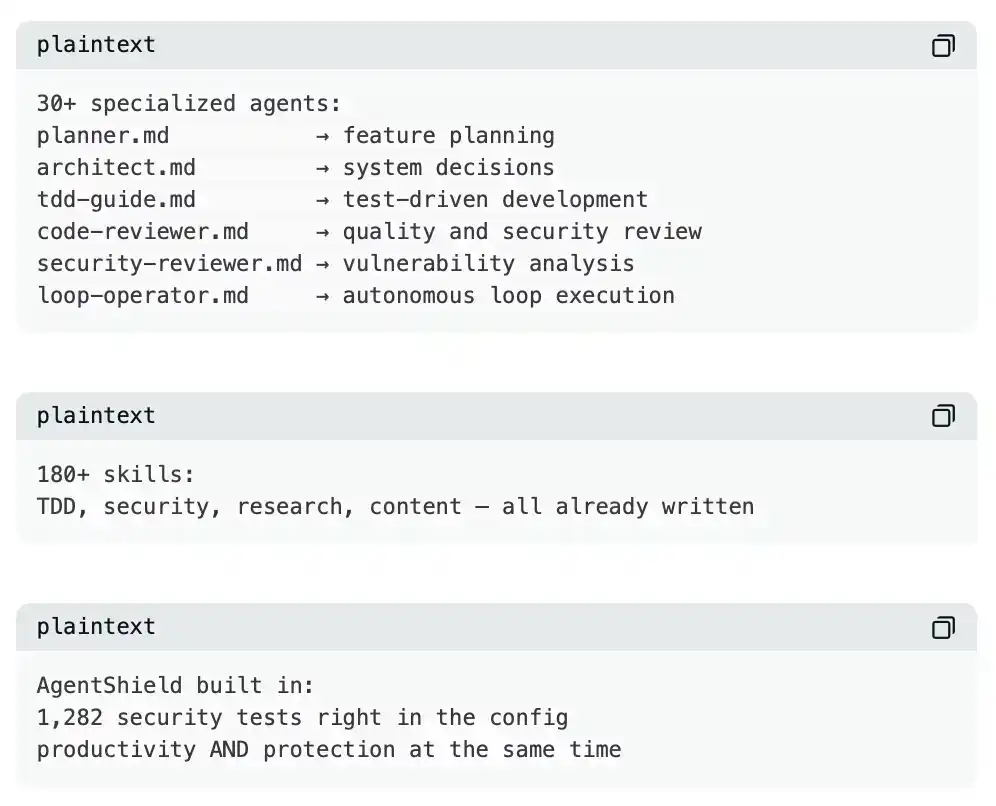
This is not just a collection of prompts; it's more like a complete AI operating system for building products.

Supports running on Claude, Codex, Cursor, OpenCode, Gemini, and more—one system, usable everywhere.

Installation:

/plugin marketplace add affaan-m/everything-claude-code

Or install manually—just copy the components you need into the project's .claude/ directory. Don't load everything at once—loading 27 agents and 64 skills simultaneously will likely exhaust your context allowance before you even input your first prompt. Only keep what you truly need.

The real difference is:

· Before: You were conversing with an AI
· After: You are managing an automatically running AI engineering team

It replaces: The weeks you would have spent building your own agent system, separately setting up different tools for planning/review/security, and the $200–500 monthly cost for various AI services.

Part3 A Hidden "Scandal": Claude Code v2.1.100 Is Quietly Consuming Your Tokens

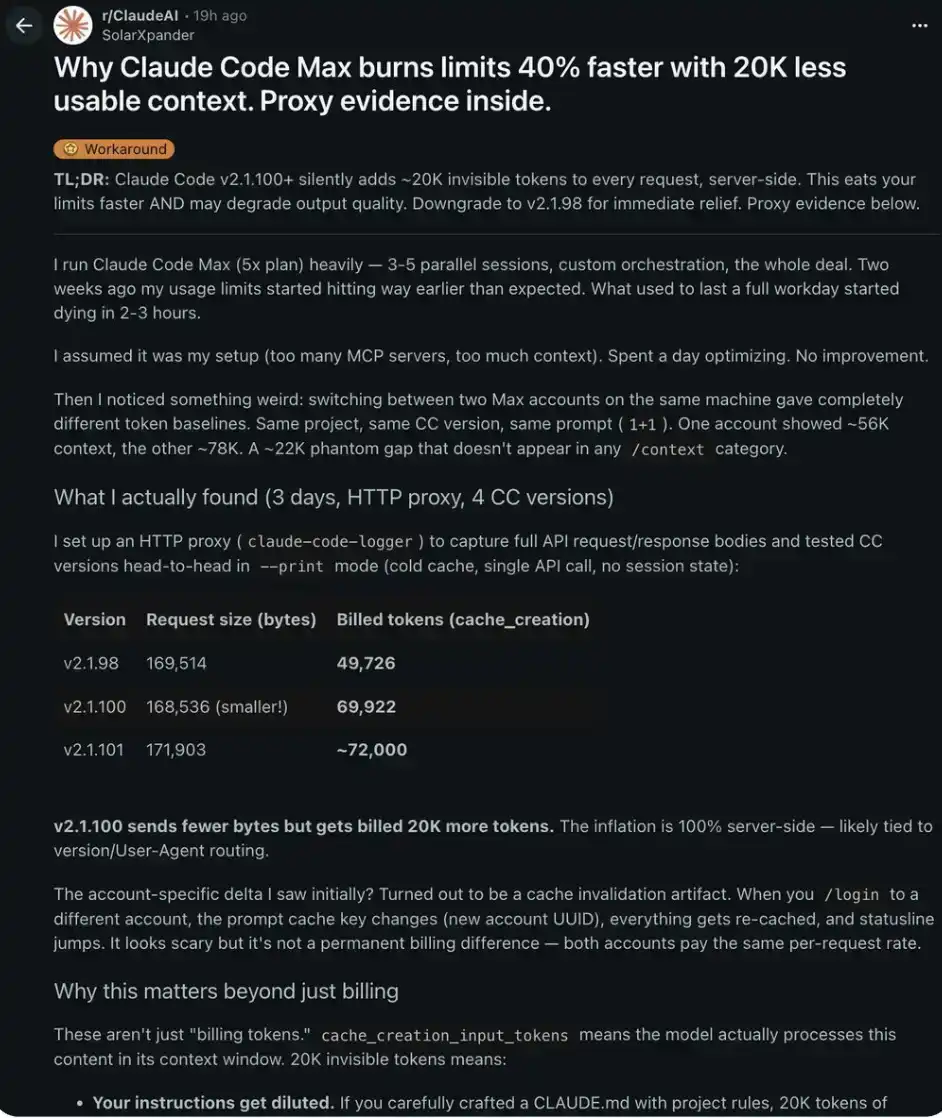
Someone set up an HTTP proxy and intercepted and analyzed the complete API requests of 4 different versions of Claude Code.

They found:

v2.1.98: 169,514 bytes request → 49,726 tokens charged
v2.1.100: 168,536 bytes request → 69,922 tokens charged
difference: -978 bytes but +20,196 tokens

v2.1.100 sent fewer data bytes but charged an extra 20,000 tokens. This "inflation" happens entirely on the server side—you can't see it, nor can you verify it through the /context interface.

Why this matters beyond billing: these extra 20,000 tokens are stuffed into Claude's actual context window.

This means:

→ Your CLAUDE.md instructions get diluted by these 20,000 "hidden contents"

→ Output quality degrades faster in long conversations

→ When Claude ignores your rules, it's hard to find the cause

→ Claude Max usage allowance is consumed about 40% faster than normal

Fix takes only 30 seconds: npx [email protected]

This is a temporary solution before Anthropic officially fixes the issue, but in practice, you can almost immediately feel the change in session effectiveness.

It replaces: You no longer need to guess why Claude suddenly stops following your instructions.

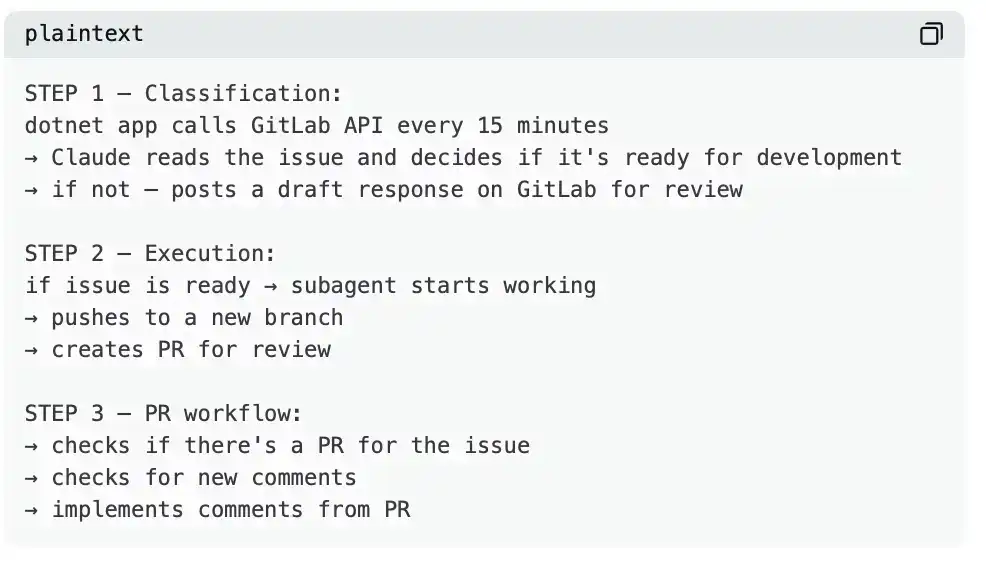
Case Study: What a Complete Automated System Looks Like

An engineer with 11 years of experience built a system consisting of three parts:

Results after one week:

· Before: 8 hours a day writing code
· After: Only 2–3 hours a day doing code review and testing

· Code quality: Basically unchanged—because he reviews each one
· Teams status: Always online—mouse moves automatically every minute
· Remaining time: Free to use all day

This isn't some "magic"; it's the result of CLAUDE.md + the right agents + a loop mechanism running every 15 minutes.

Complete checklist:

What you gain after reading this:

· Before: Claude violated existing specifications 40% of the time
· After: Using Karpathy's CLAUDE.md, violation rate dropped to 3%

· Before: You needed weeks to build agents
· After: 27 agents ready to use out-of-the-box

· Before: Claude Max exhausted its allowance in 2–3 hours
· After: Downgrading to v2.1.98 recovers about 40% of the usage limit

· Before: Needed 8 hours a day to write code
· After: Only 2–3 hours for review, the rest runs automatically

· Setup time: 15–20 minutes
· Daily savings: 5–6 hours
· Monthly savings: 100–120 hours

If your time is worth $30 per hour—you are "invisibly losing" $3000–3600 every month.

If it's $100 per hour—that's $10,000–12,000 flowing away monthly, just because you're still manually writing code that Claude could have done itself.

Most developers will never reach this level—not because they can't, but because they think it's complicated. In reality, between you and "full automation," there are only three commands and one file.

The engineer I mentioned at the beginning isn't some genius, nor is he a senior engineer from Google. He just spent one evening setting up the system—since then, the system does the work, and he lives his life.

You can do the same thing tonight. While others are still arguing whether AI will replace developers, those who have already set up the system are just collecting money and relaxing.

The choice is clear. You are building your own life—so choose the right path.

Related Questions

QWhat is the core concept behind the CLAUDE.md file mentioned in the article?

AThe core concept of the CLAUDE.md file is to provide a structured set of behavioral rules for Claude Code, based on principles like 'Think Before Coding', 'Simplicity First', 'Surgical Changes', and 'Goal-Driven Execution'. This file helps prevent common AI coding errors by setting clear, project-wide instructions, reducing violation rates from around 40% to just 3%.

QHow does the 'Everything Claude Code' system transform the developer's role?

AThe 'Everything Claude Code' system transforms the developer's role from directly coding and interacting with AI to managing an automated AI engineering team. It includes multiple agents and skills that handle tasks like planning, reviewing, and security, allowing the developer to focus on oversight and results rather than manual execution.

QWhat hidden issue was discovered with Claude Code v2.1.100, and what was its impact?

AClaude Code v2.1.100 was found to silently consume approximately 20,000 extra tokens per request compared to v2.1.98, despite sending fewer bytes. This 'hidden inflation' dilutes instructions from files like CLAUDE.md, reduces output quality in long conversations, and depletes usage limits about 40% faster, without any visible indication to the user.

QWhat were the key components of the automated system built by the Google engineer?

AThe automated system built by the Google engineer consisted of three main parts: a CLAUDE.md file for rule-based AI behavior, a set of tailored AI agents from the 'Everything Claude Code' repository, and an automated loop that ran every 15 minutes to handle coding, testing, and review processes with minimal human intervention.

QWhat time and financial benefits did the engineer achieve by automating 80% of his work?

AThe engineer reduced his daily work from 8 hours to just 2-3 hours, saving 5-6 hours per day and 100-120 hours per month. This automation generated $28,000 in monthly passive income. If valued at $30 per hour, this saves $3,000-$3,600 monthly; at $100 per hour, it saves $10,000-$12,000 monthly.

Related Reads

Single-Day Plunge of 30%, Arthur Hayes Suddenly Liquidates: Why Did ZEC Get Exploded by Security Issues?

On June 5th, Zcash founder Zooko Wilcox disclosed a critical soundness vulnerability in the project's latest Orchard privacy pool. This flaw, found in the elliptic curve multiplication constraints, could allow an attacker to create unlimited counterfeit ZEC within the shielded pool, with transactions appearing valid. The vulnerability was discovered in late May by security researcher Taylor Hornby, who utilized Anthropic's new Opus 4.8 AI model for a targeted audit. The Zcash ecosystem had already performed an emergency network upgrade to patch the issue. However, the detailed disclosure triggered severe market panic, causing ZEC's price to plummet over 30% in a single day. Notably, prominent investor Arthur Hayes announced he had sold his entire ZEC position following the news. The incident starkly challenges the "technological trust" narrative central to privacy coins. Despite years of top-tier cryptographic audits, the bug persisted until uncovered with advanced AI-assisted research. This highlights the growing gap between theoretical perfection and practical implementation in privacy technology. The event serves as a industry-wide warning: in an AI-driven security landscape, the assumption that "undiscovered equals safe" is obsolete. It underscores the urgent need for continuous, proactive security practices combining AI audits, formal verification, and rapid response mechanisms.

foresightnews_api5m ago

Single-Day Plunge of 30%, Arthur Hayes Suddenly Liquidates: Why Did ZEC Get Exploded by Security Issues?

foresightnews_api5m ago

Breaking the Curse of DeFi Cascading Liquidations, Vitalik Proposes a New Solution

**Vitalik Buterin Proposes New DeFi Design to Eliminate Forced Liquidations** Ethereum co-founder Vitalik Buterin has published a proposal for a new decentralized finance (DeFi) architecture aimed at removing the automatic liquidation mechanisms prevalent in current lending protocols. The core idea involves creating synthetic assets using options as building blocks, fundamentally avoiding the抵押借贷结构 that triggers forced sell-offs. The proposal responds to a recurring flaw in DeFi: during sharp market downturns, mass自动清算 of under-collateralized positions can exacerbate price declines, creating systemic selling pressure and market instability, as evidenced by recent crypto market volatility. Buterin's model would split an asset like 1 ETH into two option-like derivatives, P and N, pegged to a price index with a set strike price and expiration. At expiry, an oracle determines the settlement price to allocate the underlying ETH between P and N holders. This design eliminates the "cliff" of instant liquidation. Instead, a position's value would gradually drift from its target peg if not actively rebalanced by the user, transferring the rebalancing decision from the protocol to the user or automated tools. A key advantage is the reduced reliance on high-frequency, real-time oracle price feeds, which are vulnerable to manipulation and errors in current systems. The delayed settlement in the options model allows for more robust, fault-tolerant oracle designs. However, significant challenges remain for practical adoption. High transaction costs (slippage) from frequent rebalancing on automated market makers (AMMs) could erode user funds. The model may not be suitable for stablecoins requiring a strict 1:1 dollar peg, as it inherently allows for value drift. Success would depend on developing new liquidity provisioning models and deep markets for these synthetic assets. The proposal represents a fundamental rethinking of DeFi risk management, challenging the industry to explore alternatives to被动集中平仓 rather than merely optimizing existing liquidation processes. It remains a theoretical framework awaiting implementation and testing by development teams.

foresightnews_api8m ago

Breaking the Curse of DeFi Cascading Liquidations, Vitalik Proposes a New Solution

foresightnews_api8m ago

Bitcoin's Decline Marks the Transformation of Crypto

Title: The Decline of Bitcoin Marks the Transformation of Crypto While Bitcoin's price recently fell below $70,000, down approximately 45% from its peak, the broader crypto industry is not following it into decline. Instead, crypto is maturing and evolving beyond its dependence on Bitcoin's price movements. Two of Bitcoin's core functions are being usurped. First, AI has captured its role as the primary speculative asset. AI, with its tangible revenue, explosive demand, and massive capital inflows ($700-830 billion in 2024), is siphoning off the speculative "hot money" that once drove Bitcoin. It also contributes to a sustained high-interest-rate environment, further tightening liquidity for assets like Bitcoin. Second, dollar-pegged stablecoins like USDC and USDT have replaced Bitcoin as the crypto market's foundational currency and primary on/off-ramp. Most trading pairs and on-chain transactions are now settled in stablecoins, severing the historical link where all capital inflows had to pass through Bitcoin first. This decoupling allows projects to thrive based on their own fundamentals rather than Bitcoin's price. Examples include Hyperliquid, an on-chain derivatives exchange with annual revenues of $8-13 billion, and prediction market platform Polymarket, valued at $200 billion with $3.65 billion in annual fees. These projects are evaluated on traditional metrics like revenue and user growth. New opportunities are emerging, particularly around privacy. Privacy coins like Zcash (ZEC) are seeing surging demand, while infrastructure like NEAR enables private, cross-chain asset transfers without requiring users to hold a specific token—privacy becomes a universal service layer. In this new paradigm, stablecoins are the universal cash, various project tokens represent equity, and privacy-enabled cross-chain coordination layers (like NEAR) act as the critical infrastructure connecting a fragmented, multi-chain ecosystem. Bitcoin is now just one asset among many. The era where the entire crypto market moved in lockstep with Bitcoin is over. The industry's health should now be judged by project fundamentals—real revenue, active users, and tokenomics that capture value—and the development of the underlying infrastructure enabling a mature, dollar-denominated crypto economy.

foresightnews_api11m ago

Bitcoin's Decline Marks the Transformation of Crypto

foresightnews_api11m ago

Lightspark CEO: In Ten Years, Bitcoin Will Be as Invisible as TCP/IP, Yet Power Trillions in Daily Transactions

A decade from now, Bitcoin will function like TCP/IP — invisible yet foundational, supporting trillions in daily transactions globally, according to Lightspark CEO David Marcus. In this future, a coffee shop in Lagos receives instant payment, a manufacturer in São Paulo settles an invoice with a supplier in Ho Chi Minh City, and a freelancer in Bangalore gets paid weekly from an Austin startup — all via Bitcoin's settlement layer, with none of the parties consciously interacting with it. This vision parallels the adoption of open protocols: first driven by necessity where existing systems fail, then scaling rapidly as tools mature and economic benefits become clear. The structural shift begins with wallets. Modern non-custodial wallets, like Spark, allow users to hold dollars, local currency, and Bitcoin in a single address, seamlessly switching between them. This eliminates friction and revolutionizes global custody, moving significant deposits to user-controlled keys not by ideology, but by superior utility. As a result, Bitcoin becomes the default savings layer for billions, as its fixed supply and appreciating value make it a rational choice for savers holding it alongside stablecoins in their everyday wallets. Businesses follow a similar path, from small companies in emerging markets to multinational corporations, holding Bitcoin alongside operational stablecoins. The latest trend is direct Bitcoin transactions for commerce. When both parties hold Bitcoin, transacting in it becomes the simplest option — no conversions, no intermediary currency. This starts in niche areas like high-value B2B settlements but grows as infrastructure makes sending Bitcoin as easy as stablecoins. An accelerating force is AI agents. By 2036, AI agents conducting commerce on behalf of individuals and firms will increasingly choose Bitcoin for settlement. Optimizing for speed, finality, and minimal counterparty risk across jurisdictions, they find Bitcoin's global, neutral, and programmable network ideal for netting and settling obligations. Thus, Bitcoin is becoming the native currency for machine commerce, just as it has become a native savings asset for humans. The global monetary system is being rebuilt from the protocol layer: open infrastructure, default self-custody, Bitcoin settling everything underneath, with stablecoins as the interface. Most users won't think about Bitcoin when they transact — and they won't need to.

foresightnews_api15m ago

Lightspark CEO: In Ten Years, Bitcoin Will Be as Invisible as TCP/IP, Yet Power Trillions in Daily Transactions

foresightnews_api15m ago

Trading

Spot
Futures
活动图片