On-Chain Tracking|US Further Cracks Down on North Korean IT Worker Fraud Network Using Cryptocurrency to Fund Weapons of Mass Destruction, Sanctions 6 Individuals and 2 Entities

marsbitPublished on 2026-03-14Last updated on 2026-03-14

Abstract

On March 12, the U.S. Treasury’s OFAC sanctioned six individuals and two entities involved in a DPRK-led IT worker fraud network. These actors allegedly deceived U.S. companies to generate revenue for North Korea’s weapons of mass destruction programs, with nearly $800 million involved in 2024 alone. The sanctioned individuals facilitated crypto exchange, money laundering, and IT operations, while the entities (Amnokgang and Quangvietdnbg) were key operators. A total of 21 cryptocurrency addresses were identified. One individual exchanged approximately $2.5 million in crypto for North Korea. Blockchain analysis revealed fund flows to major exchanges, including over 200,000 USDT and 0.57 BTC traced to CEXs. One address held over $24 million in stablecoins, with significant outflows detected. This action underscores ongoing U.S. efforts to combat DPRK’s use of crypto to evade sanctions and fund illicit programs. Virtual asset service providers are urged to enhance AML screening and monitor high-risk addresses.

On March 12, the U.S. Department of the Treasury’s Office of Foreign Assets Control (OFAC) announced sanctions against 6 individuals and 2 entities involved in a North Korea-led IT worker fraud network. The announcement stated that these participants systematically defrauded U.S. companies to provide funding for weapons of mass destruction programs, with the amount involved in 2024 alone approaching $800 million.
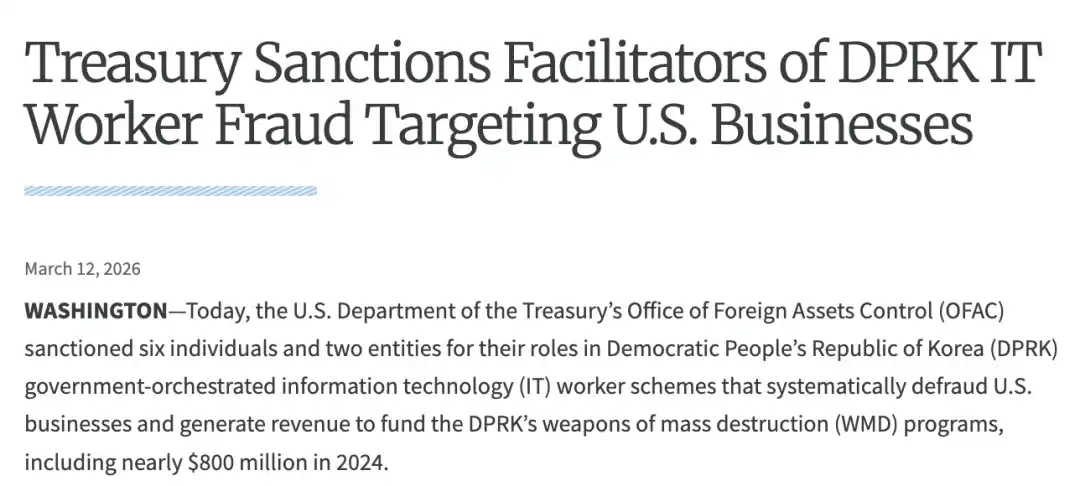
https://home.treasury.gov/news/press-releases/sb0416

Sanctions Details

According to the U.S. OFAC disclosure, North Korea-controlled IT teams used forged documents, stolen identities, and fabricated personas to conceal their true identities and gain employment at legitimate companies in the U.S. and other countries. The North Korean government seized the vast majority of these overseas IT workers' salaries, obtaining hundreds of millions of dollars to support its weapons of mass destruction and ballistic missile programs. In some cases, North Korea-linked personnel also secretly implanted malicious software into corporate networks to steal proprietary and sensitive information.

This round of sanctions targets 6 individuals (Nguyen Quang Viet, Do Pyong Kyong, Hoang Van Nguyen, Yun Song Guk, Hoang Minh Quang, York Louis Celestino Herrera), identified as providing substantial assistance to North Korean IT workers through cryptocurrency exchange, money laundering, bank account opening, and IT business matching; and 2 corporate entities (Amnokgang, Quangvietdnbg), identified as key operators and facilitators of the IT worker fraud network.

Sanctioned Address Analysis

This sanctions action locked a total of 21 cryptocurrency addresses. According to the OFAC notification, from mid-2023 to mid-2025, Quangvietdnbg CEO Nguyen Quang Viet exchanged approximately $2.5 million worth of cryptocurrency for the North Korean side, identifying cryptocurrency as a critical channel for North Korean IT workers to transfer funds and evade sanctions.

Analysis of the 21 addresses on this sanctions list was conducted using the on-chain anti-money laundering analysis platform Beosin KYT and the investigation tool Beosin Trace, with results as follows:

YUN, Song Guk (North Korean national, head of IT workers in Boten, Laos)

ETH:

0xb637f84b66876ebf609c2a4208905f9ddac9d075

0x95584C303FCd48AF5c6B9873015f2AD0ca84EaE3
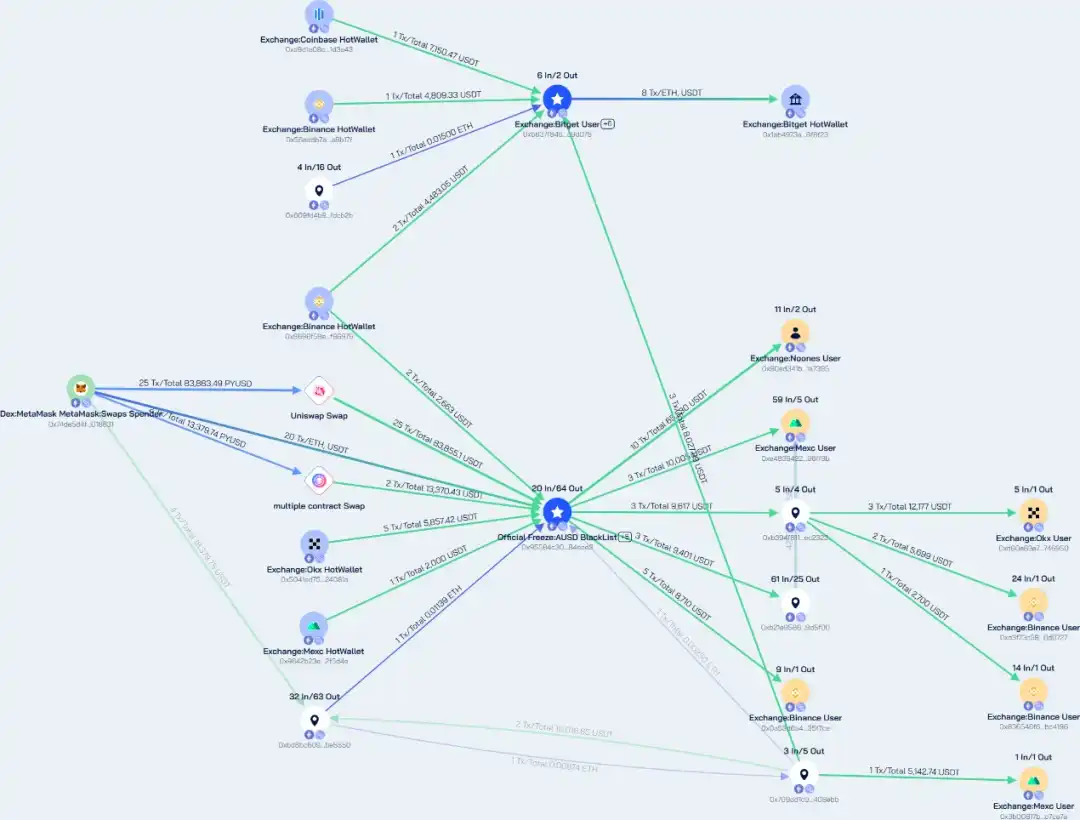
According to Beosin Trace statistics, approximately 200,851 USDT previously flowed out to various centralized exchanges.

HOANG, Minh Quang (Collaborated to complete IT service transactions exceeding $70,000)

BTC:bc1qyy5pt5cx3zth8xlj92lq5y87dh8xv3nwgs4ncq

Previously, 0.57462 BTC flowed into a Coinbase account.

SIM, Hyon Sop (Representative of North Korea's Kwangson Bank in China, 11 new addresses added)

Previously frozen address (ETH network):

0x4f47bc496083c727c5fbe3ce9cdf2b0f6496270c
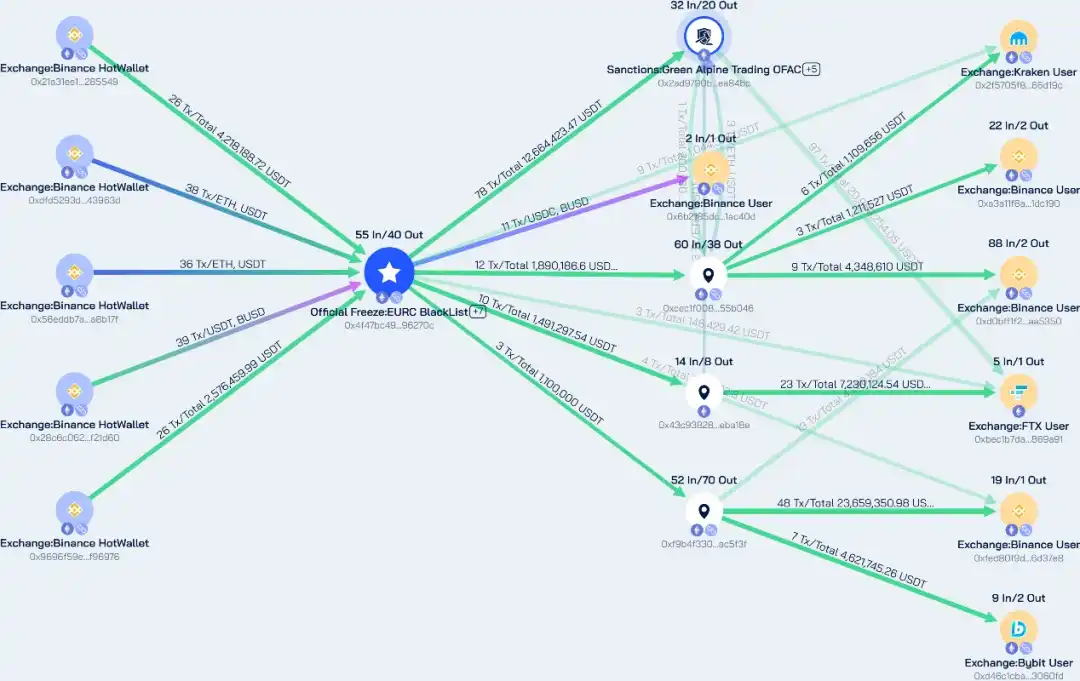
This address had a liquid volume of 21,937,732.52 USDT and 2,071,126.59 USDC, with 58,148.62 USDT currently remaining dormant at this address.

Newly sanctioned addresses (ETH network):

0xd04E33461FEA8302c5E1e13895b60cEe8AEfda7F

0x76EA76CA4Eb727f18956aB93445a94c5280412B9

0xFb3eFf152ea55D1BfA04Dbdd509A80fD7b72cdEB

0xFda1Ec4A6178d4916b001a065422D31EBE5F62FF

0x747AFB5c7A7fc34B547cD0FDEbf9b91759C5a52b

Fund flow diagram is as follows:
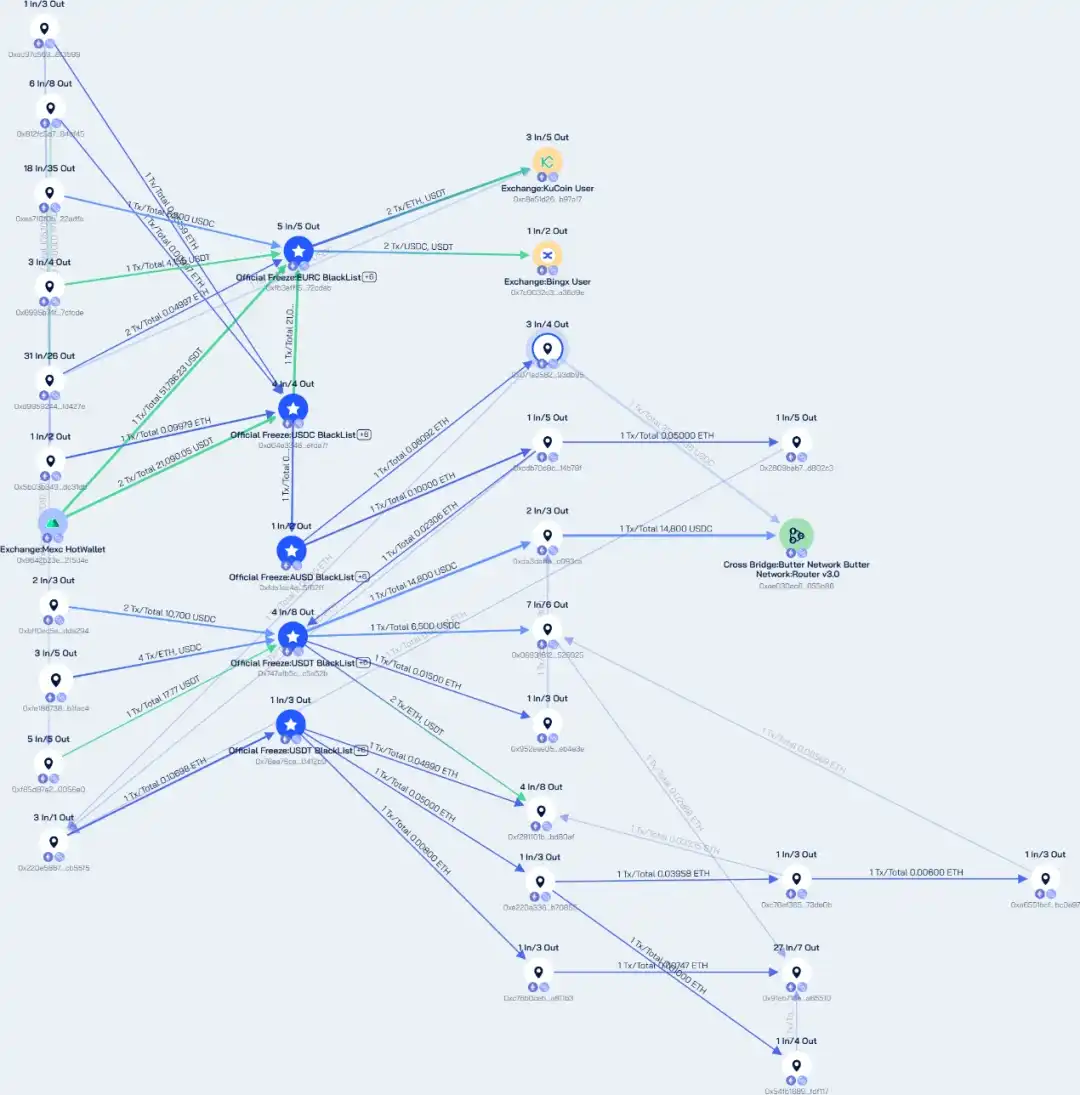
Approximately 98,139.11 USDT, 21,300 USDC, and 0.51268 ETH flowed out.

New TRX addresses:

TPDLpXxPcaSsupEZ3yrVksmNkYP5SLeKxu

TGXE9dGWawjfd3xqFSho1h1bBbRv9wUGrF

TNTFhgFoKH4srBMiWbfrVFqP2AThSmdwf1

TXhf9nU9bjo1j9z5qEesHdr6gtdndfnA4T

TK17wfSPp32RWrnzZPrGpv7TxdNFvvvE2s

TYeQD2VddTZ9NkFkAnT9DD8cUGetGUQZB2
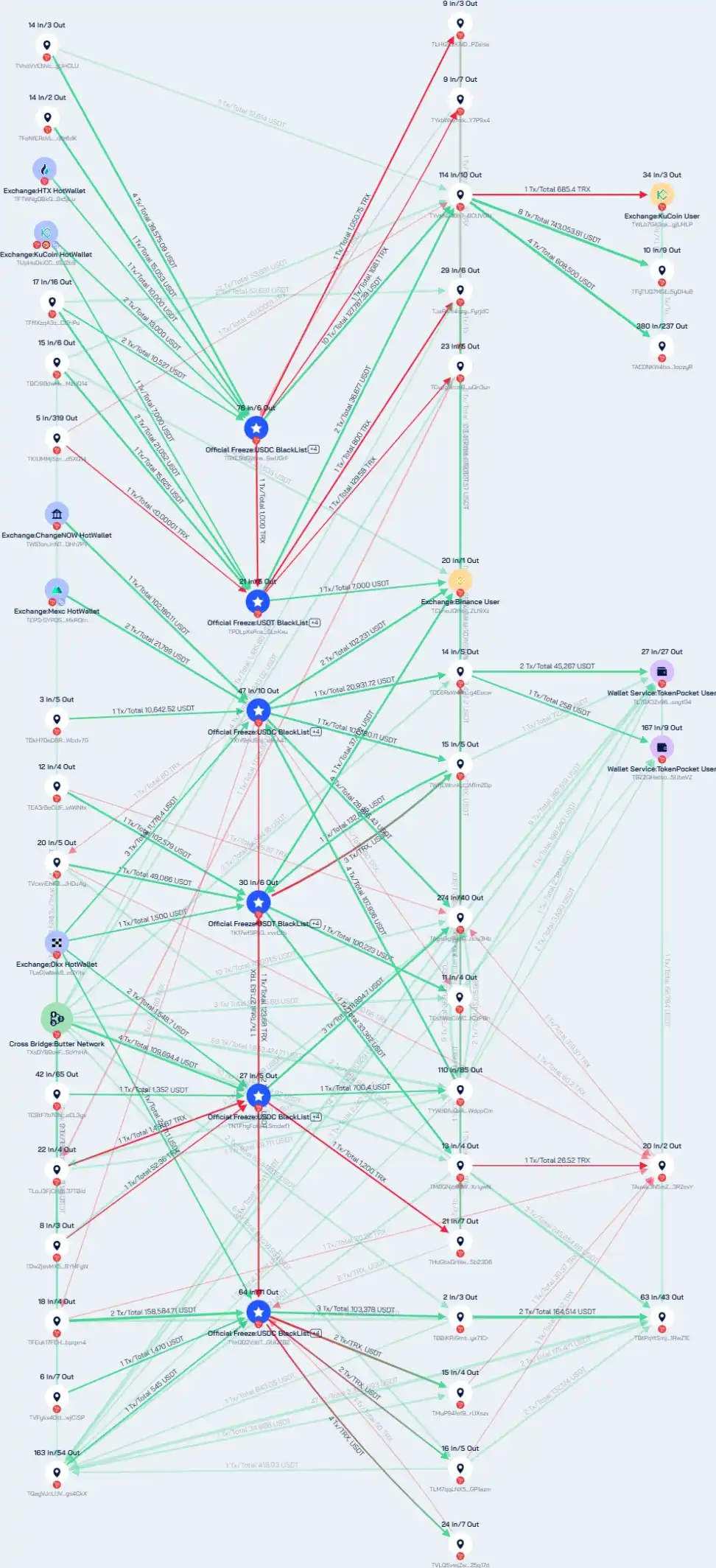
Approximately 6,236.74 TRX and 999,014.46 USDT flowed out.

Cross-chain for the same address:

ARB:0x4f47bc496083c727c5fbe3ce9cdf2b0f6496270c

BSC:0x4f47bc496083c727c5fbe3ce9cdf2b0f6496270c
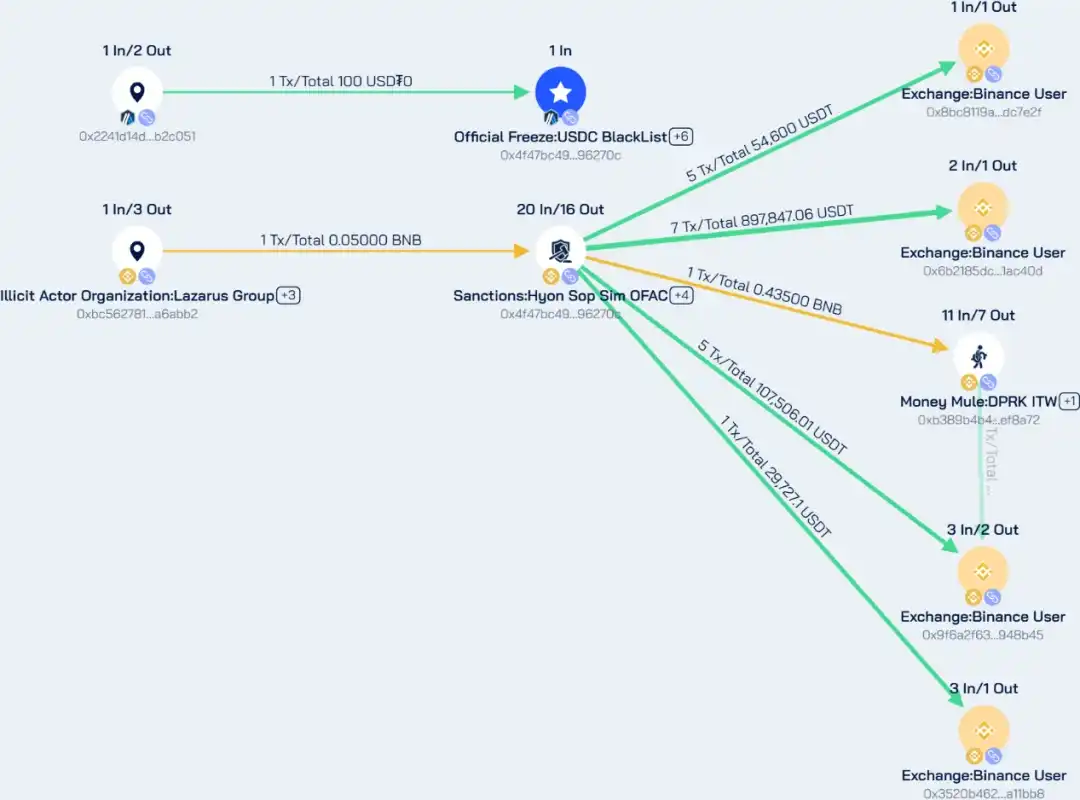
1,133,025.26 USDT, 935,943.84 BUSD, and 17,811.05 USDC flowed out to various centralized exchanges.

AMNOKGANG TECHNOLOGY DEVELOPMENT COMPANY

ETH:

0xcB74874f1e06Fcf80A306e06e5379A44B488bA2D

0x0330070FD38Ec3bB94F58FA55D40368271E9e54A

0x9Be599d7867f5E1a2D7Ec6dB9710dF2b98A15573
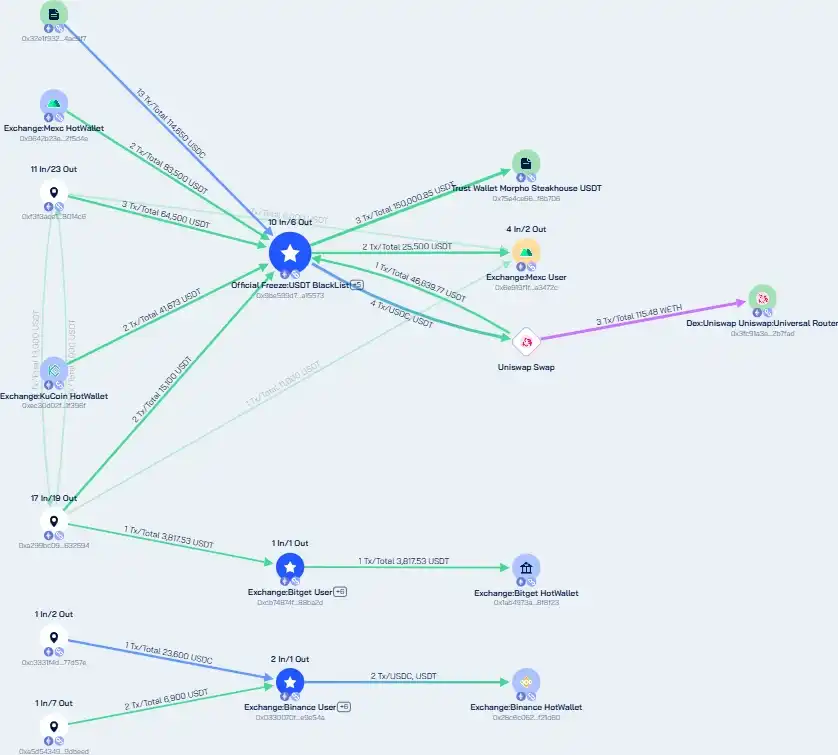
A total of approximately 205.02 ETH, 274,531.15 USDT, and 228,496.97 USDC, with 96.05 ETH dormant in address 0x9be599d7867f5e1a2d7ec6db9710df2b98a15573.

Tron network

TNrX2FwrHKoo4XACGkmSzqeK4pdnKYn6Z7

TEEYCuGDyeNkuDj4 U6GQRXxXo3Nh29r2vP

TZB4NrX7k9ZsV6PRc1GigAztLL8WHpLvwP

TDe2 UNAvuUnTbbDo7518eMe3TXN5qJW8Ft
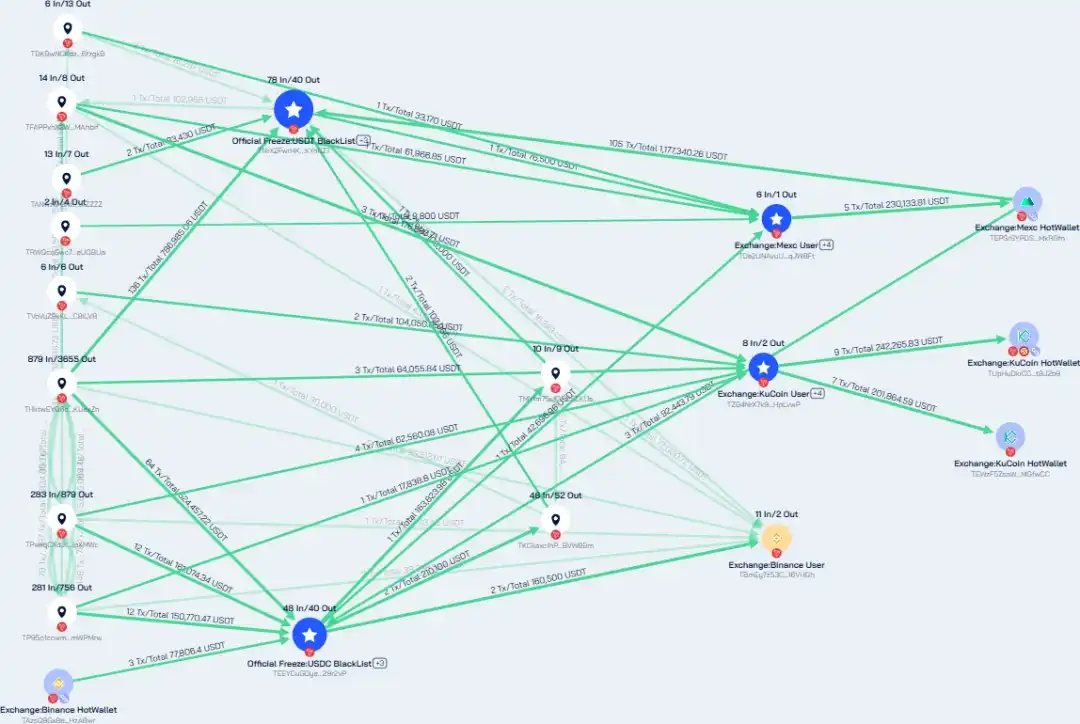
2,744.75 TRX and 4,941,817.62 USDT flowed out to various centralized exchanges.

Beosin Anti-Money Laundering Recommendations

This action is another measure by the U.S. Treasury Department to continuously combat North Korea's use of cryptocurrency to evade sanctions. For the virtual asset industry, how to conduct anti-money laundering compliance screening and identify addresses involved in high-risk funds has become a critical capability for Virtual Asset Service Providers (VASPs).


Related Questions

QWhat action did the U.S. Treasury Department's OFAC announce on March 12th, and who was targeted?

AThe U.S. Treasury Department's Office of Foreign Assets Control (OFAC) announced sanctions against 6 individuals and 2 entities involved in a Democratic People's Republic of Korea (DPRK)-led IT worker fraud network.

QWhat was the primary method used by the DPRK IT teams to infiltrate legitimate companies, and what was the ultimate goal?

AThe DPRK IT teams used forged documents, stolen identities, and fabricated personas to conceal their true identities and gain employment at legitimate companies. The North Korean government then seized the vast majority of the overseas IT workers' salaries to obtain hundreds of millions of dollars in funding for its weapons of mass destruction (WMD) and ballistic missile programs.

QHow much cryptocurrency was exchanged by Nguyen Quang Viet for the North Korean side, and what role did crypto play according to OFAC?

ANguyen Quang Viet, the CEO of Quangvietdnbg, exchanged approximately $2.5 million worth of cryptocurrency for the North Korean side. OFAC identified cryptocurrency as a critical channel for DPRK IT workers to transfer funds and evade sanctions.

QWhich sanctioned individual was identified as a DPRK IT worker leader in Laos, and what was the associated Ethereum address with significant outflows?

AYUN, Song Guk was identified as a DPRK IT worker leader in Laos. The Ethereum address 0xb637f84b66876ebf609c2a4208905f9ddac9d075 was associated with him, from which approximately 200,851 USDT had flowed out to various centralized exchanges.

QWhat was the total amount of funds involved in the fraud network's activities in 2024 alone, as stated in the OFAC announcement?

AThe amount of funds involved in the fraud network's activities in 2024 alone was close to $800 million.

Related Reads

The Second Half of Macro Influencer Fu Peng's Career

Fu Peng, a prominent Chinese macroeconomist and former chief economist of Northeast Securities, has joined Hong Kong-based digital asset management firm Bitfire Group (formerly New Huo Group) as its chief economist. This move, announced in April 2026, triggered an 11% surge in Bitfire's stock price. Fu, known for his accessible macroeconomic commentary and large social media following, will focus on integrating digital assets into global asset allocation frameworks, particularly combining FICC (fixed income, currencies, and commodities) with cryptocurrencies for institutional clients. His career includes roles at Lehman Brothers and Solomon International, with significant influence gained through public communication. However, in late 2024, Fu faced temporary social media bans after a controversial private speech at HSBC on China's economic challenges, though he denied regulatory sanctions. He later left Northeast Securities citing health reasons. Bitfire, a licensed virtual asset manager serving high-net-worth clients, seeks to build trust and attract traditional capital through Fu’s expertise and credibility. The partnership represents a strategic shift for both: Fu enters the crypto sector after a traditional finance peak, while Bitfire aims to leverage his macro framework for institutional adoption. Outcomes remain uncertain regarding capital inflows and compatibility within corporate structure.

marsbit1h ago

The Second Half of Macro Influencer Fu Peng's Career

marsbit1h ago

Trading

Spot
Futures

Hot Articles

Discussions

Welcome to the HTX Community. Here, you can stay informed about the latest platform developments and gain access to professional market insights. Users' opinions on the price of S (S) are presented below.

活动图片