No Agreement Reached In White House Meeting Between Banks And The Crypto Industry

bitcoinistPublished on 2026-02-12Last updated on 2026-02-12

A second White House meeting between major U.S. banks and leading crypto firms ended without a deal on stablecoin yield, leaving one of the most contentious issues in U.S. digital asset regulation unresolved.

The February 10 session, led by Patrick Witt, Executive Director of the President’s Crypto Council, focused on whether stablecoin issuers should be allowed to offer yield or rewards to holders.

While participants described the talks as more detailed than previous discussions, no compromise was reached. The outcome keeps the proposed Digital Asset Market Clarity Act of 2025, known as the CLARITY Act, stalled in the Senate Banking Committee.
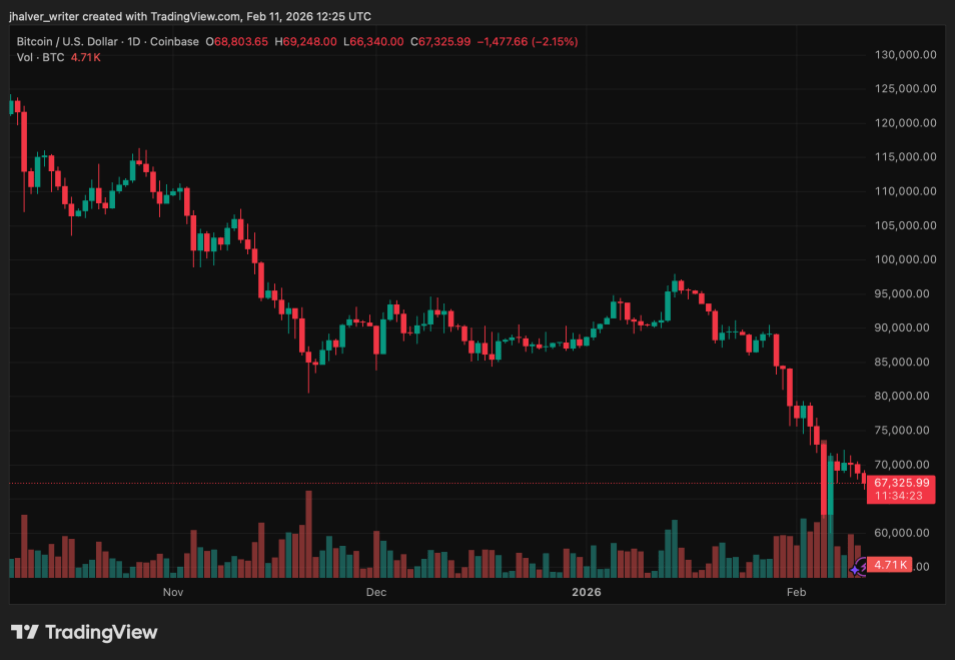
BTC's price trends to the downside on the daily chart. Source: BTCUSD on Tradingview

Stablecoin Yield at the Center of the Dispute

At the heart of the disagreement is whether stablecoin rewards resemble bank interest and, if so, should face similar restrictions.

Banking representatives from Goldman Sachs, JPMorgan, Bank of America, Wells Fargo, Citi, PNC, and U.S. Bank argued that yield-bearing stablecoins could trigger large-scale deposit outflows from traditional banks.

Banks presented a written set of “prohibition principles” calling for a ban on “any form of financial or non-financial consideration” offered to stablecoin holders. They contend that allowing such rewards could undermine lending capacity and disrupt the traditional deposit model.

Crypto firms, including Coinbase, Ripple, a16z, Paxos, and the Blockchain Association, pushed back. They argue that stablecoin rewards are a core feature of on-chain finance and necessary for fair competition with traditional financial products.

Industry representatives also said overly restrictive rules could slow innovation or drive activity outside the United States.

CLARITY Act Remains in Limbo

The debate over stablecoin yield has become a key obstacle for the CLARITY Act, which aims to define regulatory oversight for digital assets and clarify the roles of the SEC and the CFTC. The bill passed the House in 2025 but has not advanced in the Senate due to unresolved concerns around stablecoin regulation.

Although banks maintained a firm stance, participants noted a shift in tone. For the first time, banking representatives signaled limited openness to discussing potential exemptions for transaction-based rewards. However, disagreements over what qualifies as “permissible activities” remain unresolved.

The White House has urged both sides to reach an agreement by March 1 to preserve legislative momentum. Further discussions are expected in the coming days, though it is unclear whether another full-scale meeting will be held before the deadline.

Until a compromise is reached, stablecoin regulation and broader reform of the U.S. crypto market structure remain in a holding pattern.

Cover image in ChatGPT, BTCUSD chart on Tradingview

Trending Cryptos

Related Questions

QWhat was the main topic of disagreement in the White House meeting between banks and crypto firms?

AThe main topic was whether stablecoin issuers should be allowed to offer yield or rewards to holders.

QWhich major financial institutions argued against yield-bearing stablecoins?

ARepresentatives from Goldman Sachs, JPMorgan, Bank of America, Wells Fargo, Citi, PNC, and U.S. Bank argued against them.

QWhat is the name of the proposed legislation that is currently stalled due to this disagreement?

AThe proposed legislation is called the Digital Asset Market Clarity Act of 2025, also known as the CLARITY Act.

QWhat was the primary concern expressed by the banking representatives regarding stablecoin rewards?

AThey argued that yield-bearing stablecoins could trigger large-scale deposit outflows from traditional banks and undermine their lending capacity.

QWhat was the deadline given by the White House for the two sides to reach an agreement?

AThe White House urged both sides to reach an agreement by March 1 to preserve legislative momentum.

Related Reads

Interview with Robinhood Executive: Meme + Tokenized US Stocks as "Barbell" Customer Acquisition Strategy, All Business Lines Achieve Hundreds of Millions in Revenue

Interview with Robinhood executive Johann Kerbrat reveals the company's "barbell" customer acquisition strategy for its new Robinhood Chain, combining meme tokens with tokenized stocks. Three weeks after mainnet launch, the chain has seen over $3B in weekly DEX volume and 105M transactions. Kerbrat explains the logic behind the permissionless chain: meme tokens attract DeFi users, while tokenized real-world assets (RWA), currently over 90 US stocks and ETFs accessible in 120+ countries, serve global users. The goal is to bring Robinhood's 27 million funded accounts on-chain by simplifying DeFi with a user-friendly interface, exemplified by features like Robinhood Earn which offers yield without requiring wallet management. Built on Arbitrum's technology stack for its speed, low cost, and Ethereum's security, the chain focuses on financial products like Earn, spot trading, and perpetuals. Kerbrat downplays direct competition with platforms like Base, emphasizing the goal of expanding the overall market for on-chain assets. He details selective partnerships (e.g., Morpho, Lighter) based on compliance, unique UX, and differentiation. While regulatory clarity is pending for US perpetuals, the expansion continues via Bitstamp in Europe. Finally, Kerbrat positions Robinhood as a "super app" integrating stocks, options, crypto, banking, and AI trading, with all major business lines generating hundreds of millions in revenue. For the chain, current priority is driving adoption over maximizing gas fee revenue.

marsbit2h ago

Interview with Robinhood Executive: Meme + Tokenized US Stocks as "Barbell" Customer Acquisition Strategy, All Business Lines Achieve Hundreds of Millions in Revenue

marsbit2h ago

Fidelity Q3 Report: BTC, ETH, and SOL Continue to Build Bottoms; How Much Further Will This Crypto Bear Market Go?

Fidelity's Q3 Crypto Signal Report analyzes the current bear market, noting Bitcoin (BTC), Ethereum (ETH), and Solana (SOL) are in a prolonged bottoming phase. Key indicators like the weighted Net Unrealized Profit/Loss (NUPL) have turned negative (-0.01), signaling the market is slightly below its aggregate cost basis, with BTC acting as the primary stabilizing asset. BTC's dominance has risen to 68%, indicating a lack of capital rotation to other digital assets. Performance has been weak across the board, with BTC, ETH, and SOL down significantly year-to-date. Market sentiment is depressed, exacerbated by substantial outflows from spot ETPs and a challenging macro environment. The report compares the current ~203-day downtrend to historical ~300-day bottoming cycles, suggesting the process may be two-thirds complete, with late 2026 as a potential timeframe to monitor. For Bitcoin, NUPL at 0.09 indicates cautious sentiment, while momentum signals remain negative. The Yardstick metric points to potential undervaluation relative to network security (hashrate). Ethereum's NUPL is deep in the "capitulation" zone at -0.43, a historically positive signal for future returns, though its momentum and network fee revenue are negative. Solana shows the deepest NUPL at -0.72 but demonstrates relative resilience in on-chain activity and stablecoin transfer volume. The report concludes that while several metrics are near historical capitulation levels, a definitive market bottom has not yet been established. The path forward likely involves continued consolidation, with BTC's relative strength and fundamental on-chain usage for ETH and SOL providing key areas for investor observation.

marsbit2h ago

Fidelity Q3 Report: BTC, ETH, and SOL Continue to Build Bottoms; How Much Further Will This Crypto Bear Market Go?

marsbit2h ago

Trading

Spot

Hot Articles

How to Buy HOUSE

Welcome to HTX.com! We've made purchasing Housecoin (HOUSE) simple and convenient. Follow our step-by-step guide to embark on your crypto journey.Step 1: Create Your HTX AccountUse your email or phone number to sign up for a free account on HTX. Experience a hassle-free registration journey and unlock all features.Get My AccountStep 2: Go to Buy Crypto and Choose Your Payment MethodCredit/Debit Card: Use your Visa or Mastercard to buy Housecoin (HOUSE) instantly.Balance: Use funds from your HTX account balance to trade seamlessly.Third Parties: We've added popular payment methods such as Google Pay and Apple Pay to enhance convenience.P2P: Trade directly with other users on HTX.Over-the-Counter (OTC): We offer tailor-made services and competitive exchange rates for traders.Step 3: Store Your Housecoin (HOUSE)After purchasing your Housecoin (HOUSE), store it in your HTX account. Alternatively, you can send it elsewhere via blockchain transfer or use it to trade other cryptocurrencies.Step 4: Trade Housecoin (HOUSE)Easily trade Housecoin (HOUSE) on HTX's spot market. Simply access your account, select your trading pair, execute your trades, and monitor in real-time. We offer a user-friendly experience for both beginners and seasoned traders.

5.4k Total ViewsPublished 2025.04.27Updated 2026.06.02

How to Buy HOUSE

Discussions

Welcome to the HTX Community. Here, you can stay informed about the latest platform developments and gain access to professional market insights. Users' opinions on the price of HOUSE (HOUSE) are presented below.

活动图片