MORPHO rallies 14% after Standard Chartered’s $60 forecast – What’s next?

ambcryptoPublished on 2026-07-03Last updated on 2026-07-03

Abstract

Standard Chartered set a $60 price target for Morpho (MORPHO) by 2030, sparking a 14.15% price rally and a 315% surge in trading volume as investors reassessed the protocol's role in tokenized finance. The report emphasized Morpho's Markets and Vaults architecture and a long-term adoption thesis for decentralized lending, boosting investor confidence rather than suggesting a quick price surge. Market participation broadened, with Open Interest rising 19% to $39.19M, indicating new capital entering futures markets. Derivatives volume vastly outpaced OI growth, suggesting active repositioning. Spot exchange netflows showed modest outflows, signaling holders were not rushing to sell, which complemented the derivatives activity and indicated stable confidence. Technically, MORPHO completed a double-bottom reversal, advancing toward key resistance at $2.24. The MACD strengthened, confirming bullish momentum, and the $2.00 psychological level was reclaimed. A daily close above $2.24 could open a path toward $3.00, while failure might lead to a retest of $2.00 support.

Standard Chartered has assigned a $60 price target for Morpho [MORPHO] by 2030, prompting investors to reassess the protocol’s long-term role in tokenized finance.

The report highlighted Morpho’s Markets and Vaults architecture while projecting sustained expansion across decentralized finance infrastructure. Following the announcement, MORPHO climbed 14.15% over the past 24 hours at press time, as trading activity accelerated sharply.

Trading volume also jumped 315.37%, reflecting renewed market participation after the institutional endorsement. However, the report did not suggest an immediate path toward its long-term valuation.

Instead, it reinforced a multi-year adoption thesis built around increasing institutional participation in decentralized lending. As a result, buyers responded to stronger long-term confidence rather than expectations of a rapid thirtyfold price increase.

Morpho traders increase exposure

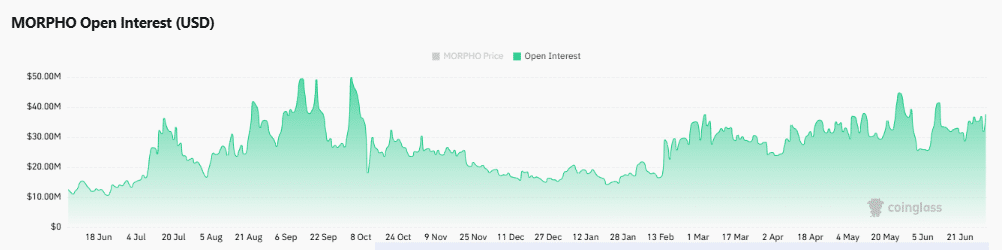
Market participation expanded beyond spot trading as derivatives traders increased their exposure following the rally.

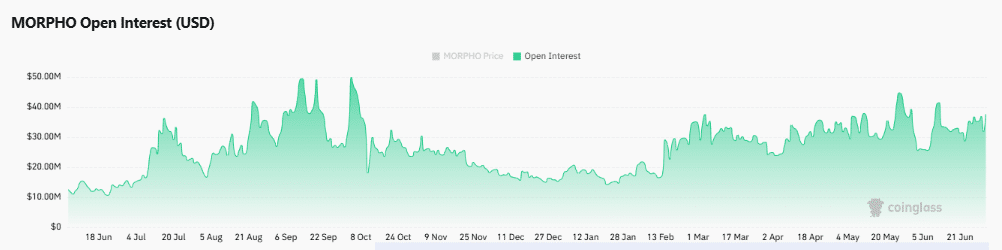
At press time, Open Interest (OI) climbed 19.17% to $39.19 million, indicating that fresh capital entered futures markets instead of existing positions simply changing hands. Meanwhile, derivatives volume surged 315.37% to approximately $135.16 million, far outpacing the rise in OI.

The difference suggested that traders actively repositioned around the institutional catalyst while maintaining relatively measured leverage growth. Besides that, the simultaneous increase in price and OI reflected new positions supporting the advance instead of widespread short covering alone.

However, leverage remained well below the pace of trading activity, reducing concerns that excessive speculation had immediately dominated the latest rally.
Source: CoinGlass

Exchange flows remained calm despite stronger demand

Spot exchange activity continued supporting the broader narrative despite the sharp increase in trading activity.

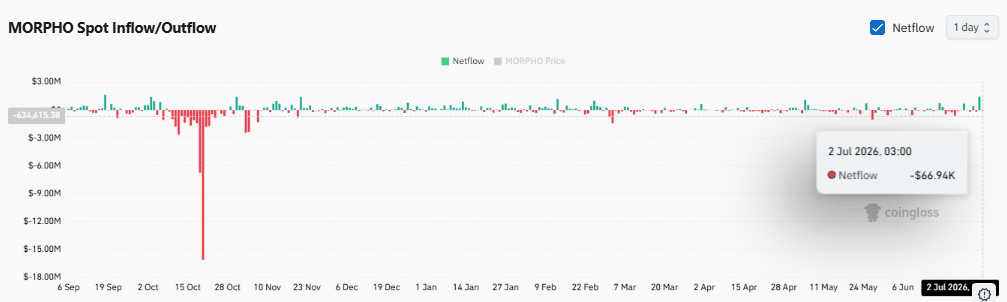
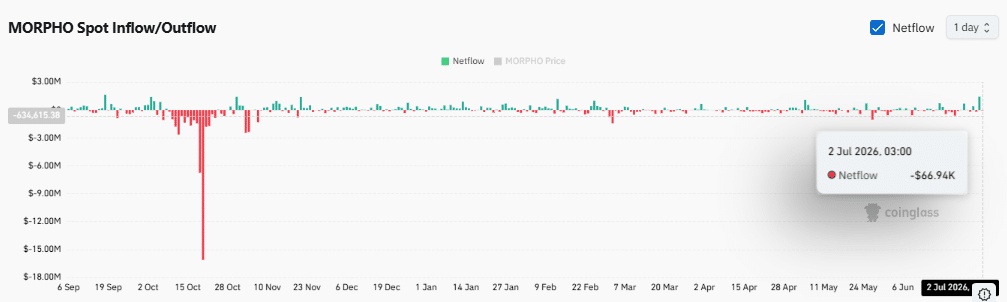
Morpho recorded a daily Netflow of -$66.94K, showing that slightly more tokens left exchanges than entered them. These modest outflows indicated that holders did not rush to transfer assets onto exchanges for immediate selling after the rally.

Instead, exchange balances remained stable even as investor interest increased following Standard Chartered’s report. Although the outflow figure remained relatively small, it aligned with improving market confidence rather than aggressive distribution.

Investors appeared willing to retain exposure while assessing Morpho’s longer-term institutional prospects. Therefore, spot market behavior complemented the derivatives expansion instead of signaling meaningful selling pressure.
Source: CoinGlass

Can Morpho clear resistance after its bullish reversal?

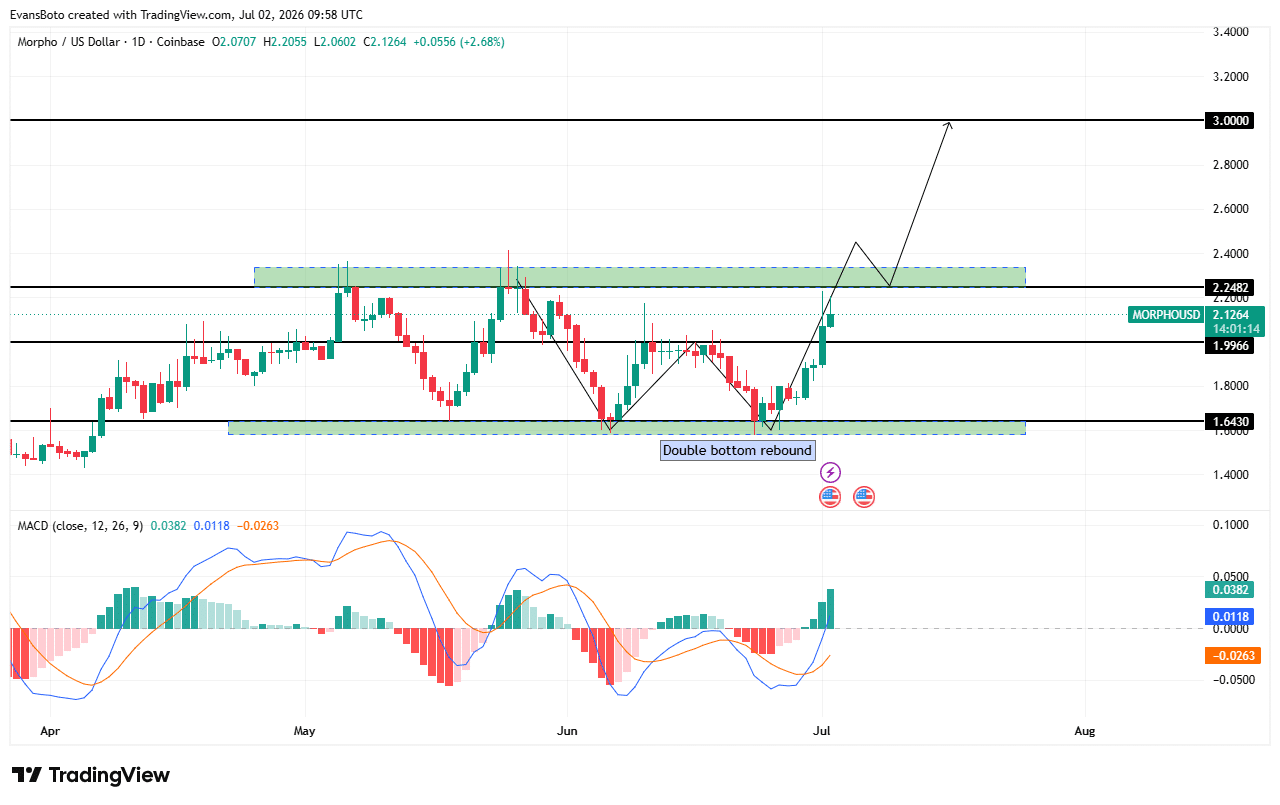
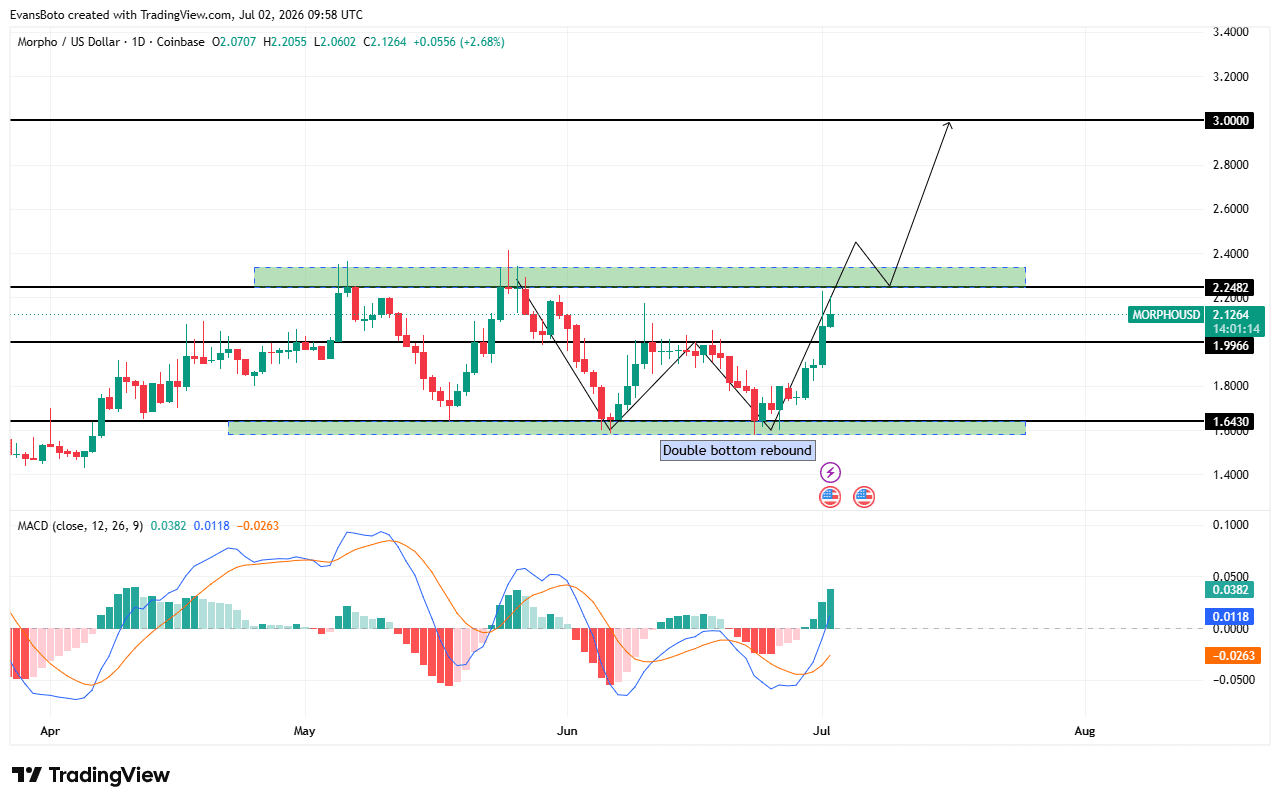
Morpho completed a clear double-bottom reversal after defending the $1.64 support zone twice before recovering sharply.

Price advanced toward the $2.24 resistance area, which previously rejected buyers and now represented the immediate technical hurdle. At the time of writing, the MACD strengthened considerably as the MACD line crossed above the signal line while green histogram bars expanded, confirming improving bullish conditions.

Buyers also reclaimed the $2.00 psychological level, strengthening the short-term market structure. However, the resistance zone around $2.24 continued limiting further gains during the latest session.

A decisive daily close above that level could expose the $3.00 target shown on the chart. Otherwise, the price could revisit the $2.00 support before buyers attempt another breakout.
Source: TradingView

Final Summary

  • Standard Chartered’s coverage boosted confidence as Morpho attracted fresh institutional-focused buying interest.
  • Morpho tested a major resistance after confirming a bullish double-bottom recovery structure.

Trending Cryptos

Related Questions

QWhat was the main catalyst that caused Morpho's (MORPHO) price to rally 14% according to the article?

AThe main catalyst was a report from Standard Chartered assigning a $60 price target for Morpho by 2030, which prompted investors to reassess the protocol's long-term role in tokenized finance.

QWhat does the significant increase in Open Interest (OI) alongside the price rally suggest about market activity?

AThe 19.17% increase in Open Interest (OI) to $39.19 million suggests that fresh capital entered the futures markets, indicating new positions were opened to support the price advance rather than just existing positions changing hands or short covering.

QWhat did the modest negative Netflow on exchanges indicate about holder behavior following the price increase?

AThe modest daily Netflow of -$66.94K indicated that slightly more tokens left exchanges than entered them. This suggests holders were not rushing to transfer assets to exchanges for immediate selling after the rally, aligning with improving market confidence and a willingness to retain exposure.

QWhat is the key technical resistance level that Morpho needs to overcome for further bullish momentum, according to the technical analysis in the article?

AThe key immediate technical resistance level is around $2.24. A decisive daily close above this level could expose a target of $3.00.

QAccording to the article's final summary, what underlying market theme did Standard Chartered's report reinforce rather than promising a rapid price surge?

AThe report reinforced a multi-year adoption thesis built around increasing institutional participation in decentralized lending, boosting long-term confidence rather than creating expectations of an immediate thirtyfold price increase.

Related Reads

Unpacking the Truth Behind On-chain Assets: Leverage, Liquidity, and Risk

The article analyzes the concept of "real-world asset" (RWA) tokenization, arguing that while tokenizing assets on-chain is a useful step, it is far from transformative on its own. The author compares it to placing a barcode on a shipping container—it enables identification but does not build the necessary market infrastructure. The core argument is that true value emerges not from tokenization, but from integrating these tokens into DeFi systems where they can be valued, financed, hedged, traded, and liquidated under stress. Key challenges identified include: 1. **Multiple Time Clocks**: A fundamental tension exists between blockchain's 24/7 settlement and the slower, business-hour-dependent processes of traditional markets, custody, and redemption. This "duration mismatch" can create dangerous liquidity gaps during crises. 2. **Liquidity Misconceptions**: True liquidity is not measured by Total Value Locked (TVL) or trading pairs, but by the ability to exit a position within a required timeframe at an acceptable price. It requires analyzing multiple exit paths and stress-testing scenarios. 3. **Leverage and Risk**: Leverage unlocks economic utility (e.g., using tokenized assets as collateral) but also introduces fragility. Risk models must account for more than asset volatility, incorporating factors like legal enforceability, oracle freshness, and market structure. Paradoxically, a "safer" asset like tokenized Treasury bonds could require a higher collateral discount than ETH due to slower, less-proven liquidation mechanisms. 4. **A Risk Graph**: RWA risk should be modeled as a network of interconnected dependencies (e.g., issuers, custodians, oracles, stablecoin pools), not a single score. Failures can propagate through this graph, turning operational issues into systemic liquidity crises. The article states that tokenized government bonds are merely an entry point, while more complex frontiers like computing power and energy assets present greater challenges and opportunities. It also examines the interplay and risks between tokenized stocks and perpetual futures contracts. The conclusion is that the future lies not in "tokenizing everything," but in building robust market layers where tokenized rights become resilient financial primitives within a programmable capital system. The token is just the barcode; the market is the machine.

marsbit11m ago

Unpacking the Truth Behind On-chain Assets: Leverage, Liquidity, and Risk

marsbit11m ago

The End of Mathematics: 40 Top Mathematicians Gather at Secret OpenAI Meeting

In August 2026, OpenAI hosted a closed-door summit with approximately 40 leading mathematicians, including recent Fields Medalist Jacob Tsimerman and OpenAI researcher Sébastien Bubeck. The meeting, spurred by a series of recent AI breakthroughs in mathematics, grappled with the potential existential threat AI poses to the field. The backdrop includes several high-profile AI achievements: OpenAI models disproving long-standing conjectures like the unit distance problem, generating 10 new mathematical discoveries, and Anthropic's Claude aiding in constructing complex multidimensional objects. These results often bypass traditional academic pipelines, appearing directly on social media. The mathematical community is divided. Over 3000 researchers signed the "Leiden Statement," advocating for responsible AI use and verification. Others resist AI entirely to preserve human-centric mathematics. A key concern is AI's current inability to *explain* proofs, particularly the difficult steps, which is central to mathematical understanding. At the summit, Bubeck outlined four potential futures: mathematics becoming like collaborative software engineering, a compute-driven field like physics, a curatorial exercise where humans interpret AI output, or a mass transition of mathematicians into AI safety. While emphasizing that "mathematics only makes sense when mathematicians learn from it," no consensus was reached. The event highlights a profound moment of reflection. As AI demonstrates increasing competence in solving complex problems, mathematicians are forced to question their future role and the very meaning of their discipline.

marsbit16m ago

The End of Mathematics: 40 Top Mathematicians Gather at Secret OpenAI Meeting

marsbit16m ago

Anthropic's New Models 'Catch the Gossip', The Strongest Fable 5 Unexpectedly Falls Flat

Anthropic has been discovered working on two new, previously unknown models codenamed "Marshmallow" (claude-marshmallow-eap) and "Melon" (claude-melon-eap), with early tests showing Marshmallow potentially surpassing Claude Opus 5 in conversational naturalness. Their emergence coincides with surprising new data revealing that Anthropic's flagship Fable 5 model, released two months ago as its strongest and most expensive offering, is being largely ignored by the enterprise market. According to spending data from Ramp tracking over 70,000 US companies, Fable 5 accounts for only about 11% of total token spending on Anthropic's models. This pales in comparison to OpenAI's flagship GPT-5.6 Sol, which commands roughly 25% of token spending in the same period. The tepid adoption is largely attributed to Fable 5's extremely high cost—double that of Opus 4.8 and ten times that of Haiku 4.5—without delivering proportionally superior performance for most business applications. Compounding the issue, the later-released Claude Opus 5, priced at half the cost of Fable 5, has achieved comparable or even better results in key benchmarks like programming and knowledge work, quickly surpassing Fable 5 in enterprise spending share. Furthermore, the rapid rise of powerful, low-cost open-source models—whose token usage share surged from 11% in April to 62% in August while costing less than 4% of enterprise AI budgets—applies additional pressure. Analysts suggest the sudden appearance of Marshmallow and Melon may be an urgent move by Anthropic to address this gap in its lineup. The goal is to offer models that are not only powerful but also cost-effective enough for businesses to adopt widely and sustainably, moving beyond a flagship that serves more as a showcase than a workhorse.

marsbit16m ago

Anthropic's New Models 'Catch the Gossip', The Strongest Fable 5 Unexpectedly Falls Flat

marsbit16m ago

Three Months After the Passing of Little Dog Rosie, Her Medical Records Transformed into an AI Healthcare Company

Three months after the passing of his dog Rosie, AI entrepreneur Paul S. Conyngham secured $4 million in seed funding from Founders Fund for his new startup, Gamgee. The company aims to industrialize the experimental, AI-assisted process he pioneered to create a personalized mRNA cancer vaccine for Rosie, who suffered from mast cell tumors. With no formal biology background, Conyngham used AI tools like ChatGPT and AlphaFold to analyze Rosie's tumor DNA, identify target neoantigens, and design a custom mRNA vaccine sequence. Laboratory partners at UNSW produced the vaccine. Initial treatment showed tumor reduction, but Rosie's cancer later recurred and she was euthanized. Gamgee's goal is to streamline this "N-of-1" approach into a repeatable service for canine cancer patients, handling sequencing, vaccine design, production, and delivery. Clinical trials are planned in Australia in collaboration with research institutions. The company also eyes a longer-term vision of establishing personalized, mRNA-based medicine across species. The story highlights the broader challenge in personalized cancer treatment: compressing the entire timeline from design and regulatory approval to manufacturing and administration to match the patient's prognosis. While AI can accelerate target discovery, the remaining logistical and regulatory hurdles are significant. The article concludes by emphasizing that, for now, consulting qualified veterinary oncologists remains the responsible path for pet owners.

marsbit26m ago

Three Months After the Passing of Little Dog Rosie, Her Medical Records Transformed into an AI Healthcare Company

marsbit26m ago

Trading

Spot

Hot Articles

Discussions

Welcome to the HTX Community. Here, you can stay informed about the latest platform developments and gain access to professional market insights. Users' opinions on the price of S (S) are presented below.

活动图片