Morgan Stanley Confirms Bitcoin Push: Trading, Yield, Custody

bitcoinistPublished on 2026-02-26Last updated on 2026-02-26

Abstract

Morgan Stanley is expanding its Bitcoin and crypto services beyond basic access, as confirmed by Amy Oldenburg, Head of Digital Asset Strategy. The roadmap includes enabling spot trading for E*TRADE clients via a partnership, with plans to develop an in-house custody and exchange solution within a year. This move aims to position Morgan Stanley as the first major bank to offer such integrated services, emphasizing control, trust, and liability management. The bank is also exploring yield and lending products backed by Bitcoin, responding to client demand and the growth of off-platform crypto assets. Oldenburg highlighted the institutionalization of crypto and cited the bank's previous classification of Bitcoin as "digital gold," recommending a 2%–4% portfolio allocation.

Morgan Stanley is preparing to expand its Bitcoin and crypto offering beyond simple access, with plans that span spot trading on E*TRADE, a longer-term move toward native custody and an internal exchange stack, and early-stage exploration of yield and lending services backed by Bitcoin.

The roadmap was outlined onstage at Strategy World 2026 in Las Vegas by Amy Oldenburg, Morgan Stanley’s head of digital asset strategy, during a discussion with Strategy President and CEO Phong Le at the Bitcoin for Corporations conference.

From ‘Renting’ Bitcoin Rails To Building Them

Oldenburg framed Morgan Stanley’s near-term step as enabling E*TRADE clients to “buy and sell crypto, spot crypto,” via a partnership, before potentially moving to “a native custody and exchange solution” over the next year. She suggested that would put Morgan Stanley in position to be “the first major bank” to offer that combination in-house.

Oldenburg asked why the custody-and-exchange layer matters strategically. The answer, she said, comes down to control, trust, and liability. “It’s a natural. We really need to build this out internally. We can’t just primarily rent the technology to do this,” she said. “People expect Morgan Stanley, they trust our brand, to be no-fail. And when you sit in that position, you have a significant responsibility to your clients to make sure that you’re delivering that in any level of technology.”

For Morgan Stanley, custody is not just another feature in the product checklist, it changes the bank’s role and responsibility. “It’s a totally different environment to know that you are custodying your assets,” Oldenburg continued. “You have legal custody with Morgan Stanley, and Morgan Stanley is overseeing those assets for you. There’s always those that are going to want to self-custody. That’s a natural part of this space, especially in the Bitcoin space.”

Oldenburg also positioned the push as a response to client behavior: crypto wealth exists, but not necessarily where Morgan Stanley can serve it. With “$8 trillion in assets on platform,” Le pressed the commercial logic that “people have crypto assets off platform.” Oldenburg agreed and characterized the pool as material, saying it is “a considerable number” of “current clients.”

Oldenburg linked her thinking on adoption back to her prior career running Morgan Stanley’s emerging markets investing business, arguing she has watched Bitcoin and crypto usage develop up close for years. “This has been a very, very long journey for me, being on the ground with many of these companies and investors and users of cryptocurrencies early on,” she said, adding that the goal now is to provide services as crypto “continues to mainstream and institutionalize.”

Oldenburg confirmed that yield and lending against Bitcoin are not theoretical topics inside the firm. Asked directly whether Morgan Stanley might offer “yield and lending services against that Bitcoin,” she replied: “Absolutely. That’s part of the discussion and the exploration. It’s a natural part of the roadmap to continue to explore.”

She added that the bank is still early in designing those products, while noting renewed activity in onchain credit markets. “I think we’re in a very early journey on that, just in terms of the number of products that are out in the market,” she said. “I think we’ve seen, even this year, a little bit surprised at how much momentum there is around DeFi lending.”

In October last year, Morgan Stanley classified Bitcoin as “digital gold,” citing its fixed supply, decentralized architecture, and perceived role as a hedge against macroeconomic instability. The firm also recommended a 2%–4% allocation to digital assets.

At press time, Bitcoin traded at $68,138.
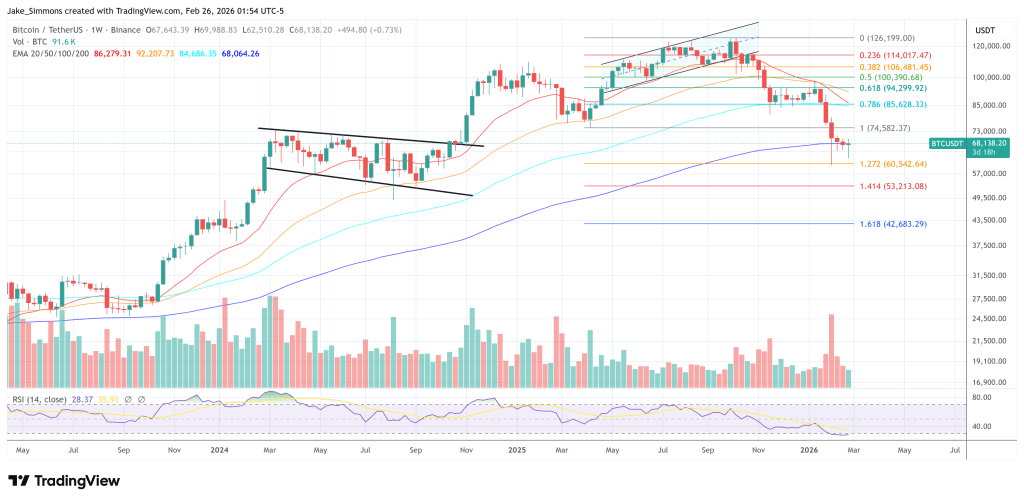
Bitcoin must remain above the 200-week EMA, 1-week chart | Source: BTCUSDT on TradingView.com

Related Questions

QWhat are the key areas of Bitcoin and crypto services that Morgan Stanley is planning to expand into?

AMorgan Stanley is planning to expand into spot trading via E*TRADE, develop a native custody and exchange solution, and explore yield and lending services backed by Bitcoin.

QAccording to Amy Oldenburg, why is building a native custody and exchange solution strategically important for Morgan Stanley?

ABuilding a native custody and exchange solution is strategically important due to control, trust, and liability. It ensures the bank can deliver no-fail technology that aligns with client expectations and the Morgan Stanley brand.

QWhat client behavior did Amy Oldenburg cite as a key reason for Morgan Stanley's expanded crypto offerings?

AShe cited that clients hold significant crypto wealth 'off platform,' which represents a material pool of assets from current clients that Morgan Stanley currently cannot serve.

QBeyond trading and custody, what other Bitcoin-based financial products is Morgan Stanley exploring?

AMorgan Stanley is in the early stages of exploring yield and lending services that are backed by Bitcoin.

QHow did Morgan Stanley classify Bitcoin in a report from October of the previous year, and what allocation did they recommend?

AIn October of the previous year, Morgan Stanley classified Bitcoin as 'digital gold' and recommended a 2%–4% allocation to digital assets.

Related Reads

Near Returns to the AI Stage: Transformation into a Public Chain Due to 'Payroll Difficulties,' Agent and Privacy Emerge as New Growth Narratives

NEAR Returns to AI Origins: From Payroll Struggles to Blockchain, Now Focusing on AI Agents and Privacy NEAR Protocol's journey began not with grand blockchain ambitions, but from a practical hurdle: its AI startup founders, including Transformer paper co-author Illia Polosukhin, couldn't efficiently pay international developers in 2017. This led them to pivot and build a high-performance, scalable blockchain. After years navigating various crypto narratives like sharding and cross-chain interoperability, NEAR is now leveraging its AI roots to re-enter the AI arena. A key driver is its "NEAR Intents" layer, which abstracts complex cross-chain transactions. Users simply state their goal (e.g., swap BTC for ETH), and a solver network finds the optimal route. This system has processed over $20B in cross-chain volume, generating significant fee revenue. A major growth area is private transactions via "Confidential Intents/Swaps," which hide trade details until settlement to protect against MEV and front-running. Remarkably, private swaps recently accounted for over 40% of NEAR's transaction volume, highlighting strong demand but also potential regulatory scrutiny. With its AI-founder pedigree, NEAR is positioning itself at the intersection of blockchain, AI agents, and privacy, aiming to become infrastructure for the emerging agent economy while navigating the challenges of its rapid adoption.

marsbit1h ago

Near Returns to the AI Stage: Transformation into a Public Chain Due to 'Payroll Difficulties,' Agent and Privacy Emerge as New Growth Narratives

marsbit1h ago

From Ethereum to AI's 'CROPS': What Exactly is This Set of 'Slow Variables' That Vitalik Repeatedly Emphasizes?

In recent discussions, Vitalik Buterin has frequently emphasized the concept of "CROPS," a framework defining core values for Ethereum's development. CROPS stands for Censorship Resistance, Capture Resistance, Open Source, Privacy, and Security. Initially outlined in the Ethereum Foundation's "EF Mandate," it represents a commitment to user sovereignty, ensuring that the network resists external control, remains open, protects privacy, and prioritizes security. The relevance of CROPS extends beyond Ethereum's foundational principles, becoming crucial in the context of AI integration. As AI agents begin handling wallet operations and automated transactions, the risk increases that users may cede control over their digital assets, privacy, and intentions to centralized AI service providers. A "CROPS AI" would therefore emphasize local execution where possible, privacy-preserving remote model calls (e.g., using zero-knowledge proofs), and transparent, verifiable processes to maintain user agency. Vitalik highlights a significant convergence between "CROPS Ethereum access layer" and "CROPS AI." Both address the same fundamental challenge: how users can access powerful services—be it blockchain data via RPCs or AI models—without exposing sensitive information or relinquishing ultimate control. This intersection points toward a future digital entry point that is more private, secure, and user-controlled. Ultimately, CROPS is not merely an abstract ideal but a practical guidepost. It steers development—from protocol resilience and wallet design to AI agent safety—towards a future where users retain self-sovereignty even as digital systems grow more complex and powerful. In an era of accelerating AI adoption, these "slow variables" of censorship resistance, openness, privacy, and security may define Ethereum's enduring value.

marsbit1h ago

From Ethereum to AI's 'CROPS': What Exactly is This Set of 'Slow Variables' That Vitalik Repeatedly Emphasizes?

marsbit1h ago

Silicon Valley 'Startup Guru' Steve Hoffman: Web3 + AI Could Be a Trap

Silicon Valley investor and "Godfather of Startups" Steve Hoffman warns that combining Web3 with AI is likely a trap, not a promising venture. In an interview, Hoffman argues that while AI is a foundational technology touching all industries, Web3 adds complexity, friction, and regulatory risk without solving mainstream consumer or business needs. He advises founders to focus on deep, specialized applications where startups can out-iterate giants, rather than on generic features easily replicated by large tech companies. Hoffman observes that Silicon Valley will lead foundational AI research, while China excels at rapid, large-scale application and commercialization, particularly in robotics. He stresses that AI-driven autonomous agents capable of collaborative, multi-step tasks are 2-4 years away, which will cause significant job displacement. The solution is not to slow AI but to redesign business models around human-AI collaboration and reform social systems like education and retraining. For startups, Hoffman recommends focusing on vertical, expertise-heavy domains to build defensibility. He sees major opportunities in AI fraud detection and cybersecurity. Key founder mindsets include systemic thinking over feature-focus, relentless customer centricity, building adaptive teams, and deeply understanding AI's capabilities and limits. Hoffman is also leading a non-profit initiative to establish university centers aimed at training future leaders in responsible, human-value-aligned AI innovation.

marsbit2h ago

Silicon Valley 'Startup Guru' Steve Hoffman: Web3 + AI Could Be a Trap

marsbit2h ago

Token Inefficient, Economy Tokenless

The article "Tokens Aren't Economical, Economics Aren't Tokenized" analyzes a pivotal shift in the AI industry from a technology-driven narrative to one dominated by capital efficiency. It highlights two concurrent trends: a severe capital shortage due to the exorbitant and recurring costs of compute (e.g., OpenAI's high burn rate) and a wave of corporate spin-offs where major tech companies are separating their AI units (like Kuaishou's Kling and Baidu's Kunlunxin). The core argument is that AI's "anti-internet" business model, where user growth increases costs rather than profits, has created a disconnect between high valuations and actual cash flow. Spin-offs address this by allowing AI assets to be valued independently. Within a parent company, they are seen as cost centers, but as standalone entities, they are priced based on their growth potential and scarcity in the primary market, leading to massive valuation premiums (e.g., Kling's estimated value tripling post-spin-off). The industry is at an inflection point, moving from "model worship" to "value realization." The competition is evolving from a pure compute (GPU) race to a broader focus on systemic efficiency and full-stack engineering (involving CPUs and orchestration) to achieve viable commercialization. The year 2026 is framed as a critical moment where the industry must definitively answer how to economically translate AI capability into tangible business value, reshaping the sector's future power structure.

marsbit2h ago

Token Inefficient, Economy Tokenless

marsbit2h ago

Trading

Spot
Futures

Hot Articles

How to Buy PUSH

Welcome to HTX.com! We've made purchasing Push Protocol (PUSH) simple and convenient. Follow our step-by-step guide to embark on your crypto journey.Step 1: Create Your HTX AccountUse your email or phone number to sign up for a free account on HTX. Experience a hassle-free registration journey and unlock all features.Get My AccountStep 2: Go to Buy Crypto and Choose Your Payment MethodCredit/Debit Card: Use your Visa or Mastercard to buy Push Protocol (PUSH) instantly.Balance: Use funds from your HTX account balance to trade seamlessly.Third Parties: We've added popular payment methods such as Google Pay and Apple Pay to enhance convenience.P2P: Trade directly with other users on HTX.Over-the-Counter (OTC): We offer tailor-made services and competitive exchange rates for traders.Step 3: Store Your Push Protocol (PUSH)After purchasing your Push Protocol (PUSH), store it in your HTX account. Alternatively, you can send it elsewhere via blockchain transfer or use it to trade other cryptocurrencies.Step 4: Trade Push Protocol (PUSH)Easily trade Push Protocol (PUSH) on HTX's spot market. Simply access your account, select your trading pair, execute your trades, and monitor in real-time. We offer a user-friendly experience for both beginners and seasoned traders.

3.6k Total ViewsPublished 2024.03.29Updated 2026.06.02

How to Buy PUSH

Discussions

Welcome to the HTX Community. Here, you can stay informed about the latest platform developments and gain access to professional market insights. Users' opinions on the price of PUSH (PUSH) are presented below.

活动图片













