More Popular Than SpaceX, Oversubscribed by Over 6586 Times, What's the Meme Power Behind Liuliumei (06658.HK)?

Odaily星球日报Published on 2026-06-15Last updated on 2026-06-15

Abstract

Titled "More Popular than SpaceX, Over 6586 Times Oversubscribed: What's the Meme Power Behind Liuliumei (06658.HK)?", this article discusses the phenomenon of "stock memefication" through the case of Liuliumei's IPO. The Chinese snack company saw its stock price surge over 190% on its Hong Kong debut, fueled not by fundamentals but largely by a viral meme. Its stock ticker abbreviation "06658.HK" was humorously linked to "LLM" (Large Language Model), coinciding with a rally in AI-related stocks like Zhipu AI. This mirrors a broader trend where stocks gain traction based on internet jokes,谐音梗 (homophonic puns), celebrity mentions, or cultural moments—similar to meme coins in crypto. Examples include Gamestop's 2021 short squeeze, Trump-related stock movements ("川大智胜"), and "孚日股份" (interpreted as "capture Japan"). The article argues global markets are entering an era where attention and social media narratives can drive significant capital flows, blurring lines between traditional finance and meme culture. While offering quick gains, this trend also carries risks like pump-and-dump schemes. Liuliumei's explosive IPO, surpassing even蜜雪冰城's subscription record, exemplifies how meme-driven attention is being converted into market volatility and liquidity in today's fragmented, emotion-driven investment landscape.

Original|Odaily Planet Daily(@OdailyChina)

Author|Wenser(@wenser2010 )

"Are you okay? Okay? Okay? Then eat some Liuliumei!"

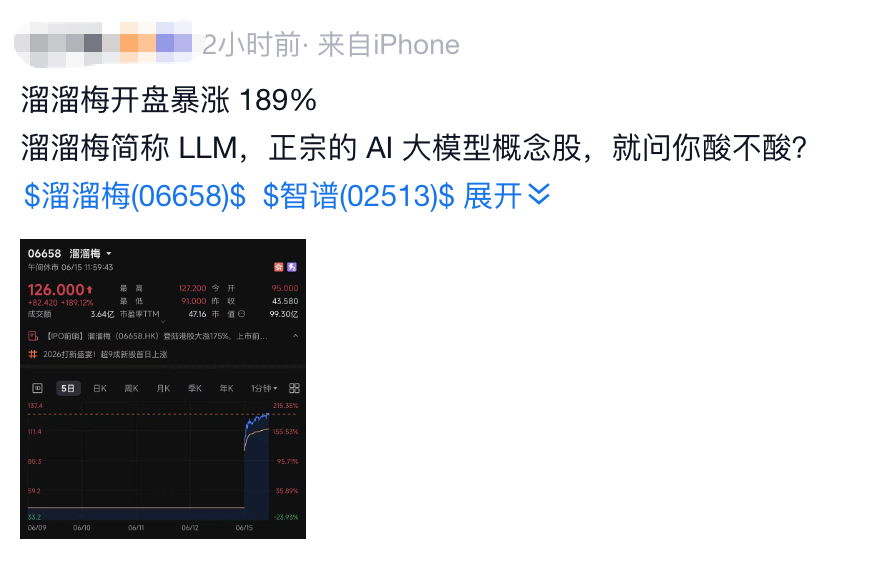
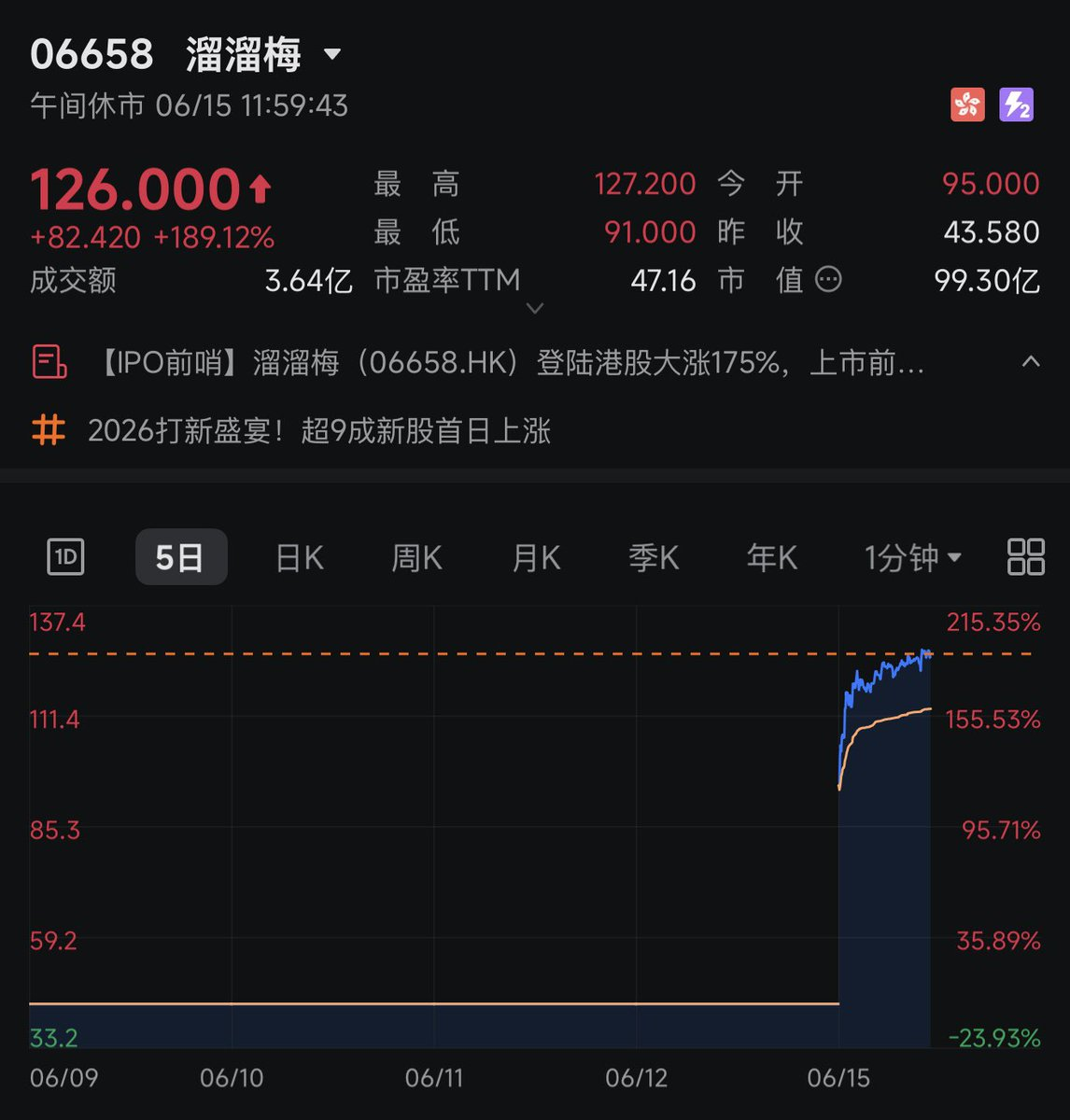
Once upon a time, a brainwashing commercial line from actress Yang Mi brought Liuliumei into thousands of households. Today, after decades of accumulation, the company behind it finally officially listed on the Hong Kong Stock Exchange, becoming the "first stock of plum snacks" on HKEx. It is reported that its issue price was HKD 43.58, the opening price was HKD 95, a surge of approximately 116% from the offering price of HKD 42; the intraday high reached HKD 127.50, an increase of over 190%; it has now pulled back to HKD 125, still up over 186%.

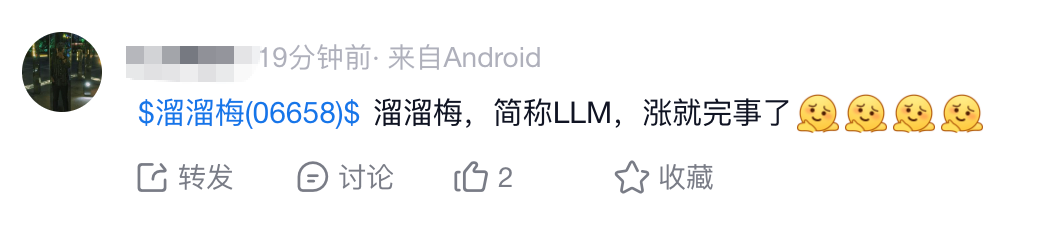
But contrary to many expectations, the stock price surge of Liuliumei (06658.HK) is not a revival of the concepts of "new consumption, new retail, new snacks." Instead, its name initials coincidentally align with the hot topic of "LLM" (Large Language Model), riding on the wave of today's 45% surge in Zhipu AI (02513.HK).

Many call it an "authentic AI Large Language Model stock," attracting countless hot money and capital inflows. Whether acknowledged or not, global stock markets may be entering the "Stock Meme-ification Era."

The New Era of Global Stock Markets: When Stocks Collide with Memes

First, the basics of Liuliumei's IPO: This was Liuliumei's fourth attempt at a capital market listing.

In 2019, its attempt to list on the A-share market failed; in 2025, its two applications to list on HKEx lapsed; it wasn't until May 21 this year, after updating its listing application materials for the third time and changing its main entity name from "Liuliumei Group Co., Ltd." to "Liuliumei Co., Ltd.," that it successfully listed in less than a month. It must be said, sometimes naming can be a mysterious thing.

According to the company's allocation results announcement, the public offering portion of this IPO recorded an oversubscription of approximately 6586.73 times. The final number of shares offered publicly was 1.1465 million, accounting for approximately 10% of the total global offering. There were approximately 180,500 valid applications received, with about 11,465 applications accepted. The ratio of allotment for one lot application was only 1.5%, meaning the one-lot winning rate was as low as 1.5%, indicating extremely fierce competition for subscription. Regarding the international placement, Liuliumei received a subscription of 2.64 times. The final number of international offering shares was 10.3176 million, accounting for 90% of the total offering shares. Comparing this data, the popularity of Liuliumei's IPO has surpassed that of "the first stock of milk tea stores by outlet number" Mixue Ice City, which listed on HKEx in March last year with a public offering oversubscription multiple of 5258.21 times.

In other words, institutions were not optimistic but held 90% of the shares; retail investors were optimistic but only held 10% of the shares. The main driving force behind the opening surge came more from the free market play of "retail investors and market makers dancing together." And this is precisely the power of "Meme stocks"—transforming the attention attracted by memes into buying power in the capital market.

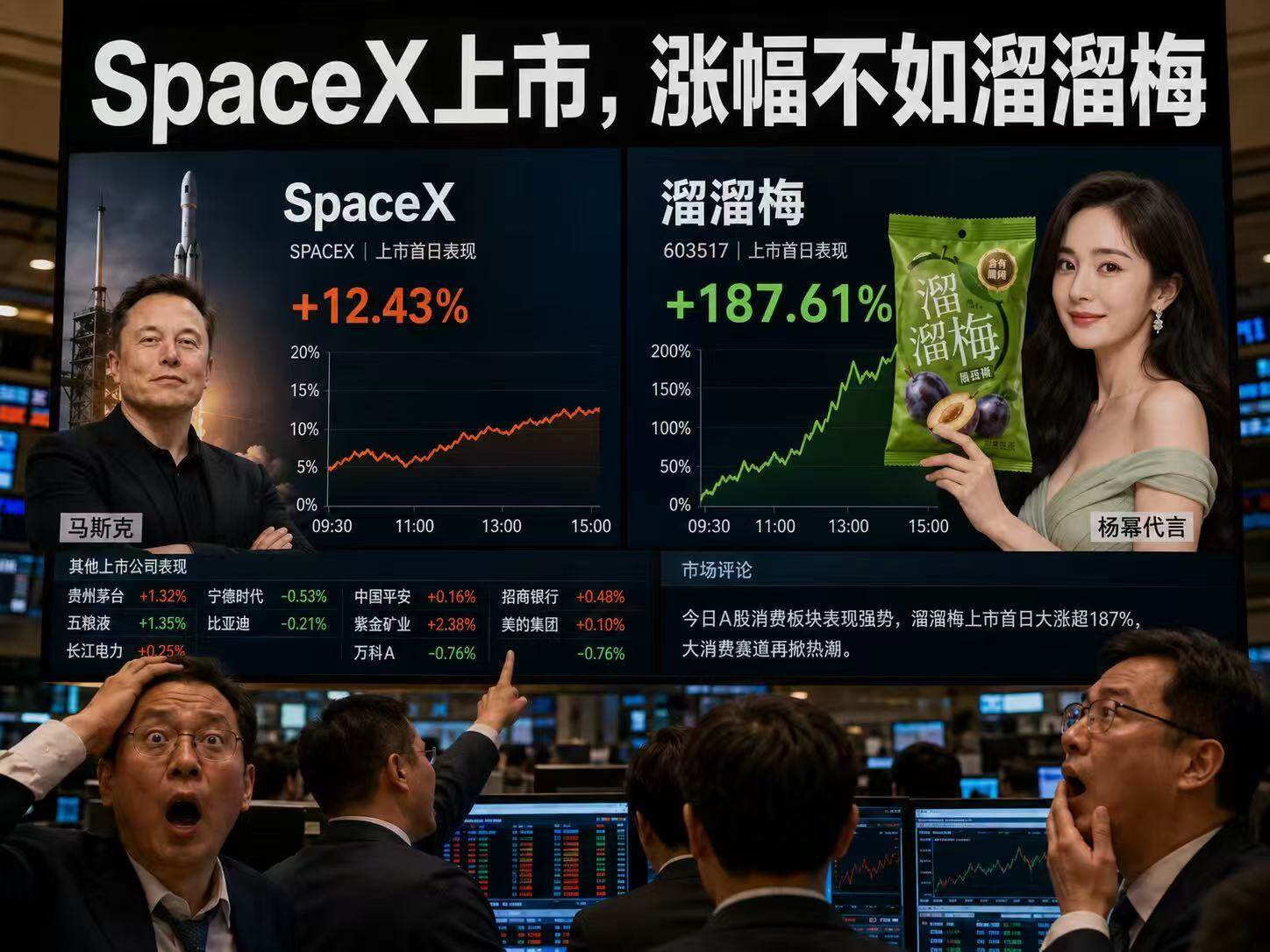
Some netizens even compared Liuliumei's opening performance to SpaceX, finding its market gains far more dazzling.
It is worth mentioning that "Meme stocks" is not a new term that recently appeared; they are an objectively existing category of stocks in major capital markets like the US, Hong Kong, and A-shares. However, the "Stock Meme-ification Era" is undoubtedly the latest trend emerging in the past 1-2 years, and its driving factors are also somewhat related to the crypto market.
The earliest Meme stocks are untraceable, so we'll only discuss some representative individual stock targets in recent years.

2021's Gamestop might be the starting point of Meme stock enlightenment for many in the US market. Led by well-known retail investors like Roaring Kitty, global retail investors united against Wall Street institutional capital, forcing a short squeeze that led many brokerage platforms and exchanges to "pull the plug" to avoid the storm. Recently, rumors of Gamestop acquiring eBay also caused market fluctuations and a temporary surge in its stock price.

Tesla and the recently IPO'd SpaceX have also been viewed as a type of Meme stock because both companies and stocks are strongly associated and deeply bound with the highly topical "world's first trillionaire" Elon Musk. Before the companies' businesses provided strong performance proof, they were considered "narrative-driven companies with sky-high dream valuations."

Before Donald Trump won the US presidential election in 2024, the A-share market had already started moving. "Chuanda Zhisheng" frequently topped platform trending lists and even experienced multiple limit-up days. That year, during Trump's campaign, an assassination attempt left his ear scratched by flying glass from a bullet. Stock "Goertek" (homophone for "cut ear") was also affected and saw a surge during trading.

Last year, when Sino-Japanese diplomatic relations deteriorated, the defense stock "Furi Shares" experienced a dramatic stock price surge due to the patriotic homophone pun "capturing Japan" (孚日 sounds like 'capture Japan'), pulling up for eight consecutive trading days, with cumulative gains exceeding 100%, becoming one of the short-term "monster stocks" in the A-share market.

In today's capital markets, similar to the crypto market with its fragmented attention and concentrated emotions, individual stock targets and sector themes that can spark the widest discussion and attention have become "attention foci" that stir up funds and liquidity.
Liuliumei's surge is also a prime example of the "Stock Meme-ification" era.

The Stock Meme-ification Era Begins: Homophone Puns, Abbreviations, AI Era Dividends

As the valuations of OpenAI and Anthropic rise close to the trillion-dollar scale, companies and stocks related to the AI industry chain—such as optics, communications, materials, and computing power—have successively entered an explosive growth period:

  • NVIDIA became the first listed company with a market cap exceeding $5 trillion;
  • Micron, SanDisk, etc., saw their stock prices break new highs consecutively, with institutions raising their bullish price targets;
  • The stock price fluctuations of SK Hynix and Samsung Electronics dictate the rises and falls of South Korea's KOSPI index;
  • A single statement from Nvidia's founder about "seeing Marvell as a future trillion-dollar giant" caused Marvell (MRVL) stock to rise accordingly;
  • Innolight (Zhongji Xuchuang) mentioned by the new stock god Serenity was misread due to translation issues as "Inno Laser," causing the latter's stock price to surge 10% due to an influx of 300 million hot money.

In the great tide of the "Stock Meme-ification" era, being associated with AI,蹭上 (catching the heat) of "large language models," having homophones with popular targets, or receiving mentions from celebrities have all become reasons for market attention and the best stage for the simultaneous influx of attention and capital.
"Trump concept stocks," "US stock government concept stocks," "TACO-style trading beneficiary targets," etc., are also manifestations of this industry trend. This is precisely the common play in the "attention-intensive industry" highly advocated by the crypto market—the Meme coin sector.

However, the capital markets are different now, the market rules are different, and the scale of funds and liquidity is also incomparable to the crypto market. After all, compared to the trading scale of the US, Hong Kong, A-share, and Japan/South Korea stock markets, the crypto market's total size of less than $3 trillion looks somewhat pitiful.

SpaceX, upon listing, immediately jumped into the top 10 of global major asset rankings. In contrast, BTC has fallen to the 17th position on that list. It must be said, numerical comparisons always look this cruel—over a decade of diligent development in the crypto industry is worth less than the market cap of one company's IPO.

Now, the emergence and increase of Meme stocks may have become an industry trend. The earlier incident where Joyoung Company produced corresponding products and saw its stock price rise due to the viral meme "North-South Mung Beans Hachimi" already illustrates one thing: for the younger generation and investor groups in today's society, investment targets that can trigger emotional fluctuations, attract market attention, and stir liquidity are more worthy of buying.

Even if this fleeting chasing sentiment is just a momentary frenzy, for most people, if you can't beat them, join them is the better choice. Of course, objectively speaking, the emergence of Meme stocks does not mean one-sided benefits, such as wealth creation effects or industry booms. Sometimes, this process is accompanied by negative phenomena like pump-and-dump schemes, one-sided harvesting, and emotional marketing.

Just like Liuliumei's opening surge, some angrily criticize it as a "pump to dump" scheme; others analyze that perhaps it's because Liuliumei joined the "Stock Connect" program, allowing A-share market funds to buy in, that pushed its stock price up. The truth and reasons are certainly multidimensional and chaotic. For us, perhaps all we can do is go with the flow of this era and find our own path to prosperity.


Related Questions

QAccording to the article, what is the main reason behind the surge in Liuliumei's stock price on its IPO day?

AThe main reason is that its stock ticker abbreviation 'LLM' coincidentally matches the acronym for 'Large Language Model', allowing it to ride the hype of the AI and LLM trend, making it a so-called 'Meme stock'.

QHow does the article describe the level of oversubscription for Liuliumei's IPO public offering?

AThe article states that the IPO's public offering portion was oversubscribed by approximately 6586.73 times, indicating extremely high retail investor demand.

QWhat comparison does the article make to illustrate the concept of 'Meme stocks' besides Liuliumei?

AThe article mentions several examples: GameStop in 2021, Tesla and SpaceX associated with Elon Musk, '川大智胜' and '歌尔股份' in the A-share market related to Donald Trump events, and '孚日股份' due to a patriotic homophonic pun.

QWhat is the article's view on the relationship between the rise of 'Meme stocks' and the cryptocurrency market?

AThe article suggests that the trend of 'stock Meme-ization' is partly influenced by the cryptocurrency market, which pioneered the 'attention-intensive' model of meme coins. However, it notes that traditional stock markets have vastly larger capital scales than the crypto market.

QWhat potential risks or negative aspects does the article associate with the 'Meme stock' phenomenon?

AThe article points out that the Meme stock trend is not without downsides. It can be accompanied by negative phenomena such as 'pump and dump' schemes, one-sided harvesting of retail investors, and emotional marketing, rather than representing genuine value creation or industry growth.

Related Reads

pump.fun's New Feature Brings 'Black Mirror' Into Reality

The article begins by recounting a dark fictional story from *Black Mirror* (Season 7, Episode 1 "Common People"), where a man is forced to perform humiliating tasks online to pay for his wife's life-sustaining medical subscription. It then draws a parallel to a new real-world feature on the crypto platform pump.fun called "Pump.fun Go," which allows users to post and complete paid bounty tasks. This feature gained mainstream attention, often negatively, through extreme examples. A prominent case involved a bounty of 40 SOL (~$2,600) offered to permanently tattoo "$bountywork" on one's forehead. An Indian man completed the task, stating the money "changed his life," and later earned significantly more from a related meme coin. Another bounty paid 200 SOL (~$14,000) for a "bounty.fun" forehead tattoo, with the participant simply stating, "We need the money." The article highlights how this system can amplify darkness, citing the dev behind $Bountywork who spent thousands on bounties for attention-grabbing stunts like eating bugs or drinking hot sauce for small sums. It compares this to past tragic live-streaming incidents where people harmed themselves for money, noting regulation cannot stop those in desperate need. However, it also points to positive, altruistic bounties that have emerged, such as organizing anti-work rallies in New York, performing random acts of kindness for strangers, organizing community food drives, or even helping an elderly person cross the street. The piece concludes by acknowledging the platform reflects both the dark and light sides of human nature when actions are given a price, hoping for more of the latter.

marsbit4m ago

pump.fun's New Feature Brings 'Black Mirror' Into Reality

marsbit4m ago

As the US and Japan Hike Interest Rates, Which Asset Class is Most at Risk?

This week, global markets face two major events: the Bank of Japan's likely interest rate hike and the US Federal Reserve's FOMC meeting. For risk assets, it is a pivotal and volatile week. In the US, expectations for rate cuts have faded dramatically. May's higher-than-expected CPI and resilient jobs data have shifted the Fed's focus from potential cuts to the possibility of future hikes. New Fed Chair Wash is unlikely to raise rates at this meeting, but any hawkish shift in communication, the dot plot, or the policy statement could lead markets to price in tighter policy, pushing up short-term Treasury yields and strengthening the dollar. High-valuation growth stocks, AI-related assets, and small-cap stocks reliant on cheap funding are most vulnerable to rising rates. In Japan, a 25 basis point hike is almost fully priced in (98.3% probability), which would bring the policy rate to 1%, its highest since 1995. The concern is not the hike itself, but its potential to unwind the massive "carry trade," where investors borrowed low-yielding yen to invest globally. Historically, Japan's rate hikes have coincided with global market stress (2000, 2007, 2024). While this well-telegraphed hike may be digested smoothly, two key factors increase uncertainty: 1) Governor Ueda's absence due to illness, putting communication in the hands of less-familiar deputies, and 2) the Fed meeting occurring just days later, creating potential for a compounded market reaction if both central banks sound hawkish. Asset implications: * **Bonds:** US short-term yields sensitive to Fed signals. Japan's rate hike could pressure its massive US Treasury holdings. * **Currencies:** Dollar likely supported by Fed; Yen's reaction hinges on BoJ's forward guidance. * **Equities:** US growth stocks, small-caps most at risk. Japanese stocks face pressure from a stronger yen. * **Crypto:** Assets like Bitcoin face headwinds from higher rates and tighter liquidity; high-beta altcoins are even more vulnerable. The convergence of these two central bank meetings amplifies market volatility risks, with potential spillovers across asset classes globally.

marsbit9m ago

As the US and Japan Hike Interest Rates, Which Asset Class is Most at Risk?

marsbit9m ago

Data Decrypts the BTC Cycle: Three Major Bottom Signals Illuminate Simultaneously, Q4 Could Be a Crucial Turning Point Window?

"Decoding the Bitcoin Cycle: Three Bottom Signals Flash Simultaneously, Is Q4 the Key Turning Point?" The article analyzes Bitcoin's current market position, comparing it to historical cycles. BTC has corrected over 52% from its October 2025 peak of $126,198 to around $59,100 in June 2026. While significant, this drawdown is milder than the 77-86% declines seen in past bear markets. The analysis is framed within Bitcoin's four-year halving cycle. Past cycles show a pattern: prices peak 12-18 months post-halving, bottom 12-14 months after the peak, with lows typically occurring roughly 17 months before the next halving. Following the April 2024 halving and the October 2025 peak, this pattern suggests a potential bottoming window around Q4 2026, ahead of the expected 2028 halving. Three key on-chain metrics are signaling undervaluation: The MVRV Z-Score has dropped near 0.27, approaching historic bottom zones. The market price is only about 9% above the network's average realized price of ~$53,600, a rare low premium. Bitcoin's price recently touched its 200-week moving average (~$62,200), a level that aligned with bottoms in 2015, 2018, and 2020. While US spot Bitcoin ETFs saw record outflows in May/June 2026, indicating retail panic, whale addresses (holding 100+ BTC) reached a yearly high. Entities like MicroStrategy resumed buying, and long-term holders control a near-record 78% of the supply, suggesting accumulation. A major macro overhang was partially removed with a US-Iran ceasefire agreement in mid-June 2026, which eased oil prices and triggered a sharp BTC rally. However, persistent inflation means high-interest rates remain a constraint. The conclusion notes that genuine investment opportunities often arise when confidence is lowest, amidst narratives that "this time is different." While not guaranteeing an immediate bottom, the confluence of cycle timing, undervaluation signals, and shifting macro risks suggests late 2026 may be a critical period for reassessing risk/reward and patient accumulation for long-term believers.

marsbit9m ago

Data Decrypts the BTC Cycle: Three Major Bottom Signals Illuminate Simultaneously, Q4 Could Be a Crucial Turning Point Window?

marsbit9m ago

Trading

Spot
Futures

Hot Articles

Discussions

Welcome to the HTX Community. Here, you can stay informed about the latest platform developments and gain access to professional market insights. Users' opinions on the price of MEME (MEME) are presented below.

活动图片