Momentum Shifts in Solana’s Favor as Price Defends Critical Support Zone

bitcoinistPublished on 2026-01-06Last updated on 2026-01-06

Abstract

Solana (SOL) has entered 2026 with renewed bullish momentum as its price stabilizes above the critical $130–$135 support zone, a level that previously acted as resistance. Currently trading above $135, SOL has recorded modest gains, with technical indicators like the RSI and MACD suggesting growing buying pressure. Key resistance lies between $138 and $145, with a break above potentially targeting $150–$155. The positive price action is supported by strong on-chain activity, including $1.6 trillion in spot trading volume processed in 2025, accounting for 12% of total crypto market activity. Network upgrades like Firedancer aim to enhance transaction speed and stability, addressing past congestion issues. With improved fundamentals and technical structure, Solana's outlook appears increasingly favorable.

Solana (SOL) has entered 2026 with renewed attention from traders as its price stabilizes above the $130 technical area. After weeks of sideways movement, SOL has pushed higher, reclaiming levels that had previously capped upside attempts.

Related Reading: 600,000 Bitcoin Allegedly Held In Venezuelan Shadow Reserve: Report

The move comes amid broader strength across major cryptos and follows a period where Solana’s on-chain activity and network upgrades have reshaped how the market views the asset. With price holding above a critical support zone, market participants are now watching whether momentum can sustain a deeper recovery.
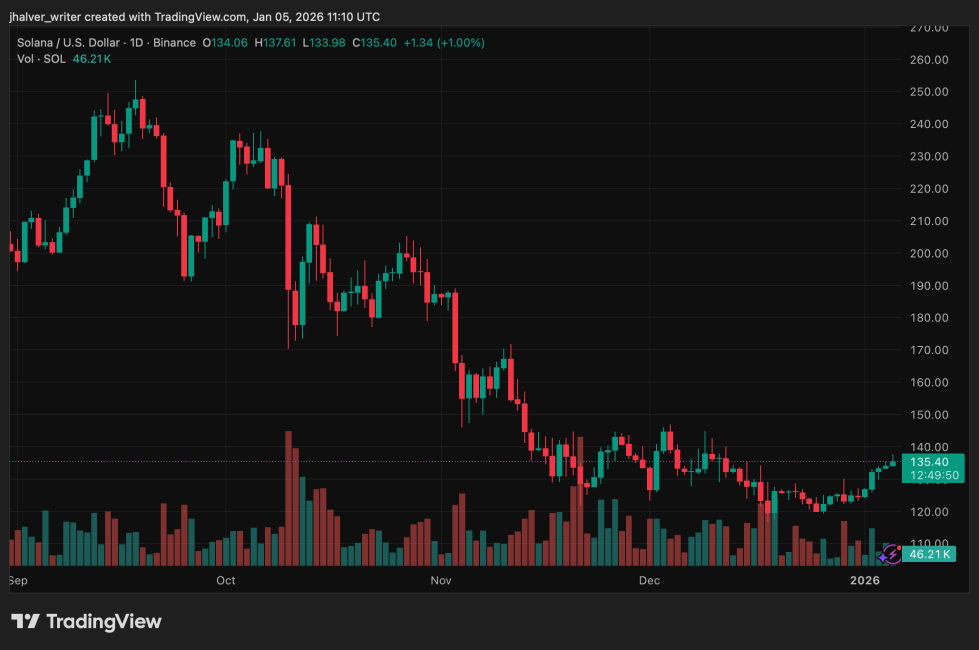
SOL's price records some gains on the daily chart. Source: SOLUSD on Tradingview

Solana Price Holds Above Key Levels as Momentum Builds

Solana (SOL) is currently trading above the $135 mark, extending gains of just over 1% in the past 24 hours. The price has successfully defended the $130–$135 zone, an area that previously acted as resistance during consolidation.

A break above $132 and the 100-hour simple moving average signaled a short-term trend shift, allowing buyers to push the price as high as $138 before a modest pullback.

Technical indicators point to improving momentum. The Relative Strength Index remains above 50, suggesting buying pressure outweighs selling interest, while the hourly MACD continues to strengthen in bullish territory.

A rising trend line around $135 now serves as near-term support, with additional downside protection near $130. Failure to hold this level could expose SOL to a deeper retracement toward $128 or $120, but for now, the structure favors stability.

On the upside, resistance remains clustered between $138 and $145. A sustained close above $145 would likely open the door to a move toward the $150–$155 range, a zone last tested during previous rally attempts.

On-Chain Activity Signals a Structural Shift

Beyond price action, Solana’s on-chain metrics continue to draw attention. In 2025, the network processed roughly $1.6 trillion in on-chain spot trading volume, accounting for about 12% of total spot activity across crypto markets.

This represents a sharp increase from just a few years ago, when Solana played a minor role in trading flows.

The shift highlights a broader trend toward high-throughput blockchains as traders and applications prioritize speed and lower transaction costs. Growing stablecoin usage and decentralized exchange activity on Solana have helped anchor liquidity on-chain, reducing reliance on centralized platforms.

Network Upgrades Support the Broader Outlook

Solana’s technical progress also underpins the recent price resilience. The rollout of the Firedancer validator client aims to improve transaction processing and network stability, addressing concerns linked to past congestion and outages.

Alongside increased block space and compute capacity, these upgrades are designed to support higher activity without significant fee pressure.

As Solana expands across payments, NFTs, gaming, and prediction markets, its usage base has become more diversified.

Related Reading: Crypto Payments Hit A Turning Point With Visa Card Use Up Over 500%

While short-term volatility remains part of the landscape, the combination of defended support, improving technical signals, and strengthening fundamentals suggests momentum has shifted modestly in Solana’s favor.

Cover image from ChatGPT, SOLUSD chart from Tradingview

Trending Cryptos

Related Questions

QWhat critical support zone is Solana's price currently defending?

ASolana's price is defending the $130–$135 support zone.

QWhat on-chain trading volume did the Solana network process in 2025, and what percentage of the total crypto market did it represent?

AThe Solana network processed roughly $1.6 trillion in on-chain spot trading volume in 2025, accounting for about 12% of total spot activity across crypto markets.

QWhat is the name of the new validator client that aims to improve Solana's transaction processing and network stability?

AThe new validator client is called Firedancer.

QAccording to the technical indicators mentioned, what does the Relative Strength Index (RSI) being above 50 suggest?

AThe RSI being above 50 suggests that buying pressure outweighs selling interest.

QWhat price range is identified as the next key resistance level that could open the door to a move toward $150–$155?

AResistance is clustered between $138 and $145. A sustained close above $145 would likely open the door to a move toward the $150–$155 range.

Related Reads

How Does Codex Use a Computer? Three Entry Points and Permission Boundaries

This article explains the three primary methods for Codex to interact with a computer, each with distinct use cases, permission boundaries, and trust levels. **1. Computer Use:** This offers the broadest access, allowing Codex to visually control and interact with the graphical user interface of authorized macOS/Windows apps, system settings, and even iOS simulators. It's ideal for tasks lacking APIs or structured tools, such as operating legacy software or multi-app workflows. However, it's the slowest method and has the widest permission scope, requiring careful supervision for sensitive actions. **2. Chrome Extension:** This grants Codex access to the user's logged-in Chrome browser state, including cookies, profiles, and open tabs. It's best for tasks requiring user identity across websites like Gmail, LinkedIn, Salesforce, or internal dashboards. Its key advantage is multi-tab control for complex workflows. While more powerful for browser-based tasks than Computer Use, it carries higher sensitivity as actions are performed under the user's identity. **3. In-App Browser:** This is a browser isolated within the Codex thread, separate from the user's personal browsing data. It excels in web development and debugging scenarios—previewing local servers, testing responsive layouts, or annotating designs directly on the page. Its isolation is a strength for development but a limitation for tasks requiring login sessions. The core principle is to choose the narrowest, safest, and most structured interface for the task. Use plugins or MCPs first, resort to visual control (Computer Use) only for GUI-dependent tasks, employ the Chrome extension for identity-reliant browser work, and prefer the In-App Browser for isolated development. **Appshots** are clarified as a fourth, complementary tool for *inputting* context—capturing a screenshot of a window to point Codex to something—rather than a method for Codex to *act*. Together, this layered approach highlights a key to AI agent productization: not granting unlimited permissions, but constraining them within clear boundaries for specific tasks while preserving user oversight.

marsbit34m ago

How Does Codex Use a Computer? Three Entry Points and Permission Boundaries

marsbit34m ago

The "Iron Rule" of Chip Equipment Is Being Broken

For years, the semiconductor equipment industry followed an unwritten "iron rule": suppliers offered steep discounts for new tool introductions (Design-in) and faced consistent price pressure during repeat orders, especially during market downturns. This long-standing buyer's market dynamic is now being upended. Recently, SK Hynix's primary equipment suppliers have reportedly requested a 3-4% price *increase*, a nearly unprecedented move. This shift is driven by a severe supply-demand imbalance fueled by the AI compute boom. Securing equipment has become an urgent arms race as chipmakers' expansion speed dictates their ability to fulfill massive AI chip orders. Key areas feeling the strain include: **TCB (Thermal Compression Bonding) Equipment:** Demand is exploding, driven by the simultaneous needs of HBM4 memory stacking, AI chip Chip-on-Substrate (C2S), and logic Chiplet Chip-on-Wafer (C2W) packaging. Players like Hanmi Semiconductor, Hanwha Semitech, and ASMPT are receiving major orders. While hybrid bonding is seen as the future, TCB remains the pragmatic choice for HBM4 mass production, with its lifecycle extended by relaxed specifications and ongoing technological upgrades. **Test Equipment Bottlenecks:** Ironically, AI-driven shortages are now crippling test equipment manufacturing. Critical components like FPGAs, Driver ICs, and CPUs face severe shortages and extended lead times (up to 52 weeks for FPGAs), as AI data center and server vendors prioritize supply. This creates a paradoxical cycle: AI chip shortages drive fab expansion, which requires more test equipment, whose production is delayed because its key parts are diverted to make AI chips. The industry is entering a broad, AI-powered upcycle. SEMI forecasts global semiconductor equipment sales to hit a record $156 billion by 2027, fueled by investment in advanced logic/foundry, HBM-driven DRAM, and advanced packaging (like CoWoS). Major players like TSMC, SK Hynix, and Micron are aggressively ramping capital expenditure. In conclusion, leading equipment vendors are no longer just selling tools; they are selling the critical capability to deliver AI-era capacity. Pricing power is shifting decisively to those with indispensable technology in key process nodes like advanced logic, HBM, and advanced packaging, rewriting the industry's traditional power structure.

marsbit47m ago

The "Iron Rule" of Chip Equipment Is Being Broken

marsbit47m ago

Trading

Spot
Futures

Hot Articles

Discussions

Welcome to the HTX Community. Here, you can stay informed about the latest platform developments and gain access to professional market insights. Users' opinions on the price of S (S) are presented below.

活动图片