Author: Jae, PANews
In traditional financial markets, high-frequency trading firms are willing to spend tens of millions of dollars laying dedicated fiber optic cables or even renting microwave towers to shave milliseconds off the signal transmission time between Chicago and New York. It's a pure physical race: whoever is closer to the exchange's data feed grabs the price and executes the trade first.
Now, Hyperliquid has brought this race on-chain and rewritten the rules. No more laying cables, no more renting towers. Traders simply need to pay HYPE tokens to 'cut in line' in the queue for data propagation and order matching.
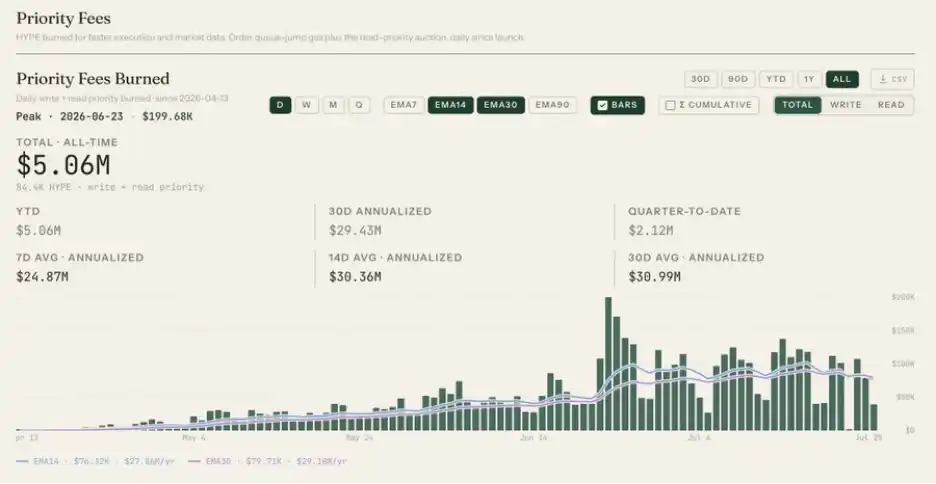
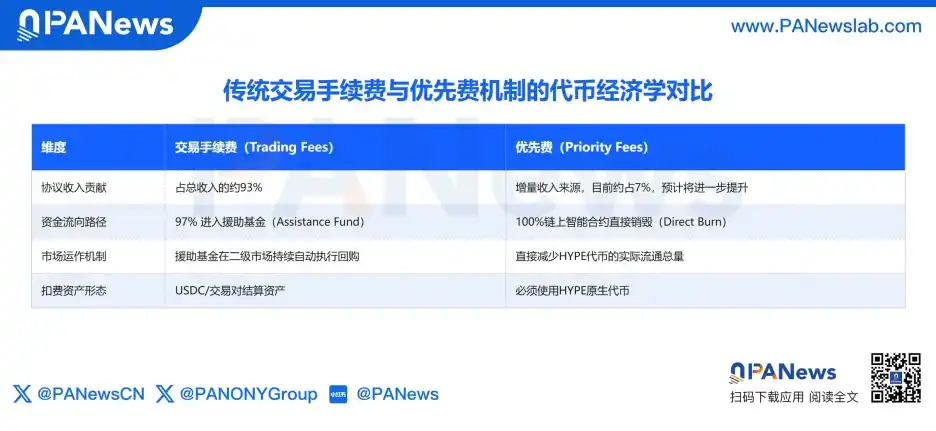
According to data from crypto research firm GLC Research, this mechanism, named 'Priority Fee,' has generated over $5 million in cumulative protocol revenue since its launch. Based on the 14-day and 30-day averages, the annualized buyback scale supported by Priority Fee revenue would exceed $30 million, accounting for roughly 7% of the protocol's total revenue.
This is more than a simple feature iteration; it also marks the first time a Perp DEX (Decentralized Perpetual Contract Exchange) has gained the ability to directly monetize MEV (Maximal Extractable Value) through block space and latency pricing, similar to public chains like Ethereum and Solana.
Dual-Track Architecture: Splitting Millisecond Latency into Two Auction Items
In traditional centralized exchanges, the speed advantage of HFT firms comes from physical leased lines, colocation servers, and hardware arms races. In the on-chain world, Hyperliquid has transformed this 'millisecond war' into a public, transparent economic gaming system.
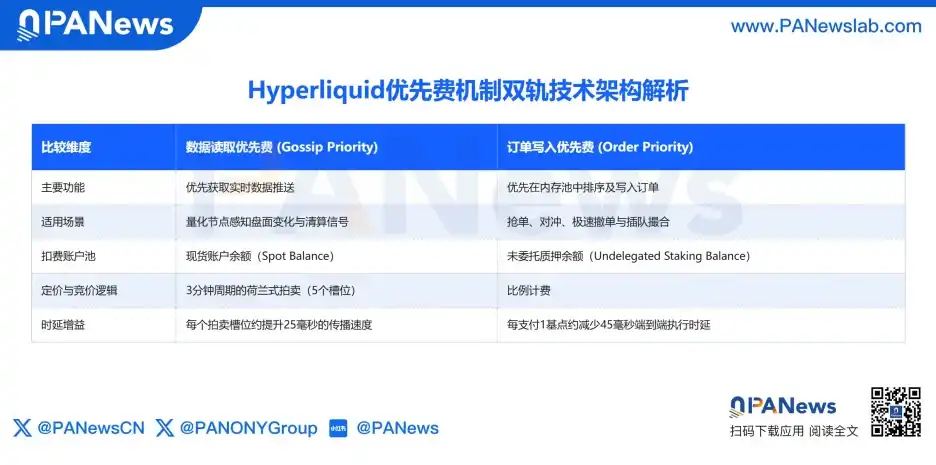
The Priority Fee is not simply 'paying higher gas to cut the line.' It's a latency auction and mempool restructuring system tailored for a decentralized order book (CLOB), consisting of two independent technical tracks: 'Data Reading Priority' and 'Order Writing Priority,' addressing the two core demands of high-frequency quantitative institutions for 'information perception' and 'trade execution.'
Data Reading Priority (Gossip Priority): Bidding for Information First-Mover Advantage
For high-frequency quantitative strategies, perceiving market changes or liquidation signals dozens of milliseconds earlier means making decisions a step sooner; victory or defeat often hinges on a split second.
Hyperliquid allows nodes to receive data streams before trades are fully executed. The platform holds a Dutch auction every 3 minutes, selling 5 data propagation priority slots. Winning nodes receive the fastest data push, with each slot providing an average latency advantage of about 25 milliseconds. Bidding fees are deducted directly from the user's spot account HYPE balance.
Order Writing Priority (Order Priority): The Right to Cut in Line for Trade Execution
Just 'knowing early' isn't enough; getting the order filled first is the key to determining profit or loss.
For IOC (Immediate-or-Cancel) and ALO (Allow-Limit-Orders) orders, users can specify rate parameters to purchase mempool sorting priority. Within the 0 to 8 basis point rate range, each additional basis point of Priority Fee can shorten end-to-end order execution latency by approximately 45 milliseconds. For orders within a 70-millisecond time block with fees exceeding 8 basis points, orders will be sorted in descending order of their Priority Fee amount.
The most significant advantage of this design is that it transforms the hardware race for physical infrastructure and leased lines in traditional HFT into an open economic game on-chain. Speed is no longer monopolized by hardware but allocated through market-driven pricing.
Explosive Revenue Potential, Protocol Internalizes MEV Value
The Priority Fee is a new feature, yet it has rapidly generated $5 million in revenue, with the potential to reach an annualized $100 million. This reflects a structural, inelastic demand within the current decentralized derivatives market.
'Determinism' is the Lifeline
Hyperliquid hosts a large concentration of whales and institutional capital, with total account holdings consistently above $5.4 billion. In the high-stakes game of perpetual contracts, a latency difference of tens of milliseconds is enough to determine the success of an arbitrage strategy, the profit or loss of a hedge, or even whether an account gets liquidated.
For market makers, the Priority Fee is essentially a mandatory 'protection fee.' To prevent being 'front-run' or having their limit orders 'sniped' during periods of high external market volatility, they are willing to pay high Priority Fees to ensure their orders or cancellations are precisely positioned at the front of the queue, trading fees for execution certainty.
Market makers gain protection for placing and canceling orders, making them more willing to provide deeper liquidity, which further compresses bid-ask spreads on Hyperliquid, allowing ordinary users to benefit from better order book depth and lower trading slippage.
However, efficiency gains often come at the cost of fairness. The Priority Fee is no exception; its essence is converting capital advantage into latency advantage. Well-funded quantitative institutions can consistently pay high Priority Fees, always occupying the front positions in liquidation, arbitrage, and order matching. Meanwhile, retail users may experience larger slippage or delayed order fills during periods of high volatility, potentially becoming the 'victims' in this 'bidding game.'
Keeping MEV Profits 'In-House'
In traditional public chain or DEX models, arbitrageurs like Flashbots pay bribes to validators or inflate gas fees to front-run trades, with most value flowing to external validators or MEV searchers. Through the Priority Fee auction mechanism, Hyperliquid internalizes this previously outsourced MEV value as protocol revenue. This is akin to the platform itself taking control of block ordering pricing power, putting the 'toll fee' into its own pocket. It represents another upgrade in the Perp DEX business model and opens a new profit growth stream beyond regular trading fees.
Ecosystem Expansion Fuels a Flywheel Effect
The growth of Priority Fee revenue is also tied to the expansion of the platform's ecosystem boundaries.
As the HIP-3 market continues to expand and asset classes become more diversified, cross-market and cross-asset arbitrage opportunities will grow exponentially. Arbitrage activities typically demand extremely high execution speeds, potentially creating a virtuous cycle of 'ecosystem asset expansion → increased arbitrage demand → higher Priority Fee revenue.'
Synergy with Tokenomics: Dual Burn + Capital Lock-up
The explosive growth of Priority Fee is not just about adding a new revenue stream; it fundamentally strengthens the value capture chain of the HYPE token, resonating with the existing token economic system.
For a long time, Hyperliquid's Assistance Fund mechanism has directed 97% of protocol trading fees towards the continuous, automatic buyback of HYPE tokens on the secondary market. To date, the Assistance Fund has spent over $2.5 billion to buy HYPE, holding approximately 18% of the circulating supply. It serves as the backbone supporting the token's price.
The Priority Fee mechanism adds a second engine of 'deflationary effect' for HYPE. Unlike trading fees that go to the fund for secondary market buybacks, the HYPE collected as Priority Fees is directly burned by the smart contract, reducing the total circulating supply without passing through the secondary market.
On the other hand, Priority Fee introduces a capital lock-up effect. Order Writing Priority Fees are mandated to be deducted from the 'Undelegated Staking Balance' of HYPE. To maintain their 'cutting' privileges for high-frequency trading, quantitative institutions must hold significant amounts of undelegated, staked HYPE tokens in their accounts long-term. This effectively locks up circulating tokens, significantly dampening marginal sell pressure from potential token unlocks and providing additional price stability for HYPE.
More importantly, the Priority Fee mechanism establishes a new paradigm for the self-sustaining economy of a public chain. Traditional public chains often rely on high token emission to subsidize validators, falling into a cycle of 'issuance → sell pressure → more issuance.' By auctioning latency as a scarce resource, Hyperliquid demonstrates that decentralized networks can achieve self-sustainability based on Real Economic Value and return profits to token holders.
However, balancing the efficiency needs of whales with the trading fairness for retail users will be a long-term challenge the Priority Fee mechanism must address as it matures.