Microsoft CEO's Lengthy Post: Two Types of Capital in the Future, Human Capital + Token Capital

marsbitPublished on 2026-06-15Last updated on 2026-06-15

Abstract

Microsoft CEO Satya Nadella published a long essay titled "A frontier without an ecosystem is not stable," expressing deep concerns about the future of enterprises in the AI-driven economy. He argues that AI is fundamentally changing competition by enabling models to absorb and commodify human expertise, potentially allowing a few dominant AI systems to capture disproportionate economic value. To counter this, Nadella introduces the concepts of "Human Capital" (employee knowledge, judgment, creativity) and "Token Capital" (proprietary AI capabilities). He emphasizes that these two forms of capital must create a compounding "learning loop" within organizations, where human guidance drives AI improvement and accumulated institutional knowledge becomes a key competitive advantage. Nadella warns against a future where industries are hollowed out by a few AI models, similar to past outsourcing waves. Instead, he calls for building a diverse AI ecosystem where every company can innovate, retain control over its intellectual property, and ensure value flows broadly across the economy.

Last night, Microsoft CEO Satya Nadella posted a lengthy thread on X titled "A frontier without an ecosystem is not stable".

This thread attracted massive attention as soon as it went live, and its view count has now surpassed 28 million.
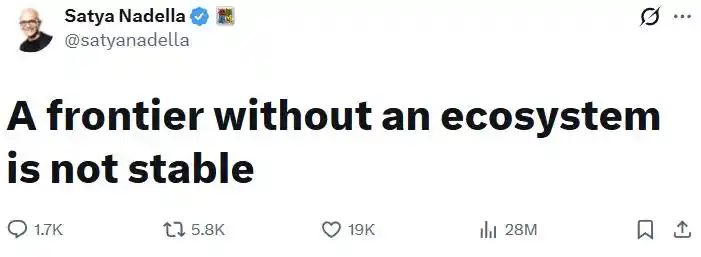
Original post: https://x.com/satyanadella/status/2066182223213293753

Nadella profoundly explores the future form of enterprises, digital sovereignty, and the socio-economic impact of AI development in an AI-driven economic era.

He introduces two concepts: "Human Capital" and "Token Capital".

In his view, AI is changing the underlying logic of corporate competition. In the past, companies bought or built digital tools to enhance human efficiency: tools amplified people, and people created value. But today, AI models themselves possess the ability to absorb human expertise and "commoditize" it. A model, after learning enough enterprise data, can turn the unique skills originally belonging to a company into a standard service accessible to everyone.

In this way, AI seems to have the ability to devour other software services, or as Nadella puts it, "every company in every industry is ceding value to a handful of voracious, all-consuming models."

This also worries him greatly. In the text, he calls for "We cannot allow a handful of AI systems to capture all the economic returns."

Interestingly, world's richest man Elon Musk, who often mocks Microsoft, commented with a sarcastic tone that the article was interesting:
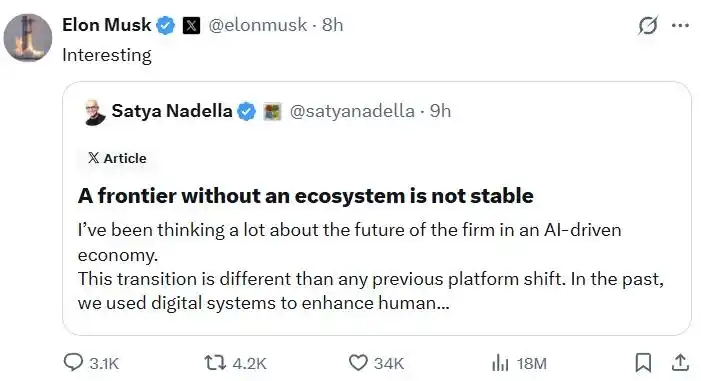
After all, this blog post seems to validate a comment Musk made in August last year: "OpenAI is going to eat Microsoft alive."
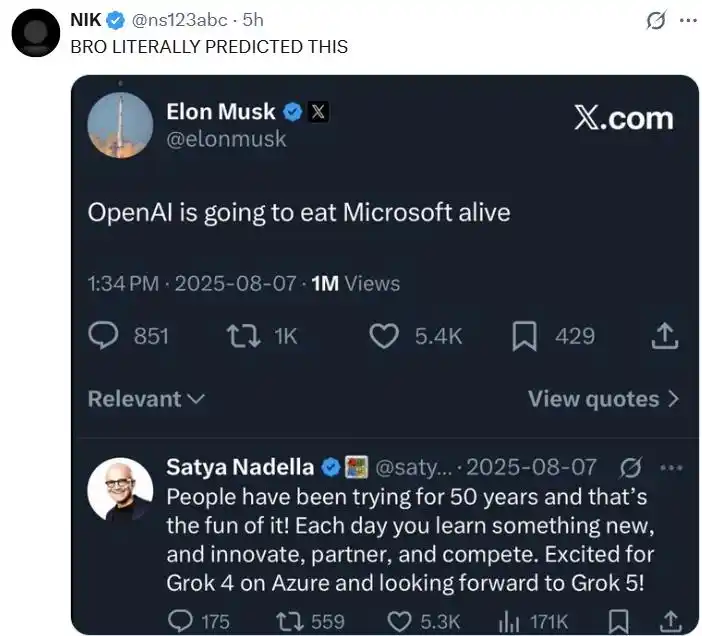
At that time, Nadella had just announced that GPT-5 would be fully integrated into Microsoft's Copilot, GitHub, and Azure product lines. His response was then light and confident: "People have wanted to eat us for 50 years, and that's what makes it fun!"

The implication of Musk's words is clear: Microsoft's proud software empire is handing over its own moat to a partner. In the field of AI, relying on someone else's model will eventually be replaced by that model.

Today's post indicates that Nadella no longer possesses that same confidence.

The following is a full translation of Nadella's post:

I've been thinking about the future of the enterprise in an AI-driven economy.

This shift is unlike any previous platform transition. In the past, we used digital systems to augment human capital. For the first time, we can establish a genuine cognitive loop between humans and digital systems. This is deeply disruptive because it changes how we conceive of work inside the enterprise.

The key issue transcends the use of certain digital tools or systems. What we need to focus on is how organizations can continue to learn, build intellectual property, stay differentiated, and thrive in a world where AI models can continuously absorb and commoditize the expertise of humans and organizations.

Every company must build what I call "Human Capital" and "Token Capital":

Human Capital encompasses employees' knowledge, judgment, relationships, creativity, and pattern recognition abilities.

Token Capital represents the AI capabilities that a company builds and owns.

Importantly, the value of Human Capital does not decrease as Token Capital grows. It only becomes more valuable! I believe human agency will be the driver of Token Capital growth. Humans will set audacious goals, connect dots across domains, build relationships, and identify the most critical patterns. Without human direction, compute just spins its wheels.

This means the real opportunity is not in picking the best model. We should build a learning loop on top of models where Human Capital and Token Capital compound. You can outsource a task, even a job, but you can never outsource your learning process. The future of a firm depends on its ability to accumulate this learning compound between humans and AI.

This requires a new kind of architectural approach, one where every enterprise can build agentic systems that evolve over time while maintaining control over their intellectual property. A company should be able to swap out a "general" model while retaining the "corporate veteran" level expertise accumulated in its learning system. This will be a crucial "test" of your control and sovereignty in the era to come.

Enterprises need to turn their workflows, domain knowledge, and accumulated judgment into AI systems that improve with every use. Private evaluation frameworks should capture whether models are truly getting better at the outcomes that matter most to the enterprise (external benchmarks aren't enough!). Private reinforcement learning environments should make models stronger on the execution trajectories real to the organization. Its knowledge base makes institutional memory queryable and token use more efficient.

This loop becomes the new intellectual property of the enterprise. I think of it as a hill-climbing machine. And unlike most assets, it compounds. Every improved workflow generates better training signals, accelerating the accumulation of tacit knowledge unique to the firm. Companies that build this early will have an advantage that's hard to replicate, no matter what new capabilities individual models come up with.

We cannot have a world where every company in every industry cedes value to a handful of voracious, all-consuming models. Assume all value gets captured by a few models, the political economy won't tolerate it. Society won't accept an AI future that hollows out entire industries.

Think back to what happened in the first phase of globalization when whole industrial economies were hollowed out by offshoring. Even though GDP numbers looked good on paper, the job losses were real and the consequences are still with us today. We cannot bring that dynamic into the AI era, with a few AI systems capturing all the economic returns while whole industries watch their knowledge get commoditized without even realizing it.

In my view, our imperative must be to build a frontier ecosystem. Merely building a frontier model isn't enough. Only then will value flow broadly across every company, every industry, and every country. In this ecosystem, every organization can own the learning loops that encode its institutional knowledge and compound its Human and Token Capital.

This is the ethos I grew up with: platforms should enable more value creation on top than they capture inside, so every company can innovate and create its own value.

When that happens, enterprises will create value for themselves and the economies around them. Employees will see their expertise amplified, their judgment becoming part of a system that's replicable and scalable. And the gains will accrue to the businesses and communities around them.

This is how enterprises drive value for themselves and the broader economy. And it's the stable equilibrium we should build together.

This article is from the WeChat public account "Machine Heart" (ID: almosthuman2014), author: Machine Heart


Trending Cryptos

Related Questions

QAccording to Satya Nadella, what are the two types of capital that every company must build in the AI era?

AAccording to Satya Nadella, every company must build 'Human Capital' and 'Token Capital'. 'Human Capital' encompasses employee knowledge, judgment, relationships, creativity, and pattern recognition. 'Token Capital' represents the AI capabilities that a company builds and owns.

QWhat is Nadella's main concern about the concentration of AI model development?

ANadella's main concern is that if value is concentrated in just a few all-encompassing AI models, the socio-economic system will not tolerate it. He warns against a future where companies across industries cede their value to a handful of models, leading to the commoditization of their unique knowledge and expertise without fair economic return.

QWhat is the key 'test' of control and sovereignty for companies in the future, as described in the article?

AThe key 'test' is a company's ability to preserve the accumulated, proprietary expertise within its learning system—akin to 'institutional veteran' knowledge—even when it switches out or replaces the underlying 'general-purpose' AI models.

QWhat does Nadella compare the learning loop between human and AI capital to, and why is it significant?

ANadella compares the learning loop between human and AI capital to a 'stairmaster' or compound interest machine. It is significant because, unlike most assets that depreciate, this loop compounds: each improved workflow generates better training signals, accelerating the accumulation of unique, implicit knowledge and creating a competitive advantage that is difficult to replicate.

QHow does Elon Musk's past comment relate to the themes in Nadella's article?

AElon Musk's past comment that 'OpenAI will eat Microsoft alive' relates thematically to Nadella's concern about AI models becoming central value extractors. The article suggests that Musk's quip highlights the risk of a company (like Microsoft) potentially ceding its competitive edge by relying heavily on a partner's AI model, which could eventually subsume the value traditionally captured by its software ecosystem.

Related Reads

From Somersaults to Working 24/7: We Saw the ‘Working-Class’ Aura in Robots at WAIC

From performing acrobatics to working 24/7: Robots at WAIC are getting down to business. This year's World Artificial Intelligence Conference (WAIC) in Shanghai showcased a significant shift in the robotics industry. While "show-off" robots that dance, play music, or compete in sports are still present, the dominant trend is now practical, task-oriented machines. Hundreds of wheeled and humanoid robots were deployed as guides, baristas, factory workers, and even traffic controllers, moving beyond mere demonstrations to highlight real-world "work capabilities." The focus has pivoted from showcasing technical parameters to pursuing mass production and industrial落地 (landing/implementation). This transition presents major challenges. First, deploying powerful AI models onto robots requires overcoming hardware limitations in computing power and latency. Second, robots demand complex, integrated systems for real-time perception and control. Third, achieving reliable mass production necessitates unprecedented industry-wide collaboration on standards and supply chains. A key bottleneck identified by industry leaders is the robot's "brain"—its AI and cognitive capabilities. While hardware and basic movement ("little brain") have advanced rapidly, the higher-level intelligence for understanding complex instructions and adapting to unstructured environments is progressing more slowly. Companies are investing heavily in developing more advanced "brain" systems, but fully autonomous operation in dynamic settings remains a work in progress. Cost is another critical hurdle. While some consumer-oriented humanoid robots are now priced under $15,000, capable industrial models often cost $50,000 or more. The industry consensus is that bringing robots into unstructured home environments for tasks like comprehensive cleaning is still at least five years away due to technical, safety, and cost barriers. Therefore, 2026 is being called the "first year of mass production," but primarily for industrial and specific commercial applications. WAIC 2026 served less as a stage for spectacular tricks and more as a serious examination of robots' commercial viability, marking their transition from laboratory prototypes to real-world products that must prove their value through stable, repetitive work.

marsbit56m ago

From Somersaults to Working 24/7: We Saw the ‘Working-Class’ Aura in Robots at WAIC

marsbit56m ago

Live-Action Short Series Forced onto the Big Screen by AI

Live-action short dramas, originally a popular online format, are now attempting to enter the cinema. Several top IPs like "What a Good Girl" and "One Family, Same Class" have received approval for film adaptations. This shift is driven by several pressures within the short drama industry. After rapid growth fueled by low costs and platform support, the sector now faces a slowdown with fewer hits and reduced investment. A major disruptor is the explosive rise of AI-generated short dramas, which dominate new releases and challenge the traditional model with their speed and low cost. Platform policy changes, such as adjustments to revenue guarantees, have further squeezed producers. In this context, film adaptation is seen as a potential new growth path. It offers a chance to extend a short-lived online hit into a longer-lasting IP asset, moving beyond the "fast production, fast consumption" cycle. Established short dramas bring pre-validated stories and emotional appeal to the table, potentially lowering the risk for film investors. However, significant challenges remain. Translating a fast-paced, fragmented viewing experience designed for phones into a compelling cinematic narrative is difficult. Past attempts by popular TV shows and variety programs to make films have often failed due to weak content. A short drama's massive online viewership does not guarantee box office success, as cinema requires a higher commitment of time and money from audiences. Ultimately, the success of these adaptations will depend not on their original popularity, but on their ability to tell complete, emotionally resonant stories that meet the standards of the theatrical market.

marsbit2h ago

Live-Action Short Series Forced onto the Big Screen by AI

marsbit2h ago

Asymmetry of Algorithmic Agency: When AI Makes Decisions for You, You Don't Even Have the Right to Oppose

As AI increasingly makes decisions on our behalf, a critical asymmetry emerges: the entities deploying these systems understand and refine their algorithms, while individuals merely endure the consequences. This article explores the three layers of this "algorithmic agency asymmetry." First, opacity shields system goals, incentives, and flaws, creating a "black box fallacy" where outputs seem objective. Second, algorithms amplify historical biases, repackaging past inequalities in a seemingly neutral, computational form. Third, recursive systems lead to "algorithmic drift," where users train the system and are simultaneously trained by it, shaping their own choices and behaviors. This asymmetry has profound implications, extending into hiring, education, policing, and daily life. Users adapt to what the system rewards, but only see the end result—a score, recommendation, or price—without understanding the underlying logic or manipulated conditions. To rebalance this power dynamic, the article proposes policy interventions: 1) Meaningful transparency and explainability for users affected by AI decisions. 2) Enforceable impact assessments before deploying high-risk systems. 3) Genuine human oversight with the power to challenge outputs. 4) Mandatory post-deployment monitoring and auditing. 5) Outright bans on manipulative or exploitative systems. Finally, fostering widespread "algorithmic literacy" is essential public infrastructure. Ultimately, this asymmetry is a structural power imbalance. Good policy cannot eliminate it but can narrow the gap by making automated influence visible, contestable, auditable, and governable.

marsbit2h ago

Asymmetry of Algorithmic Agency: When AI Makes Decisions for You, You Don't Even Have the Right to Oppose

marsbit2h ago

Trading

Spot

Hot Articles

Discussions

Welcome to the HTX Community. Here, you can stay informed about the latest platform developments and gain access to professional market insights. Users' opinions on the price of S (S) are presented below.

活动图片