Metaplanet Will Keep Buying Bitcoin, Says Gerovich, as $HYPER Hits $31M Presale Milestone

bitcoinistPublished on 2026-02-06Last updated on 2026-02-06

Abstract

Metaplanet CEO Simon Gerovich announced the company will continue its Bitcoin accumulation strategy, positioning itself as a public-market wrapper for long-term BTC exposure. This comes as Bitcoin hovers around $65,882 amid significant market volatility, with U.S. spot Bitcoin ETFs experiencing their worst week since February 2025, shedding roughly $1.33B in net outflows. The article highlights that corporate Bitcoin treasury strategies are under scrutiny during this drawdown, shifting focus towards liquidity and execution over leverage. Concurrently, competition among Bitcoin Layer-2 (L2) solutions is intensifying, with projects like Citrea launching mainnets to address Bitcoin's programmability gap. Bitcoin Hyper ($HYPER) is presented as a key player in this space, positioning itself as the fastest Bitcoin L2. It utilizes a modular architecture with Bitcoin L1 for settlement and a Solana Virtual Machine (SVM) Layer-2 for high-throughput execution. Its features aim to solve Bitcoin's constraints of slow transactions, high fees, and limited programmability. The project's presale has raised over $31.2M, with on-chain records showing substantial whale accumulation, indicating high-conviction interest. The narrative suggests that if Bitcoin L2s become integral for corporate treasury operations, $HYPER's execution layer could be well-positioned for the current market environment.

Trusted Editorial content, reviewed by leading industry experts and seasoned editors. Ad Disclosure

Quick Facts:

  • ➡️ Bitcoin is rebounding near $64.9K, but ETF flow volatility shows institutions are still actively de-risking and re-entering tactically.
  • ➡️ Metaplanet’s accumulation strategy stands out more during drawdowns, when markets scrutinize treasury leverage, liquidity, and long-duration conviction.
  • ➡️ Bitcoin L2 competition is heating up as new mainnets push DeFi-on-Bitcoin narratives, raising the stakes for execution and bridge security.
  • ➡️ Bitcoin Hyper’s SVM-based execution layer narrative targets Bitcoin’s programmability gap, aligning with demand for faster BTC-adjacent applications.

Bitcoin’s latest drawdown puts corporate ‘$BTC treasury’ strategies back under the microscope.

After a brutal stretch, $BTC hovers around $65,882 today, while $ETH sits near $1,925. That bounce looks punchy on a 24-hour chart.

But zoom out. The bigger picture shows a market still shaken by violent de-risking. Case in point: U.S. spot Bitcoin ETFs just logged their worst week since February 2025, shedding roughly $1.33B in net outflows.

That context matters for Metaplanet. They aren’t merely ‘buying Bitcoin.’ They’re underwriting an entire corporate identity around the asset, acting more like a public-market wrapper for long-duration $BTC exposure.

CEO Simon Gerovich points to ‘BTC yield’ metrics to frame performance, a strategy straight out of the MicroStrategy playbook.

The ripple effect is simple. When flows and risk appetite wobble, traders ask which ‘Bitcoin proxy’ models are built to survive the chop, and which ones need price to do all the heavy lifting.

And that’s where Bitcoin infrastructure narratives are quietly regaining oxygen. If balance sheets keep leaning into $BTC, demand for faster, cheaper, more programmable Bitcoin rails doesn’t disappear. It intensifies.

That’s where Bitcoin Hyper ($HYPER) comes in.

Buy your $HYPER today.

Metaplanet’s BTC Treasury Play Meets A Volatile Tape

Metaplanet’s message, Gerovich signaling the company intends to keep accumulating, hits a market that’s stopped rewarding leverage and started rewarding liquidity.

ETF flow volatility is the tell here. After heavy late-January redemptions, flows briefly flipped positive with about $561.8M in inflows on Feb. 2, 2026, before outflows resumed in subsequent sessions (based on various flow trackers).

That dynamic changes short-term spot demand in ways we didn’t see in prior cycles. When the marginal ETF bid fades, corporate buyers become more visible, and more scrutinized.

Metaplanet has leaned into scale (tens of thousands of BTC and $600M+ purchases in 2025), but they aren’t operating in a vacuum.

At the same time, Bitcoin L2 competition is accelerating.

Citrea, for instance, reportedly launched a Bitcoin ZK-rollup mainnet with DeFi ambitions and a BTC-collateralized stablecoin angle. It’s exactly the kind of ‘fight for Bitcoin block space’ debate that tends to flare when fees and miner economics enter the conversation.

So the setup is paradoxical: price is shaky, but the infrastructure race is getting louder. Want to keep buying Bitcoin through volatility? Fine. But idle $BTC pushes the market toward the next question: what can $BTC do beyond cold storage?

Get your $HYPER today.

Bitcoin Hyper ($HYPER) Pushes The ‘Execution Layer’ Narrative

Bitcoin Hyper ($HYPER) is positioning itself as the fastest Bitcoin L2 built around a modular architecture: Bitcoin L1 for settlement paired with a real-time SVM Layer 2 for execution.

The pitch is straightforward. Attack Bitcoin’s core constraints, slow transactions, high fees, and limited programmability, without discarding Bitcoin’s settlement gravity.

Two design choices shape the risk/reward profile here:

  1. SVM integration: By leaning on Solana Virtual Machine-style execution, Bitcoin Hyper aims to attract developers who already know high-throughput smart contract environments (Rust tooling, SDK/API) but want Bitcoin-adjacent liquidity and branding.
  2. Decentralized Canonical Bridge: Bridging is where many L2 narratives break (literally and metaphorically). Bitcoin Hyper explicitly makes this a headline feature. Smart move, considering users now treat “bridge risk” as a first-class variable rather than a footnote.

The data points to a market that’s done paying for vague roadmaps. If a Bitcoin L2 can’t explain execution, bridging, and settlement clearly, it gets ignored.
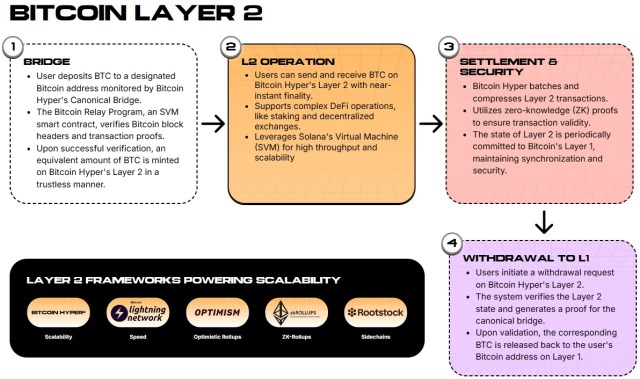
The key forward-looking catalyst? Whether Bitcoin L2s become capital markets plumbing for BTC treasury companies—yield, payments, and programmable treasury ops, rather than just retail DeFi experiments.

If that thesis lands, Bitcoin Hyper’s ‘execution layer for Bitcoin’ framing fits the moment. Track Bitcoin Hyper closely.

$HYPER Presale Hits $31.2M With Whale Buys On Record

On the funding side, Bitcoin Hyper ($HYPER) is showing real traction.

According to the official presale page, it has raised over $31.2M, with tokens currently priced at $0.0136752. Those aren’t ’round-number hype’ stats, they’re precise, and they matter in a market where capital has been incredibly selective.
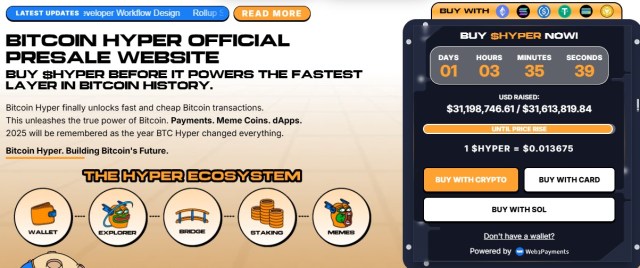
Then there’s the on-chain activity. According to Etherscan records, 3 whale wallets have accumulated over $1M, with the largest single transaction of $63K occurring on Jan 15, 2026.

That’s not definitive proof of future performance, but it suggests high-conviction wallets are willing to size in before broader sentiment turns. (Why now? Often because narrative rotation happens before price does.)

One caveat: staking is marketed as high APY, though the exact rate isn’t disclosed yet. Presale stakers face a 7-day vesting period, with staking available immediately after TGE. That’s a reasonable structure, but it means the ‘yield story’ should be treated as a bonus, not the core valuation anchor.

Buy $HYPER here.

This isn’t financial advice. DYOR before investing.

Editorial Process for bitcoinist is centered on delivering thoroughly researched, accurate, and unbiased content. We uphold strict sourcing standards, and each page undergoes diligent review by our team of top technology experts and seasoned editors. This process ensures the integrity, relevance, and value of our content for our readers.

patrubogdan

Follow

Full Profile

Related Posts

Bitcoin ETFs See $434M in Outflows as $BTC Tests $60K Support – Can Bitcoin Hyper Take Over?

Peter Brandt Says Bitcoin is Heading to $42K – Has $SUBBD’s Time Arrived?

Bitcoin’s Crash Triggered IBIT’s Biggest Trading Day, as $HYPER Keeps Pumping

ETH Down to $1.8K – Will It Keep Crashing and Will LiquidChain Explode in 2026?

Winklevoss‑Backed Gemini Cuts Up To 25% Of Staff, Exits UK, EU, And Australia

New Virginia Bill Allows the State to Invest in Bitcoin, Signaling Institutional Shift for Bitcoin Hyper

Related Questions

QWhat is Metaplanet's strategy regarding Bitcoin, as stated by Simon Gerovich?

AMetaplanet intends to keep accumulating Bitcoin, underwriting an entire corporate identity around the asset and acting as a public-market wrapper for long-duration BTC exposure, similar to the MicroStrategy playbook.

QWhat milestone has the Bitcoin Hyper ($HYPER) presale recently achieved?

AThe Bitcoin Hyper ($HYPER) presale has raised over $31.2 million.

QWhat are the two key design choices that shape Bitcoin Hyper's risk/reward profile?

AThe two key design choices are: 1. SVM (Solana Virtual Machine) integration for high-throughput smart contract execution. 2. A decentralized canonical bridge to mitigate bridge risk.

QWhat recent trend in U.S. spot Bitcoin ETFs is mentioned as context for Metaplanet's strategy?

AU.S. spot Bitcoin ETFs recently logged their worst week since February 2025, with approximately $1.33 billion in net outflows, indicating a market shaken by violent de-risking.

QAccording to the article, what is the core problem that Bitcoin Hyper aims to solve for Bitcoin?

ABitcoin Hyper aims to solve Bitcoin's core constraints of slow transactions, high fees, and limited programmability without discarding Bitcoin's settlement security, positioning itself as a fast execution layer for Bitcoin.

Related Reads

US Stocks Suffer Worst Plunge Since 2025: Three Triggers Ignite Tech Stock Valuation Reset

The US stock market experienced its most severe sell-off since the 2025 tariff crisis on June 5th, 2025. The Nasdaq Composite plummeted 4.18%, the S&P 500 fell 2.64%, and the Dow Jones dropped 695 points. The panic stemmed from three converging factors. First, Broadcom's earnings report ignited fears of a slowdown in AI growth. While its AI chip revenue surged 143% YoY to $10.8B, its Q3 AI revenue guidance of $16B fell short of the $17.2B consensus. This triggered a massive sector-wide sell-off, with the Philadelphia Semiconductor Index crashing 10.26% and semiconductor stocks losing roughly $1.3 trillion in market value in a single day. Second, a shockingly strong May jobs report crushed hopes for Federal Reserve rate cuts. Non-farm payrolls added 172,000 jobs, doubling expectations. This robust data, combined with persistently high oil prices above $92/barrel due to the ongoing Iran war and blockade of the Strait of Hormuz, drastically increased market expectations for a potential Fed rate hike instead of a cut. Higher interest rates compress the valuations of growth-heavy tech stocks. Third, the prolonged Iran conflict continues to fuel inflationary pressures, complicating the Fed's policy decisions and undermining the "inflation is tamed" narrative. Together, these events challenged the twin pillars of the market rally: the "limitless AI growth" story and expectations for imminent monetary easing. The sell-off spread globally, impacting Asian and European markets and cryptocurrencies. The article posits this is likely a severe "valuation repricing" rather than the end of the AI story. The underlying demand for AI remains strong, but investor expectations for growth speed and the prices they are willing to pay are being recalibrated. Key upcoming factors include the June FOMC meeting, future AI company earnings, and developments in the Iran conflict.

marsbit1h ago

US Stocks Suffer Worst Plunge Since 2025: Three Triggers Ignite Tech Stock Valuation Reset

marsbit1h ago

From Madison Square Garden to Kalshi: Prediction Markets Break into the NBA Finals

From Madison Square Garden to Kalshi: Prediction Markets Break into the NBA Finals Prediction markets are playing a significant role in the 2026 NBA Finals, particularly around the New York Knicks' unexpected 2-0 series lead. Platforms like Kalshi and Polymarket have seen massive trading volumes, exceeding hundreds of millions of dollars on championship and related markets. Their influence extends beyond online trading. Kalshi's official partnership with Madison Square Garden has given it prominent physical branding at the arena. Furthermore, local businesses like The Jeffrey bar are using prediction market contracts to hedge the risk of game-result-based promotions, turning potential losses into manageable costs—a concept similar to the famous "Mattress Mack" strategy from traditional sports betting. These markets differentiate themselves by offering a wider, more entertainment-focused range of "event contracts" beyond typical game outcomes, such as predicting celebrity attendance. They also have broader accessibility across the U.S. compared to age- and location-restricted traditional sportsbooks. However, their rapid integration into sports raises regulatory and ethical questions. The NBA is cautiously engaging, discussing integrity frameworks with regulators like the CFTC. While the league permits minor investments like Giannis Antetokounmpo's stake in Kalshi, it advocates for strict rules to prevent insider trading. Many fans express concern on platforms like Reddit, fearing that the close ties between prediction markets, the league, and players could compromise the game's integrity. The NBA Finals has thus become a high-stakes testing ground, showcasing prediction markets' commercial potential while challenging traditional boundaries between financial trading, entertainment, and gambling.

marsbit3h ago

From Madison Square Garden to Kalshi: Prediction Markets Break into the NBA Finals

marsbit3h ago

Recursive Self-Improvement AI Gains Traction, Google Pours Cold Water, While DeepSeek and Others Approach the Fringes

The term "recursive self-improvement" (RSI), where AI improves itself autonomously, is gaining momentum in the AI industry. Startups like Recursive Superintelligence and projects such as Andrej Karpathy's Auto-Research aim to create systems where AI designs, implements, and validates its own research, moving toward superintelligence. While Google CEO Sundar Pichai cautions that such exponential acceleration is not yet a reality, progress is evident. For instance, Anthropic reported its Claude Code writes nearly 100% of the team's code, though it still lacks true self-direction. Analysts frame RSI development in stages: "adequacy" (systems functioning without humans), "parity" (matching human research quality), and "supremacy" (exceeding human-AI collaboration). Reaching parity could trigger rapid, unpredictable advancement due to AI's continuous operation. In China, companies like DeepSeek and Baidu incorporate self-optimization techniques without explicitly branding them as RSI, focusing on algorithmic efficiency and reinforcement learning. However, challenges remain, including "model collapse" from training on AI-generated data and the immense computational and open-collaboration requirements. Ultimately, RSI represents a trend of increasing automation in AI development, potentially reducing human oversight in the creation process itself.

marsbit3h ago

Recursive Self-Improvement AI Gains Traction, Google Pours Cold Water, While DeepSeek and Others Approach the Fringes

marsbit3h ago

Trading

Spot
Futures

Hot Articles

What is $BITCOIN

DIGITAL GOLD ($BITCOIN): A Comprehensive Analysis Introduction to DIGITAL GOLD ($BITCOIN) DIGITAL GOLD ($BITCOIN) is a blockchain-based project operating on the Solana network, which aims to combine the characteristics of traditional precious metals with the innovation of decentralized technologies. While it shares a name with Bitcoin, often referred to as “digital gold” due to its perception as a store of value, DIGITAL GOLD is a separate token designed to create a unique ecosystem within the Web3 landscape. Its goal is to position itself as a viable alternative digital asset, although specifics regarding its applications and functionalities are still developing. What is DIGITAL GOLD ($BITCOIN)? DIGITAL GOLD ($BITCOIN) is a cryptocurrency token explicitly designed for use on the Solana blockchain. In contrast to Bitcoin, which provides a widely recognized value storage role, this token appears to focus on broader applications and characteristics. Notable aspects include: Blockchain Infrastructure: The token is built on the Solana blockchain, known for its capacity to handle high-speed and low-cost transactions. Supply Dynamics: DIGITAL GOLD has a maximum supply capped at 100 quadrillion tokens (100P $BITCOIN), although details regarding its circulating supply are currently undisclosed. Utility: While precise functionalities are not explicitly outlined, there are indications that the token could be utilized for various applications, potentially involving decentralized applications (dApps) or asset tokenization strategies. Who is the Creator of DIGITAL GOLD ($BITCOIN)? At present, the identity of the creators and development team behind DIGITAL GOLD ($BITCOIN) remains unknown. This situation is typical among many innovative projects within the blockchain space, particularly those aligning with decentralized finance and meme coin phenomena. While such anonymity may foster a community-driven culture, it intensifies concerns about governance and accountability. Who are the Investors of DIGITAL GOLD ($BITCOIN)? The available information indicates that DIGITAL GOLD ($BITCOIN) does not have any known institutional backers or prominent venture capital investments. The project seems to operate on a peer-to-peer model focused on community support and adoption rather than traditional funding routes. Its activity and liquidity are primarily situated on decentralized exchanges (DEXs), such as PumpSwap, rather than established centralized trading platforms, further highlighting its grassroots approach. How DIGITAL GOLD ($BITCOIN) Works The operational mechanics of DIGITAL GOLD ($BITCOIN) can be elaborated on based on its blockchain design and network attributes: Consensus Mechanism: By leveraging Solana’s unique proof-of-history (PoH) combined with a proof-of-stake (PoS) model, the project ensures efficient transaction validation contributing to the network's high performance. Tokenomics: While specific deflationary mechanisms have not been extensively detailed, the vast maximum token supply implies that it may cater to microtransactions or niche use cases that are still to be defined. Interoperability: There exists the potential for integration with Solana’s broader ecosystem, including various decentralized finance (DeFi) platforms. However, the details regarding specific integrations remain unspecified. Timeline of Key Events Here is a timeline that highlights significant milestones concerning DIGITAL GOLD ($BITCOIN): 2023: The initial deployment of the token occurs on the Solana blockchain, marked by its contract address. 2024: DIGITAL GOLD gains visibility as it becomes available for trading on decentralized exchanges like PumpSwap, allowing users to trade it against SOL. 2025: The project witnesses sporadic trading activity and potential interest in community-led engagements, although no noteworthy partnerships or technical advancements have been documented as of yet. Critical Analysis Strengths Scalability: The underlying Solana infrastructure supports high transaction volumes, which could enhance the utility of $BITCOIN in various transaction scenarios. Accessibility: The potential low trading price per token could attract retail investors, facilitating wider participation due to fractional ownership opportunities. Risks Lack of Transparency: The absence of publicly known backers, developers, or an audit process may yield skepticism regarding the project's sustainability and trustworthiness. Market Volatility: The trading activity is heavily reliant on speculative behavior, which can result in significant price volatility and uncertainty for investors. Conclusion DIGITAL GOLD ($BITCOIN) emerges as an intriguing yet ambiguous project within the rapidly evolving Solana ecosystem. While it attempts to leverage the “digital gold” narrative, its departure from Bitcoin's established role as a store of value underscores the need for a clearer differentiation of its intended utility and governance structure. Future acceptance and adoption will likely depend on addressing the current opacity and defining its operational and economic strategies more explicitly. Note: This report encompasses synthesised information available as of October 2023, and developments may have transpired beyond the research period.

363 Total ViewsPublished 2025.05.13Updated 2025.05.13

What is $BITCOIN

Discussions

Welcome to the HTX Community. Here, you can stay informed about the latest platform developments and gain access to professional market insights. Users' opinions on the price of BTC (BTC) are presented below.

活动图片