Metaplanet Strengthens Bitcoin Treasury Position Amid Yen Weakness

TheNewsCryptoPublished on 2026-01-05Last updated on 2026-01-05

Abstract

Metaplanet, a Japanese firm, is strategically leveraging significant Bitcoin holdings to counter the weakening yen and national debt pressures. With 35,102 BTC on its balance sheet, the company benefits as Bitcoin's value appreciates strongly against the depreciating yen, effectively reducing the real cost of its yen-denominated debt. This unique financial position is further supported by recent capital restructuring efforts, including issuing preferred shares, to attract institutional investment and enhance long-term stability.

Metaplanet has been identified to greatly benefit from the depreciated value of the Japanese currency, given that a change in the value of the Bitcoin-focused balance sheet is dependent on the value of the currency that the company uses to repay its debts. Analysts indicate that companies that possess Bitcoin and repay debts in the form of the Japanese Yen may notice a drop in the costs of their debts due to the devaluation of the local currency.

Bitcoin analyst Adam Livingston highlighted the case of Japan, which has a government debt of around 250% of its GDP, as one of the factors that has been pressuring the Japanese yen. These kinds of factors help create a situation where companies involved in hard assets like Bitcoin may have different financial dynamics compared to those involved in strong fiat currencies.
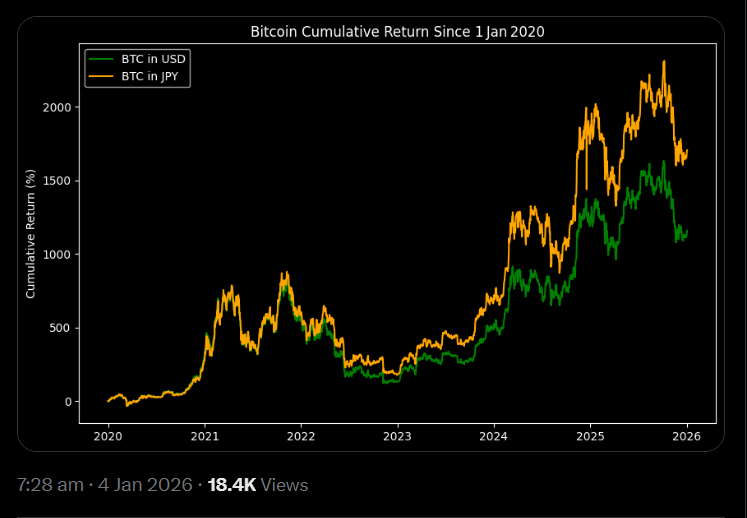
Data indicates that the appreciation of Bitcoin against the U.S. dollar is approximately 1,159% since 2020. Compared to the Japanese yen, the appreciation is higher, standing at 1,704% appreciation, thus indicating the rising discrepancy concerning the appreciation of value in the Japanese currency compared to Bitcoin.

Debt Costs and Treasury Position

As observed by analysts, Metaplanet is servicing a reported coupon of 4.9% with a currency that is constantly depreciating against Bitcoin. This means that the actual costs associated with such payments keep on lowering. This is opposed to the liabilities associated with the cryptocurrency treasuries that service a higher coupon with a stronger currency.

As of data from Bitcoin Treasuries, Metaplanet currently has a total of approximately 35,102 BTC, which makes it one of the top companies that have Bitcoin as a corporate asset. In fact, it recently expanded its holdings by approximately 4,279 BTC through a purchase worth $451 million.

Capital Restructuring to Attract Institutions

In December 2025, Metaplanet affirmed the modification of its capital structure to enhance access to long-term capital. The firm authorized the issuance of dividend-bearing preference stocks. This is in a bid to attract institutional investors.

The director of Bitcoin strategy at the company, Dylan LeClair, has confirmed that investors have approved proposals regarding preferred share issuance and alternative dividend arrangements, as well as possible share repurchase actions by reclassification of capital reserves.

The relevance of Metaplanet’s strategy is because the firm is affected by macroeconomic variables such as the value of Yen against the US dollar. For MetaPlanet, the presence of Yen–dominated liabilities in addition to the growth in the value of Bitcoin presents a paradigm with a unique balance sheet that is quite different from the rest globally.

In this respect, however, the increased Bitcoin reserves and capital structure of Metaplanet also imply a strategic, institutional, and flexible focus. As the cryptocurrency treasury market also grapples with market volatility and valuation challenges, the corporate structure of Metaplanet also signifies the increasing relevance of currency exposure, debt, and capital strategy in cryptocurrency adoption.

Highlighted Crypto News:

‌BTC and ETH Note Upswings as Respective ETFs See Inflows; Tides Turning?

TagsBitcoinbitcoin treasuryBTCmetaplanet

Related Questions

QWhy does Metaplanet benefit from the depreciated Japanese Yen according to the article?

AMetaplanet benefits because it holds Bitcoin as a corporate asset and repays its debts in Japanese Yen. As the Yen depreciates, the real cost of servicing its debt decreases, making it cheaper for the company to pay back its loans.

QWhat is the appreciation of Bitcoin against the Japanese Yen since 2020, as stated in the article?

AThe appreciation of Bitcoin against the Japanese Yen since 2020 is 1,704%.

QHow much Bitcoin does Metaplanet currently hold in its treasury?

AMetaplanet currently holds a total of approximately 35,102 BTC in its treasury.

QWhat recent capital restructuring move did Metaplanet make to attract institutional investors?

AIn December 2025, Metaplanet authorized the issuance of dividend-bearing preference stocks as part of a modification to its capital structure to attract institutional investors.

QAccording to the article, what is one of the major factors pressuring the Japanese Yen?

AOne of the major factors pressuring the Japanese Yen is Japan's high government debt, which is around 250% of its GDP.

Related Reads

STRC Major De-pegging's First Financial Report, How Will Strategy Repair Its Capital Flywheel?

Bitcoin treasury company Strategy released its Q2 2026 earnings report on July 31. Despite a 6.9% year-over-year revenue increase to $122 million, the company recorded a net loss of $8.22 billion, largely due to $8.32 billion in unrealized losses from Bitcoin price fluctuations. As of quarter-end, Strategy holds 843,775 BTC with an average cost of $75,000 per coin, and Bitcoin per share increased. The report highlights a critical shift in Strategy's capital model following the de-pegging of its key financing tool, STRC (Strategic Coin), which fell below its $100 target. Management's top priority is restoring STRC to its target value, aiming for a recovery by September 8. They rule out discounted STRC issuances and plan to maintain its dividend yield at 12%, instead focusing on bolstering its $3.75 billion cash reserve. Strategy has moved from a one-way "buy-and-hold" Bitcoin strategy to active capital management. This new approach, part of its "Digital Credit Capital Framework," involves flexibly managing its balance sheet across four elements: BTC, USD cash, common stock (MSTR), and digital credit securities like STRC. This allows for BTC monetization (having sold $218.4 million in BTC so far), strategic repurchases of discounted securities, and debt optimization, as seen with a $1.5 billion convertible bond buyback. The company's future hinges on two key tests: successfully re-pegging STRC to restore market confidence in its digital credit system, and a long-term recovery in Bitcoin's price to ultimately support its growth thesis.

marsbit36m ago

STRC Major De-pegging's First Financial Report, How Will Strategy Repair Its Capital Flywheel?

marsbit36m ago

STRC's First Financial Report Post-Depegging, How is Strategy Restoring the Capital Flywheel?

On July 31, 2026, Bitcoin treasury company Strategy released its Q2 financial report. Despite a 6.9% year-over-year increase in revenue to $122 million, the company recorded a substantial net loss of $8.22 billion, primarily due to $8.32 billion in unrealized losses from Bitcoin holdings. While Strategy's core Bitcoin strategy remains intact—its holdings grew 11% to 843,775 BTC—the company is undergoing a fundamental shift in its capital model. Following the de-pegging of its key financing tool, the STRCoin (STRC), from its $100 target in May, Strategy has pivoted from a one-directional "raise funds, buy Bitcoin" cycle to a more dynamic, multi-asset capital management approach. A key part of this new framework is the "Monetization Program," through which Strategy has sold approximately $218.4 million worth of BTC to bolster liquidity. The company's top priority is repairing STRC's peg, committing not to issue discounted shares until it returns to its target range. It has initiated a $1 billion buyback program for discounted digital credit securities, having repurchased $28.9 million face value of STRC so far. Management aims to restore the peg around September 8, 2026. Strategy now actively manages a matrix of assets: Bitcoin (for accumulation or strategic sales), USD cash reserves (now at $3.75 billion), common stock (MSTR), and digital credit securities like STRC. This allows for tactical moves like repurchasing discounted debt or equity to capture value. The future success of Strategy's "capital flywheel" hinges on two factors: the short-term ability to successfully re-peg STRC to restore market confidence in its digital credit system, and the long-term price trajectory of Bitcoin, upon which its entire investment thesis ultimately depends.

Odaily星球日报41m ago

STRC's First Financial Report Post-Depegging, How is Strategy Restoring the Capital Flywheel?

Odaily星球日报41m ago

With Two Consecutive Quarters of Losses, Coinbase Must Rely on Paths Beyond Trading

Coinbase posted its second consecutive quarterly net loss of $359 million on $1.22 billion in revenue for Q2, highlighting its vulnerability to crypto market cycles where weaker prices and lower volatility reduce user trading. However, the report also reveals a strategic shift in its business model. Despite a 25% quarter-over-quarter decline in global spot trading volume, Coinbase increased its market share to a company-record 10.3%. This suggests its position as a compliant U.S. on-ramp is strengthening even in a cooler market. A key development is the diversification of revenue streams. Transaction revenue fell to $599 million, nearly equaling subscription and services revenue of $555 million. Stablecoin services, generating $292 million, are becoming a crucial revenue "floor." This income, derived from interest on the $20 billion average USDC balance held on its platform, is less tied to daily trading activity. Furthermore, while spot trading volume dropped significantly, derivatives volume held steady at $1.03 trillion. Coinbase is pushing to integrate spot, stablecoin, and derivatives liquidity to create a more interconnected and sticky ecosystem for users. The GAAP net loss includes non-cash expenses like stock-based compensation and crypto asset valuation changes. Its adjusted EBITDA remained positive at $208 million for the 14th straight quarter, indicating core operations can cover ongoing costs. The company is also reducing expenses to manage the downturn. The central question moving forward is whether Coinbase's growing market share, stablecoin revenues, and expanding product integration can sufficiently offset the inherent cyclicality of its core trading business during future market contractions.

marsbit57m ago

With Two Consecutive Quarters of Losses, Coinbase Must Rely on Paths Beyond Trading

marsbit57m ago

Trading

Spot
活动图片