Mechanism Capital Founder: Excessive Worry About Bubbles Is Foolish

marsbitPublished on 2026-02-11Last updated on 2026-02-11

Abstract

Mechanism Capital founder Andrew Kang argues that excessive worry about market bubbles is misguided in the current technological landscape. He emphasizes that we are at a uniquely asymmetric moment in history, driven by exponential advancements in AI, robotics, energy, and other innovative fields. Short-term volatility and corrections are noise compared to the long-term transformative potential of these technologies. Kang predicts a near-future "singularity" with billions of AI agents, humanoid robots, space data centers, multi-planetary colonization, and revolutionary medical therapies. He states that the technological progress and economic growth compressed into the next 20 years will surpass the entirety of human history. Companies leveraging AI are already seeing order-of-magnitude improvements in productivity. Traditional valuation models are inadequate for pricing this unprecedented growth, which could reach "20-sigma" levels in historical statistical terms. The wealth creation will be extreme, and those without exposure will find it difficult to enter the market later. Kang advises adopting a long-term, exponential mindset and avoiding short-term trading, as the potential upside represents the largest asymmetric opportunity in history.

Original Author:Andrew Kang, Founder of Mechanism Capital

Compiled by: Ken, Chaincatcher

For those who have experienced at least one full market cycle, you develop an instinct to be wary of price increases that far exceed historical growth rates. Witnessing the dot-com bubble, the 2008 global financial crisis, and the rise and fall of cryptocurrencies sets off pattern recognition alarms in your brain. You are afraid to enter the market because prices are too high, and you want to sell your assets for fear of being at a peak.

But it is important to recognize that we are in one of the most profound and unique asymmetric moments in history. The only move right now is to extend your time horizon and completely abandon short-termism.

Excessive worry about bubbles is foolish. Trying to time the market is also foolish. Short-term fluctuations and corrections will always happen, but given how close we are to the "singularity," these fluctuations are completely just noise. Artificial intelligence, robotics, energy, and innovation are about to experience runaway explosive growth.

Within the next decade, we will have billions (or more) of AI agent workforces, humanoid robots, space data centers, multi-planetary colonization, and significantly improved medical therapies; we will fundamentally change the development pace and output of technological breakthroughs in all fields. The technological progress and economic growth we compress into the next twenty years will exceed the sum total of all human civilization history.

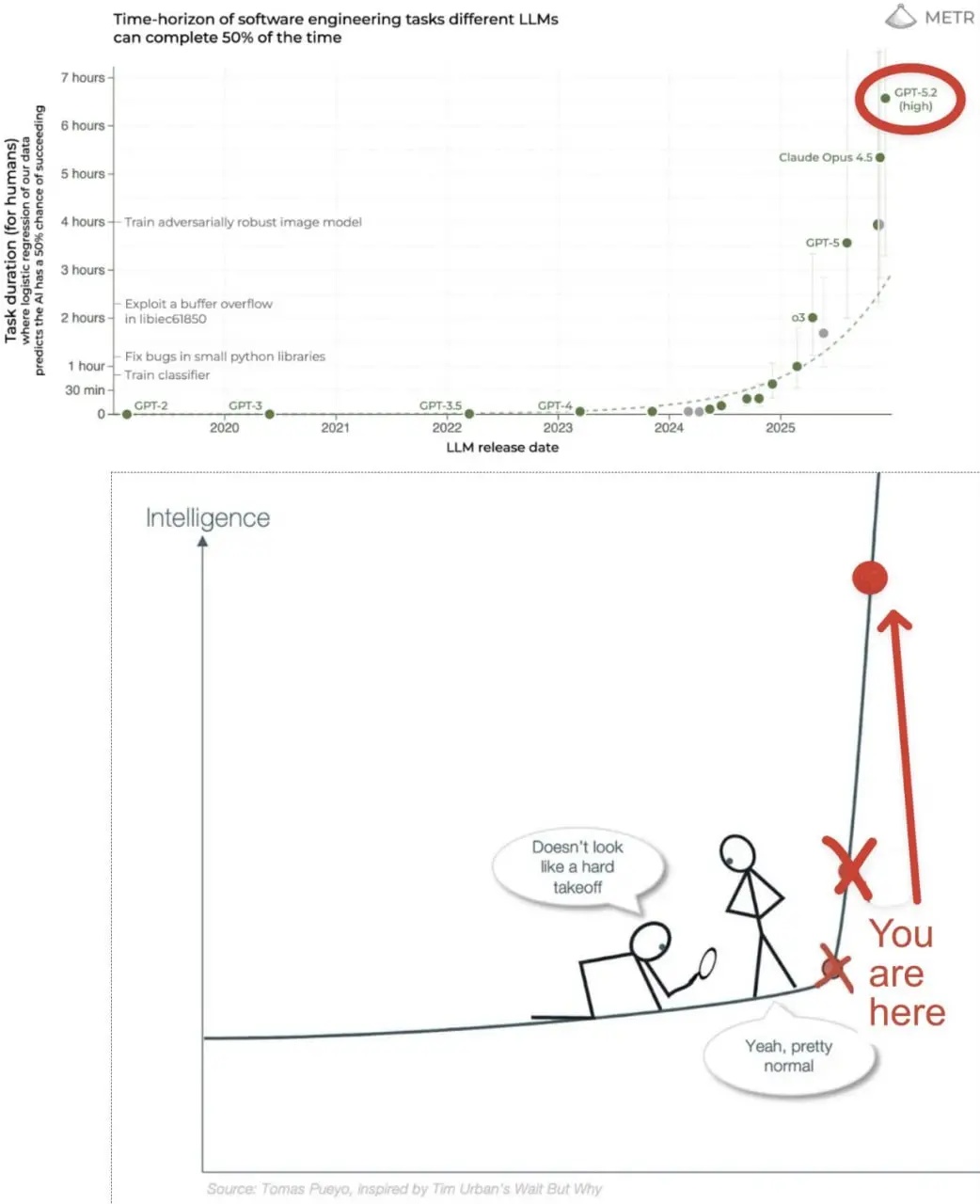
We are already in an extremely steep phase of the J-curve, but this is hard to perceive when we zoom in to the micro level of daily or weekly views. 100% of Anthropic's product code is now written by Claude. Product managers have a virtual team of software engineers, so efficient it's as if they can change time. The improvement in product iteration speed for companies that efficiently utilize AI is not single-digit, not double-digit, but triple-digit.

Moreover, the capabilities of these tools are still evolving at an even faster rate. Whether we officially achieve Artificial Superintelligence (ASI) in 2027 or 2029 doesn't really matter. It will happen. By the time it's officially announced, the assets you want to own will have already multiplied in price.

It is highly likely that the actual economic growth over the next 3-10 years will be on the order of 20 standard deviations (20-sigma) in any historical distribution model. This growth, once considered almost impossible, will be driven by unprecedented second and third-order changes. Traditional valuation models cannot price these transformations. The potential upside is so vast that traditional present value calculations struggle to capture them.

The speed of wealth appreciation will be staggering, much like how cryptocurrencies initially created numerous billionaires and millionaires in a short time, but the magnitude this time will be far more extreme. If you have no exposure, it will be difficult to pull the trigger and buy into such vertically rising asset prices; but unlike previous bubbles, the creation of real economic value will better keep pace with the vertical rise in asset prices. Over the past three years, those operating in the market with the cognition of an "exponential perspective" have reaped significant rewards. If you haven't adopted this perspective yet, it's not too late.

While it's important to always be mindful of downside risk, this is the largest upside risk in world history. Learn to bear risk over longer time horizons. Now is not the time for swing trading. For the vast majority of people, long-term investing typically outperforms short-term trading, but the gap in expected value between "trading" and "investing" will be wider than ever before. Ask yourself, what is the value of the call option embedded in the singularity?
Related Questions

QAccording to Andrew Kang, why is it foolish to be overly concerned about market bubbles in the current economic climate?

AHe believes we are at a profoundly unique asymmetric moment in history, where the potential upside from technological advancements like AI, robotics, and energy innovation is so immense that short-term volatility and bubbles are merely noise. The focus should be on long-term growth rather than short-term fluctuations.

QWhat does Andrew Kang predict will be achieved in the next decade in terms of technological progress?

AHe predicts that in the next decade, we will have billions of AI agent workers, humanoid robots, space data centers, multi-planetary colonization, and significantly improved medical therapies. The technological progress and economic growth compressed into the next 20 years will exceed the sum of all human civilization history.

QHow does Andrew Kang describe the current stage of the J-curve in technological development?

AHe describes the current stage of the J-curve as extremely steep, though it is hard to perceive at a daily or weekly micro-level. Companies effectively using AI are seeing product iteration speed improvements not in single or double digits, but in triple digits.

QWhat does Andrew Kang suggest about the timing of achieving Artificial Superintelligence (ASI) and its impact on asset prices?

AHe suggests that whether ASI is achieved in 2027 or 2029 is not important because it is inevitable. By the time it is officially announced, the prices of assets one would want to own will have already increased manifold.

QAccording to the article, why might traditional valuation models fail in the current economic transformation?

ATraditional valuation models are unable to price the unprecedented second and third-order changes driven by technologies like AI. The potential upside is so vast that traditional present value calculations struggle to capture them, making historical distribution models irrelevant for predicting future growth.

Related Reads

Bitcoin Monthly Chart Adjustment Structure Established, HYPE Entry Opportunity Emerges | Exclusive Analysis

Bitcoin Monthly Correction Structure Confirmed, HYPE Entry Opportunity Emerges | Guest Analysis Last week's analysis correctly identified that the $60,000 level for Bitcoin was an intermediate point, not the bottom of the current correction. This was validated on June 5th when the price broke below this key support, dropping to around $59,100. The monthly-level a-b-c three-wave corrective structure from the October 2025 high of $126,200 is now fully established, with the market currently in the c-wave decline phase. The cumulative adjustment time is less than 35 days, indicating the structure is far from complete. This week's focus will be tracking the rebound's strength and resistance performance. The two key resistance zones of $65,000 and $69,500~$70,500 will be crucial observation points for determining the subsequent trend. For HYPE, last week's top warning signal was also validated, with the price falling up to 27% from its $75.87 high. The token has now entered a support zone, presenting a potential short-term entry opportunity. From a strategic standpoint, the medium-term outlook remains bearish, awaiting optimal timing to add short positions upon a rebound. **Key Trading Views Summary:** * **BTC:** The analysis maintains a bearish medium-term bias. Strategy involves building short positions on rebounds towards $65,000 or the $69,500~$70,500 resistance area. A break below the $59,000-$60,000 support could trigger additional short entries. Short-term trading (30% capital) focuses on range-bound opportunities. * **HYPE:** Following a confirmed correction from the $75.87 high, the short-term strategy shifts to "buying on dips." Consider light long positions (under 30%仓位) if the price finds support and shows stabilization signals in the $55-$57 or deeper $47-$49 support zones, contingent on confirming technical signals. The key resistance to watch is the $62.5-$64.57 area. **Risk Management Reminder:** Always set an initial stop-loss immediately upon opening a position. Move the stop-loss to breakeven upon achieving 1% profit, and subsequently trail it to lock in gains. Market conditions change rapidly; this analysis is for informational purposes only and not investment advice.

marsbit49m ago

Bitcoin Monthly Chart Adjustment Structure Established, HYPE Entry Opportunity Emerges | Exclusive Analysis

marsbit49m ago

Trading

Spot
Futures
活动图片