Mastercard Just Built A Payment Network For AI Agents — And It Runs On Crypto

bitcoinistPublished on 2026-06-10Last updated on 2026-06-10

Abstract

Mastercard has launched "Agent Pay for AI," a new payment protocol enabling AI agents to conduct small, automated, machine-to-machine transactions. The system addresses a gap in traditional payment infrastructure, which is poorly suited for such micropayments. A key feature is the storage of human-granted permissions on the Polygon blockchain, allowing for decentralized verification without a central authority. Mastercard is developing the protocol with partners Adyen, Coinbase, and Cloudflare. It enters a competitive field where Visa, Stripe, and Google have also introduced similar AI payment tools. While Mastercard's Chief Product Officer, Jorn Lambert, does not expect significant near-term revenue, he views it as a strategic infrastructure investment for an anticipated future where AI agents facilitate a meaningful share of commerce. This move follows Mastercard's recent integration of stablecoins, signaling a broader shift towards incorporating crypto into its core systems.

Mastercard has launched Agent Pay for AI, a new protocol designed to enable artificial intelligence agents to pay each other and send micropayments — storing the permissions that humans grant their AI agents on Polygon, a blockchain network built on top of Ethereum, according to an exclusive report by Fortune published June 10.

Related Reading: Trump’s Crypto Deals May Have Increased The Family Fortune By $2 Billion—At Investors’ Expense

The protocol is built around a specific use case that existing payment infrastructure handles poorly: small, automated, machine-to-machine transactions. When an AI agent needs to access data piecemeal from a website, or pay another service incrementally for a task it is performing on a user’s behalf, traditional card rails — built for human-initiated, merchant-facing transactions — are poorly suited for the job. Agent Pay for AI is designed to fill that gap, per Fortune’s reporting.

The decision to log permissions onto a public blockchain rather than a private database is a deliberate architectural choice. Multiple parties that want to verify whether an agent is acting within the boundaries a human has authorized can access that information directly on-chain, without relying on a single centralized authority to confirm it, per Fortune. Mastercard selected Polygon for the initial deployment.
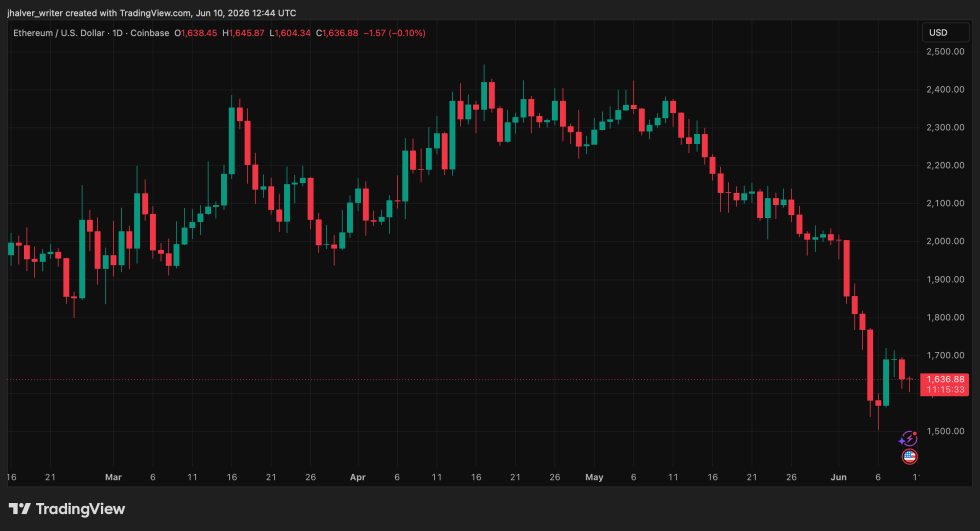
ETH's price trends to the downside on the daily chart. Source: ETHUSD on Tradingview

The Partners And The Crypto Competition

Three companies are working with Mastercard to develop the protocol: fintech platform Adyen, crypto exchange Coinbase, and web infrastructure giant Cloudflare, per Fortune’s reporting. The combination of a payment processor, a crypto-native exchange, and the company that handles a significant share of the internet’s traffic signals that Mastercard is building Agent Pay for AI as interoperable infrastructure rather than a proprietary walled garden.

The competitive landscape is already crowded. Visa and Stripe have each built tools anticipating a world where AI bots buy groceries, manage bank accounts, and pay for subscriptions. Coinbase launched the x402 protocol for AI payments, Stripe collaborated with Tempo to develop the Machine Payments Protocol, and Google released its own standard in September 2025, per Fortune.

Jorn Lambert, Mastercard’s Chief Product Officer, was measured about near-term commercial expectations in his conversation with Fortune. He does not expect Agent Pay for AI to be a significant revenue driver in the next twelve months. Over five years, however, he described it as a meaningful new addressable market. Lambert separately predicted that AI chatbots will eventually sit between a meaningful share of e-commerce transactions — framing the protocol not as a speculative bet but as infrastructure being built ahead of an inevitable shift in how commerce flows.

Related Reading: Japan’s SBI Bank Expands Crypto Push With BTC, ETH, XRP Rewards Program For Depositors

This development marks a pivotal moment for the nascent sector’s convergence with artificial intelligence. Mastercard choosing a public blockchain to anchor the permissions layer of its AI payment infrastructure — one week after opening its global settlement rails to six regulated stablecoins across eight blockchain networks — confirms that the world’s second-largest card network is systematically rebuilding its core architecture around crypto rails rather than alongside them.

Cover image from Grok, ETHUSD chart from Tradingview

Trending Cryptos

Related Questions

QWhat is the name of the new protocol launched by Mastercard for AI agents, and what problem does it aim to solve?

AMastercard launched the Agent Pay for AI protocol. It aims to solve the problem of enabling small, automated, machine-to-machine (AI agent-to-agent) payments and micropayments, a use case poorly handled by traditional card payment infrastructure designed for human-initiated, merchant-facing transactions.

QOn which blockchain network is Mastercard storing the permissions for its Agent Pay for AI protocol, and why was a public blockchain chosen?

AMastercard is storing the permissions for its Agent Pay for AI protocol on the Polygon blockchain. A public blockchain was chosen so that multiple parties can directly verify on-chain whether an agent is acting within authorized boundaries, without relying on a single centralized authority.

QWhich three companies are partnering with Mastercard to develop the Agent Pay for AI protocol?

AThe three companies partnering with Mastercard are the fintech platform Adyen, the crypto exchange Coinbase, and the web infrastructure giant Cloudflare.

QAccording to Mastercard's Chief Product Officer Jorn Lambert, what is the commercial outlook for the Agent Pay for AI protocol in the near term and over a longer period?

AAccording to Jorn Lambert, Agent Pay for AI is not expected to be a significant revenue driver in the next twelve months. However, over a five-year horizon, he described it as a meaningful new addressable market.

QHow does Mastercard's recent launch of Agent Pay for AI, combined with another recent action, indicate its strategic direction regarding cryptocurrency infrastructure?

ACombined with its decision the week prior to open its global settlement rails to regulated stablecoins, the launch of Agent Pay for AI on a public blockchain confirms that Mastercard is systematically rebuilding its core architecture around crypto rails, rather than just operating alongside them.

Related Reads

Navigating the World of Event Trading: Top 5 Prediction Markets for Every Type of User

The prediction market industry has grown significantly, with trading volumes exceeding $20 billion monthly by mid-2026, driven by sports, politics, and macroeconomics. Success now depends heavily on platform choice and execution logistics. This guide compares five leading networks: **Polymarket**: A high-volume, decentralized platform on Polygon, using USDC for international and crypto-native users. It offers diverse markets but lacks built-in risk tools. **Kalshi**: A CFTC-regulated U.S. exchange for institutional traders, using direct fiat. It leads in regulated volume, especially for major sports and economic events, but has limited contract listings. **Outpoll**: A CeDeFi platform for advanced traders, focusing on professional tools. It uniquely features built-in stop-loss/take-profit orders, 0.1% fees, and full API support, with settlement in USDC. **OG Predictive**: A CFTC-regulated, sports-focused platform from Crypto.com. It offers granular player props and a flat fee structure, appealing to long-term position traders. **Manifold Markets**: A play-money, no-KYC platform for casual users and developers. It allows user-generated markets on any topic with zero fees, serving as a sandbox for strategy testing. Key differentiators include regulatory models (regulated vs. decentralized), funding (fiat vs. crypto), order types, risk management features, API access, and mobile support. The conclusion emphasizes that in today's event trading, profitability hinges not just on accurate predictions but on optimizing execution through platform infrastructure, liquidity, fees, and risk tools.

TheNewsCrypto24m ago

Navigating the World of Event Trading: Top 5 Prediction Markets for Every Type of User

TheNewsCrypto24m ago

Why Are Large-Scale Crypto Conferences No Longer Glamorous?

Why Are Major Crypto Conferences Losing Their Allure? A growing sense of fatigue surrounds large in-person crypto conferences, with many founders and investors now avoiding events they would never have missed just two years ago. While complaints cite declining ROI and information quality, the root causes are more structural. Crypto, global from inception, once relied on these mega-conferences as neutral hubs for essential face-to-face connections. However, their core value has been fragmented. High-quality participants—developers, investors—have largely migrated to smaller, private side-events, leaving main stages for repetitive content already shared online. The main conference often just becomes the excuse for being in the same city, with attendees scrambling between exclusive dinners and micro-events. While these intimate gatherings offer signal-rich conversations, they lose the "serendipitous encounters" of large conferences and can create insular echo chambers, especially as talent concentrates in hubs like New York. Meanwhile, invite-only, high-caliber summits are rising, offering quality and scale but at the cost of accessibility and crypto's early egalitarian ethos. This shift isn't unique to crypto; AI events in San Francisco show a similar trend. The perception of higher-value interactions drives core groups towards smaller, private settings, potentially creating a vicious cycle that drains larger events of their vitality. Yet, a more optimistic view exists. The apparent decline of crypto-centric events may signal industry maturation. Leading projects are now focused outward—on stablecoins for traditional finance, consumer-facing digital banks, or real-world assets. Crypto topics are increasingly integrated into mainstream finance and tech conferences. Just as dedicated "internet conferences" faded, dedicated crypto summits may become redundant as the technology embeds into every sector. The future likely holds far fewer large, inward-looking crypto conferences. The industry has moved past needing frequent self-congratulatory gatherings. True growth lies in engaging with the broader economy. This evolution towards private networking and mainstream integration, for better or worse, is a mark of the industry coming of age.

marsbit36m ago

Why Are Large-Scale Crypto Conferences No Longer Glamorous?

marsbit36m ago

Coin & Stock Compass: Global Listed Companies Net Sold $85.45 Million in BTC Last Week, Strategy's Dollar Reserves Scale Up to $3 Billion (July 14)

Global Public Companies Net Sell $85.45 Million in BTC; Strategy's Dollar Reserves Hit $3 Billion (July 14) Last week saw a significant net sell-off of Bitcoin by global public companies, excluding miners, totaling $85.45 million—a 908.42% decrease from the prior week. Major buyers like Strategy (formerly MicroStrategy) and Japan's Metaplanet were notably absent from the market. However, two companies, Brazil's OrangeBTC and asset manager Strive, made purchases, adding 8 and 18 BTC, respectively. The aggregate BTC holdings of tracked public companies now stand at 1,139,635 BTC, valued at approximately $71.38 billion and representing 5.7% of Bitcoin's circulating market cap. In corporate updates, Strategy announced its dollar reserves have grown by $450 million to reach $3 billion, while its BTC holdings remain at 843,775 coins. Hyperscale Data increased its BTC reserves past 1,000 coins. Strategy will report its Q2 2026 financial results on July 30. Mining firm Cleanspark added 454 BTC, bringing its total to 13,924 BTC. Conversely, BitFuFu sold 184 BTC, Bitdeer maintained zero net BTC holdings after selling its weekly production, and Empery Digital sold 1,400 BTC to fund an AI data center project and repay debt. Overall, public companies purchased 110,000 BTC in Q2 2026, 1.8 times the volume of the previous two quarters combined. In other cryptocurrency-related corporate news, Ethereum treasury company Bitmine increased its ETH holdings by 27,801 coins, with total staked ETH exceeding 4.9 million. Solana-focused company DFDV transferred daily operations of its meme coin DONT to an independent team. BNB treasury company BNB Plus was delisted from Nasdaq for failing to meet the $1 minimum bid price and moved to trade on the OTCQB market under the symbol BNBX. The broader equity markets showed mixed signals. Bank of America warned that bullish investor positioning indicated a potential pullback risk for stocks. In contrast, Morgan Stanley predicted the ongoing earnings season could broaden market gains beyond tech giants. Specific regional highlights included continued foreign investor outflows from South Korean stocks, pressure on US equities, and the upcoming IPO of Chinese memory chip maker ChangXin Memory. Most crypto-linked stocks remained in a downtrend.

marsbit49m ago

Coin & Stock Compass: Global Listed Companies Net Sold $85.45 Million in BTC Last Week, Strategy's Dollar Reserves Scale Up to $3 Billion (July 14)

marsbit49m ago

Why Are Major Crypto Conferences Losing Their Luster?

Why Are Major Crypto Conferences Losing Their Appeal? A growing sense of fatigue surrounds large-scale offline crypto conferences. Participants complain of declining returns and less substantial information, but the root cause is deeper. Initially, these global summits were vital for a decentralized industry without a physical hub, enabling crucial face-to-face connections. However, the value of large main-stage events has been eroded. High-quality developers and investors have migrated to exclusive, invitation-only side events and private dinners. While these offer focused networking, they lose the "serendipitous encounters" of larger gatherings and can create elitist barriers, contradicting crypto's open ethos. This fragmentation triggers a vicious cycle: as key people leave main events, their value diminishes further. Simultaneously, the industry's focus is shifting outward. Leading crypto firms are now engaging with traditional finance and real-world applications like stablecoins, digital banking, and prediction markets. Consequently, crypto-specific topics are increasingly integrated into mainstream financial conferences, making dedicated crypto summits potentially redundant. Looking ahead, the frequency of top-tier crypto conferences will likely decrease significantly. The industry has moved past its inward-looking phase. The migration of quality discourse to private settings and the push for mainstream adoption, while diluting the large conference model, are ultimately signs of the sector's maturation.

Foresight News1h ago

Why Are Major Crypto Conferences Losing Their Luster?

Foresight News1h ago

Trading

Spot

Hot Articles

Discussions

Welcome to the HTX Community. Here, you can stay informed about the latest platform developments and gain access to professional market insights. Users' opinions on the price of AI (AI) are presented below.

活动图片