Losing $19,000 Per Mined Coin, Bitcoin Mining Companies Collectively Flee to AI

marsbitPublished on 2026-03-29Last updated on 2026-03-29

Abstract

Facing unsustainable losses of approximately $19,000 per Bitcoin mined due to rising costs and stagnant BTC prices, major public mining firms are pivoting aggressively toward AI infrastructure. According to a CoinShares report, these companies have signed over $70 billion in AI and high-performance computing contracts, with AI revenue projected to reach 70% of total income by 2026. To fund this transition, miners are taking on significant debt and selling Bitcoin holdings—over 15,000 BTC have been liquidated collectively. This shift is reducing Bitcoin’s network security, as hash rate has dropped from 1,160 EH/s to 920 EH/s. Market valuations now favor AI-exposed miners at 12.3x forward revenue, compared to 5.9x for pure-play miners. The industry’s future depends heavily on Bitcoin’s price: a recovery to $100,000 could slow the AI transition, while prices below $70,000 may accelerate the move away from mining.

Author: Shaurya Malwa

Compiled by: Deep Tide TechFlow

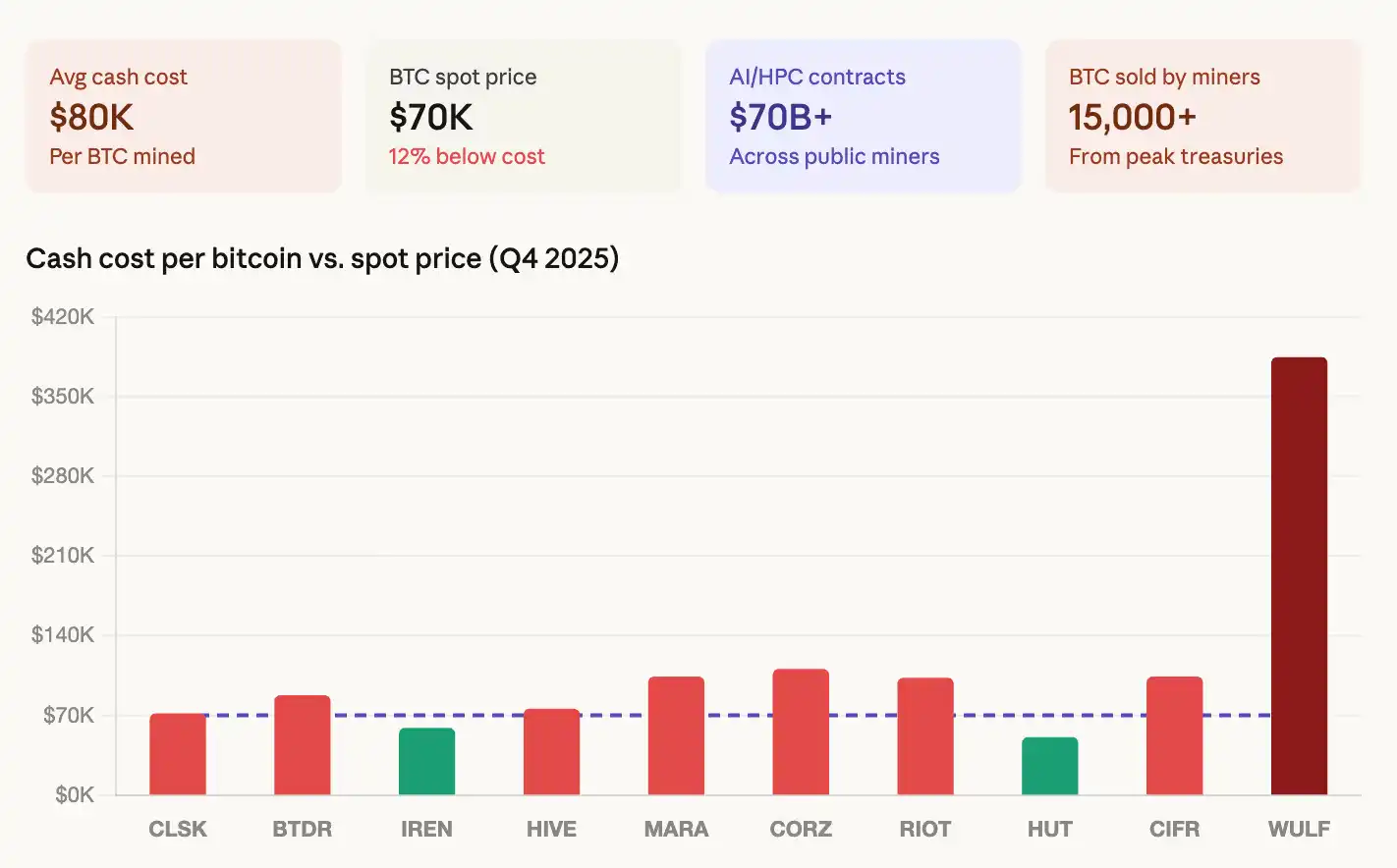
Deep Tide Guide: The latest mining report from CoinShares shows that the weighted average cost for listed mining companies to mine one Bitcoin has risen to about $80,000, while the current price of BTC is between $68,000 and $70,000—resulting in a loss of $19,000 per coin mined.

The industry is undergoing its most fundamental transformation since its inception: over $70 billion in AI/HPC contracts have been signed, listed mining companies have collectively sold over 15,000 BTC, and companies like IREN and TeraWulf have taken on tens of billions of dollars in debt. By the end of 2026, AI revenue may account for up to 70% of some mining companies' income. They are transitioning from Bitcoin miners to data center operators that happen to still mine. The core contradiction is: the companies selling Bitcoin to transition to AI are the same ones that secure the Bitcoin network. The hash rate has dropped from a peak of 1,160 EH/s to about 920 EH/s.

  • The Bitcoin mining industry is experiencing its most fundamental transformation since its inception, and the clearest signal is not the hash rate or difficulty adjustment, but the balance sheet.
  • CoinShares' Q1 2026 mining report released this week shows that the weighted average cash cost for listed mining companies to mine one Bitcoin in Q4 2025 rose to about $79,995.
  • Bitcoin has been trading in the $68,000–$70,000 range, and a CoinDesk report last week estimated a loss of about $19,000 per BTC mined.
  • This number is unsustainable, and the industry knows it. The response is a full-scale shift to AI infrastructure—which is reshaping the essence of these companies.

According to the CoinShares report, listed mining companies have collectively announced over $70 billion in AI and high-performance computing (HPC) contracts. CoreWeave's expanded agreement with Core Scientific is worth $10.2 billion over 12 years. TeraWulf has secured $12.8 billion in HPC contract revenue. Hut 8 signed a $7 billion, 15-year AI infrastructure lease at its River Bend campus. Cipher Digital signed a multi-billion dollar agreement with Google-backed Fluidstack.
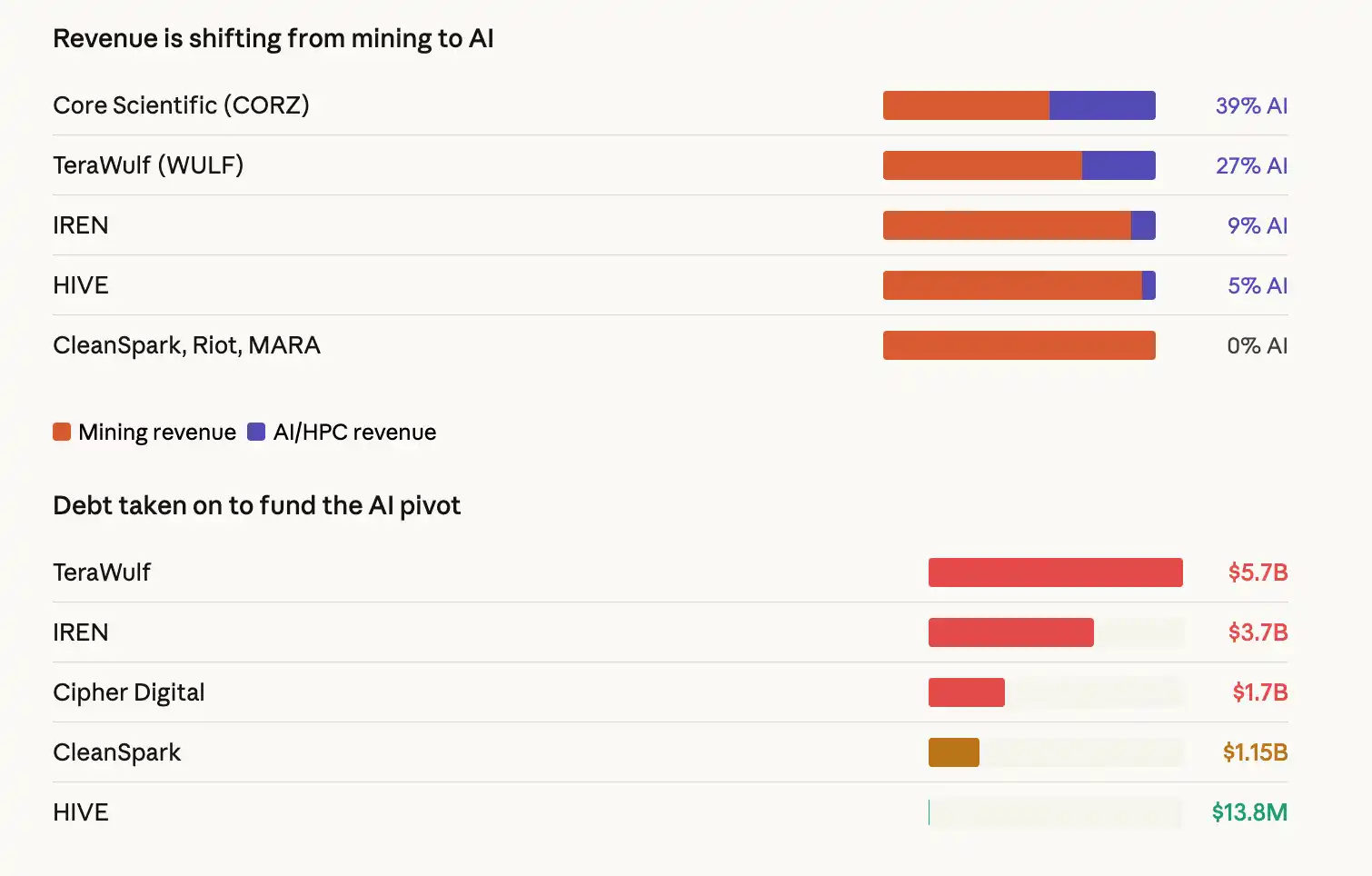
By the end of 2026, AI revenue could account for up to 70% of listed mining companies' income, compared to about 30% now. Core Scientific's AI hosting revenue already makes up 39% of its total revenue. TeraWulf is at 27%. IREN is currently at 9% but is rapidly expanding, with 200 megawatts of liquid-cooled GPU computing capacity under construction.

This means these mining companies are increasingly resembling data center operators that happen to still mine Bitcoin.

The economics explain why. CoinShares data shows that Bitcoin mining infrastructure costs about $700,000–$1 million per megawatt, while AI infrastructure costs about $8–$15 million per megawatt. The gap is significant, but AI offers structurally higher and more stable returns.

Hash price—a metric measuring miners' revenue per unit of computing power—fell to a post-halving all-time low in early March, around $28–$30/PH/day.

At this level, miners using mid-generation machines need electricity prices below $0.05/kWh to remain cash-flow positive. In contrast, AI infrastructure contracts promise profit margins exceeding 85%, with multi-year guaranteed revenue visibility.

Where Is the Money for the Transition Coming From?

The CoinShares report points out that there are two sources of funding for this transition, both clearly visible in the data.

First, debt. Leverage across the industry has qualitatively changed. IREN now carries $3.7 billion in convertible notes across five series. TeraWulf has total debt of $5.7 billion, consisting of convertible bonds and priority guaranteed notes from its computing power subsidiary.

Cipher Digital issued $1.7 billion in priority guaranteed notes in November, causing its quarterly interest expense to soar from $3.2 million in the first nine months to $33.4 million in Q4 alone. This is not a mining-level debt burden; it's an infrastructure-level bet—wagering that AI revenue will come fast enough to cover debt obligations.

Second, selling Bitcoin. Listed mining companies have collectively sold over 15,000 BTC from their peak holdings. Core Scientific sold about 1,900 BTC (worth $175 million) in January and plans to liquidate almost all remaining holdings in Q1 2026. Bitdeer zeroed out its holdings in February. Riot Platforms sold 1,818 BTC (worth $162 million) in December.

Even the largest listed holder, Marathon (holding 53,822 BTC), quietly expanded its policy in its March 10-K annual report, authorizing sales from its entire balance sheet reserves. Part of the reason is pressure from its $350 million Bitcoin-collateralized credit facility—as the price fell toward $68,000, the loan-to-value (LTV) ratio climbed to 87%.
Who Will Protect the Bitcoin Network?

The companies selling Bitcoin to fund AI are precisely those whose mining operations secure the Bitcoin network. This constitutes the core contradiction of this transition. When mining is unprofitable and AI is profitable, the rational economic decision is to shift capital away from mining. But if enough miners do this, the network's security budget shrinks.

Hash rate data already reflects this. The network hash rate peaked at about 1,160 EH/s in early October 2025 and has since declined to about 920 EH/s, with three consecutive negative difficulty adjustments—the first since July 2022.

Valuation Divergence

The market has already priced in this divergence. Mining companies with signed HPC contracts currently trade at 12.3 times their revenue for the next 12 months. Pure mining companies trade at only 5.9 times. The market is paying a premium of over twice for AI exposure, further reinforcing the incentive to transition.

The geographical landscape is also changing. The US, China, and Russia currently control about 68% of the global hash rate. In Q4 alone, the US increased its market share by about 2 percentage points. But emerging markets are also entering the fray—Paraguay and Ethiopia have entered the top ten global mining countries, driven by HIVE's 300-megawatt facility and Bitdeer's 40-megawatt facility, respectively.

Hash Rate Forecast

CoinShares predicts the network hash rate will reach 1.8 ZH/s by the end of 2026 and 2 ZH/s by the end of March 2027 (one month later than previous forecasts).

But this prediction assumes Bitcoin returns to $100,000 by year-end. If the price remains below $80,000, CoinShares forecasts the hash price will continue to fall, the hash rate will decline further, and more miners will exit. A sustained drop below $70,000 could trigger larger-scale capitulation—ironically, this would benefit survivors by lowering the difficulty.

New-generation hardware offers a potential way out. Bitmain's S23 series and Bitdeer's self-developed SEALMINER A3 both have energy efficiency below 10 joules/TH and are expected to ship in large volumes in the first half of 2026. These miners can roughly halve the energy cost per Bitcoin compared to current mainstream mid-generation models. But deploying them requires capital—and many miners are putting their money into AI.

The Bitcoin mining industry began this cycle as a group of companies protecting the network and hoarding Bitcoin. It is exiting this cycle as something else: a group of companies building AI data centers and selling Bitcoin to fund it.

Is this a temporary response to unfavorable economic conditions or a permanent structural shift? It depends on one variable: the price of Bitcoin. If it returns to $100,000, mining profits recover, and the AI transition slows. If it stays at $70,000 or lower, the transition accelerates, and the mining industry, which has been centered on mining for the past decade, will continue to disappear into something entirely different.

Original link: https://www.coindesk.com/markets/2026/03/27/bitcoin-miners-are-becoming-ai-companies-and-selling-their-btc-to-fund-the-transition


Related Questions

QAccording to the CoinShares report, what is the weighted average cash cost for public mining companies to mine one Bitcoin in Q4 2025?

AThe weighted average cash cost for public mining companies to mine one Bitcoin in Q4 2025 was approximately $79,995.

QWhat is the estimated loss per Bitcoin mined at the current price range of $68,000-$70,000?

AThe estimated loss per Bitcoin mined is approximately $19,000 at the current price range.

QWhat is the total value of AI and High-Performance Computing (HPC) contracts that listed mining companies have announced?

AListed mining companies have announced AI and HPC contracts with a cumulative value exceeding $70 billion.

QWhat are the two primary sources of funding for the mining industry's transition to AI infrastructure, as identified in the report?

AThe two primary sources of funding are taking on significant debt and selling their Bitcoin holdings.

QHow has the network's total hash rate changed since its peak in October 2025, and what is the implication of this change?

AThe network's total hash rate has dropped from a peak of approximately 1,160 EH/s to about 920 EH/s, indicating a contraction in the network's security budget as miners reallocate resources.

Related Reads

Will the Fed Still Cut Interest Rates? Tonight's Data Is Crucial

The core debate surrounding the Federal Reserve's potential interest rate cuts is intensifying amid geopolitical conflict and rebounding inflation. The key question is whether high energy prices will cause persistent inflation or weaken consumer demand enough to force the Fed to cut rates. Citigroup presents a bullish case for cuts, arguing that oil supply disruptions from the Strait of Hormuz are temporary and will not lead to lasting inflationary pressure. They point to receding bond yields and oil prices as evidence the market is pricing in a short-lived shock. Citi's data also shows tightening financial conditions, a stabilizing labor market, and healthy tax returns, supporting their view that the path to lower rates remains open. Conversely, Deutsche Bank offers a starkly contrasting, more hawkish outlook. They argue the Fed's current policy is already neutral and expect rates to remain unchanged indefinitely. Their view is based on stalled disinflation progress and a shift toward more hawkish rhetoric from key Fed officials like Waller, who cited risks from prolonged Middle East conflict and tariffs. Other officials, including Williams and Hammack, signaled rates would likely stay on hold for a "considerable time." The market pricing has shifted dramatically, now forecasting zero cuts in 2026. The imminent release of the March retail sales "control group" data is highlighted as a critical test. This metric, which excludes gas station sales, will reveal if high gasoline prices are eroding consumer spending in other areas. A weak reading could support the case for imminent rate cuts, while a strong one would bolster the argument for the Fed to hold steady. This data is pivotal for determining the near-term policy path.

marsbit13m ago

Will the Fed Still Cut Interest Rates? Tonight's Data Is Crucial

marsbit13m ago

The Second Half of Macro Influencer Fu Peng's Career

Fu Peng, a prominent Chinese macroeconomist and former chief economist of Northeast Securities, has joined Hong Kong-based digital asset management firm Bitfire Group (formerly New Huo Group) as its chief economist. This move, announced in April 2026, triggered an 11% surge in Bitfire's stock price. Fu, known for his accessible macroeconomic commentary and large social media following, will focus on integrating digital assets into global asset allocation frameworks, particularly combining FICC (fixed income, currencies, and commodities) with cryptocurrencies for institutional clients. His career includes roles at Lehman Brothers and Solomon International, with significant influence gained through public communication. However, in late 2024, Fu faced temporary social media bans after a controversial private speech at HSBC on China's economic challenges, though he denied regulatory sanctions. He later left Northeast Securities citing health reasons. Bitfire, a licensed virtual asset manager serving high-net-worth clients, seeks to build trust and attract traditional capital through Fu’s expertise and credibility. The partnership represents a strategic shift for both: Fu enters the crypto sector after a traditional finance peak, while Bitfire aims to leverage his macro framework for institutional adoption. Outcomes remain uncertain regarding capital inflows and compatibility within corporate structure.

marsbit1h ago

The Second Half of Macro Influencer Fu Peng's Career

marsbit1h ago

Trading

Spot
Futures

Hot Articles

What is $BITCOIN

DIGITAL GOLD ($BITCOIN): A Comprehensive Analysis Introduction to DIGITAL GOLD ($BITCOIN) DIGITAL GOLD ($BITCOIN) is a blockchain-based project operating on the Solana network, which aims to combine the characteristics of traditional precious metals with the innovation of decentralized technologies. While it shares a name with Bitcoin, often referred to as “digital gold” due to its perception as a store of value, DIGITAL GOLD is a separate token designed to create a unique ecosystem within the Web3 landscape. Its goal is to position itself as a viable alternative digital asset, although specifics regarding its applications and functionalities are still developing. What is DIGITAL GOLD ($BITCOIN)? DIGITAL GOLD ($BITCOIN) is a cryptocurrency token explicitly designed for use on the Solana blockchain. In contrast to Bitcoin, which provides a widely recognized value storage role, this token appears to focus on broader applications and characteristics. Notable aspects include: Blockchain Infrastructure: The token is built on the Solana blockchain, known for its capacity to handle high-speed and low-cost transactions. Supply Dynamics: DIGITAL GOLD has a maximum supply capped at 100 quadrillion tokens (100P $BITCOIN), although details regarding its circulating supply are currently undisclosed. Utility: While precise functionalities are not explicitly outlined, there are indications that the token could be utilized for various applications, potentially involving decentralized applications (dApps) or asset tokenization strategies. Who is the Creator of DIGITAL GOLD ($BITCOIN)? At present, the identity of the creators and development team behind DIGITAL GOLD ($BITCOIN) remains unknown. This situation is typical among many innovative projects within the blockchain space, particularly those aligning with decentralized finance and meme coin phenomena. While such anonymity may foster a community-driven culture, it intensifies concerns about governance and accountability. Who are the Investors of DIGITAL GOLD ($BITCOIN)? The available information indicates that DIGITAL GOLD ($BITCOIN) does not have any known institutional backers or prominent venture capital investments. The project seems to operate on a peer-to-peer model focused on community support and adoption rather than traditional funding routes. Its activity and liquidity are primarily situated on decentralized exchanges (DEXs), such as PumpSwap, rather than established centralized trading platforms, further highlighting its grassroots approach. How DIGITAL GOLD ($BITCOIN) Works The operational mechanics of DIGITAL GOLD ($BITCOIN) can be elaborated on based on its blockchain design and network attributes: Consensus Mechanism: By leveraging Solana’s unique proof-of-history (PoH) combined with a proof-of-stake (PoS) model, the project ensures efficient transaction validation contributing to the network's high performance. Tokenomics: While specific deflationary mechanisms have not been extensively detailed, the vast maximum token supply implies that it may cater to microtransactions or niche use cases that are still to be defined. Interoperability: There exists the potential for integration with Solana’s broader ecosystem, including various decentralized finance (DeFi) platforms. However, the details regarding specific integrations remain unspecified. Timeline of Key Events Here is a timeline that highlights significant milestones concerning DIGITAL GOLD ($BITCOIN): 2023: The initial deployment of the token occurs on the Solana blockchain, marked by its contract address. 2024: DIGITAL GOLD gains visibility as it becomes available for trading on decentralized exchanges like PumpSwap, allowing users to trade it against SOL. 2025: The project witnesses sporadic trading activity and potential interest in community-led engagements, although no noteworthy partnerships or technical advancements have been documented as of yet. Critical Analysis Strengths Scalability: The underlying Solana infrastructure supports high transaction volumes, which could enhance the utility of $BITCOIN in various transaction scenarios. Accessibility: The potential low trading price per token could attract retail investors, facilitating wider participation due to fractional ownership opportunities. Risks Lack of Transparency: The absence of publicly known backers, developers, or an audit process may yield skepticism regarding the project's sustainability and trustworthiness. Market Volatility: The trading activity is heavily reliant on speculative behavior, which can result in significant price volatility and uncertainty for investors. Conclusion DIGITAL GOLD ($BITCOIN) emerges as an intriguing yet ambiguous project within the rapidly evolving Solana ecosystem. While it attempts to leverage the “digital gold” narrative, its departure from Bitcoin's established role as a store of value underscores the need for a clearer differentiation of its intended utility and governance structure. Future acceptance and adoption will likely depend on addressing the current opacity and defining its operational and economic strategies more explicitly. Note: This report encompasses synthesised information available as of October 2023, and developments may have transpired beyond the research period.

363 Total ViewsPublished 2025.05.13Updated 2025.05.13

What is $BITCOIN

Discussions

Welcome to the HTX Community. Here, you can stay informed about the latest platform developments and gain access to professional market insights. Users' opinions on the price of BTC (BTC) are presented below.

活动图片