Load The Bags! Bitcoin MVRV Hits Key Accumulation Threshold – Details

bitcoinistPublished on 2025-12-20Last updated on 2025-12-20

Abstract

Bitcoin's recent correction has pushed its price down to around $85,000, creating a wave of fear and investor capitulation. However, on-chain data indicates this may present a prime accumulation opportunity. The Bitcoin MVRV Percentile, a key metric comparing current market value to its historical realized value, has fallen into the 0-10% range. Historically, this zone signals extreme fear and market bottoms but has also preceded massive rallies. For instance, similar MVRV levels occurred after the 2015 Mt. Gox crash and the 2022 FTX collapse, both followed by significant price surges. Despite current short-term losses, analysts suggest this high-risk, high-reward threshold is an ideal entry point for investors seeking aggressive long-term gains, anticipating the next major upward move. Bitcoin currently trades near $88,200.

Over the last week, Bitcoin recorded waves of significant correction, reaching a price bottom of $85,000 as broader financial markets also tumbled in fear of an impending economic recession. As many are opting to exit their investments, recent on-chain data show that the current tumultuous market presents an ideal accumulation opportunity for risk-seeking Bitcoin investors.

Accumulation Zones – Stressful In Real Time, Rewarding Long-Term: Analyst

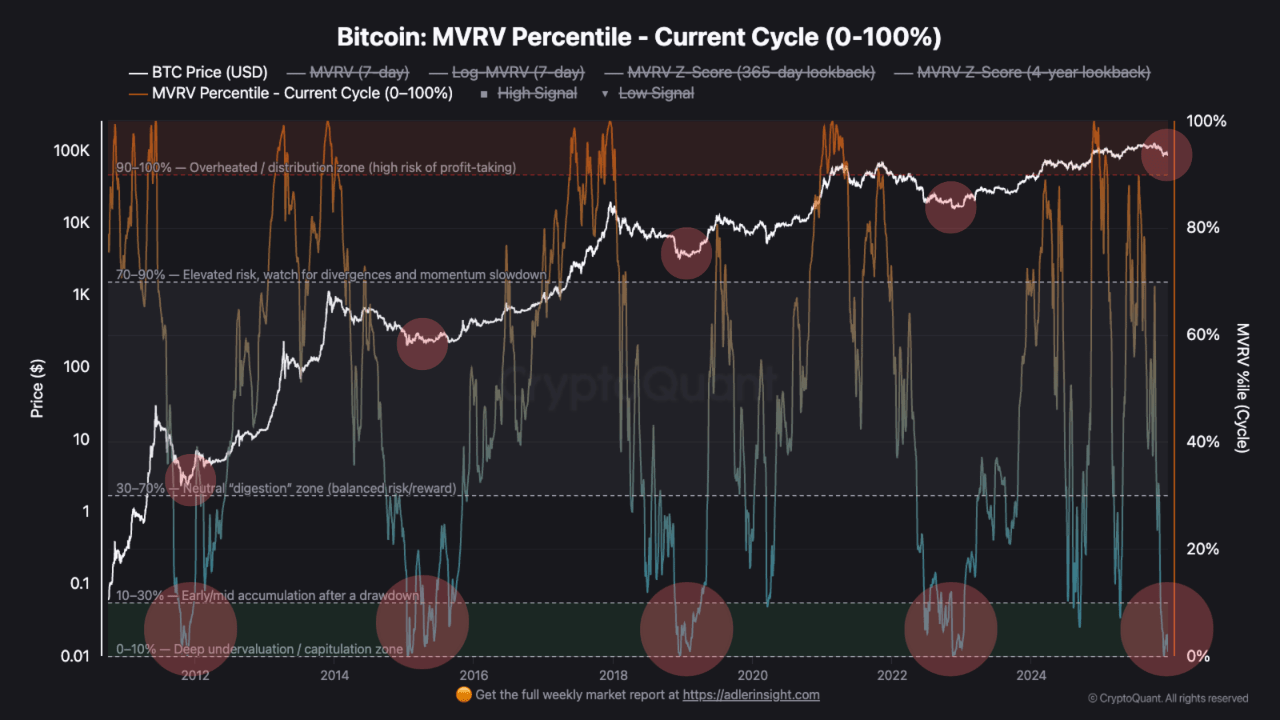
Q4 2025 has largely been an enduring period for most Bitcoin investors. After attaining a new-time high of $126,100 in early October, the leading cryptocurrency has struggled with further price growth, but rather succumbed to strong selling pressure to decline by 30.1%. However, Bitcoin’s latest price drops pushed the market into new dynamics favorable for investors with high risk tolerance, based on historical data from the MVRV percentile metric.

For context, the Bitcoin MVRV (Market Value to Realized Value) compares Bitcoin’s current market capitalization to its realized capitalization (the value of coins at their last on-chain movement), showing whether BTC is over- or undervalued. Raw MVRV can be hard to compare across cycles. Therefore, the MVRV Percentile ranks current MVRV against its historical distribution (0–100), making it easier to judge extremes across different cycles, where high percentiles indicate overheated markets, low percentiles suggest capitulation.

Source: CryptoQuant

Using this metric, seasoned market analyst RugaResearch explains that the present MVRV percentile falls within 0-10%, a range that is usually associated with heavy investor capitulation and market losses as fear gripped the market. However, the crypto expert also observed similar market situations to have served as ideal entry points to an exponential price rally.

For example, Bitcoin MVRV dropped below 10% when prices crashed to around $200-$300 in 2015, after the Mt.Gox black swan event, spreading waves of pessimism among investors, some of whom might have expected a total regulatory ban. However, the premier cryptocurrency surges in the following months with heavy traction, reaching a peak price of $20,000 in 2017 to represent a 10x gain.

RugaResearch also references a more recent example after BTC slumped to $15,000 following the FTX collapse in 2022, which was heralded by other events, including the collapse of the Terra Luna Ecosystem, and businesses such as Celsius and Three Arrows Capital. Despite the heavy market fear during this period, Bitcoin would record another resurgence to double its price within the following year.

Bitcoin Set To Boom?

At the time of writing, Bitcoin trades at $88,200 after a price gain of 0.54% in the past day. However, its performance on the weekly and monthly charts reports losses of 2.52% and 3.52%, respectively, as many investors remain underwater, and others exit the market. Nevertheless, RugaResearch explains that recent retail capitulation represents an ideal “high-risk, high-reward” zone considering the MVRV Percentile that is less than 10. The analyst nudges investors to get aggressive with accumulation to benefit from the next explosive upside move.

BTC trading at $88,256 on the daily chart | Source: BTCUSDT chart on Tradingview.com

Related Questions

QWhat is the Bitcoin MVRV (Market Value to Realized Value) metric and what does it indicate?

AThe Bitcoin MVRV metric compares Bitcoin's current market capitalization to its realized capitalization, which is the value of coins at their last on-chain movement. It is used to determine whether Bitcoin is overvalued or undervalued. A low MVRV Percentile (0-10%) suggests investor capitulation and a potentially undervalued market, often serving as a historical accumulation zone.

QAccording to the analyst RugaResearch, what does an MVRV Percentile in the 0-10% range signify for Bitcoin investors?

AAccording to RugaResearch, an MVRV Percentile in the 0-10% range signifies a period of heavy investor capitulation and market fear. However, historically, this range has also represented an ideal 'high-risk, high-reward' accumulation zone and has served as a precursor to significant price rallies.

QWhat historical events are cited as examples where a low MVRV preceded a major Bitcoin price increase?

ATwo historical examples are cited: the price crash to around $200-$300 in 2015 following the Mt.Gox incident, after which Bitcoin surged to $20,000 in 2017, and the price drop to $15,000 after the FTX collapse in 2022, which was followed by a price doubling within the next year.

QWhat was Bitcoin's price and recent performance at the time the article was written?

AAt the time of writing, Bitcoin was trading at $88,200, with a 0.54% gain in the past 24 hours. However, it reported weekly and monthly losses of 2.52% and 3.52%, respectively.

QWhat is the main advice given to investors based on the current MVRV data?

AThe main advice, based on the MVRV Percentile being below 10%, is for risk-seeking investors to become aggressive with their accumulation of Bitcoin, as the current market turmoil presents a potential opportunity to benefit from a future explosive upside price move.

Related Reads

How Much Debt Does Strategy Really Have? Is There a Risk of Implosion?

MicroStrategy's Debt Risk: A Turning Point in the "Never Sell" Strategy As of June 3, 2026, MicroStrategy holds 843,706 bitcoins (valued at ~$53.1B) but faces significant financial obligations. Its capital structure includes $6.75B in convertible notes and $15.48B in perpetual preferred stock (led by the $8.5B STRC series), creating an annual payout burden of ~$1.71B. With software revenue at only ~$500M, interest and dividend obligations far exceed operating income. A critical shift occurred in late May 2026 when the company sold 32 bitcoins for ~$2.5M to cover dividends, breaking CEO Michael Saylor's long-standing "never sell" pledge. This symbolic move triggered a sharp decline in both Bitcoin's price and MSTR stock, reflecting market fears about cash flow sustainability. The core of the strain is the STRC perpetual preferred stock, designed as a "permanent loan" with no maturity date but requiring high monthly dividends (currently 11.5%). Its business model relies on a three-part cycle: issuing new STRC shares, using proceeds to buy more Bitcoin and fund a USD reserve, and using that reserve to pay dividends. This cycle depends on continuous investor demand for STRC and Bitcoin's price appreciation. Analysis shows Bitcoin needs to appreciate at least 2.3% annually to cover the $1.71B in yearly obligations at current holdings. With Bitcoin price down ~22% from March 2026 highs, this pressure has intensified. The company's $900M USD reserve can only cover about 7 months of payments if STRC issuance stalls. Key risks are not immediate bankruptcy or forced Bitcoin liquidation (as BTC is not collateral), but rather: 1) The erosion of MSTR's premium to its Bitcoin holdings (mNAV), which would cripple its ability to raise cheap capital; 2) A vicious cycle where stagnant Bitcoin prices reduce STRC demand, draining the USD reserve and forcing BTC sales, further depressing prices. The period from February 2027 to September 2028 is a crucial test, with over $5.9B in convertible notes facing put options or maturity. In essence, MicroStrategy has evolved from a simple Bitcoin holder into a complex financial entity acting like a "private Bitcoin bank," leveraging its BTC holdings to create layered financial products. Its survival depends on maintaining Bitcoin's price trend, its stock premium, and market appetite for its preferred shares. The recent token sale marks not a betrayal of its Bitcoin thesis, but an admission that the leveraged strategy must eventually be paid for.

marsbit6m ago

How Much Debt Does Strategy Really Have? Is There a Risk of Implosion?

marsbit6m ago

Anthropic Cries Wolf: Is the AGI Threat Real, or Just an IPO Story?

Anthropic has published an article titled "When AI builds itself," discussing the emerging concept of "recursive self-improvement," where AI begins to actively participate in designing, training, testing, and optimizing its own subsequent versions. The company presents internal data showing that by May 2026, over 80% of code merged into its codebase was written by Claude, its AI model. Claude's capabilities have expanded to handling complex, open-ended engineering tasks, achieving a 76% success rate in such areas, and even contributing to research processes, such as optimizing code performance and conducting AI safety experiments. Anthropic outlines an evolution from human-driven development to AI-assisted workflows, culminating in the current stage where AI agents can autonomously write, run, and delegate code. The company cautions that the path toward a "closed loop," where AI continuously improves itself, is becoming visible. It calls for coordinated global mechanisms to potentially slow or pause frontier AI development to allow safety research and societal structures to catch up. However, the timing of this warning coincides with Anthropic's preparations for an IPO, framing the narrative not just as a safety concern but also as a demonstration of Claude's advanced capabilities and its integral role in accelerating Anthropic's own R&D—creating a potential "flywheel" effect for competitive advantage. This contrasts with OpenAI's recent, more policy-oriented discussion of the same risks, highlighting the competitive dynamics in the AI industry as companies position themselves in both the technological and regulatory landscape.

marsbit1h ago

Anthropic Cries Wolf: Is the AGI Threat Real, or Just an IPO Story?

marsbit1h ago

BIT Research: ETF Purchases Have Slowed, Strategy (MicroStrategy) Has Slowed, What Else Can Drive Bitcoin's Rise?

Market Refocus on Inflation and Rate Expectations Weighs on Bitcoin Currently, the market is in a phase of macro-repricing dominated by inflation and interest rate expectations. Bitcoin, which previously benefited from easy liquidity and low inflation, is seeing its core bullish drivers weaken. These drivers were market expectations for interest rate cuts and strong inflows from Bitcoin ETFs and institutions like MicroStrategy (referred to as "Strategy" in the text). The logic has shifted. Recent high inflation data (e.g., CPI hitting 3.8% in a May 2026 report) has caused the market to sharply reduce its rate cut expectations for 2025 and even price in potential hikes. This is a key constraint for Bitcoin, as it lacks cash flows and is highly sensitive to rate expectations. Concurrently, institutional capital flows have slowed significantly. Following the hot CPI data, Bitcoin ETFs saw accelerated outflows, with around $4.3 billion leaving over a period. MicroStrategy's ability to keep adding substantial Bitcoin to its balance sheet is also diminishing. Together, ETF and MicroStrategy holdings total roughly $110 billion, but their momentum as growth engines is cooling. In summary, Bitcoin's current pressure stems not from its own fundamentals but from a changing macro environment. As long as inflation stays elevated, Bitcoin is likely to remain in a consolidating phase. However, historically, inflation eventually peaks. Once it recedes and rate cut expectations rebuild, institutional capital could return, potentially fueling a new and more robust recovery phase for Bitcoin.

marsbit1h ago

BIT Research: ETF Purchases Have Slowed, Strategy (MicroStrategy) Has Slowed, What Else Can Drive Bitcoin's Rise?

marsbit1h ago

Trading

Spot
Futures

Hot Articles

What is $BITCOIN

DIGITAL GOLD ($BITCOIN): A Comprehensive Analysis Introduction to DIGITAL GOLD ($BITCOIN) DIGITAL GOLD ($BITCOIN) is a blockchain-based project operating on the Solana network, which aims to combine the characteristics of traditional precious metals with the innovation of decentralized technologies. While it shares a name with Bitcoin, often referred to as “digital gold” due to its perception as a store of value, DIGITAL GOLD is a separate token designed to create a unique ecosystem within the Web3 landscape. Its goal is to position itself as a viable alternative digital asset, although specifics regarding its applications and functionalities are still developing. What is DIGITAL GOLD ($BITCOIN)? DIGITAL GOLD ($BITCOIN) is a cryptocurrency token explicitly designed for use on the Solana blockchain. In contrast to Bitcoin, which provides a widely recognized value storage role, this token appears to focus on broader applications and characteristics. Notable aspects include: Blockchain Infrastructure: The token is built on the Solana blockchain, known for its capacity to handle high-speed and low-cost transactions. Supply Dynamics: DIGITAL GOLD has a maximum supply capped at 100 quadrillion tokens (100P $BITCOIN), although details regarding its circulating supply are currently undisclosed. Utility: While precise functionalities are not explicitly outlined, there are indications that the token could be utilized for various applications, potentially involving decentralized applications (dApps) or asset tokenization strategies. Who is the Creator of DIGITAL GOLD ($BITCOIN)? At present, the identity of the creators and development team behind DIGITAL GOLD ($BITCOIN) remains unknown. This situation is typical among many innovative projects within the blockchain space, particularly those aligning with decentralized finance and meme coin phenomena. While such anonymity may foster a community-driven culture, it intensifies concerns about governance and accountability. Who are the Investors of DIGITAL GOLD ($BITCOIN)? The available information indicates that DIGITAL GOLD ($BITCOIN) does not have any known institutional backers or prominent venture capital investments. The project seems to operate on a peer-to-peer model focused on community support and adoption rather than traditional funding routes. Its activity and liquidity are primarily situated on decentralized exchanges (DEXs), such as PumpSwap, rather than established centralized trading platforms, further highlighting its grassroots approach. How DIGITAL GOLD ($BITCOIN) Works The operational mechanics of DIGITAL GOLD ($BITCOIN) can be elaborated on based on its blockchain design and network attributes: Consensus Mechanism: By leveraging Solana’s unique proof-of-history (PoH) combined with a proof-of-stake (PoS) model, the project ensures efficient transaction validation contributing to the network's high performance. Tokenomics: While specific deflationary mechanisms have not been extensively detailed, the vast maximum token supply implies that it may cater to microtransactions or niche use cases that are still to be defined. Interoperability: There exists the potential for integration with Solana’s broader ecosystem, including various decentralized finance (DeFi) platforms. However, the details regarding specific integrations remain unspecified. Timeline of Key Events Here is a timeline that highlights significant milestones concerning DIGITAL GOLD ($BITCOIN): 2023: The initial deployment of the token occurs on the Solana blockchain, marked by its contract address. 2024: DIGITAL GOLD gains visibility as it becomes available for trading on decentralized exchanges like PumpSwap, allowing users to trade it against SOL. 2025: The project witnesses sporadic trading activity and potential interest in community-led engagements, although no noteworthy partnerships or technical advancements have been documented as of yet. Critical Analysis Strengths Scalability: The underlying Solana infrastructure supports high transaction volumes, which could enhance the utility of $BITCOIN in various transaction scenarios. Accessibility: The potential low trading price per token could attract retail investors, facilitating wider participation due to fractional ownership opportunities. Risks Lack of Transparency: The absence of publicly known backers, developers, or an audit process may yield skepticism regarding the project's sustainability and trustworthiness. Market Volatility: The trading activity is heavily reliant on speculative behavior, which can result in significant price volatility and uncertainty for investors. Conclusion DIGITAL GOLD ($BITCOIN) emerges as an intriguing yet ambiguous project within the rapidly evolving Solana ecosystem. While it attempts to leverage the “digital gold” narrative, its departure from Bitcoin's established role as a store of value underscores the need for a clearer differentiation of its intended utility and governance structure. Future acceptance and adoption will likely depend on addressing the current opacity and defining its operational and economic strategies more explicitly. Note: This report encompasses synthesised information available as of October 2023, and developments may have transpired beyond the research period.

363 Total ViewsPublished 2025.05.13Updated 2025.05.13

What is $BITCOIN

Discussions

Welcome to the HTX Community. Here, you can stay informed about the latest platform developments and gain access to professional market insights. Users' opinions on the price of BTC (BTC) are presented below.

活动图片