Key Figure at xAI Departs, Dealing a Heavy Blow to Musk's AI Ambitions

marsbitPublished on 2026-02-12Last updated on 2026-02-12

Abstract

Elon Musk's AI ambitions face a major setback as Tony Wu, co-founder and head of AI reasoning at xAI, resigns. This marks the departure of a second co-founder within months, following Igor Babuschkin’s exit last August. Wu led a critical division focused on AI reasoning—a core capability for advancing toward artificial general intelligence. The loss is particularly damaging given the current competitive AI landscape, where reasoning is key to surpassing models like GPT-4 and Claude. Wu’s exit may delay xAI’s R&D progress by at least six months and weaken its position against rivals like OpenAI and Anthropic. The departures highlight potential internal challenges. Musk’s intense, top-down management style—effective in engineering-driven companies like Tesla and SpaceX—may clash with the creative, research-oriented culture required for breakthrough AI work. Of xAI’s original 12 founding members, five have now left. In a fiercely competitive AI talent market, top researchers prioritize environments that offer technical autonomy and clear direction—areas where xAI may struggle against more research-centric organizations. The repeated loss of key figures raises questions about xAI’s ability to compete long-term in the race toward AGI.

Author: Hua Lin Wu Wang, Geek Park

Editor: Jing Yu

Just as Musk was preparing to merge SpaceX and xAI to create a cosmic AI behemoth valued at $1.25 trillion, he never expected that not everyone could stomach his grand vision.

On February 10, 2026, local time, xAI co-founder Tony Wu announced his departure from Musk's AI company.

This marks the second co-founder to leave xAI since Igor Babuschkin's departure last August. Wu was responsible for AI reasoning capabilities—a key technical direction considered by the industry to be the core competitiveness of next-generation AI systems.

It is uncommon in Silicon Valley for an AI company, barely over two years old, to lose two co-founders in succession. More critically, this is happening at a time when AI competition is fiercest and talent is scarcest.

With founders leaving one after another, can Musk's AI ambitions continue?

01. Reasoning Expert Walks Away

Tony Wu's role at xAI was far more important than it appeared.

As the technical lead responsible for reasoning capabilities, Wu reported directly to Musk. At the current stage of AI development, reasoning capabilities are seen as the critical bridge between large models like GPT-4 and Claude and true "Artificial General Intelligence."

Simply put, Wu was tasked with making AI "think," not just "memorize and imitate."

Losing Wu at this juncture is a devastating blow to xAI.
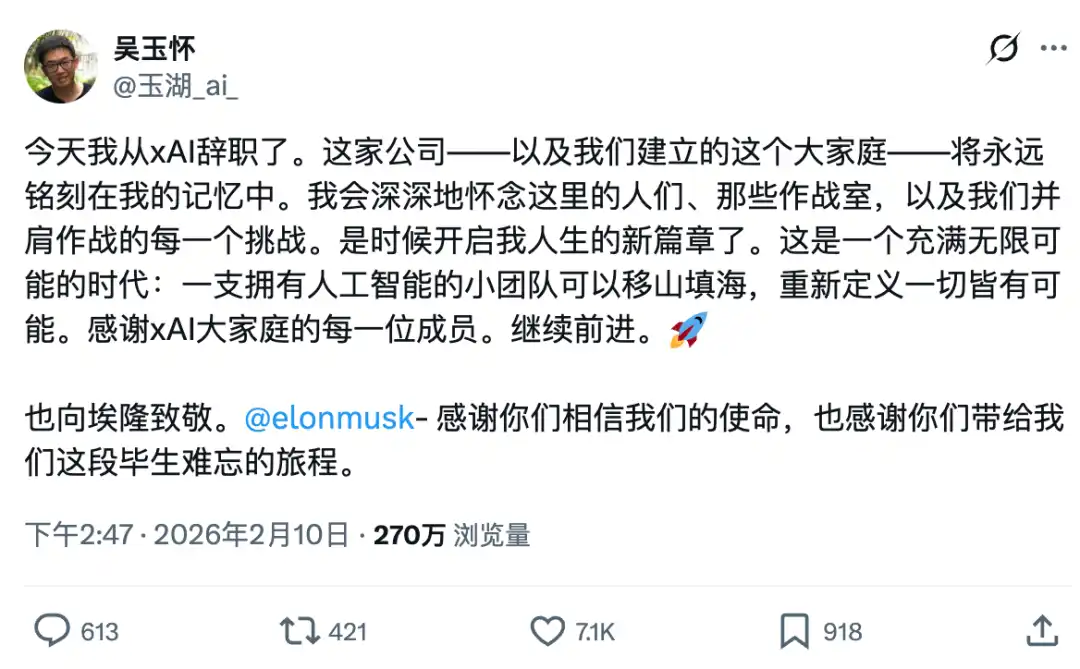
Tony Wu announced his departure on X | Image source: X

From a technical perspective, breakthroughs in AI reasoning require long-term accumulation and continuous iteration. The departure of a reasoning expert takes away not just individual expertise, but also entire technical approaches, experimental data, and judgment on future R&D directions. In the fast-paced AI industry, where progress is measured in months, losing a key technical lead often means at least six months of stalled development.

The timing is even more concerning. OpenAI just released a new code model, achieving significant breakthroughs in AI coding; Anthropic's Claude is performing increasingly well on reasoning tasks. Losing the core figure of the reasoning team at this point could easily cause xAI to fall behind in the most critical technological race.

One developer bluntly stated on X: "Losing Tony Wu is like Tesla losing its head of battery technology. On the surface, the company keeps operating, but its core competitiveness has been hit."

Tony Wu isn't the only one. In fact, over the past year, 5 out of the 12 founding members of xAI have left—a nearly 50% attrition rate, matching the efficiency of Musk's massive Twitter layoffs.

Why are top AI talents unwilling to follow Musk's AI vision?

02. The "Side Effects" of Musk-Style Management

The consecutive departures of two co-founders force a re-examination of what is really happening inside xAI.

Although the specific reasons for leaving were not disclosed officially, judging from Musk's management style at Twitter, Tesla, and SpaceX, the issue might not be compensation, but a clash of management philosophies.

Musk is known for his "extreme pressure" management style.

During the overhaul of Twitter, he once had employees sleeping in the office and conducted large-scale layoffs with an "extremely hardcore or leave" approach. This management style might work in manufacturing or relatively mature tech products, but AI R&D requires creative thinking and long-term focus, not just execution efficiency.

A former OpenAI researcher said in an interview: "AI research has its own rhythm. Sometimes a algorithmic breakthrough requires months of quiet contemplation; other times it requires repeated trial and error. If management is always催促 ('faster, even faster'), it's easy for researchers to feel frustrated."

More critical are divergences in technical路线 (roadmaps).

Musk has publicly stated that xAI pursues "maximum truth-seeking" and "understanding the universe." Such a grand vision is inspiring, but its technical implementation often requires more pragmatic path choices.

When the CEO's vision conflicts with the technical team's judgment, who has the final say?

In traditional AI research institutions, technical experts usually have greater say. But in Musk's companies, the final decision-making power often rests with him.

03. The "Bloodbath" for AI Talent

Viewing xAI's brain drain in a broader context, it is a microcosm of the "bloodbath" for talent across the entire AI industry.

In today's AI industry, top talent is as rare as nuclear physicists were in the last century.

A talented AI researcher might receive offers from OpenAI, Anthropic, and Google DeepMind simultaneously, with an annual salary easily exceeding $500,000, not to mention equity packages worth astronomical figures.

In this environment, the key to retaining talent isn't just money, but also the platform and culture. Researchers prefer places where they can focus on technology, have clear R&D paths, and aren't frequently disturbed by management.

From this perspective, OpenAI and Anthropic do have an advantage.

These two companies are led by AI researchers, where the technical team has sufficient say in key decisions. In contrast, xAI seems more like a "CEO-driven" company—Musk's personal will often overrides the technical team's judgment.

This isn't to say Musk's approach is wrong, but in the unique context of the AI industry, this management style might not be optimal.

A Reddit user hit the nail on the head: "Musk excels at engineering and productization, but the first half of AI research is more like scientific research, requiring patience and room for trial and error."

The question now is, how much time does xAI have to adjust?

In the "winner-takes-all" game of AI, falling behind by six months could mean complete elimination. Losing two co-founders could be a heavier price than imagined for an AI company still searching for its technological breakthrough.

After all, in this AI arms race, the scarcest resource has never been money, but the people who truly know how to make machines "think."


Trending Cryptos

Related Questions

QWho is the co-founder that recently left xAI, and what was his key responsibility?

ATony Wu, who was responsible for AI inference capabilities, a key technology considered the core competitiveness of next-generation AI systems.

QHow many co-founders have left xAI in total, and what does this indicate about the company?

ATwo co-founders have left, including Tony Wu and Igor Babuschkin (who left in August), indicating potential internal challenges and a high turnover rate among top talent.

QWhat is the significance of AI inference capabilities in the current AI development stage?

AAI inference capabilities are seen as the critical bridge between large models like GPT-4 and Claude and true 'Artificial General Intelligence,' enabling AI to 'think' rather than just 'memorize and imitate.'

QWhat management style is attributed to Elon Musk, and how might it affect AI research at xAI?

AElon Musk is known for an 'extreme pressure' management style, which may conflict with AI research's need for creative thinking, long-term focus, and iterative experimentation, potentially leading to frustration among researchers.

QWhy is retaining top AI talent particularly challenging in the current industry environment?

ATop AI talent is extremely scarce and highly sought after by major players like OpenAI, Anthropic, and Google DeepMind. Retention depends not only on compensation but also on platform quality, research autonomy, and a conducive environment for innovation.

Related Reads

In Conversation with Ray Dalio: We Are Currently in an AI Bubble, with 1% of My Portfolio in Bitcoin

Ray Dalio, founder of Bridgewater Associates, warns in an interview that the current AI boom shows classic bubble characteristics, which could lead to significant economic downturns as seen in past cycles like 1929 or 2000. He explains that speculative enthusiasm, fueled by debt and overvaluation, often precedes a crash when rising rates or taxation force asset sales, causing widespread losses and recession. Dalio also outlines his "Big Cycle" theory, describing an approximate 80-year pattern where widening wealth gaps, massive government deficits, and shifting geopolitical power (like China's rise) create internal conflict and global instability. He emphasizes that we are in a late-cycle, transitional phase where traditional powers like the US and UK face decline. For personal wealth protection, Dalio advises diversification beyond cash into assets like stocks, bonds, real estate, and particularly gold, which he prefers over Bitcoin. While he holds about 1% of his portfolio in Bitcoin as a non-printable hard asset, he views gold as more secure from technological or governmental threats. Regarding AI's impact, Dalio believes it will disproportionately benefit capital owners, worsening inequality by replacing both physical and cognitive labor. He suggests that human intuition and emotional intelligence, combined with AI, will be key for future workers. On taxation, Dalio argues that wealth taxes are impractical and risk triggering asset sell-offs, reducing productive investment. He points to the UK as a cautionary example of debt, low productivity, and political strife. Geopolitically, Dalio foresees a more regionalized world, with the US showing weakness in prolonged conflicts like with Iran, akin to past imperial declines. The ideal outcome, he suggests, is coexisting powerful blocs (e.g., Americas, China-Asia Pacific) without major war.

marsbit59m ago

In Conversation with Ray Dalio: We Are Currently in an AI Bubble, with 1% of My Portfolio in Bitcoin

marsbit59m ago

Daily 7.2 Trillion KRW: Foreign Capital's Record Net Buying on Friday! Wall Street Says Headwinds for Korean Stock Fund Flows Have Subsided

South Korean stock market sees a dramatic shift in fund flows. On July 31, foreign investors made a record net purchase of approximately KRW 7.2 trillion in KOSPI stocks, marking a fundamental reversal from the persistent large-scale net outflows seen in previous months. This contributed to a significant narrowing of foreign net selling in July to KRW 9.8 trillion, down sharply from KRW 48.4 trillion in June and KRW 44.5 trillion in May. Simultaneously, domestic institutional pressure eased. South Korean pension funds and asset managers turned to a net buying position in July, purchasing KRW 1.0 trillion worth of KOSPI shares, contrasting with net sales in May and June. Market volatility is expected to be dampened by new financial regulations. Effective July 31, the Financial Services Commission tightened access for retail investors to single-stock leveraged ETFs by raising the minimum cash deposit requirement. Trading volumes for these products subsequently dropped to about 50% of their monthly average. Citigroup Research maintains its year-end KOSPI target of 10,000 points. The firm cites several supportive factors: the substantial easing of headwinds from capital outflows, a robust fundamental outlook for the semiconductor sector, historically low market valuations, strong economic fundamentals, and the potential for policy support from financial authorities if needed.

marsbit59m ago

Daily 7.2 Trillion KRW: Foreign Capital's Record Net Buying on Friday! Wall Street Says Headwinds for Korean Stock Fund Flows Have Subsided

marsbit59m ago

Thanks to Dice Rolls, Bitcoin Keys Are Stored Offline, But Not Everyone Will Do It

The article discusses using dice rolls to generate secure Bitcoin wallet seeds, providing entropy independent of potentially flawed hardware random number generators. It explains that each fair dice roll offers about 2.585 bits of entropy, with around 50 rolls needed for a standard 12-word seed phrase and 99+ recommended for higher security. This method gained attention after a vulnerability was revealed in some Coldcard hardware wallets, where a faulty firmware RNG (dating back to 2021) compromised generated keys. The analysis notes that while a dice-generated main seed was safe from this specific flaw, other Coldcard functions (like creating paper wallets, backup keys, or passwords) could still be vulnerable if they used the defective RNG. The piece argues that while dice-based entropy is technically robust, the manual process is error-prone, tedious, and unrealistic for most new users, who might make mistakes in recording or inputting rolls. It concludes that while manual entropy generation should remain an option for advanced users, the long-term goal is to develop reliable, user-friendly hardware and software that securely generates randomness without requiring specialized knowledge. Coldcard users are advised to check their firmware version and replace any secondary secrets (like paper wallet keys) created with vulnerable devices, while also considering multi-signature setups with devices from different manufacturers for added security.

cryptonews.ru6h ago

Thanks to Dice Rolls, Bitcoin Keys Are Stored Offline, But Not Everyone Will Do It

cryptonews.ru6h ago

Trading

Spot

Hot Articles

Discussions

Welcome to the HTX Community. Here, you can stay informed about the latest platform developments and gain access to professional market insights. Users' opinions on the price of AI (AI) are presented below.

活动图片














