Kaito Reboots 'Talk-to-Earn Economy', but Many Are Hesitant to Install the New Plugin

Odaily星球日报Published on 2026-08-21Last updated on 2026-08-21

Abstract

Kaito AI has launched a new browser extension called Kaito Pulse, aiming to revitalize what the community terms the "talk-to-earn" or "social-fi" economy on X (formerly Twitter). The plugin displays users' on-chain trading activity, such as positions from platforms like Polymarket, directly within the X timeline. This aims to create a new "attention + behavior verification" system, shifting focus from who generates the most discussion to whose discussions are backed by credible, verifiable actions. However, the launch quickly sparked significant privacy concerns within the crypto community. Critics, led by an analysis from user "Ultra," allege the extension's code enables deep data collection. This includes potential device fingerprinting (using GPU, hardware, and audio data), tracking of X user behavior (browsing paths, clicks, engagement), and verification processes that could access sensitive data from third-party accounts like ChatGPT, Claude, and trading platforms. The debate centers on whether such extensive verification is necessary to combat fake engagement and AI-generated content, or if it constitutes an unacceptable privacy sacrifice. In response, Kaito founder Yu Hu stated the design follows data minimization principles. He claimed Kaito Pulse does not collect or store users' raw data but instead uses verification techniques, including zkTLS, to generate proofs of identity or behavior without exposing the underlying information. Yu Hu acknowledged that some perm...

Original | Odaily Planet Daily (@OdailyChina)

Author | Asher (@Asher_ 0210)

Your X feed might once again be flooded with 'Talk-to-Earn' projects.

On August 18, Kaito AI announced the launch of its browser plugin Kaito Pulse, further binding users' discussion behavior on X, on-chain activities, and social influence. Simultaneously, Kaito revealed its first post-relaunch partnership with Axis Robotics, reigniting the incentive model centered around content creators and community contributors.

Unlike the simple content incentives previously centered around Yaps, Kaito's aim this time is not merely 'rewarding posts' but establishing a new scoring system based on 'attention + behavior verification.'

What is Kaito Pulse?

Kaito Pulse is a browser plugin launched by Kaito, designed to overlay more 'on-chain identity' information onto the X timeline. This allows users to not only see the opinions expressed by an X account but also understand the real market actions behind it.
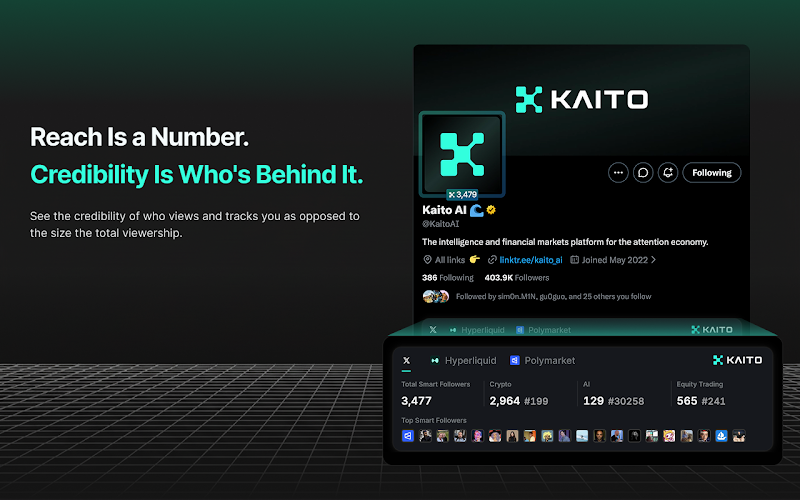
After installing the plugin, users can directly view other users' on-chain activity information within the X timeline, including public trading positions from platforms like Polymarket and Hyperliquid, to better assess whether an account's views align with its actual actions.

By combining social influence with on-chain behavior, Kaito hopes to transform X from a simple information dissemination platform into a social layer that integrates 'opinions, identity, and trading behavior.'

This also represents an upgrade from Yaps to Pulse for Kaito.

Previously, Kaito primarily tracked discussion heat around crypto on X, building content influence leaderboards and incentivizing user participation with KAITO tokens. However, as numerous accounts began mass-producing content, the limitations of measuring influence solely based on discussion volume became increasingly apparent. Therefore, Pulse further incorporates dimensions like content influence, community interaction, and on-chain behavior verification, while introducing a new scoring system called Aura to measure user influence and verified on-chain actions.

Previously, Kaito focused on who generated the most discussion; now, Kaito is more concerned with whose discussion is worth trusting.

Plugin's Excessive Permissions Spark 'Data Collection' Controversy Upon Launch

The launch of Kaito Pulse sparked heated community discussions, with many believing that as market conditions warm up, a new wave of 'Talk-to-Earn economy' is imminent. However, Kaito Pulse also quickly ignited debates within the community regarding privacy and permission overreach.
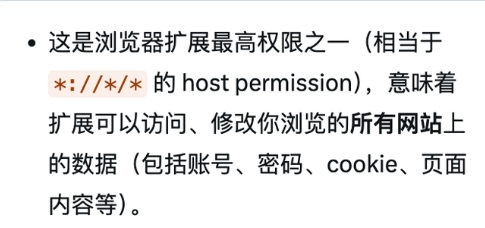
Kaito Pulse Plugin Accused of Multiple Deep Data Collection Behaviors

Ultra posted on X, stating that an analysis of the Pulse plugin code revealed potential involvement in multiple data collection activities, including device fingerprinting, X platform behavior tracking, and third-party account verification.

Among these, device identification is the most concerning issue. Ultra claimed that Kaito Pulse might generate a device fingerprint using information like GPU rendering results, hardware model, and hardware test audio, and link this information to X accounts, affecting anonymity in scenarios involving multi-account users and community matrix accounts.

Besides device information, Ultra also questioned the scope of Kaito Pulse's collection of user X behavior data. The plugin might record certain user behaviors on the X platform, including browsing paths, content dwell time, click behavior, and follow status, and use periodic requests to determine user activity status.

Additionally, third-party account verification is another point of contention. Ultra pointed out that Pulse involves verification processes for ChatGPT, Claude, and multiple trading platform accounts, suggesting these processes might access sensitive user data like subscription status, usage quotas, and trading account information.

Community Divide: Verifying Authenticity or Sacrificing Privacy?

During the Yaps era, Kaito primarily measured influence based on discussion heat on X. However, as mass content production by numerous accounts became more common, the community gradually raised a question: Does high heat equal real influence?

By adding more dimensions like on-chain behavior and external account verification, Kaito Pulse aims to reduce the room for users to gain rankings solely through posting and interaction, making the influence score closer to users' real contributions.

But more verification mechanisms also mean users need to grant more data permissions. Consequently, the community has formed two different views on Kaito Pulse:

  • Supporters argue that a major issue in InfoFi is artificial inflation and false influence, and only by adding identity and behavior verification can a more credible incentive system be built;
  • Skeptics believe platforms should not infinitely expand data collection scope just to improve scoring accuracy, and a new balance must be found between user privacy and incentive rewards.

Official Response to Privacy Controversy: Kaito Pulse Does Not Collect User Raw Data

In response to community skepticism, Kaito founder Yu Hu subsequently addressed the concerns.

Yu Hu stated that Kaito Pulse is designed with the principle of data minimization. The product's goal is not to collect user data but to prove certain identities or behaviors through verification mechanisms under active user authorization.

Regarding concerns about account information, Kaito Pulse does not obtain complete account contents from users nor does it save user raw data. The related processes are mainly used to generate verification results; the platform receives proof information, not the underlying user data.

Addressing the controversy over external account verification, Kaito Pulse uses verification technologies including zkTLS, aiming to allow users to prove they possess certain off-chain identities or behavioral records without exposing raw data.

Simultaneously, Yu Hu acknowledged that the presentation scope of certain permissions might be prone to misunderstanding, and future versions will further optimize permission descriptions and user prompts.

The Next Step for 'Talk-to-Earn Economy': Verifying Influence or Surrendering Privacy?

The debate sparked by Kaito Pulse essentially touches on the unavoidable data dilemma within the InfoFi sector.

In the past, platforms judged an account's value mainly based on follower count, interaction data, and content popularity. However, with the increasing prevalence of AI-generated content, batch accounts, and matrix operations, simple 'discussion volume' has become an increasingly unreliable proxy for genuine influence.

Therefore, Kaito attempts to introduce more verification dimensions, and controversy has followed suit—as platforms seek to further prove 'who you are' and 'whether your views are credible,' the information users need to provide also increases.

For users, installing the plugin to participate in the next wave of the 'Talk-to-Earn economy' also means they need to reconsider: for rankings, points, and potential rewards, how much data are they truly willing to open? Platforms need more data to distinguish real influence from artificial hype; but users also need assurance that this data is genuinely used only for verification and does not become a new digital profile.

Kaito Pulse aims to verify user influence, but as it gains access to more device, behavioral, and account data, Kaito itself has become the subject of scrutiny.


Trending Cryptos

Related Questions

QWhat is Kaito Pulse, and what is its main purpose?

AKaito Pulse is a browser plugin launched by Kaito AI. Its main purpose is to integrate on-chain identity information into the X (formerly Twitter) timeline. It allows users to view others' on-chain activities, such as public trading positions from platforms like Polymarket and Hyperliquid, to assess if a user's opinions align with their actual market behavior. It aims to evolve X from a simple information platform into a social layer combining 'opinions, identity, and trading behavior'.

QWhat are the main privacy concerns raised by the community regarding the Kaito Pulse plugin?

AThe main privacy concerns raised by the community include: 1. Device fingerprinting: The plugin may collect information like GPU rendering results and hardware models to create a device fingerprint, potentially compromising anonymity for users with multiple accounts. 2. X platform behavior tracking: It may record user actions on X, such as browsing paths, content dwell time, and click behavior. 3. Third-party account verification: The verification process for accounts like ChatGPT, Claude, and trading platforms might access sensitive data such as subscription status and transaction information.

QHow did Kaito's founder, Yu Hu, respond to the privacy controversy surrounding Kaito Pulse?

AYu Hu responded by stating that Kaito Pulse is designed with a principle of data minimization. He clarified that the product's goal is not to collect user data but to generate verification proofs based on user authorization. He emphasized that the plugin does not access or store users' raw data; instead, it only obtains proof of certain identities or actions. He also acknowledged that some permission descriptions might be misleading and promised to optimize user prompts in future versions.

QAccording to the article, how has Kaito's approach to measuring user influence evolved from Yaps to Pulse?

AKaito's approach has evolved from primarily tracking discussion volume and popularity on X (during the Yaps era) to incorporating multiple verification dimensions with Pulse. Previously, Kaito focused on 'who generated the most discussion.' Now, with Pulse and its new Aura scoring system, it aims to assess 'whose discussion is worth believing' by adding factors like content influence, community interaction, and verified on-chain behavior to create a more trustworthy measure of real influence.

QWhat fundamental dilemma does the Kaito Pulse plugin highlight for the InfoFi (Information Finance) sector?

AThe Kaito Pulse plugin highlights the fundamental data dilemma in the InfoFi sector: platforms need more user data (like on-chain activity and verified identities) to distinguish genuine influence from artificial hype or bot-generated content. However, to provide this data, users must surrender more privacy. The core challenge is finding a balance where platforms can verify credibility without excessively expanding data collection, ensuring user data is used solely for verification and not for creating detailed digital profiles without consent.

Related Reads

Morgan Stanley Research Report Analysis: Treasury's Repurchase Scale Doubles, The Logic for a Steepening Yield Curve Remains Unchanged

Morgan Stanley report: US Treasury doubles long-term bond buyback size, steepening yield curve thesis intact. The US Treasury will double the size of its regular liquidity support buyback operations for 10-20 year and 20-30 year bonds to at least $4 billion per operation starting Sept 9. Morgan Stanley views this move, the first adjustment outside a quarterly refunding window since the program's May 2024 launch, as a more important signal than the buybacks themselves. The Treasury is signaling close attention to long-end yield dynamics, using the tool to buy time ahead of the November refunding where it could cut long-term issuance. The report argues recent long-end yield rises and curve steepening are driven not by supply/deficit concerns but by repricing of energy prices and central bank policy paths. Analysis of cash Treasury vs. swap spreads shows no clear pattern consistent with dominant supply worries. The action echoes a November 2023 "supply surprise" that briefly flattened the curve. MS maintains its recommendation to steepen the 7s30s curve, targeting a 100 bps spread vs. ~71 bps currently. It believes fundamentals—cooling inflation, weaker-than-expected labor data, and potential downward revision of the Fed's terminal rate—will ultimately drive markets, supporting further steepening. In FX, MS strategists note the move was interpreted as a mild tool to curb USD strength. A refocus on USD policy could lead to further weakness, particularly against CHF, with EUR/USD potentially rising toward 1.2150.

marsbit33m ago

Morgan Stanley Research Report Analysis: Treasury's Repurchase Scale Doubles, The Logic for a Steepening Yield Curve Remains Unchanged

marsbit33m ago

Kaito Revives 'Talk-to-Earn' Economy, But Many Are Hesitant to Install the New Plugin

Kaito AI has launched a new browser extension called Kaito Pulse, aiming to integrate users' discussions on X (formerly Twitter) with their on-chain activities and social influence to build a new "attention + behavior verification" scoring system. The plugin displays users' public trading positions from platforms like Polymarket directly on the X timeline, allowing others to assess if their statements align with their actual market behavior. This move is seen as reviving "influence-to-earn" incentives. However, the launch sparked significant privacy concerns. Critics, including an analysis by "Ultra," allege the extension collects extensive data, such as device fingerprints (via GPU, hardware info), X user behavior (browsing paths, clicks), and may access sensitive data from third-party accounts (e.g., ChatGPT, trading platforms). This raised debates about trading privacy for verified influence. In response, Kaito founder Yu Hu stated the design follows data minimization principles, aiming to generate verification proofs without collecting or storing raw user data, using technologies like zkTLS. He acknowledged some permission descriptions could be misleading and promised improvements. The controversy highlights a core dilemma for social finance (SocialFi) platforms: as fake engagement and AI content grow, more user data is needed to verify genuine influence, but this risks encroaching on user privacy and trust.

marsbit33m ago

Kaito Revives 'Talk-to-Earn' Economy, But Many Are Hesitant to Install the New Plugin

marsbit33m ago

Trading

Spot

Hot Articles

How to Buy KAITO

Welcome to HTX.com! We've made purchasing Kaito (KAITO) simple and convenient. Follow our step-by-step guide to embark on your crypto journey.Step 1: Create Your HTX AccountUse your email or phone number to sign up for a free account on HTX. Experience a hassle-free registration journey and unlock all features.Get My AccountStep 2: Go to Buy Crypto and Choose Your Payment MethodCredit/Debit Card: Use your Visa or Mastercard to buy Kaito (KAITO) instantly.Balance: Use funds from your HTX account balance to trade seamlessly.Third Parties: We've added popular payment methods such as Google Pay and Apple Pay to enhance convenience.P2P: Trade directly with other users on HTX.Over-the-Counter (OTC): We offer tailor-made services and competitive exchange rates for traders.Step 3: Store Your Kaito (KAITO)After purchasing your Kaito (KAITO), store it in your HTX account. Alternatively, you can send it elsewhere via blockchain transfer or use it to trade other cryptocurrencies.Step 4: Trade Kaito (KAITO)Easily trade Kaito (KAITO) on HTX's spot market. Simply access your account, select your trading pair, execute your trades, and monitor in real-time. We offer a user-friendly experience for both beginners and seasoned traders.

4.2k Total ViewsPublished 2025.02.21Updated 2026.07.29

How to Buy KAITO

Discussions

Welcome to the HTX Community. Here, you can stay informed about the latest platform developments and gain access to professional market insights. Users' opinions on the price of KAITO (KAITO) are presented below.

活动图片