Author: Rita
The US Treasury has doubled its long-term bond repurchase scale, effective September 9.
On August 20, Morgan Stanley released its Global Macro Strategy report. The US Treasury has increased the size of its liquidity support repurchase operations (regular buyback operations aimed at improving Treasury market liquidity) for the 10-20 year and 20-30 year tenors from $2 billion per operation to at least $4 billion each, effective September 9. This is the first adjustment to the repurchase scale outside of a quarterly refunding window since the program's launch in May 2024.
Morgan Stanley believes the signal from this move is more important than the repurchases themselves.
Treasury Uses Repurchase Tool to Buy Time for the Long End
The absolute size of the repurchase increase is relatively small. Each operation of $4 billion across two tenors adds a total nominal amount of $1.6 billion, corresponding to approximately $19.3 million DV01 (price change for a 1 basis point move in rates). For reference, during the November 2023 refunding, the Treasury unexpectedly reduced long-term bond issuance; that "supply surprise" had a DV01 impact of about $10.5 million. The risk impact of this repurchase expansion is roughly double that of the previous event.
The intent behind this action is key. In its early August refunding statement, the Treasury for the first time changed the wording from "auction sizes may increase in the future" to "auction sizes may change." Replacing "increase" with "change" indicates the Treasury has opened the door to policy adjustments.
That the Treasury moved ahead of the quarterly refunding window to expand repurchases is interpreted by Morgan Stanley as "the Treasury sending a clear signal to the market that it is paying close attention to the dynamics at the long end (long-term bonds)." The repurchase tool serves to stabilize the long end and buy time before the November refunding window. At that point, the Treasury can choose to cut long-term bond issuance or signal other policy adjustments.
Supply Concerns Are Not the Main Driver of Recent Yield Rise
Morgan Stanley's analytical framework distinguishes between supply-side drivers and macro fundamental drivers.
If supply concerns were the main cause, cash Treasuries should significantly underperform swap contracts, with cash Treasuries falling more than swaps as the market prices in the balance sheet capacity consumed by dealers to absorb bonds. The reality is different.
The spread between 10-year cash Treasuries and SOFR (Secured Overnight Financing Rate) swaps has not shown changes consistent with supply worries, and the 2-year/10-year swap spread curve has only steepened modestly.
Morgan Stanley judges that the recent rise in long-end yields and curve steepening primarily reflect the market repricing energy prices and central bank policy paths. Concerns about the deficit and Treasury supply are not the dominant factors.
Heavy issuance of investment-grade corporate bonds has also not had a lasting impact on the Treasury market. Corporate bond supply has been dense since August, but end-investors have absorbed the duration risk rather than it accumulating on dealer balance sheets. Morgan Stanley believes concerns about corporate bond supply may fade after the September supply is absorbed, allowing Treasury yields to return to being driven by fundamentals.
The 2023 Supply Surprise Triggered Curve Flattening
This preemptive repurchase expansion by the Treasury recalls a similar episode in 2023. In November of that year, the Treasury unexpectedly slowed the pace of long-term bond issuance in its quarterly refunding, triggering a brief yield curve flattening. That flattening lasted only about a week before weaker labor market data emerged and the market's pricing for the Fed's terminal rate shifted down by 100 basis points, and yields resumed their decline.
Morgan Stanley sees parallels between the current environment and late 2023. Data on labor, consumption, and inflation all point to an economy that is not overheating, and the market's pricing for the Fed's terminal rate remains above the forecasts of Morgan Stanley economists. There is room for the terminal rate to be revised lower, and such a downward revision is a key driver of yield curve steepening.
Morgan Stanley maintains its trading recommendation for steepening the 7-year/30-year Treasury yield curve, targeting a spread of 100 basis points (currently around 71 bps).
The impact of the repurchase expansion on the forex market is also noteworthy. Morgan Stanley's FX strategy team points out that the market has interpreted this action as the US Treasury using its toolbox to mildly suppress dollar strength.
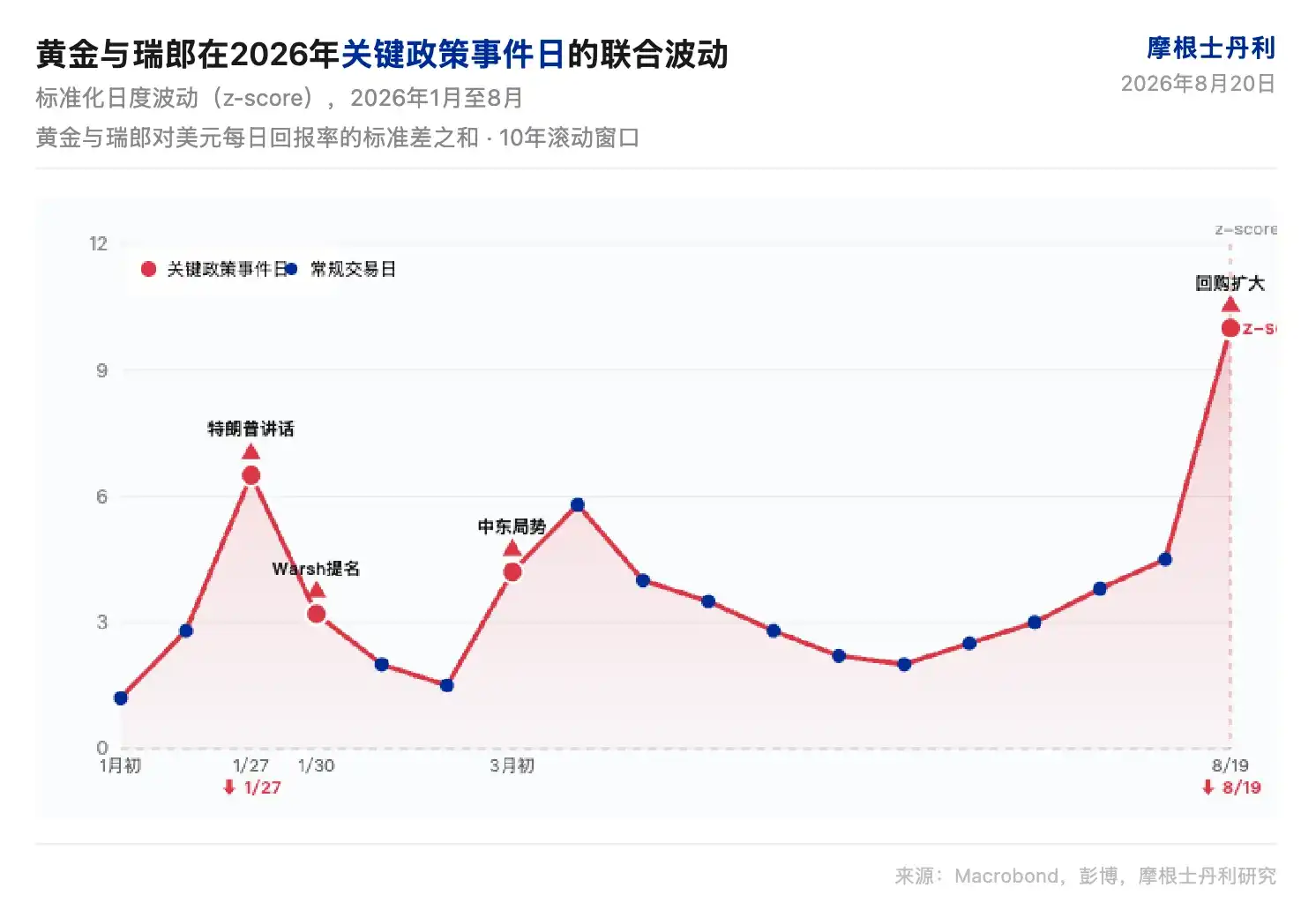
There have been two similar market signals earlier this year: on January 27, after former President Trump stated the dollar should "find its own level," gold and the Swiss franc rallied in tandem; they retreated on January 30 after the White House nominated Kevin Warsh for Fed Chair. On August 19, the combined normalized daily moves of gold and the Swiss franc reached their highest level of the year, exceeding 4 standard deviations.
If dollar policy returns to the market's focus, Morgan Stanley believes the dollar could weaken further, especially against the Swiss franc. The current 2-year Germany-US bond yield spread implies a EUR/USD rate around 1.18; if a dollar policy premium re-emerges, EUR/USD could rise toward 1.2150.
The Treasury's repurchase action has bought time for the market, but it does not change Morgan Stanley's core view on yield curve steepening and dollar weakness. Slowing inflation, weaker-than-expected labor data, and a path correction in the Fed's reaction function—these fundamental factors will ultimately dominate market pricing.

Disclaimer
This article is a translation and interpretation of a third-party research report (Morgan Stanley, August 20, 2026) by Chaoxiang Research, combined with publicly available market information. The ratings, target prices, earnings forecasts, and related judgments cited are solely the views of the analyst(s) of that brokerage, representing only the stance of their institution, and do not represent the views of Chaoxiang Research, nor do they constitute any investment advice.
The market carries risks, and decisions should be made independently. This article should not serve as the basis for buying or selling any securities.