Author: Hu Shixin, Deep Net · Tencent News Xiaoman Studio
Editor: Ye Jinyan
On March 3, Jack Ma, along with core executives from Alibaba and Ant Group such as Joe Tsai, Wu Yongming, Shao Xiaofeng, Jiang Fan, as well as Ant Group's Jing Xiandong and Han Xinyi, made a rare gathering at YunGu School in Hangzhou. This discussion, the first stop after the New Year's resumption of work, focused on the opportunities and challenges brought by AI, sending a strong strategic signal to the outside world that both groups are "All in AI".
Dramatically, on the early morning of the next day after this high-level discussion concluded, the technical leader who single-handedly pushed Alibaba's Qwen to the pinnacle of global open source, the youngest P10 in the group, Lin Junyang, suddenly posted on social platform X: "me stepping down. bye my beloved qwen." This update ignited the global AI community.
Overnight, Alibaba's Qwen lost its "helmsman".
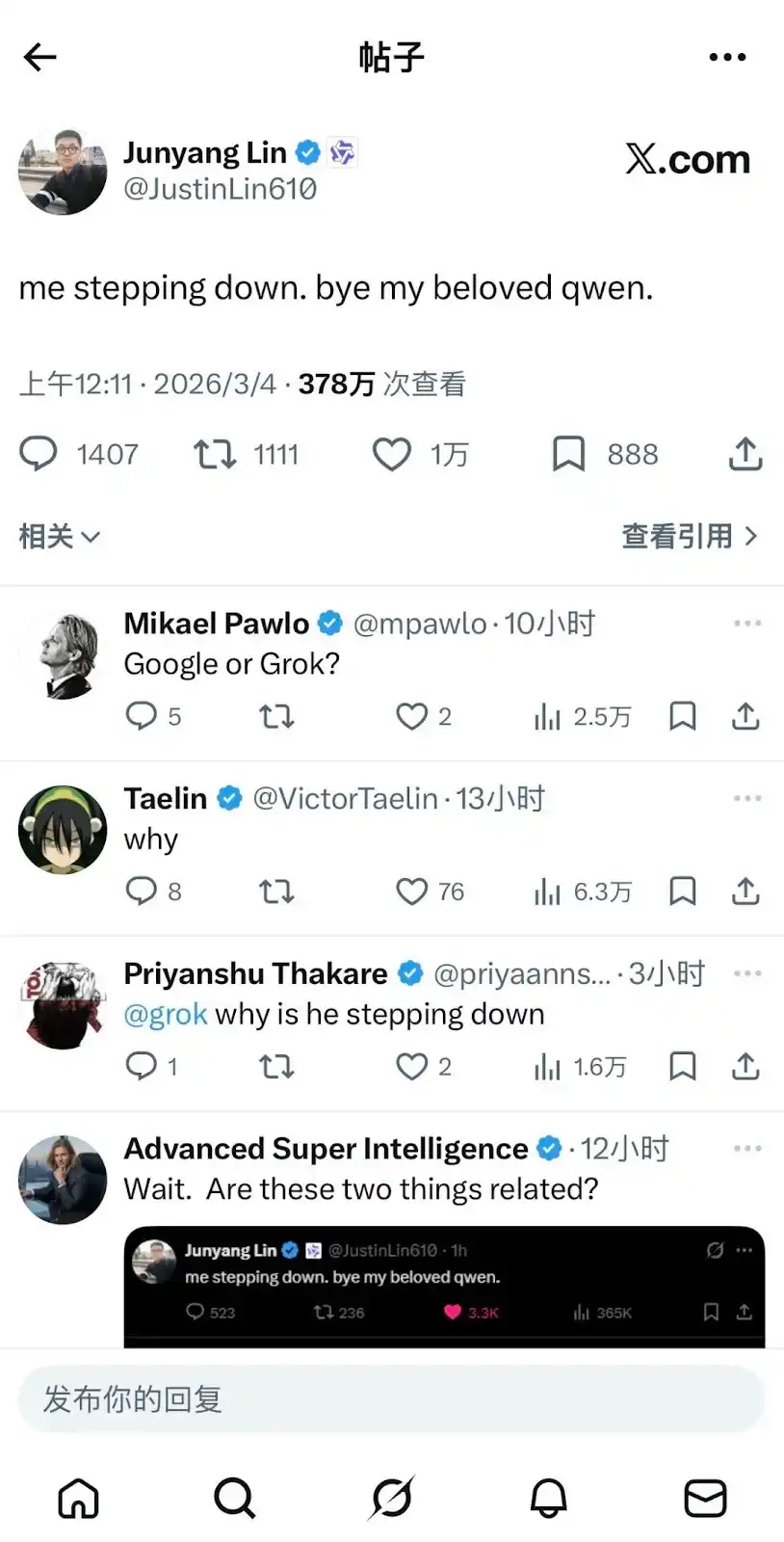
(Lin Junyang's latest update on X)
Was Lin Junyang's Departure Voluntary?
Based on information from multiple sources, we have reconstructed the key points of this departure incident.
On the evening of March 2, Lin Junyang's team released four small-scale open-source models of Qwen3.5, which immediately attracted global attention from the tech community. Elon Musk even commented that they showed "impressive intelligence density," and Lin Junyang himself reposted the comment to express gratitude. On the same day, Alibaba officially announced the unification of its B-end and C-end large model brands under "Qwen," establishing it as the group's core AI brand.
According to reports from LatePost and Phoenix Net Technology, on the afternoon of March 3, Lin Junyang left an internal meeting due to disagreements, submitted his resignation to Alibaba, and informed the Qwen team. Some colleagues were moved to tears upon hearing the news.
On the evening of March 3, Lin Junyang reposted the song "A Toast to Myself" on his WeChat Moments.
In the early hours of March 4, Lin Junyang publicly announced his resignation on platform X. As of 4 PM today, the post had received over 10,000 likes and more than 1,400 comments. Numerous industry developers left messages thanking him and the Qwen team for their contributions to the open-source field. Official accounts of AI companies like MiniMax also appeared in the comments to express recognition.
On the morning of March 4, Yu Bowen, head of Qwen post-training, and Li Kaixin, core contributor to Qwen3.5/VL/Coder, announced their resignations.
On the afternoon of March 4, Lin Junyang posted on his Moments: "Sorry friends, I won't be replying to messages and calls today. I really need to rest. Brothers of Qwen, keep working according to the original plan. It will be fine."
It is worth noting that Qwen team core contributor Chen Cheng said bluntly when forwarding Lin Junyang's post: "My heart is truly broken. I know leaving wasn't your choice. Just last night, we were standing side by side releasing the Qwen3.5 small models. I can't imagine what Qwen will be like without you."
This comment fueled the rapid spread of the involuntary departure theory within the industry. As of now, Alibaba has not publicly responded to this personnel change. A source close to Alibaba believes that Lin Junyang's resignation was not voluntary, and his quick posting of the resignation notice on X was likely due to an inability to control his emotions at the time.
Why Did He Leave?
Lin Junyang's sudden departure caused a huge shock in the industry, leading to widespread speculation. At its root, it was the concentrated eruption of long-standing multiple conflicts within Alibaba regarding organizational structure, technical路线 (path/approach), commercial goals, and talent landscape.
The trigger likely came from a team restructuring. According to LatePost, the Tongyi Lab planned to break the vertically integrated R&D model of the Qwen team. The original full-process closed-loop team covering pre-training, post-training, multimodal R&D, and infrastructure building was to be split into several independent horizontal modules, all directly managed and coordinated by the Tongyi Lab. Consequently, Lin Junyang's management authority and business scope would be narrowed.
Behind the structural adjustment lies a fundamental conflict in large model development philosophy between Lin Junyang and Alibaba's top management. Lin Junyang believes that the core competitiveness of large model R&D comes from the deep collaboration of a full-process team. Fragmented assembly-line division of labor would severely damage R&D efficiency and innovation space, and his team had already built a self-developed infrastructure system. The lab's direction of splitting and dispersing the work was completely contrary to his judgment of the development trend of large model technology.
Even harder to reconcile than the technical route分歧 (divergence/disagreement) is the deep-seated contradiction between the open-source route and the group's commercial goals. Under Lin Junyang's leadership, Qwen topped the global open-source large model rankings with a comprehensive open-source strategy, becoming a benchmark for Chinese large models going global. However, Alibaba's core assessment of Qwen has shifted from building technical influence to commercial落地 (landing/commercialization).
However, there have always been internal doubts about the revenue efficiency of the open-source model. It is reported that some executives even评价 (evaluated) the Qwen-3.5, which debuted on New Year's Eve, as an unfinished "semi-product." Coupled with the market pressure from the Qwen App's 3 billion RMB subsidy in the C-end not meeting expectations and the B-end AI cloud business facing aggressive competition from rivals, the misalignment between technical ideals and commercial goals became increasingly difficult to reconcile.
Behind this change, the restructuring of the talent landscape within the Tongyi Lab also led to a dilution of core decision-making power. Since 2025, Alibaba has continuously引入 (brought in) top global AI talent. After IEEE Fellow Xu Zhuhong transferred to the Tongyi Lab, the business he was responsible for overlapped significantly with Qwen's布局 (layout/plan). In early 2026, former DeepMind senior researcher Zhou Hao joined, reporting directly to the head of the lab, and was also set to take over the work of the departing post-training head Yu Bowen.
The lab's shift from a Lin Junyang-led single-core model to a "multi-power parallel" structure,叠加 (coupled with) the successive loss of Qwen's core founding team members, contributed to this industry-shaking departure incident.
Who Can Replace Lin Junyang?
The reason this departure caused连锁 (chain) reactions within Alibaba and the global open-source community lies in Lin Junyang's key industry status within the Qwen team, Alibaba's AI system, and even the global open-source large model field.
As a rare, entirely locally grown technical leader in China's AI industry, Lin Junyang, born in 1993, has an interdisciplinary background with a bachelor's degree in Computer Science from Peking University and a master's degree in Linguistics and Applied Linguistics. This also gave him a unique advantage in large language model R&D.
After graduating with his master's degree in 2019, he chose not to study abroad but joined Alibaba DAMO Academy directly, starting as a senior algorithm engineer. He was promoted four levels in 6 years, becoming Alibaba's youngest P10 technical expert at 32, standing shoulder to shoulder with technical leaders like Tang Jie from Zhipu AI, Yang Zhilin from MoonShot AI, and Yao Shunyu from Tencent (who have overseas PhD backgrounds), and跻身 (stepping into) the industry-recognized ranks of the "Four Heroes of Foundation Models" in China.
When Lin Junyang took over as technical lead of Tongyi Qianwen (Qwen) at the end of 2022, the domestic large model track was just emerging, and Alibaba's large model布局 (layout) had not yet formed a clear differentiated advantage. Under his leadership, Qwen embarked on a comprehensive open-source strategy, creating a model family covering full parameter sizes from 0.8B to 72B. The trillion-parameter flagship model Qwen3-Max, launched in 2025, surpassed同期 (contemporary) international mainstream models in多项 (multiple) evaluations like GPQA.
As of January 2026, the number of derivative models of the Qwen series on Hugging Face, the world's largest AI open-source community, exceeded 200,000, with downloads surpassing 1 billion, firmly ranking first globally for open-source large models. Stanford University's "2025 AI Index Report" showed that the performance gap between top Chinese and US AI large models narrowed to 0.3%, with Qwen's core model contribution ranking third globally.
After Lin Junyang's departure, two main doubts arose externally.
- Who will succeed Lin Junyang? According to internal sources, due to the suddenness of the incident, there is currently no candidate who can fully replace Lin Junyang. His originally responsible full-stack management work will be decomposed into multiple parallel teams following the team split.
- Where will Lin Junyang go? A long-time Alibaba industry observer stated that there is a high probability he will start his own business independently, or possibly join a明星 (star) team focused on embodied AI or world models. The probability of being persuaded to stay is very small.
For Alibaba AI, the primary heavy impact brought by this personnel change is the risk of a chain reaction of core team loss and dampened team morale. According to Phoenix Net Technology, Alibaba's top management is still communicating with him to try to retain Lin Junyang.
Within just three months, the technical lead, post-training lead, code lead, and other early core founding members of Qwen have resigned successively. This will not only directly affect the subsequent iteration rhythm of the Qwen model but may also trigger further talent loss.
Lin Junyang's departure is a标志性 (symbolic) node marking a comprehensive gear shift in Alibaba's AI strategy. This means Alibaba's large model will bid farewell to the stage focused on building technical benchmarks and global open-source ecosystem construction, and fully transition to a new cycle centered on commercial落地 (landing/commercialization).
But what lies ahead for Alibaba is the disruption to the R&D rhythm caused by the loss of the core team, fluctuations in trust within the global open-source ecosystem, and intense industry competition from rivals like ByteDance and Tencent. The chain reaction caused by this personnel shock will directly test the落地韧性 (landing resilience) of Alibaba's All in AI strategy.