Author: Tiger Research
Compilation: AididiaoJP, Foresight News
Key Takeaways
Rebranding is usually not a signal of recovery, but more like an admission of the failure of the original strategy. Past cases show that if products, users, and liquidity don't truly return after a name change, it often ends in failure.
However, judging success or failure solely by price is prone to error. If on-chain execution evidence persists after the rebrand, one shouldn't jump to conclusions of failure too early.
The true test of success lies in the path of ETHLend's transformation into Aave: first comes growth in users and Total Value Locked, and then price follows.
Whether Story Protocol's shift from IP to DATA is a genuine business restructuring or a final marketing attempt will be answered by its future execution.
Market Reaction to Rebranding: Not Necessarily a Good Omen
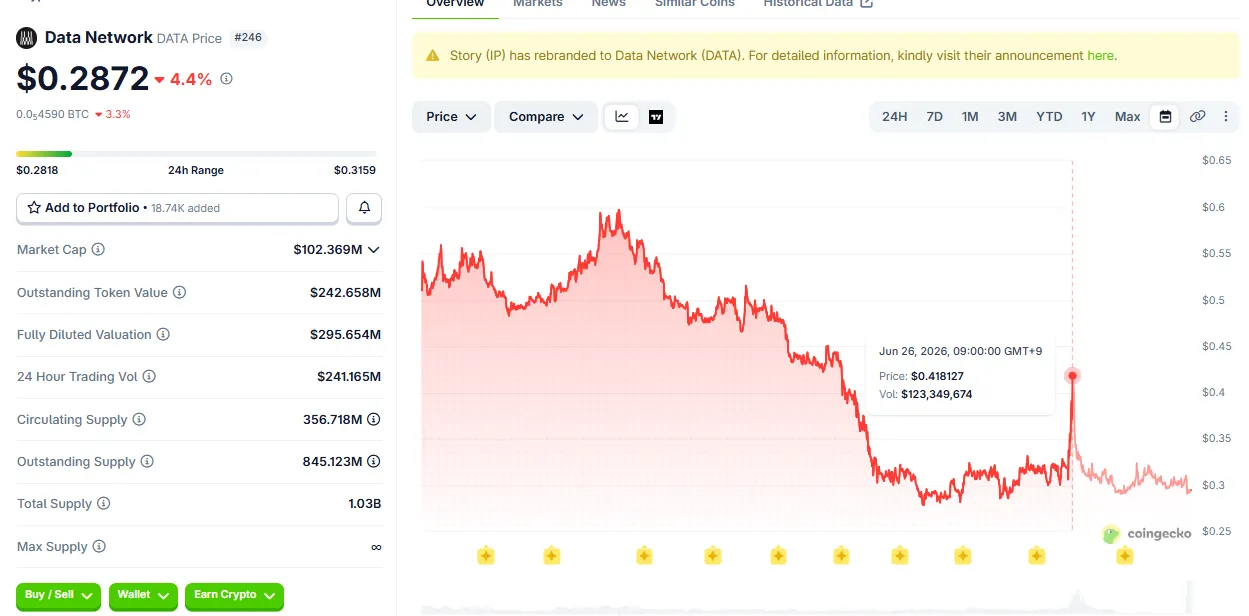
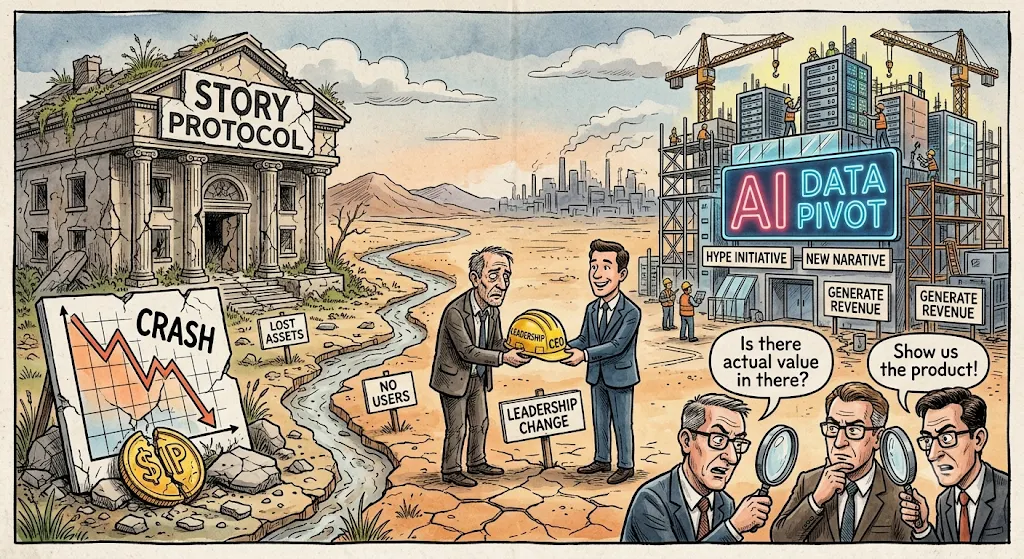
On June 25th, Story Protocol announced its transformation into the DATA Foundation and plans to switch its token from IP to DATA. Although the project had previously secured consecutive funding rounds led by a16z, the IP token struggled to sustain its value during the bear market, falling approximately 98% from its all-time high.
The token subsequently hit new lows. Following the rebranding announcement, the price saw a brief rebound but soon fell back near its lows.
In reality, it's difficult to view this rebranding as a long-term positive for the project. To some extent, it indirectly acknowledges that the project has reached a dead end.
A comprehensive rebrand incurs significant tangible and intangible costs. The time and funds previously invested in brand recognition become sunk costs. Changing the token symbol and project name also carries risks related to internal communication, external coordination, and on-chain asset migration. This means the decision itself carries weight; a rebrand is not superficial but involves a comprehensive adjustment of on-chain and off-chain infrastructure.
Before expecting short-term price rebounds from a token symbol change, a more pertinent question is: what fundamental problem forced the project to abandon the accumulated brand equity and decide to take this path?
Common Traits of Failed Rebranding Cases
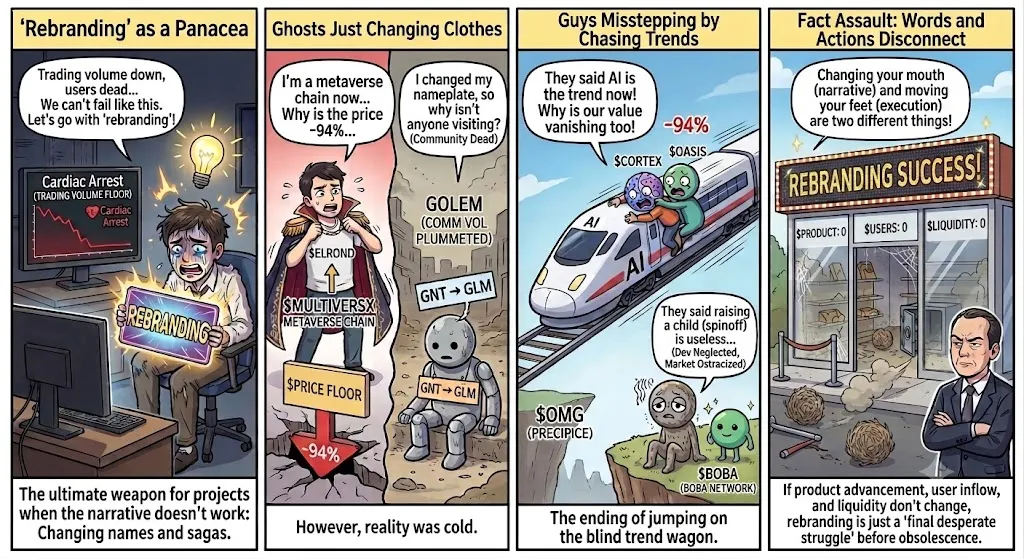
On the surface, rebranding seems like just changing the project name and token symbol, but in essence, it's a shift in product direction and core philosophy. Data from failed rebrands show that most projects that failed to demonstrate genuine improvement in real metrics were eventually eliminated by the market.
- MultiversX (formerly Elrond): Kept the original EGLD token symbol, pivoted to a metaverse narrative, but the token value has fallen about 94% since the rebrand.
- Golem (GNT to GLM): Completed token migration, but price is down 92.7% from its peak. Trading volume and development activity have significantly declined, and the project has largely lost relevance.
- Cortex (CTXC) and Oasis (ROSE): As the AI blockchain narrative faded, Cortex's value nearly zeroed out. Oasis, after pivoting to AI privacy, has also fallen about 94% since its rebrand.
- OMG Network: After spinning off Boba Network, core network development and ecosystem management were neglected, eventually being left behind by the market.
The common thread among these failed cases is the lack of substantive follow-through in product development, user acquisition, or liquidity provision after the rebrand. Adjusting the narrative and executing the business are two different things.
Judging by Token Price Alone is Far from Enough
Of course, judging a project's success or failure solely by price decline has its limitations, as post-rebrand performance is often intertwined with the overall bear market environment. To avoid mistakenly categorizing projects that still maintain robust on-chain execution data as failures, the following cases are worth referencing.
Ongoing Operational Cases
Kaia (KLAY & FNS merged into KAIA): Post-merger token price fell about 73%, but the project demonstrated strong underlying vitality through initiatives like partnering with South Korea's Kookmin Bank and Busan Bank to issue a Korean won stablecoin, and LINE's mini-program decentralized application. The mini-program attracted 35 million users in its first month, generating 7.3 million new wallets.
Polygon (MATIC to POL): Token fell about 81%, but underlying business continues to advance through the operation of multi-chain settlement infrastructure like AggLayer and the retention of a large ecosystem.
Render (RNDR to RENDER) and ASI: Although market performance has been weak, they possess clear real-world use cases—providing AI computing power and operating core AI products, and their technical execution is validated. Therefore, they are not categorized as failures.
The Benchmark for Successful Rebranding
The case of ETHLend transforming into Aave sets the standard for success.
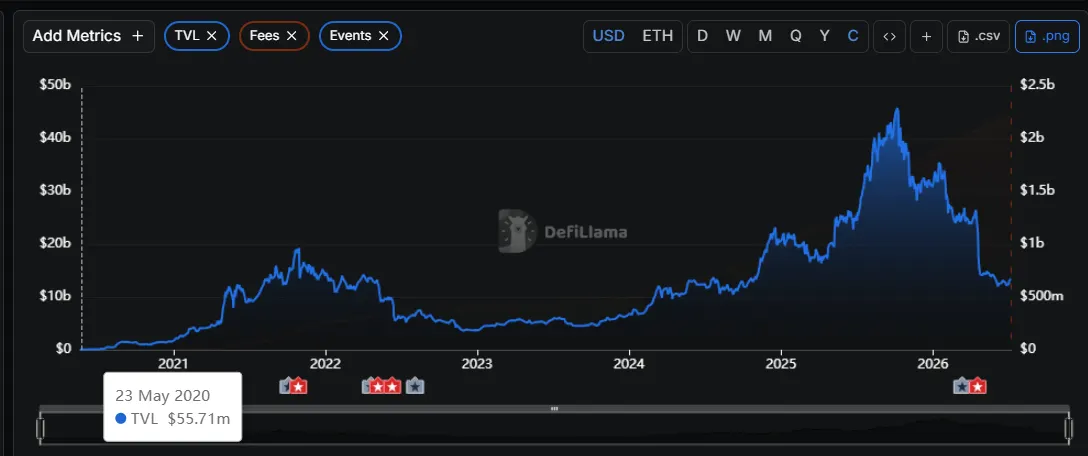
Since its name change in 2020, Aave's Total Value Locked has grown steadily. It has enriched its product line by expanding supported assets, and its user base has significantly expanded. Today, it has become synonymous with the lending protocol sector, a setter of on-chain benchmark interest rates, akin to the "central bank" of decentralized finance. This is a classic example of improving business metrics driving brand value appreciation.
The story of MakerDAO pivoting to Sky is similar: what matters is not the token's roughly 20% decline, but its performance relative to the broader market and its clear execution in running the USDS and sUSDS decentralized stablecoins.
These cases show that the key to judging the success of a rebrand is not short-term price volatility, but whether the project's stated rationale truly materializes and the subsequent tangible results. A rebrand without genuine growth in underlying metrics will eventually be abandoned by the market once the marketing effect wears off.
Story Protocol's Current Rebrand
Story's IP token launched in February 2025, reaching its all-time high of around $14.78 in September of the same year, then entering a period of stagnation.
Notably, consider the timing: the token hit its all-time low of $0.275 on June 10, 2026. Just two weeks later, on June 25, the project announced its pivot to AI training data infrastructure.
Because the rebrand occurred near the all-time low, the market questions whether this is merely the final card played to boost the price.
For Story to justify this rebrand, three key metrics need to be tracked in the future:
- Whether the token's relative strength compared to the broader market recovers;
- The trend of on-chain liquidity and trading volume after the token switch;
- Whether the new AI data narrative genuinely brings on-chain user growth and increased settlement revenue.
Changes in core leadership are also noteworthy. The original narrative leader, Seung Yoon Lee, has stepped back from the foundation's daily operations into an advisory role focusing on strategy. Former Chief Product Officer Andrea Muttoni has taken over as the new CEO of the DATA Foundation.
Seung Yoon Lee remains the CEO of the development company PIP Labs, but his reduced role in the foundation marks the end of a chapter for the original Story (IP) narrative centered around this Korean founder and the three consecutive a16z-led funding rounds.
Based on currently available data, this pivot to DATA looks more like a defensive adjustment than a long-term strategic overhaul. To change this perception, tangible results in liquidity, users, and settlement revenue must be delivered after the token switch. Otherwise, Story will become just another failed rebranding case, with its past brief glory fading into memory.