Interview with PPP: How the World Cup Ignited the Prediction Market, and How to Find "Replicable Smart Money"?

Odaily星球日报Published on 2026-06-26Last updated on 2026-06-26

Abstract

Interview with PPP: World Cup Ignites Prediction Markets, How to Find “Replicable Smart Money”? With the World Cup underway, prediction markets are experiencing a historic surge in data and activity. However, most ordinary users struggle to achieve consistent profits amidst the volatility. Simply chasing "smart money" signals on social media is often ineffective due to slow manual execution. Even dedicated copy-trading tools can be misleading, as high total profits don't guarantee a strategy is suitable or sustainable for others to follow. Prediction market strategy platform PPP (Prediction Position Platform) argues that not all profitable addresses are fit for copying. Truly replicable "smart money" must demonstrate stable, long-term profitability across key metrics like win rate, max drawdown, and strategy consistency. PPP aims to solve this by building a system that structures complex on-chain data into actionable strategies for users. It employs a dual AI-modeling and manual-review process to analyze addresses based on performance, risk, capital allocation, and more, filtering out偶然性盈利 to identify statistically reliable strategies. The platform categorizes these strategies into two main products: a "Strategy Square" featuring long-term, vetted strategies with strict criteria like a six-month minimum track record, and a "Trading Leaderboard" highlighting shorter-term, high-performing opportunities from the past 30 days. Both are presented with clear style descriptions ...

Original | Odaily Planet Daily (@OdailyChina)

Author|Azuma(@azuma_eth)
With the World Cup battles raging, the prediction market has witnessed a historically massive explosion of data.

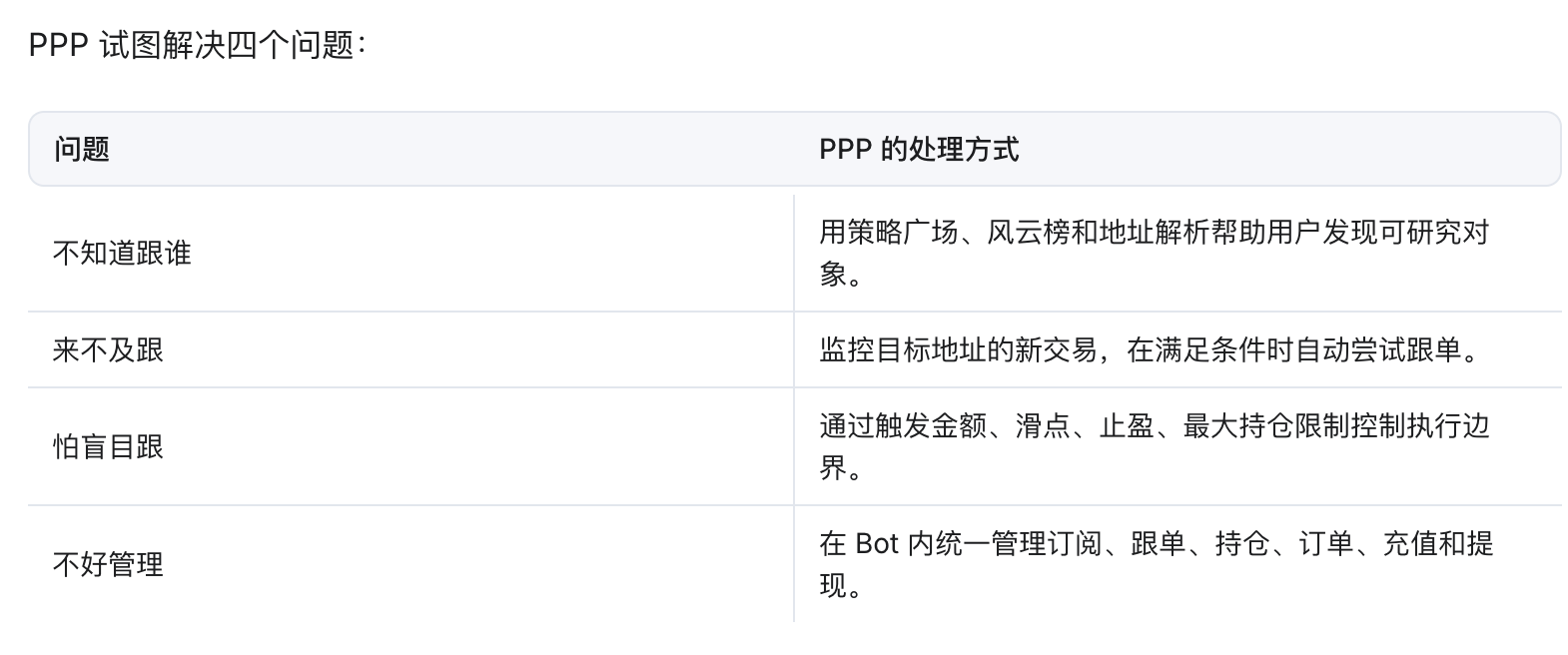
Match outcomes, group stage progressions, champion predictions, Golden Boot rankings... vast amounts of capital are passionately gaming in the prediction market, driving trading volume and user participation to unprecedented heights. However, amidst the狂欢, a stark reality faces most ordinary users — staring at screens full of fluctuating probabilities, unsure how to操作 to achieve consistent profits.

In search of profit certainty, many users track "smart money" movements on social media or news platforms, but in reality, this method of "waiting for signals, then manually copying trades" often leads to passivity. Because prediction market odds fluctuate in real-time, opportunity costs vanish in an instant, making it difficult for manual operations to keep pace.

To address this issue, some users have turned their attention to generic copy-trading tools available on the market, which hide more insidious "smart money traps." Many tools only display so-called smart money addresses based on singular metrics like "total profit" or "recent win rate." Users, seeing these "gurus" with eye-catching收益 often in the millions of dollars, blindly follow, only to end up incurring losses after入场.

"Not all profitable addresses are suitable for copying."

When discussing the reasons behind this situation, PPP (Prediction Position Platform), a prediction market strategy platform we recently encountered, gave the above response.

PPP further explained that some addresses may gain收益 due to special information, extreme positions, single market events, or capital scale advantages. Ordinary users who only look at profit rankings can easily overlook factors like drawdown, liquidity, position style, and actual followability, leading to unexpected results if they copy blindly. In other words, "profitable" itself is not equivalent to "copyable."

"An address that can truly be safely copied by ordinary users must be able to achieve stable profits over a large样本 in a longer周期, with metrics like win rate, maximum drawdown, strategy stability, and position allocation... none can be missing. Only addresses that can withstand scrutiny across these dimensions have a盈利 logic that is replicable."

AI Modeling + Manual Review, Screening for Truly Reusable Strategies

In PPP's view, the biggest problem facing current prediction market users is how to筛选出 truly "replicable, verifiable, and sustainable" smart money addresses from the vast sea of trading addresses, and be able to track related address dynamics in a simpler way to participate via copy-trading.

To this end, PPP is attempting to build a comprehensive system — structuring and筛选复杂的地址数据 and trading signals, ultimately transforming them into strategy entry points that ordinary users can understand and use.

PPP team member Lorne stated regarding this: "The market isn't short on monitoring tools, nor is it short on copy-trading tools. What's missing is a mechanism that structures complex trading behaviors, cleanses them, and transforms them into strategies that ordinary users can understand, dare to use, and easily操作."
Lorne补充道, PPP employs a dual mechanism based on AI modeling and manual review, conducting a multi-dimensional analysis of specific addresses, including but not limited to:

  • Profit performance and stability;
  • Win rate structure;
  • Maximum drawdown and risk exposure;
  • Capital规模 and position allocation ratio;
  • Activity level and trading frequency;
  • Holding周期...

After AI综合建模 based on these indicators, the system first filters out "coincidental profits" and "abnormal trading samples," then结合人工多轮复核, finally筛选出一批 statistically more stable and具有持续研究价值的交易地址.
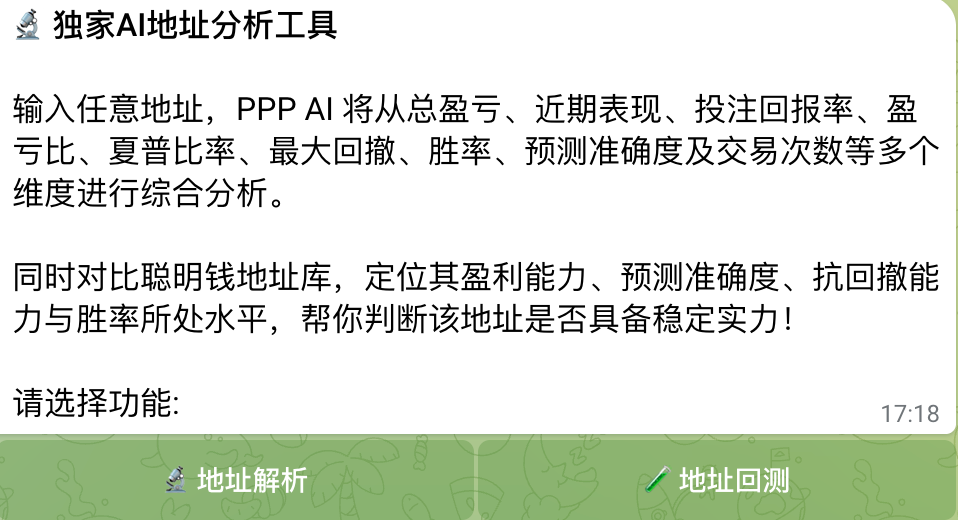
PPP emphasized that its AI algorithm model itself is not公开, but the platform will open this解析能力 to users in the form of an "AI Address Analysis Tool." Users can paste addresses they are tracking on PPP,同时对比聪明钱地址库,定位其盈利能力, information advantage,抗回撤能力, and win rate level, thereby判断该地址是否具备稳定实力.

Strategy Layering: Meeting Diverse Needs

After completing the initial筛选, PPP further layers these replicable smart money addresses and constructs two core product systems面向不同用户需求.
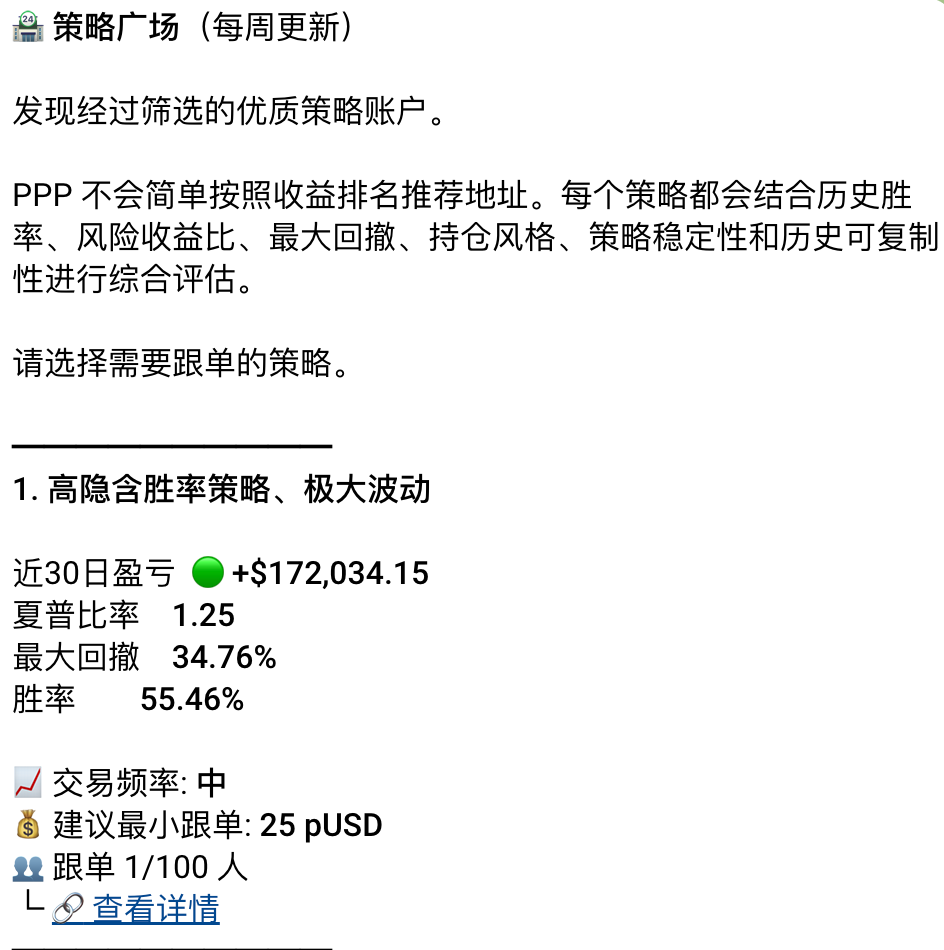
First is the "Strategy Square." According to Lorne, Strategy Square aggregates stable trading strategies verified over longer周期. Addresses entering this system typically need to meet stricter筛选标准, including:

  • At least half a year of historical trading验证;
  • Passing AI multi-dimensional scoring;
  • Manual review confirming strategy consistency;
  • Focus on risk-reward ratio and drawdown control ability;
  • Emphasis on strategy replicability and long-term stability;

In summary, Strategy Square can be understood as a filtered pool of long-term strategies, aiming to provide more sustainable options for users seeking stable copy-trading. PPP also conducts weekly定期复核 on strategies in this section to ensure their continued effectiveness.
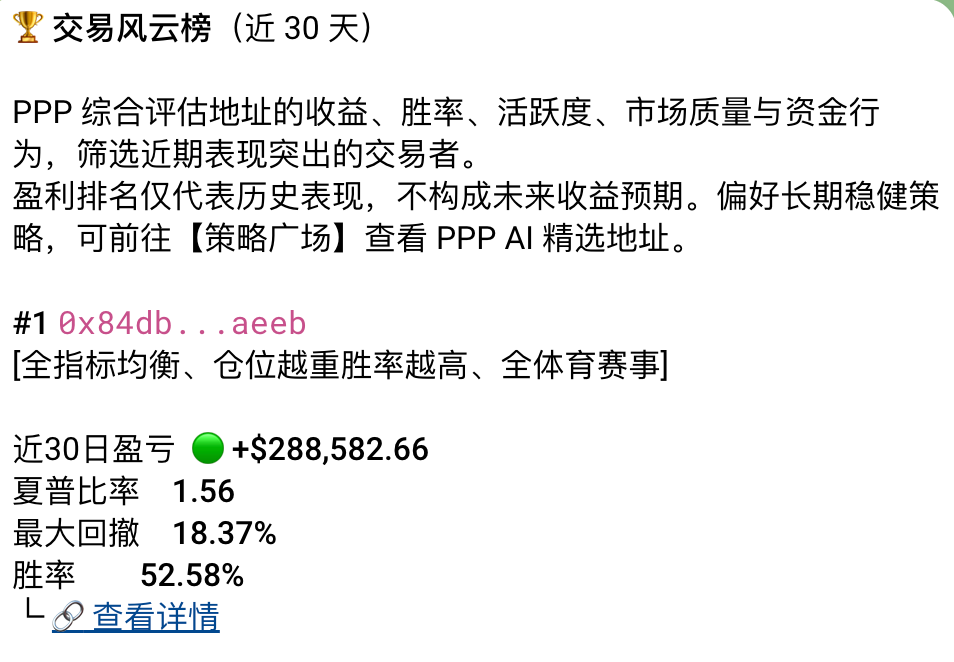
Next is the "Trading Leaderboard." Lorne explained that, unlike Strategy Square, the Trading Leaderboard leans more towards capturing阶段性机会. This list is generated by PPP through AI multi-dimensional models and manual review, primarily筛选近 30 天内表现突出的交易者, focusing on dimensions including:

  • Profit growth speed;
  • Win rate change trends;
  • Activity level and market participation;
  • Short-term capital behavior characteristics;

In this system, high收益 often come with higher volatility. PPP has also explicitly warned: "This list is more suitable for users seeking阶段性机会, not long-term stable copy-trading strategies."

To meet users' diverse操作需求, PPP will provide simple, understandable abstract summaries and descriptions of the specific styles of strategies and addresses in both Strategy Square and the Trading Leaderboard (e.g., "High implied win rate strategy,极大波动"), allowing users to更清晰地理解不同策略差异 and make informed choices.
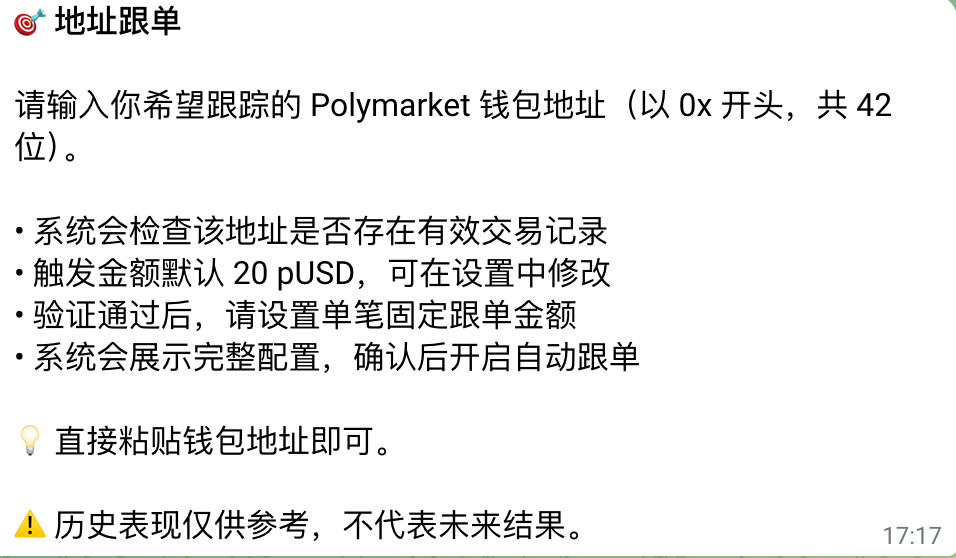
In addition to the two standardized list systems mentioned above, PPP also provides one-click trading and address copy-tracking functions — the former helps users immediately copy a trade upon receiving a signal; the latter allows users to input any address they关注 for copy-tracking.

Trial Run Hits Jackpot: Over 60% Return in a Single Day

Lorne revealed that PPP has recently officially launched its Telegram Bot product, currently using it as the main user交互入口, with the website and other products actively under preparation.

Guided by Lorne, we also tried walking through the complete user流程 as an ordinary user.

Upon first entry, users need to log in via the Telegram小程序 (Mini App) and create a wallet. PPP's wallet system is non-custodial; users always retain control of the wallet (the私钥 can be exported following the process —务必自行妥善保管). This means any potential future收益 obtained by this wallet, such as possible airdrops from Polymarket, will belong entirely to the user.

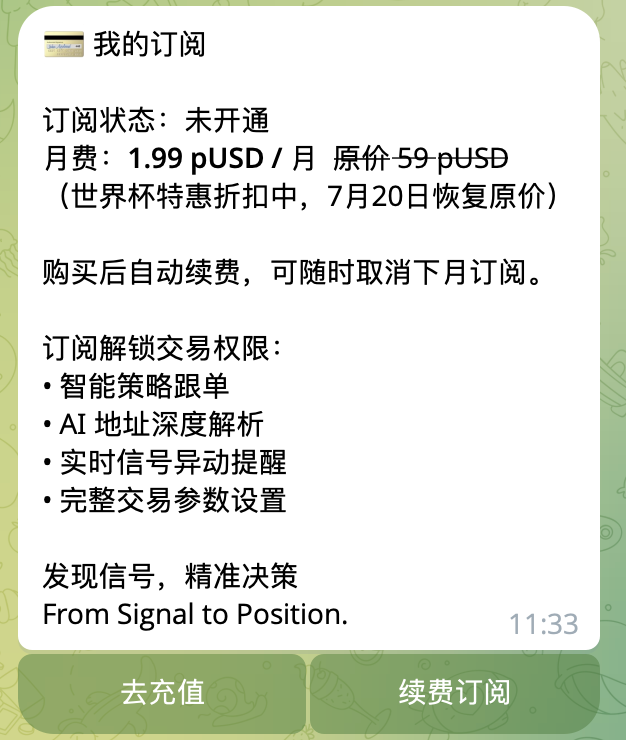
Next is the top-up and subscription环节. PPP employs a subscription-based service; users need to subscribe first to unlock full features. The monthly subscription fee is 59 USDC, but currently, there is a limited-time discount offering subscription for 1.99 USDC, allowing第一批用户 to experience it at a low cost.
After subscribing, users can see the full unlocked services on PPP's homepage, including the aforementioned Strategy Square, Trading Leaderboard, Address Copy-Tracking, AI Address Analysis, etc., as well as "Wallet & Assets" for checking balances, "Current Copies" for查询现有持仓, "Signal Detection" for关注市场最新动向... PPP has also专门为世界杯 launched a dedicated section where users can view the latest match schedules in real-time, while PPP将持续更新相关的聪明钱动向与关键交易信号,快速定位资金正在押注什么.
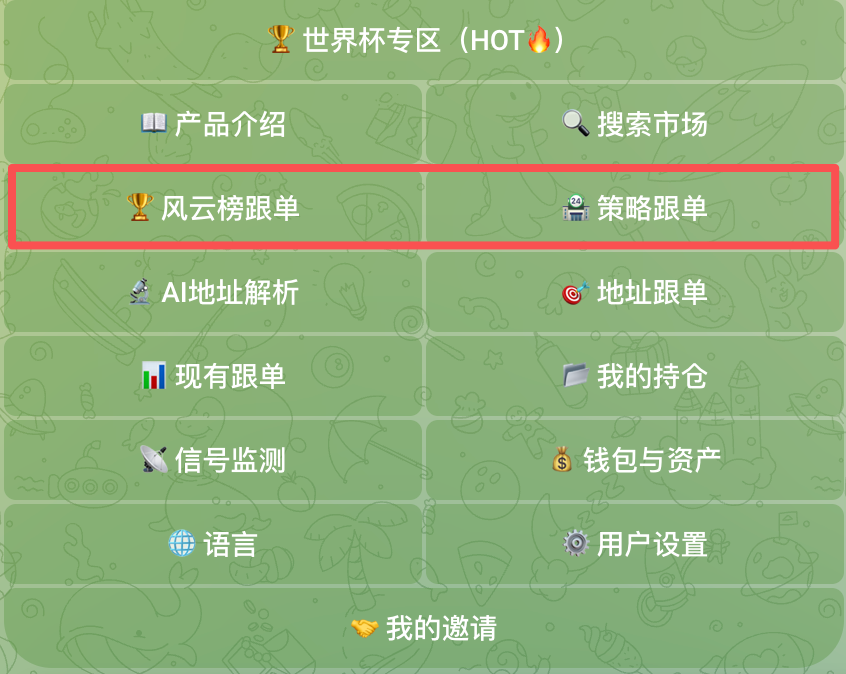
As for具体的跟单操作, after selecting a strategy, users can view the core metrics of that strategy across various dimensions. Once确认符合需求, they can choose a copy amount or set custom parameters to initiate copying. It's worth特别提一下 the "Copy Settings" function within the features. Users can actively adjust parameters such as trigger amount, copy amount, slippage, take-profit, maximum position limit, etc., for different strategies in this interface to control the execution boundaries of copying.
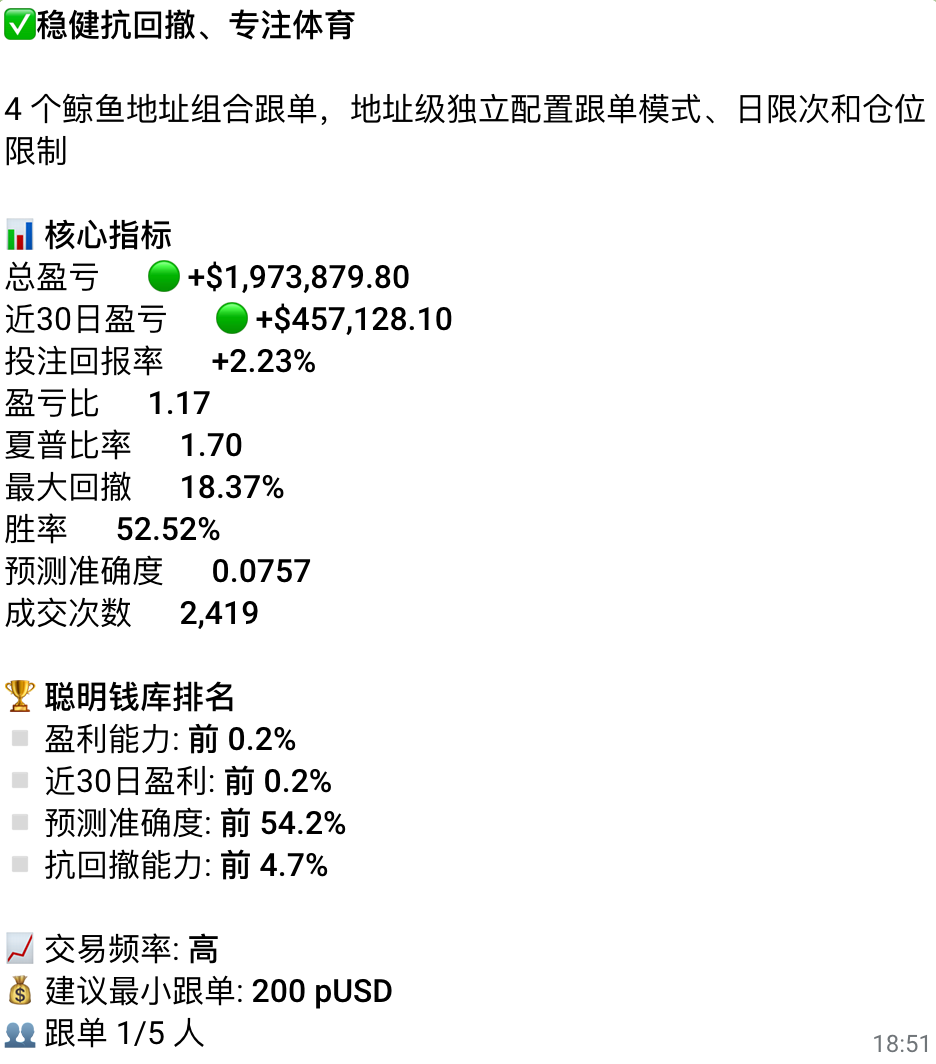
I topped up a small $100 for a test run for a day, copying two strategies/addresses each from Strategy Square and the Trading Leaderboard. The next day when I checked, I was startled — the account net worth一度达到了 $164 at its peak, representing over a 60% return in a single day.
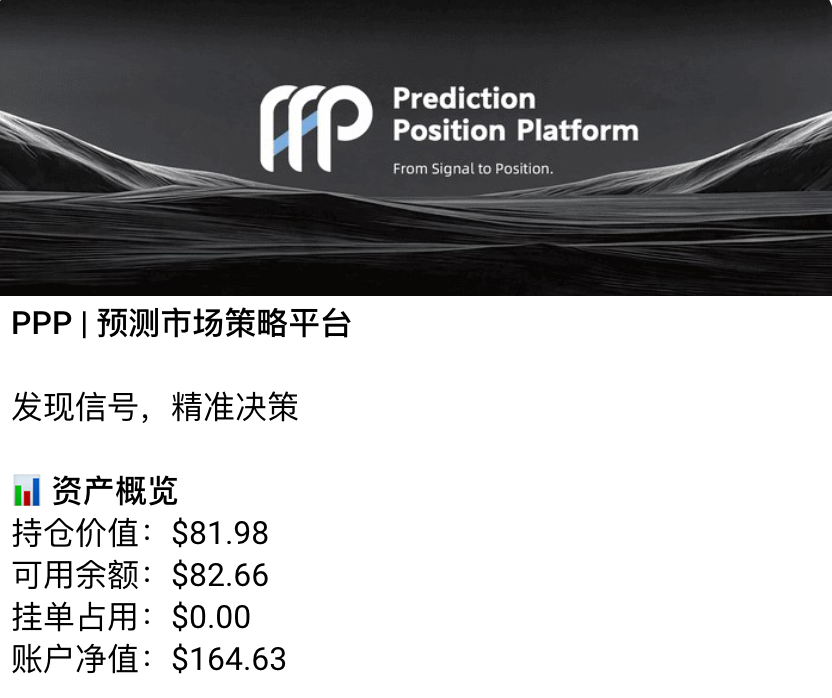
However, in subsequent testing, the account experienced some drawdown. Summarizing, the main issue was not setting different copy amounts for strategies with different risk appetites, leading to low-probability events consuming too much capital.

Lorne坦承 regarding this: "Although PPP has conducted rigorous筛选与复核 on the historical performance of selected strategies,认可了该地址的能力 under multi-dimensional modeling, the platform cannot guarantee that strategy accounts will continue to be profitable in the future. Therefore, it is recommended that users try within an acceptable risk range and切忌上头."

Seeking Certainty in an Uncertain Market

After testing for a few days and having an in-depth exchange with Lorne, our most直观感受 is that PPP should not be简单地理解 as a 'copy-trading tool.' It更像是 attempting to build a structured 'compilation' path 'from trading signals to executable strategies.'

Smart money确实存在, but it is分散在无数地址, strategies, and短期波动之中; profit records are also real, but the underlying risk structure, capital behavior, and strategy stability are often masked by simple profit numbers. This also explains why "following smart money" is often不稳定 in practice — users see the结果, but the market runs on过程; users want to复制收益, but often忽略掉路径.

What PPP试图解决的 is precisely this断层. Through the深度结合 of AI's complex algorithms and manual review, it denoises and structures原本混沌,随机的链上交易信号,提炼出 truly具备 "replicability"的聪明钱策略, and delivers them to users in the极低门槛 form of a TG Bot. This is both an effective defense against the "smart money trap" and an effort to消除预测市场中的信息差.

Of course, as Lorne emphasized, no historical backtesting or strategy筛选 can promise 100% future收益. High收益 in prediction markets必然伴随着高波动与高风险. PPP provides a deeply processed "weapon" — it can help users提高胜率,规避明显的坑洼 — but ultimately, whether one succeeds in the长周期的博弈 still depends on the user's own资金管理能力与风险偏好.

As the prediction market continues to evolve, whether PPP's方法论 can be tested in future market博弈仍需时间去检验. But at least for now, it provides a确定性更高的入口 for those ordinary users who want to分一杯羹 in the World Cup wave yet don't know where to start.


Related Questions

QWhat is the main problem that most ordinary users face in the prediction market during events like the World Cup according to the article?

AMost ordinary users face the problem of not knowing how to operate effectively to achieve sustained profits despite the massive amount of funds and enthusiasm in the prediction market. They struggle with real-time probability fluctuations and often miss fleeting opportunities due to manual operations.

QAccording to PPP, why is it not advisable to blindly follow addresses that only show high total profits or recent win rates?

ABlindly following such addresses is risky because high profits can result from special information, extreme positions, single market events, or advantages in capital scale. These addresses may lack stability in terms of drawdowns, liquidity, position style, and actual follow-ability. 'Profitability' does not necessarily equate to 'being suitable to follow.'

QWhat two core product systems does PPP build to cater to different user needs after screening 'replicable smart money' addresses?

APPP builds two core product systems: 'Strategy Plaza,' which aggregates stable trading strategies validated over long cycles, and 'Trading Leaderboard,' which focuses on capturing short-term or phased opportunities by highlighting top performers from the past 30 days.

QHow does the PPP platform use AI and human review in its methodology to select suitable addresses for users to follow?

APPP uses AI modeling to comprehensively analyze multiple dimensions of specific addresses (such as profit performance, win rate structure, maximum drawdown, capital scale, and trading frequency). The system first filters out 'accidental profits' and 'abnormal trading samples.' This is followed by multiple rounds of manual review to ultimately select a batch of addresses that are statistically stable and have continuous research value.

QWhat cautionary advice does Lorne from PPP give to users regarding following strategies, even after PPP's rigorous screening process?

ALorne advises users to try within their acceptable risk range and not to get carried away. Although PPP conducts rigorous screening and review of historical performance through multi-dimensional modeling and acknowledges the capability of an address, the platform cannot guarantee that the strategy account will continue to be profitable in the future. High returns in prediction markets inherently come with high volatility and risk.

Related Reads

Domestic First Explosion-Proof Certification, World's First Fueling Brain Solution: How Did They Secure Two 'Firsts'?

China's embodied AI sector is booming, with over ¥37 billion in funding this year. The focus has shifted decisively to real-world application, particularly in hazardous, repetitive tasks humans should avoid. A key, often prohibitive, barrier to entry for robots in environments like gas stations and oil fields is obtaining explosion-proof certification, requiring meticulous hardware and circuit design from the ground up. The article explores three main application areas. At gas stations, the challenge lies in executing a long, precise sequence of actions (opening caps, handling the fuel nozzle) with millimeter accuracy across diverse car models. For facility inspections, robots need sustained autonomous patrols combined with real-time anomaly detection and response. Port scenarios introduce the complexity of multi-robot coordination. Addressing the core challenge of long-horizon tasks, the piece highlights a technical breakthrough: a "world model"-driven approach. This enables predictive planning, allowing the AI to visualize the desired end-state (e.g., nozzle returned, cap closed) and work backward to synthesize intermediate visual frames. This "imagination" of the task trajectory, as implemented in the H-GAR architecture, guides action generation, significantly reducing cumulative error in multi-step operations. The three-step H-GAR process involves generating a coarse action draft, synthesizing target-conditioned observation frames, and then refining actions based on visual context and a memory of past successful motions. The conclusion emphasizes that success in specialized, safety-critical fields requires long-term commitment and deep integration of the "embodied brain" (AI) with a purpose-built, certified physical "body." Mastering this brain-body-data闭环 (closed-loop) is positioned as a crucial competitive advantage for commercialization.

marsbit2m ago

Domestic First Explosion-Proof Certification, World's First Fueling Brain Solution: How Did They Secure Two 'Firsts'?

marsbit2m ago

Bitcoin Bear Market Triggers Crypto Layoffs, Yet Fuels Industry's Most Aggressive M&A Wave Ever

A prolonged Bitcoin downturn is forcing crypto companies to lay off employees and automate operations, but has simultaneously triggered the industry's most aggressive wave of mergers and acquisitions (M&A). In the first half of 2026, crypto M&A deal value reached $93.7 billion, 26 times higher than the same period last year. This activity is primarily driven by traditional financial institutions—banks, payment processors, and asset managers—who are acquiring compliant crypto infrastructure like custody solutions, payment rails, and regulatory licenses instead of building them internally. Examples include Mastercard's acquisition of stablecoin firm BVNK and Franklin Templeton's launch of a dedicated crypto division via acquisition. This consolidation contrasts sharply with a shrinking crypto labor market, where active job openings have plummeted. Companies like Coinbase are restructuring to become "AI-native," leading to a sharp increase in roles requiring AI skills, while engineering and compliance positions now dominate hiring. Financially pressured crypto firms, such as Messari which was acquired at a fraction of its prior valuation, are becoming prime targets. Capital remains available but is highly selective, flowing overwhelmingly into businesses that bridge digital assets with traditional finance, such as tokenization platforms and regulated trading venues. The trend indicates a market where capital is rewarding compliant, utility-focused infrastructure while weaker models consolidate or downsize.

marsbit3m ago

Bitcoin Bear Market Triggers Crypto Layoffs, Yet Fuels Industry's Most Aggressive M&A Wave Ever

marsbit3m ago

Trillion-Dollar Pension Fund Entry? Franklin Bitcoin Dividend Reinvestment ETF Comes with a Built-in Selling Pressure Ceiling

Franklin Templeton has filed to launch two ETFs that embed a "default configuration" logic into Bitcoin investment, aiming to tap into massive pension fund flows. These "Bitcoin Dividend Reinvestment Index ETFs" will initially hold 95% equities and 5% Bitcoin, automatically reinvesting stock dividends to buy Bitcoin. However, a quarterly rebalancing rule forces selling of Bitcoin if its allocation exceeds 5%, capping its maximum holding at 20%. While the product cleverly circumvents advisor reluctance and compliance hurdles by labeling itself as a U.S. equity product, its actual Bitcoin buying power is minimal. Given low dividend yields (e.g., ~1% for broad market indices), annual Bitcoin purchases from a fund the size of Franklin's existing Bitcoin ETF would be a mere $3.6 million—negligible against Bitcoin's daily trading volume. Crucially, during bull markets, the fund becomes a programmed, passive *seller* of Bitcoin, potentially creating sustained sell pressure if many similar funds emerge. The strategy leverages investor inertia and automatic enrollment, similar to the success of target-date funds in 401(k) plans. It also uses an offshore Cayman subsidiary for holding Bitcoin and raises a tax complication where investors must pay taxes on dividends they never receive as cash. Although recent U.S. regulatory changes allow crypto in retirement plans, widespread adoption as a default option faces legal hurdles. The core premise remains: the system doesn't need to convince anyone to buy Bitcoin actively; it simply relies on people doing nothing.

marsbit34m ago

Trillion-Dollar Pension Fund Entry? Franklin Bitcoin Dividend Reinvestment ETF Comes with a Built-in Selling Pressure Ceiling

marsbit34m ago

Bitcoin Hits 20-Month Low as Largest Bull Suffers $15 Billion Paper Loss

Bitcoin Hits 20-Month Low as Major Bull Loses $15 Billion On June 25th, Bitcoin fell below $60,000, hitting a low of $58,030—its lowest level since October 2024. The sell-off triggered over $1 billion in leveraged liquidations in 24 hours, with longs accounting for $788 million. This marks a more than 53% decline from the October 2025 all-time high of $126,198. A critical factor in the downturn is the weakening position of MicroStrategy, the largest corporate Bitcoin holder. With 847,363 BTC at an average cost of $75,651, the company now faces over $14.6 billion in unrealized losses. Its core financing flywheel—raising capital to buy Bitcoin—is stalling. Its variable-rate preferred shares (STRC), a key fundraising tool, have fallen 25% below their $100 target. This raises doubts about its ability to continue providing steady institutional demand for Bitcoin. Simultaneously, U.S. spot Bitcoin ETFs are experiencing significant outflows, with a single-day net outflow of $469 million on June 24th. This represents the most severe sustained capital flight since their launch. The macroeconomic backdrop remains restrictive, with persistent inflation delaying expected Fed rate cuts. Analysts note a shift in capital allocation, with institutional funds moving away from crypto towards AI infrastructure stocks. Immediate pressure comes from approximately $10 billion worth of Bitcoin options expiring on June 26th, which could increase market volatility. The combined effect of these factors—eroding core demand pillars, macro headwinds, and capital rotation—has decisively broken the $60,000 support level.

Foresight News40m ago

Bitcoin Hits 20-Month Low as Largest Bull Suffers $15 Billion Paper Loss

Foresight News40m ago

Trading

Spot
Futures
活动图片