Blockchain for Europe has called for targeted reforms to the European Union’s (EU) landmark crypto framework in a new report, seeking to boost the global competitiveness of Euro-denominated stablecoins.
Euro Stablecoins On The ‘Regulatory Laffer Curve’ Downside
On Monday, Blockchain for Europe, an organization that represents international Blockchain industry players in the EU, said that while the EU’s Markets in Crypto Asset Regulation (MiCA) has established a framework that makes euro-pegged stablecoins safe, it has also made them less competitive than their US-denominated rivals.
In its report titled “Reforming MiCA for Euro Stablecoins,” the industry group observes that the absence of regulation hinders market development. Conversely, excessively stringent regulations may prove ineffective, as they risk driving the targeted economic activity to less regulated or more welcoming jurisdictions.
“If compliant projects do not ultimately locate domestically, then regulation fails to achieve its objectives,” Blockchain for Europe affirmed, adding that a framework’s goal is to have a regulated but strong local industry.
The report noted that euro-pegged stablecoins account for less than 1% of global stablecoin volume, far below the level the euro’s broader role in global markets would suggest.
Under this premise, the group argues that the ground-breaking, comprehensive legislation has placed Europe on the “downward-sloping part of the regulatory Laffer curve,” as skepticism prevails among European policymakers regarding the trajectory of euro electronic money tokens (EMTs).
Last year, the European Central Bank (ECB) and the European Systemic Risk Board (ESRB) expressed concerns about financial instability risks, pushing for stricter regulations, including a ban on multi-issuance stablecoins in the bloc.
Nonetheless, the European Banking Authority (EBA) addressed these concerns in November, asserting that MiCA already has safeguards against potential risks posed by the tokens.
Reforming MiCA To Boost The European Market
Blockchain For Europe suggested multiple reforms to improve the regulated European stablecoin market and maximize MiCA’s positive impact on the industry, the Savings and Investment Union, European citizens, and businesses.
To achieve this, the industry group proposed allowing remuneration of euro-denominated EMTs with adequate regulation to ensure liquidity, arguing that there is no justification for such a ban.
In addition, the industry group suggested removing or reducing the minimum bank deposit requirement, replacing the 30% and 60% thresholds with a principle-based approach to reserve composition. This would allow issuers to allocate across high-quality liquid assets without forcing concentrated exposure to bank deposits.
They also proposed broadening and diversifying the eligible reserve asset suite and introducing a more proportionate and risk-based transparency regime for EMTs to reduce concentration risk, improve market functioning, and avoid raising barriers to entry.
Meanwhile, the report listed enabling calibrated access to central bank infrastructure and providing clarity and a “workable framework” for cross-border stablecoin usage as potential reforms to support the token’s competitiveness.
Europe Eyes Centralized Crypto Oversight
Blockchain for Europe’s report comes as the European Central Bank backs a proposal to shift oversight of key financial markets, including crypto, from national authorities to a centralized supervisory authority.
As reported by Bitcoinist, the ECB has supported the European Commission (EC)’s plan to integrate the EU’s capital market through a centralized entity, the European Securities and Markets Authority (ESMA), to enhance competitiveness and harmonize regulation.
The EU initially proposed the plan, led by France and Germany, during MiCA’s development, but ultimately scrapped the plan. Notably, multiple nations and industry participants have opposed the measure.
In November, the Secretary General of Blockchain for Europe, Robert Kopitsch, argued that a shift towards a more centralized supervisory model should happen in the future based on “concrete” evidence gathered from MiCA’s initial years, and pointed out that local regulators have more direct and frequent interactions with firms.
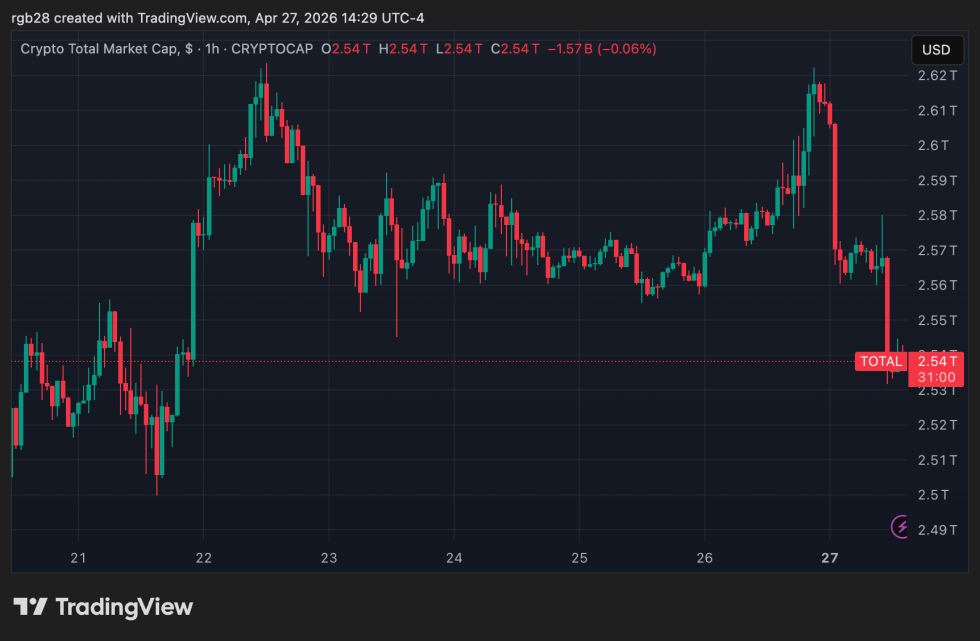
The total crypto market capitalization is at $2.54 trillion in the one-week chart. Source: TOTAL on TradingView