In the First Half of the Year, Half of VC Money Flowed to AI, with These 30 Companies Alone Raising Over 170 Billion Yuan

marsbitPubblicato 2026-07-03Pubblicato ultima volta 2026-07-03

Introduzione

First Half of 2026: VC Investment in AI Explodes, with 30 Top Companies Raising Over 170 Billion RMB In the first half of 2026, China's AI sector saw a massive surge in venture capital, with total equity financing exceeding 300 billion RMB—already surpassing the entire 2025 total. Key trends include: * **Massive Funding Scale:** The AI track recorded 1,203 financing events totaling over 300 billion RMB. Investment peaked in June, partly driven by DeepSeek's landmark 51-billion-RMB Series A round. * **Geographic Concentration:** Beijing, Hangzhou, Shanghai, and Shenzhen dominated, accounting for 74% of deals and 86% of total funding. Beijing led with 95.5 billion RMB, while Hangzhou surged to second place due to DeepSeek's round. * **Sector Focus:** * **Large Models** were the top draw, securing over half of all funds (nearly 1.6 trillion RMB). * **AI Infrastructure** (compute, chips) and **Embodied AI** (e.g., robotics) were other major investment areas, with the latter being the most active in number of deals. * **AIGC Applications** attracted significant capital (59.6 billion RMB), indicating strong belief in near-term commercialization. * **Investment Stage Logic:** Capital followed a clear strategy: heavy bets on growth-stage companies (A/B rounds), major funding for mature leaders, and widespread, smaller-scale seeding of early-stage innovators. * **Notable Early-Stage Trends:** World models (seen as the "OS" for embodied AI) attracted the m...

Part I: AI Sector Races Forward in H1, Funding Skyrockets

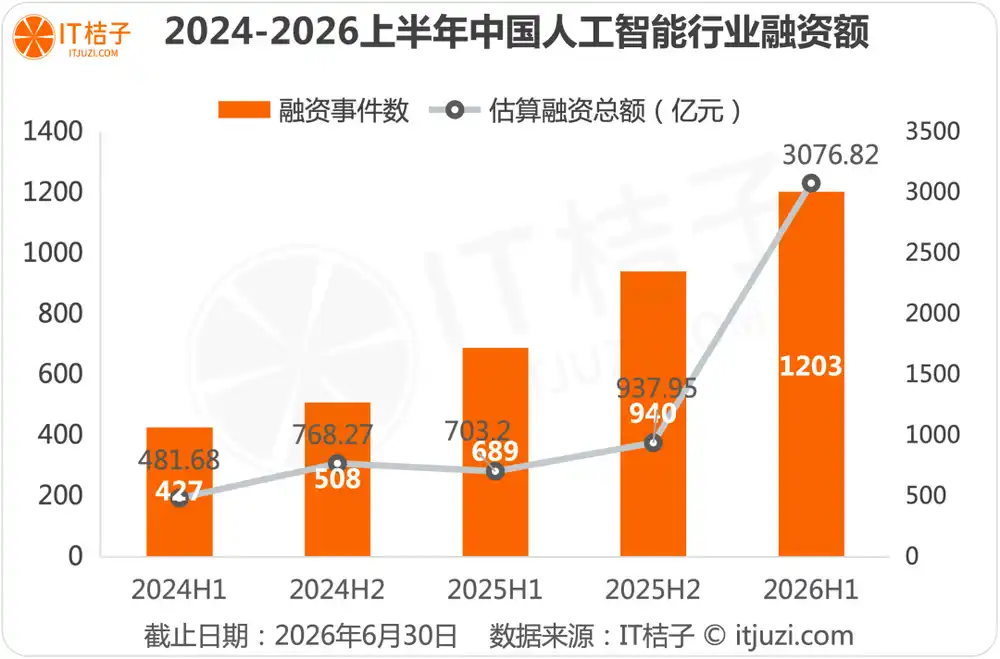
From January to June 2026, data from ITJuzi shows that equity financing in China's AI sector exhibited the core characteristics of "high total volume growth and a significant surge in funding amounts." Capital continues to increase its investment intensity in AI, with the funding scale for just six months already far exceeding the full-year level of 2025.
Data Statement:

1. Data filtering criteria: entries labeled "Artificial Intelligence" in the ITJuzi database's "Event Library," excluding non-AI industry entries.

2. Statistics scope limited to equity financing events in the primary market, excluding company listings (IPOs), post-IPO refinancing, M&A transactions, etc.

ITJuzi data shows that in the first half of 2026, there were 1,203 financing events in the AI sector, with total funding exceeding 300 billion yuan, far surpassing the full year of 2025. This reflects a sustained enhancement of capital's investment confidence in the AI sector. The AI industry has fully transitioned from the technology verification phase into the explosive period of large-scale implementation.

The funding pace in the AI sector during H1 2026 remained high from March onwards. Domestic AI funding scale consistently stayed above 40 billion yuan in March, April, and May. June saw explosive growth, with single-month total funding exceeding 100 billion yuan, primarily driven by the completion of DeepSeek's 51 billion yuan first-round financing, continuously pushing the overall funding scale of the sector higher.

The geographical pattern of AI sector financing in H1 2026 showed a landscape of "absolute leadership by Beijing, Hangzhou, Shanghai, and Shenzhen, significant agglomeration effects in the Yangtze River Delta region, and accelerated follow-up by new first-tier cities," highlighting prominent features of industrial cluster development.
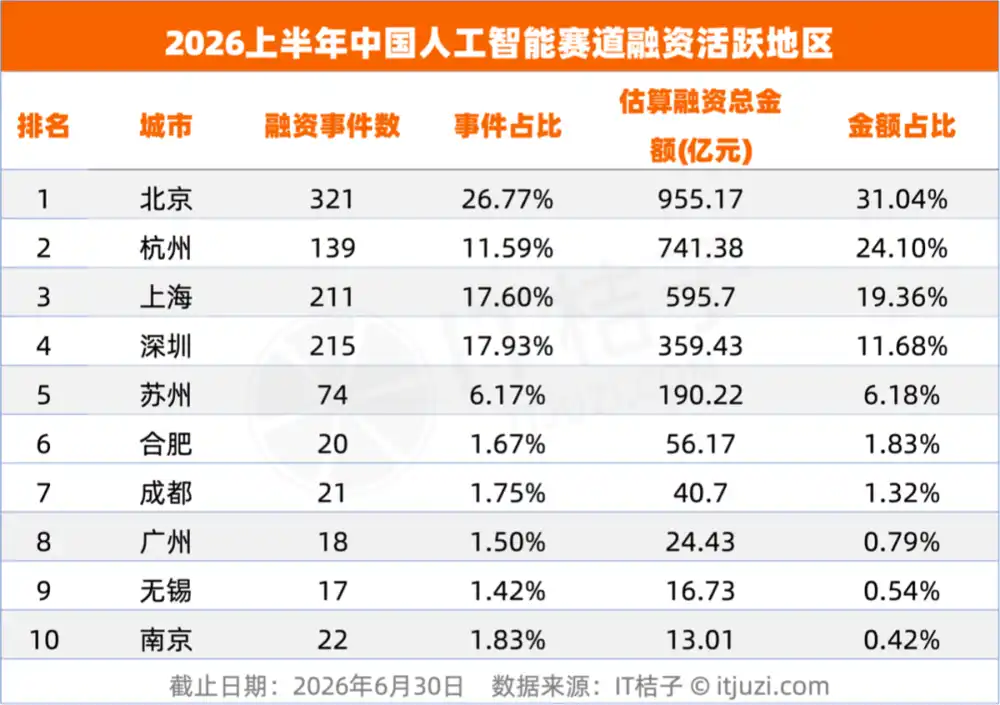
In the AI financing landscape of the first half of the year, Beijing, Shanghai, Hangzhou, and Shenzhen absolutely led the way, contributing 73.89% of the total financing transaction count and monopolizing 86% of the funding scale, becoming the absolute core of China's AI financing.

Among them, Beijing, with 321 financing events and total financing of 95.517 billion yuan, ranked first nationally, serving as the absolute core of domestic AI sector financing. Hangzhou, benefiting from the rise of Deepseek and its first-round subscription exceeding 50 billion yuan, saw its funding amount surpass Shanghai and Shenzhen to rank second nationally, becoming the absolute leader among new first-tier cities.

Shanghai had 211 AI financing events with total financing of 59.570 billion yuan in H1, while Shenzhen had 215 events with total financing of 35.943 billion yuan. Although their financing volumes were similar, Shanghai's AI companies demonstrated stronger overall capital attraction ability, reflecting higher valuation midpoints for Shanghai AI companies and larger bets per deal by institutions.

Suzhou, with 19.022 billion yuan, ranked 5th nationally, becoming the third pillar in the Yangtze River Delta. Momenta's cornerstone round of 2.9 billion HKD and Pre-IPO round of 1 billion USD contributed approximately 9.7 billion yuan, accounting for over half of Suzhou's H1 AI financing amount.

In addition to Yangtze River Delta cities like Hangzhou, Shanghai, Suzhou, Wuxi, and Nanjing, new first-tier cities such as Hefei, Chengdu, Guangzhou, Xi'an, and Wuhan also saw AI projects securing financing. Some cities achieved zero breakthroughs in financing events, reflecting the continuous expansion of the AI industry's radiation scope and second-tier cities accelerating their AI sector layout through policy support and industrial spillover absorption.

Part II: Funding Scale Across AI Sub-sectors

Since the artificial intelligence industry covers a wide range, relying solely on a conceptual term cannot reveal its full picture. Therefore, we conducted a broader statistical analysis of sub-fields.
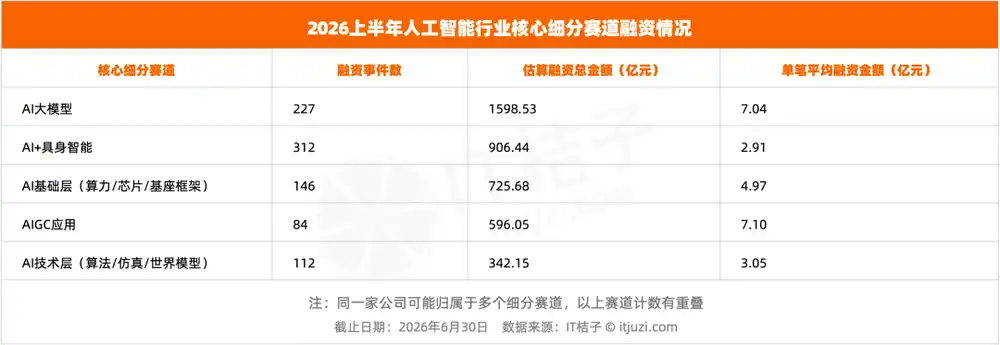
From the distribution characteristics of sub-sectors: In terms of total funding distribution, large models dominate overwhelmingly, taking over half of the total sector funds.

The large model sub-sector, with 159.853 billion yuan in total financing, became the absolute core technical foundation of the AI sector. Top projects frequently secured single rounds of tens of billions in financing, showing the strongest Matthew effect for capital. It is the first most heavily invested sub-sector in the primary market.

Additionally, in H1 2026, the AI infrastructure layer (including computing power, AI chips, training frameworks) raised a total of 72.568 billion yuan. These are capital-intensive sub-sectors with frequent large-scale financing. The AI technology layer, leaning towards simulation and spatial algorithms, had lower numbers of financing events and amounts compared to the infrastructure layer, often financing in sync with large model and embodied intelligence companies.

These two major sub-sectors together accounted for 258 events and combined financing of 106.783 billion yuan, constituting 18.00% of the total summarized funds. They represent the core investment direction for the AI industry's technical foundation, apart from large models.

The AI+Embodied Intelligence sub-sector is the second growth driver, with total financing reaching 90.644 billion yuan. It is the core hardware carrier sub-sector for AI technology implementation, with 312 financing events, making it the sub-sector with the highest number of financing events and the highest project activity level.

The AIGC application sub-sector raised a total of 59.605 billion yuan in six months, representing the most mature sub-sector for AI technology commercialization, with the highest capital recognition of its commercial value.

In terms of financing event distribution, the AI+Embodied Intelligence sub-sector had 312 financing events, accounting for 26.02% of all sector events. It is the most densely populated sub-sector with projects, covering all stages from early startups to growth-stage leaders, showing the strongest industry innovation vitality.

From the perspective of single-project financing capability, large models and AIGC are most prominent. The top three sub-sectors with the highest average financing amount per event are: AIGC (710 million yuan), Large Models (704 million yuan), both far exceeding the sector average. This reflects that capital is willing to offer extremely high valuation premiums and large-scale financial support for top projects in these three sub-sectors, which are the core targets of capital's heavy investment.

Part III: Capital's Core Betting Rhythm

&

In-depth Analysis Matching Different AI Companies' Financing Development Stages

Capital allocation in the AI sector in H1 2026 presented a clear rhythm: "heavy investment in growth stage, anchor in maturity stage, early-stage incubation." The financing scale, number of events, and capital preferences differed significantly across these three investment stages.
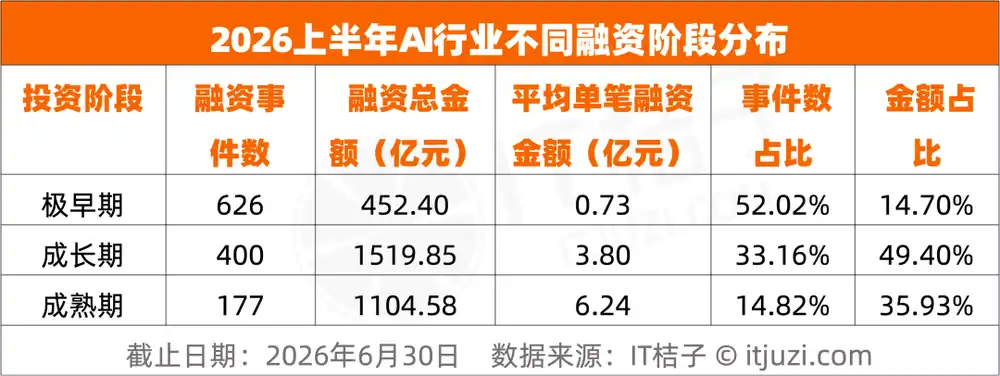
The core betting logic of capital can be clearly seen from the key data:

Companies in the ultra-early stage (Seed, Angel, Pre-A rounds) are the core source of technological innovation in the AI sector. They contributed 626 events, over half of the total, but the average financing amount per event was only 73 million yuan. The core logic of early-stage investment is "casting a wide net, early positioning, betting on the future"—locking in early-stage projects with innovative potential through small, high-frequency investments.

Growth-stage AI companies (Series A, A+, B, B+ rounds) were the core battlefield for capital deployment in the AI sector in H1 2026. Companies at this stage have completed technology validation and possess initial product implementation capabilities and commercialization potential. Together, they contributed 49.40% of the total financing amount, with an average financing amount per event of 380 million yuan.

Mature-stage AI companies are the anchor of the sector. Although they accounted for only 177 events, they contributed over 100 billion yuan in total financing, with the highest average financing amount per event reaching 624 million yuan. These mature-stage companies, which have formed industry leadership positions and possess stable profitability capabilities, often receive larger financial support.

To penetrate beyond the surface information of "funding amounts," we will break down the analysis into two stages—early stage and mid-to-late stage—and conduct an in-depth analysis of the companies with the highest financing amounts to answer a core question: What exactly is every penny of capital betting on?

1. Early Stage: The Source of Innovation and Incubation Pool for the Sector

According to ITJuzi statistics, the top 10 early-stage companies collectively secured 16.589 billion yuan, accounting for 36.7% of the total ultra-early stage financing. Who are the companies that can secure large-scale, even over 1 billion yuan, financing in the early stage?
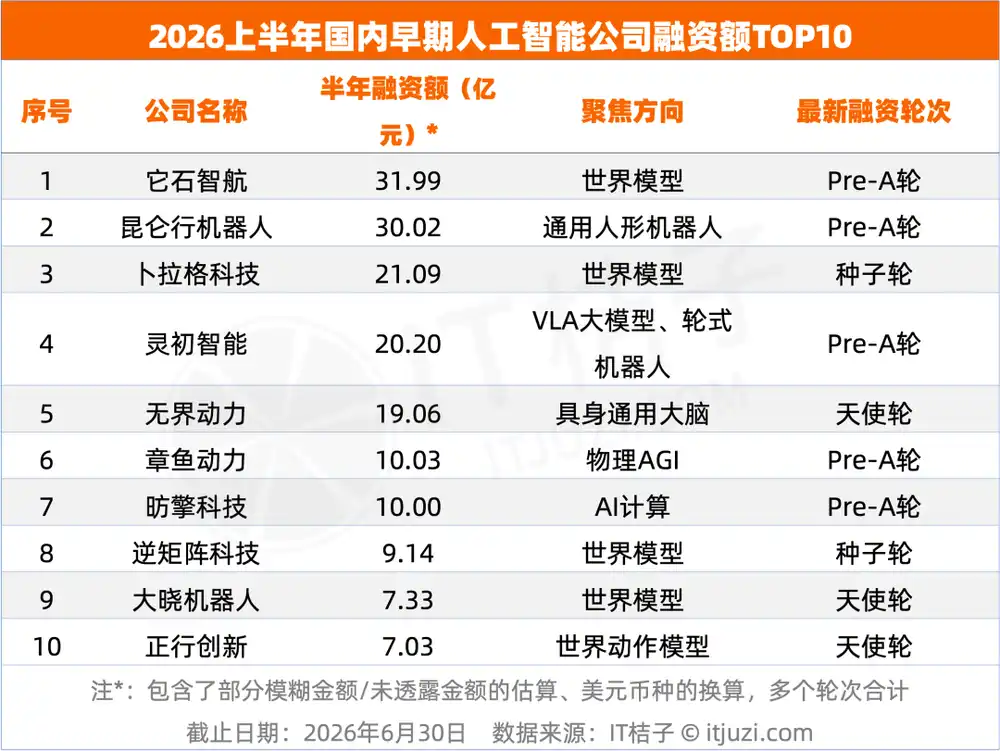
Four Key Insights from the Early-Stage TOP10

Insight One: World Models become the "First Consensus" for early-stage investment.

Six companies in the world model direction collectively raised 9.7 billion yuan (58%). World models are seen as the "operating system" for embodied intelligence—whoever masters the world model masters the robot's ability to understand the physical world. The logic of early-stage VCs is to position themselves at the operating system level, which holds greater strategic value than competing at the application level.

Insight Two: Significant "Inflation" in Angel round financing amounts.

Four companies among the TOP10 completed financing exceeding 700 million yuan in their Seed or Angel rounds (Brag 2.1B, Wujie Power 1.9B, Inverse Matrix 900M, Daxiao 700M), which was unimaginable before 2024. This phenomenon indicates that the premium for founding teams' academic/industry backgrounds in the AI sector is extremely high. Top VCs are moving towards earlier stages to compete for scarce top-tier teams.

Insight Three: The spillover effect of the talent ecosystem from major companies is becoming evident.

Daxiao Robot, founded in 2025, is an embodied intelligence company incubated by SenseTime, launching the first domestically open-source and commercially applied "Kaiwu" World Model 3.0. Daxiao Robot's inclusion on the list represents a trend—AI talent and technology from major companies are diffusing outward through incubation/entrepreneurship, forming a "major company ecosystem" for startups.

Insight Four: None of the early-stage TOP10 are pure large model companies.

This is an extremely important signal—the early window for the large model sub-sector has essentially closed. Capital judges that the competitive landscape for foundational large models has preliminarily taken shape, and new early-stage large model projects are unlikely to receive support from top VCs. Capital is shifting towards the "downstream of large models"—world models, embodied brains, physical AGI.

2. Growth/Maturity Stage: Core Targets of Capital's Heavy Investment

Large-scale financing occurs frequently in both the growth and maturity stages, so they are considered together. According to ITJuzi statistics, the TOP20 companies collectively raised 156.5 billion yuan, accounting for over half of the total sector financing. So, who can attract concentrated capital bets?
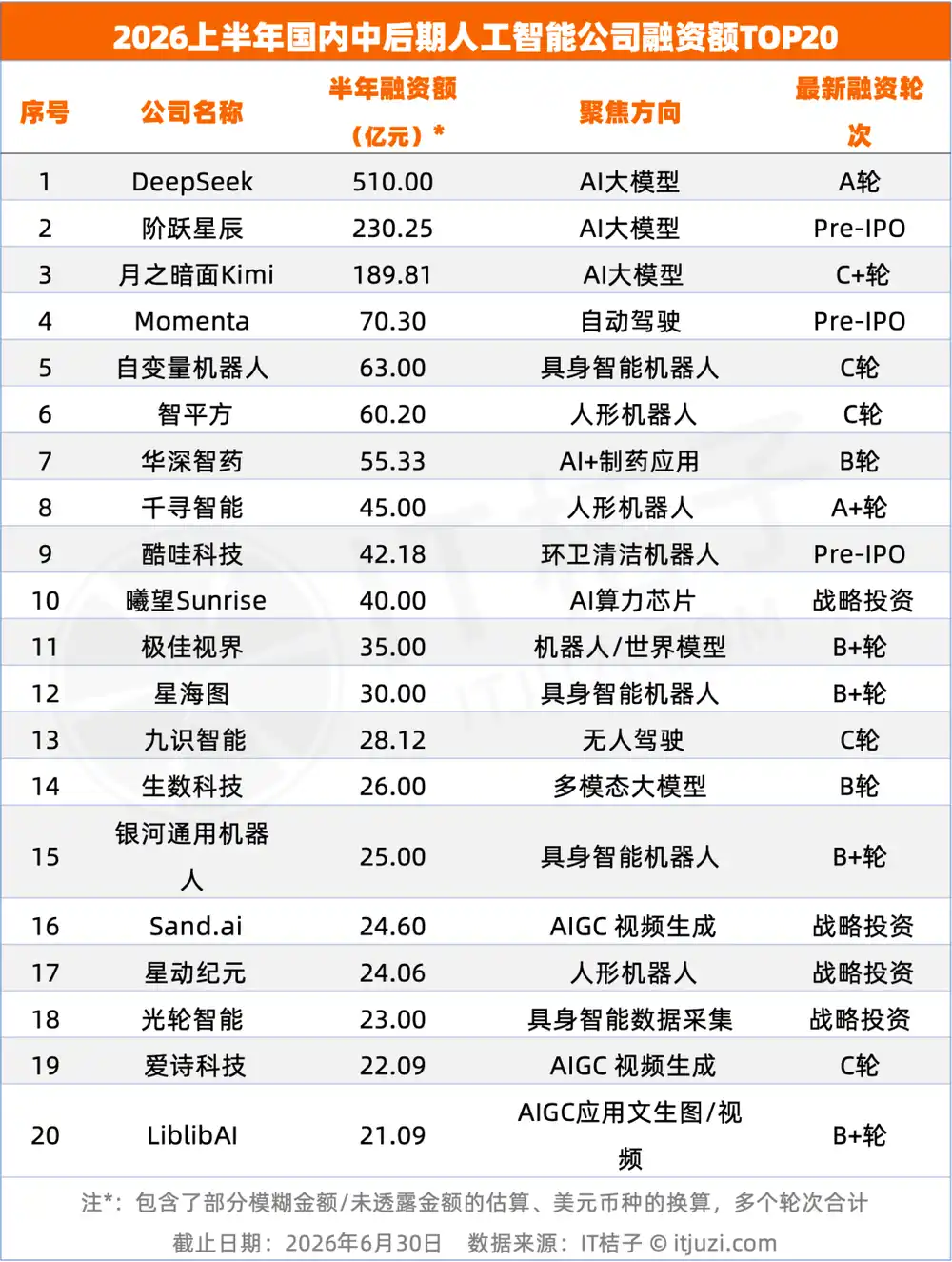
Based on their focus areas, we categorize the TOP20 AI companies in mid-to-late stages into five major camps for analysis:

Camp One: The Big Three Large Models (Collectively 93.006 billion yuan, 59.4% of TOP20)

Deepseek, StepFun, and Kimi took the top three spots, each securing over 10 billion yuan in financing. Among them, DeepSeek obtained 51 billion yuan with just one Series A round, making it the largest financing event in the AI sector in H1 2026.

However, the financing logic of the big three differs significantly. DeepSeek's single 51 billion yuan round was completed at Series A, indicating extremely high valuation elasticity and capital trust. StepFun's intensive financing (four rounds in six months) reflects capital needs in the Pre-IPO冲刺冲刺 sprint stage, with a considerable portion of its 23 billion yuan likely allocated for final resource preparation before listing. Kimi's 18.9 billion yuan was completed in two relatively balanced rounds.

Camp Two: The "Seven Samurai" of Humanoid Robots (Collectively 28.226 billion yuan, 18.0% of TOP20)

Humanoid robots are the second major area, with the industry on the eve of large-scale implementation. Seven embodied intelligence companies—Independent Variable Robotics, ZhiPingFang, Qianxun Intelligence, Jijia Vision, Xinghai Tu, Galaxy General Robot, and Xingdong Jiyuan—each secured large-scale financing exceeding 2 billion yuan.

Moreover, their financing stages collectively entered Series B to strategic investment, indicating capital is no longer betting on technical routes but on who can achieve mass production first. Additionally, Independent Variable Robotics completed four rounds totaling 6.3 billion yuan in six months—an unusually intensive financing pace in the robotics sector—suggesting funds are rapidly concentrating towards it.

Camp Three: The "Three Musketeers" of AIGC Applications (Collectively 6.778 billion yuan, 4.3% of TOP20)

In the AIGC application sub-sector, ShengShu Technology, Sand.ai and LiblibAI, and Aishi Technology focus on the core scenario of multimodal video/image generation and have preliminarily achieved scaled commercialization of AIGC technology.

Compared to 2024 when most AIGC companies were in Angel/Series A stages, H1 2026 shows the AIGC sub-sector has clearly entered the commercialization verification phase. Notably, the financing amounts of the three companies are highly similar, without a clear "winner-takes-all" pattern—this reflects that the AIGC application layer is still in a "dividing the pie" rather than a "determining the winner" phase.

Camp Four: Autonomous Driving & Others (Collectively 25.893 billion yuan, 16.6% of TOP20)

Both Momenta and Kuwa Technology are in the Pre-IPO stage, reflecting that the autonomous driving sub-sector is entering an exit window. Huashen Zhiyao's 5.533 billion yuan represents the largest single financing in the AI drug discovery sub-sector, indicating that AI's commercial prospects in pharmaceutical R&D have been validated by capital's heavy investment. Sunrise's 4 billion yuan strategic investment represents the financing capability of AI chips under the logic of domestic substitution.

Part IV: Outlook for the Second Half of the Year

Looking at the AI industry from the midpoint of 2026, we predict the annual financing scale is highly likely to exceed 600 billion yuan, but the pace in the second half will be "high front, low back."

The H1 financing total of 307.682 billion yuan has already set a high base. According to seasonal patterns, financing is typically more active in H2, making it highly probable that the full year will exceed 600 billion yuan.

Additionally, the large model sub-sector will face its first round of "elimination matches."

In H1, the big three large models took 93 billion yuan. Furthermore, Zhipu and Minimax have entered the secondary market. The funding window for the remaining 200+ model companies is rapidly narrowing. We anticipate that the first cases of layoffs/transitions/M&A among large model startups will emerge in H2.

Companies that can survive will either have found clear differentiated scenarios (e.g., vertical models for AI drug discovery, AI programming, etc.) or secured strategic investments from industry giants. The window for pure "general-purpose large model" entrepreneurship has closed.

This article is from WeChat Official Account: ITJuzi , Author: Wu Meimei

Crypto di tendenza

Domande pertinenti

QWhat was the total AI financing amount and the number of deals in the first half of 2026 according to the article?

AIn the first half of 2026, the total AI financing amount exceeded 300 billion yuan across 1,203 deals.

QWhich city ranked first in AI financing amount in China during H1 2026, and what was its total?

ABeijing ranked first with a total financing amount of 95.517 billion yuan across 321 deals.

QWhich AI sub-sector received the largest share of financing in H1 2026, and what was its total?

AThe Large Model sub-sector received the largest share, with a total financing amount of 159.853 billion yuan, accounting for over half of the total AI financing.

QWhat were the three main investment stages in AI during H1 2026, and which stage attracted the highest total amount?

AThe three main stages were Early-stage (seed/angel), Growth-stage (Series A/B), and Mature-stage. The Mature-stage attracted the highest total financing amount, over 100 billion yuan, despite having fewer deals.

QWhich company had the single largest financing round in H1 2026, and how much was it?

ADeepSeek had the single largest financing round, raising 51 billion yuan in its Series A funding.

Letture associate

How Far Are We from the End of the Crypto Bear Market?

How Much Longer Until the Crypto Bear Market Ends? A persistent negative Coinbase Bitcoin Premium Index, reaching a record 46 consecutive days of negative values, underscores the ongoing crypto bear market. The downturn accelerated in late May/early June when MicroStrategy (referred to as "Strategy" in the text), a major BTC holder, sold a small amount of Bitcoin (32 BTC), shattering market confidence and triggering sharp declines in BTC, ETH, and SOL. This was compounded by sustained net outflows from US spot Bitcoin ETFs. June saw Bitcoin briefly fall below $60,000, its worst weekly performance since 2022, breaking below the critical 200-week moving average—a signal some analysts consider confirmation of a bear market. While some institutional analyses in mid-June suggested the bottom might be near (e.g., around $53,600 based on realized price, or a potential end during the 2026 World Cup summer), further price drops quickly disproved these optimistic forecasts. Key bear market indicators include: the severe de-pegging of MicroStrategy's preferred shares (STRC) from their $100 NAV, which later recovered partly due to company stabilization plans; a record number of BTC (over 10.83 million) and a significant portion of long-term ETH holders now in unrealized loss; and Bitcoin's price trading below its 200-week moving average. Predictions for the bear market's end vary. Some, like investor Yilihua, suggest July-August 2026 could present a final buying opportunity. Others, like miner Jiang Zhu'o'er, predict a bottom between $42,000-$44,000 in October-December 2026, based on the historical lag between MicroStrategy's mNAV ratio bottom and Bitcoin's price bottom. Technical indicators like the BTC 4-year average price index dipped briefly below 1, and the Coinbase Premium Index remains negative, suggesting a need for a price rebound to around $77,000 for a return to positive territory. In the absence of major external catalysts, the consensus leans toward the bear market persisting for another 2-3 months, with late September to early October 2026 being a potential turning point window.

Odaily星球日报27 min fa

How Far Are We from the End of the Crypto Bear Market?

Odaily星球日报27 min fa

Solana Ecosystem Shows Signs of Recovery: On-Chain Governance Upgrade, Tokenized Stocks and Meme Coins Heat Up

Solana Ecosystem Shows Signs of Revival: Governance Upgrades, Tokenized Stocks, and Memecoins Heat Up While the broader crypto market faces a downturn, Solana has shown relative strength with its price rising nearly 15% recently. This resilience is attributed to warming ecosystem activity, particularly in tokenized stocks and memecoins, coupled with a major upgrade to its on-chain governance. In the Real World Assets (RWA) sector, Solana now leads all public chains in both the number of unique holder wallets and the quantity of RWA assets. Its tokenized stock weekly trading volume has surged to a record $1.42 billion, capturing about 96% of the market share, largely driven by the Backpack exchange. Simultaneously, the Solana memecoin sector has reignited, fueled by the rapid ascent of the ANSEM token following endorsements from a prominent crypto influencer. This has boosted activity across platforms like Pump.fun and increased fee revenue for several Solana-based exchanges. A key development is the launch of Solana Governance Proposals (SGP), a new on-chain mechanism. It allows validators with at least 100,000 SOL delegated to submit proposals for community vote, enhancing decentralized decision-making. SGP will operate alongside the existing technical proposal process (SIMD), focusing on broader ecosystem governance. Despite these positive signals in specific areas, overall on-chain activity and transaction volumes still lag behind previous bull market peaks, indicating the recovery remains partial rather than ecosystem-wide.

marsbit50 min fa

Solana Ecosystem Shows Signs of Recovery: On-Chain Governance Upgrade, Tokenized Stocks and Meme Coins Heat Up

marsbit50 min fa

While Semiconductor Stocks Plunge, Anthropic Plans to Develop a 2nm Chip

Anthropic, the AI company behind Claude, is exploring the development of its own custom AI chip, according to a report from The Information. The company is in early discussions with Samsung Electronics to manufacture the chip using Samsung's most advanced 2-nanometer process and packaging technology. While the project is still in preliminary stages, including defining chip specifications, and could be abandoned, it marks a strategic step for Anthropic. The move comes as the company seeks greater control over its computing costs and hardware optimization, particularly for inference tasks to run its models more efficiently and cheaply. Samsung's potential involvement follows its participation as a strategic investor in Anthropic's recent $65 billion funding round. For Samsung, partnering with a major AI lab represents a significant opportunity for its foundry business to compete with market leader TSMC in advanced semiconductor manufacturing. Anthropic's CEO, Dario Amodei, has previously highlighted the immense financial challenge of securing enough computing power for anticipated growth, making cost-effective inference a critical focus. The company would join other tech giants like Google, Amazon, Microsoft, Meta, and OpenAI in pursuing custom AI silicon. However, analysts note this trend creates deeper interdependencies rather than independence, as US AI labs become more tightly woven into Asian semiconductor supply chains. Despite this move, Anthropic remains heavily reliant on a multi-cloud, multi-vendor strategy for its immediate computing needs. It has secured massive, long-term commitments for capacity from Amazon Web Services (Trainium chips), Google (TPUs), and even leased a large GPU cluster from xAI. For now, Nvidia continues to dominate the AI chip market, with its share reportedly growing to 74%.

链捕手52 min fa

While Semiconductor Stocks Plunge, Anthropic Plans to Develop a 2nm Chip

链捕手52 min fa

Korean Companies Following Strategy in Accumulating Cryptocurrency: From Bull Market to Delisting?

Title: Korean DAT Companies Following "Strategy" Bitcoin Hoarding Model Face Delisting Amid Bear Market Summary: Several Korean KOSDAQ-listed companies, known as Digital Asset Trusts (DATs), are at risk of being delisted due to a combination of stricter regulatory thresholds and a downturn in crypto markets. These firms, inspired by models like Strategy and Japan's Metaplanet, raised capital to buy Bitcoin, relying on a cycle of rising crypto prices to boost their stock value. However, recent reforms in Korea have raised the minimum market capitalization required to stay listed from 150 billion won to 200 billion won (approx. $1.3M), with a further increase to 300 billion won set for next January. The new rules also close loopholes like reverse stock splits used to artificially inflate share prices. The situation is exacerbated by a significant drop in Bitcoin's price from its 2025 peak and a weak KOSDAQ market. While the main KOSPI index has surged nearly 95% year-to-date, KOSDAQ has fallen about 10%, draining liquidity from smaller companies. Many DATs now hover near or below the new market cap thresholds and must also book substantial valuation losses on their Bitcoin holdings. Analysts suggest that without a sustained recovery in both crypto prices and broader market interest in KOSDAQ stocks, these companies have limited options to avoid delisting, marking a precarious moment for Korea's crypto-linked public companies.

marsbit1 h fa

Korean Companies Following Strategy in Accumulating Cryptocurrency: From Bull Market to Delisting?

marsbit1 h fa

Trading

Spot

Articoli Popolari

Cosa è GROK AI

Grok AI: Rivoluzionare la Tecnologia Conversazionale nell'Era Web3 Introduzione Nel panorama in rapida evoluzione dell'intelligenza artificiale, Grok AI si distingue come un progetto notevole che collega i domini della tecnologia avanzata e dell'interazione con l'utente. Sviluppato da xAI, un'azienda guidata dal rinomato imprenditore Elon Musk, Grok AI cerca di ridefinire il modo in cui interagiamo con l'intelligenza artificiale. Mentre il movimento Web3 continua a prosperare, Grok AI mira a sfruttare il potere dell'IA conversazionale per rispondere a query complesse, offrendo agli utenti un'esperienza che è non solo informativa ma anche divertente. Cos'è Grok AI? Grok AI è un sofisticato chatbot di intelligenza artificiale conversazionale progettato per interagire dinamicamente con gli utenti. A differenza di molti sistemi di intelligenza artificiale tradizionali, Grok AI abbraccia un'ampia gamma di domande, comprese quelle tipicamente considerate inappropriate o al di fuori delle risposte standard. Gli obiettivi principali del progetto includono: Ragionamento Affidabile: Grok AI enfatizza il ragionamento di buon senso per fornire risposte logiche basate sulla comprensione contestuale. Supervisione Scalabile: L'integrazione dell'assistenza degli strumenti garantisce che le interazioni degli utenti siano sia monitorate che ottimizzate per la qualità. Verifica Formale: La sicurezza è fondamentale; Grok AI incorpora metodi di verifica formale per migliorare l'affidabilità delle sue uscite. Comprensione del Lungo Contesto: Il modello di IA eccelle nel trattenere e richiamare una vasta storia di conversazione, facilitando discussioni significative e consapevoli del contesto. Robustezza Adversariale: Concentrandosi sul miglioramento delle sue difese contro input manipolati o malevoli, Grok AI mira a mantenere l'integrità delle interazioni degli utenti. In sostanza, Grok AI non è solo un dispositivo di recupero informazioni; è un partner conversazionale immersivo che incoraggia un dialogo dinamico. Creatore di Grok AI Il cervello dietro Grok AI non è altri che Elon Musk, un individuo sinonimo di innovazione in vari campi, tra cui automotive, viaggi spaziali e tecnologia. Sotto l'egida di xAI, un'azienda focalizzata sull'avanzamento della tecnologia AI in modi benefici, la visione di Musk mira a rimodellare la comprensione delle interazioni con l'IA. La leadership e l'etica fondamentale sono profondamente influenzate dall'impegno di Musk nel superare i confini tecnologici. Investitori di Grok AI Sebbene i dettagli specifici riguardanti gli investitori che sostengono Grok AI rimangano limitati, è pubblicamente riconosciuto che xAI, l'incubatore del progetto, è fondato e supportato principalmente dallo stesso Elon Musk. Le precedenti imprese e partecipazioni di Musk forniscono un robusto sostegno, rafforzando ulteriormente la credibilità e il potenziale di crescita di Grok AI. Tuttavia, al momento, le informazioni riguardanti ulteriori fondazioni di investimento o organizzazioni che supportano Grok AI non sono facilmente accessibili, segnando un'area per potenziali esplorazioni future. Come Funziona Grok AI? Le meccaniche operative di Grok AI sono innovative quanto il suo framework concettuale. Il progetto integra diverse tecnologie all'avanguardia che facilitano le sue funzionalità uniche: Infrastruttura Robusta: Grok AI è costruito utilizzando Kubernetes per l'orchestrazione dei container, Rust per prestazioni e sicurezza, e JAX per il calcolo numerico ad alte prestazioni. Questo trio garantisce che il chatbot operi in modo efficiente, si scaldi efficacemente e serva gli utenti prontamente. Accesso alla Conoscenza in Tempo Reale: Una delle caratteristiche distintive di Grok AI è la sua capacità di attingere a dati in tempo reale attraverso la piattaforma X—precedentemente nota come Twitter. Questa capacità consente all'IA di accedere alle informazioni più recenti, permettendole di fornire risposte e raccomandazioni tempestive che altri modelli di IA potrebbero perdere. Due Modalità di Interazione: Grok AI offre agli utenti la scelta tra “Modalità Divertente” e “Modalità Normale”. La Modalità Divertente consente uno stile di interazione più giocoso e umoristico, mentre la Modalità Normale si concentra sulla fornitura di risposte precise e accurate. Questa versatilità garantisce un'esperienza su misura che soddisfa varie preferenze degli utenti. In sostanza, Grok AI sposa prestazioni con coinvolgimento, creando un'esperienza che è sia arricchente che divertente. Cronologia di Grok AI Il viaggio di Grok AI è segnato da traguardi fondamentali che riflettono le sue fasi di sviluppo e distribuzione: Sviluppo Iniziale: La fase fondamentale di Grok AI si è svolta in circa due mesi, durante i quali sono stati condotti l'addestramento iniziale e il perfezionamento del modello. Rilascio Beta di Grok-2: In un significativo avanzamento, è stata annunciata la beta di Grok-2. Questo rilascio ha introdotto due versioni del chatbot—Grok-2 e Grok-2 mini—ognuna dotata delle capacità per chattare, programmare e ragionare. Accesso Pubblico: Dopo lo sviluppo beta, Grok AI è diventato disponibile per gli utenti della piattaforma X. Coloro che hanno account verificati tramite un numero di telefono e attivi per almeno sette giorni possono accedere a una versione limitata, rendendo la tecnologia disponibile a un pubblico più ampio. Questa cronologia racchiude la crescita sistematica di Grok AI dall'inizio all'impegno pubblico, enfatizzando il suo impegno per il miglioramento continuo e l'interazione con gli utenti. Caratteristiche Chiave di Grok AI Grok AI comprende diverse caratteristiche chiave che contribuiscono alla sua identità innovativa: Integrazione della Conoscenza in Tempo Reale: L'accesso a informazioni attuali e rilevanti differenzia Grok AI da molti modelli statici, consentendo un'esperienza utente coinvolgente e accurata. Stili di Interazione Versatili: Offrendo modalità di interazione distinte, Grok AI soddisfa varie preferenze degli utenti, invitando alla creatività e alla personalizzazione nella conversazione con l'IA. Avanzata Struttura Tecnologica: L'utilizzo di Kubernetes, Rust e JAX fornisce al progetto un solido framework per garantire affidabilità e prestazioni ottimali. Considerazione del Discorso Etico: L'inclusione di una funzione di generazione di immagini mette in mostra lo spirito innovativo del progetto. Tuttavia, solleva anche considerazioni etiche riguardanti il copyright e la rappresentazione rispettosa di figure riconoscibili—una discussione in corso all'interno della comunità AI. Conclusione Come entità pionieristica nel campo dell'IA conversazionale, Grok AI incarna il potenziale per esperienze utente trasformative nell'era digitale. Sviluppato da xAI e guidato dall'approccio visionario di Elon Musk, Grok AI integra conoscenze in tempo reale con capacità di interazione avanzate. Si sforza di spingere i confini di ciò che l'intelligenza artificiale può realizzare, mantenendo un focus su considerazioni etiche e sicurezza degli utenti. Grok AI non solo incarna il progresso tecnologico, ma rappresenta anche un nuovo paradigma conversazionale nel panorama Web3, promettendo di coinvolgere gli utenti con sia conoscenze esperte che interazioni giocose. Man mano che il progetto continua a evolversi, si erge come testimonianza di ciò che l'incrocio tra tecnologia, creatività e interazione simile a quella umana può realizzare.

509 Totale visualizzazioniPubblicato il 2024.12.26Aggiornato il 2024.12.26

Cosa è GROK AI

Cosa è ERC AI

Euruka Tech: Una Panoramica di $erc ai e delle sue Ambizioni in Web3 Introduzione Nel panorama in rapida evoluzione della tecnologia blockchain e delle applicazioni decentralizzate, nuovi progetti emergono frequentemente, ciascuno con obiettivi e metodologie uniche. Uno di questi progetti è Euruka Tech, che opera nel vasto dominio delle criptovalute e del Web3. L'obiettivo principale di Euruka Tech, in particolare del suo token $erc ai, è presentare soluzioni innovative progettate per sfruttare le crescenti capacità della tecnologia decentralizzata. Questo articolo si propone di fornire una panoramica completa di Euruka Tech, un'esplorazione dei suoi obiettivi, della funzionalità, dell'identità del suo creatore, dei potenziali investitori e della sua importanza nel contesto più ampio del Web3. Cos'è Euruka Tech, $erc ai? Euruka Tech è caratterizzato come un progetto che sfrutta gli strumenti e le funzionalità offerte dall'ambiente Web3, concentrandosi sull'integrazione dell'intelligenza artificiale nelle sue operazioni. Sebbene i dettagli specifici sul framework del progetto siano piuttosto sfuggenti, è progettato per migliorare l'engagement degli utenti e automatizzare i processi nello spazio crypto. Il progetto mira a creare un ecosistema decentralizzato che non solo faciliti le transazioni, ma incorpori anche funzionalità predittive attraverso l'intelligenza artificiale, da cui il nome del suo token, $erc ai. L'obiettivo è fornire una piattaforma intuitiva che faciliti interazioni più intelligenti e un'elaborazione delle transazioni più efficiente all'interno della crescente sfera del Web3. Chi è il Creatore di Euruka Tech, $erc ai? Attualmente, le informazioni riguardanti il creatore o il team fondatore di Euruka Tech rimangono non specificate e piuttosto opache. Questa assenza di dati solleva preoccupazioni, poiché la conoscenza del background del team è spesso essenziale per stabilire credibilità nel settore blockchain. Pertanto, abbiamo classificato queste informazioni come sconosciute fino a quando dettagli concreti non saranno resi disponibili nel dominio pubblico. Chi sono gli Investitori di Euruka Tech, $erc ai? Allo stesso modo, l'identificazione degli investitori o delle organizzazioni di supporto per il progetto Euruka Tech non è prontamente fornita attraverso la ricerca disponibile. Un aspetto cruciale per i potenziali stakeholder o utenti che considerano di impegnarsi con Euruka Tech è la garanzia che deriva da partnership finanziarie consolidate o dal supporto di società di investimento rispettabili. Senza divulgazioni sulle affiliazioni di investimento, è difficile trarre conclusioni complete sulla sicurezza finanziaria o sulla longevità del progetto. In linea con le informazioni trovate, anche questa sezione rimane allo stato di sconosciuto. Come funziona Euruka Tech, $erc ai? Nonostante la mancanza di specifiche tecniche dettagliate per Euruka Tech, è essenziale considerare le sue ambizioni innovative. Il progetto cerca di sfruttare la potenza computazionale dell'intelligenza artificiale per automatizzare e migliorare l'esperienza dell'utente all'interno dell'ambiente delle criptovalute. Integrando l'IA con la tecnologia blockchain, Euruka Tech mira a fornire funzionalità come operazioni automatizzate, valutazioni del rischio e interfacce utente personalizzate. L'essenza innovativa di Euruka Tech risiede nel suo obiettivo di creare una connessione fluida tra gli utenti e le vaste possibilità presentate dalle reti decentralizzate. Attraverso l'utilizzo di algoritmi di apprendimento automatico e IA, mira a ridurre le sfide degli utenti alle prime armi e semplificare le esperienze transazionali all'interno del framework Web3. Questa simbiosi tra IA e blockchain sottolinea l'importanza del token $erc ai, fungendo da ponte tra le interfacce utente tradizionali e le avanzate capacità delle tecnologie decentralizzate. Cronologia di Euruka Tech, $erc ai Sfortunatamente, a causa delle limitate informazioni disponibili riguardo a Euruka Tech, non siamo in grado di presentare una cronologia dettagliata dei principali sviluppi o traguardi nel percorso del progetto. Questa cronologia, tipicamente preziosa per tracciare l'evoluzione di un progetto e comprendere la sua traiettoria di crescita, non è attualmente disponibile. Man mano che le informazioni su eventi notevoli, partnership o aggiunte funzionali diventano evidenti, gli aggiornamenti miglioreranno sicuramente la visibilità di Euruka Tech nella sfera crypto. Chiarimento su Altri Progetti “Eureka” È importante sottolineare che più progetti e aziende condividono una nomenclatura simile con “Eureka.” La ricerca ha identificato iniziative come un agente IA della NVIDIA Research, che si concentra sull'insegnamento ai robot di compiti complessi utilizzando metodi generativi, così come Eureka Labs ed Eureka AI, che migliorano l'esperienza utente nell'istruzione e nell'analisi del servizio clienti, rispettivamente. Tuttavia, questi progetti sono distinti da Euruka Tech e non dovrebbero essere confusi con i suoi obiettivi o funzionalità. Conclusione Euruka Tech, insieme al suo token $erc ai, rappresenta un attore promettente ma attualmente oscuro nel panorama del Web3. Sebbene i dettagli sul suo creatore e sugli investitori rimangano non divulgati, l'ambizione centrale di combinare intelligenza artificiale e tecnologia blockchain si erge come un punto focale di interesse. Gli approcci unici del progetto nel promuovere l'engagement degli utenti attraverso l'automazione avanzata potrebbero distinguerlo mentre l'ecosistema Web3 progredisce. Con l'evoluzione continua del mercato crypto, gli stakeholder dovrebbero tenere d'occhio gli sviluppi riguardanti Euruka Tech, poiché lo sviluppo di innovazioni documentate, partnership o una roadmap definita potrebbe presentare opportunità significative nel prossimo futuro. Così com'è, attendiamo ulteriori approfondimenti sostanziali che potrebbero svelare il potenziale di Euruka Tech e la sua posizione nel competitivo panorama crypto.

528 Totale visualizzazioniPubblicato il 2025.01.02Aggiornato il 2025.01.02

Cosa è ERC AI

Cosa è DUOLINGO AI

DUOLINGO AI: Integrare l'apprendimento delle lingue con Web3 e innovazione AI In un'era in cui la tecnologia rimodella l'istruzione, l'integrazione dell'intelligenza artificiale (AI) e delle reti blockchain annuncia una nuova frontiera per l'apprendimento delle lingue. Entra in scena DUOLINGO AI e la sua criptovaluta associata, $DUOLINGO AI. Questo progetto aspira a fondere la potenza educativa delle principali piattaforme di apprendimento delle lingue con i benefici della tecnologia decentralizzata Web3. Questo articolo esplora gli aspetti chiave di DUOLINGO AI, esaminando i suoi obiettivi, il framework tecnologico, lo sviluppo storico e il potenziale futuro, mantenendo chiarezza tra la risorsa educativa originale e questa iniziativa indipendente di criptovaluta. Panoramica di DUOLINGO AI Alla sua base, DUOLINGO AI cerca di stabilire un ambiente decentralizzato in cui gli studenti possono guadagnare ricompense crittografiche per il raggiungimento di traguardi educativi nella competenza linguistica. Applicando smart contracts, il progetto mira ad automatizzare i processi di verifica delle competenze e le allocazioni di token, aderendo ai principi di Web3 che enfatizzano la trasparenza e la proprietà da parte degli utenti. Il modello si discosta dagli approcci tradizionali all'acquisizione linguistica, facendo forte affidamento su una struttura di governance guidata dalla comunità, che consente ai detentori di token di suggerire miglioramenti ai contenuti dei corsi e alle distribuzioni delle ricompense. Alcuni degli obiettivi notevoli di DUOLINGO AI includono: Apprendimento Gamificato: Il progetto integra traguardi blockchain e token non fungibili (NFT) per rappresentare i livelli di competenza linguistica, promuovendo la motivazione attraverso ricompense digitali coinvolgenti. Creazione di Contenuti Decentralizzati: Apre opportunità per educatori e appassionati di lingue di contribuire con i propri corsi, facilitando un modello di condivisione dei ricavi che beneficia tutti i collaboratori. Personalizzazione Guidata dall'AI: Utilizzando modelli avanzati di machine learning, DUOLINGO AI personalizza le lezioni per adattarsi ai progressi individuali, simile alle funzionalità adattive presenti nelle piattaforme consolidate. Creatori del Progetto e Governance A partire da aprile 2025, il team dietro $DUOLINGO AI rimane pseudonimo, una pratica comune nel panorama decentralizzato delle criptovalute. Questa anonimato è inteso a promuovere la crescita collettiva e il coinvolgimento degli stakeholder piuttosto che concentrarsi su sviluppatori individuali. Lo smart contract distribuito sulla blockchain di Solana annota l'indirizzo del wallet dello sviluppatore, che segna l'impegno verso la trasparenza riguardo alle transazioni, nonostante l'identità dei creatori sia sconosciuta. Secondo la sua roadmap, DUOLINGO AI mira a evolversi in un'Organizzazione Autonoma Decentralizzata (DAO). Questa struttura di governance consente ai detentori di token di votare su questioni critiche come l'implementazione di funzionalità e le allocazioni del tesoro. Questo modello si allinea con l'etica dell'empowerment della comunità presente in varie applicazioni decentralizzate, enfatizzando l'importanza del processo decisionale collettivo. Investitori e Partnership Strategiche Attualmente, non ci sono investitori istituzionali o capitalisti di rischio identificabili pubblicamente legati a $DUOLINGO AI. Invece, la liquidità del progetto proviene principalmente da scambi decentralizzati (DEX), segnando un netto contrasto con le strategie di finanziamento delle aziende tradizionali di tecnologia educativa. Questo modello di base indica un approccio guidato dalla comunità, riflettendo l'impegno del progetto verso la decentralizzazione. Nel suo whitepaper, DUOLINGO AI menziona la formazione di collaborazioni con “piattaforme educative blockchain” non specificate, mirate ad arricchire la sua offerta di corsi. Sebbene partnership specifiche non siano ancora state divulgate, questi sforzi collaborativi suggeriscono una strategia per mescolare innovazione blockchain con iniziative educative, ampliando l'accesso e il coinvolgimento degli utenti attraverso diverse vie di apprendimento. Architettura Tecnologica Integrazione AI DUOLINGO AI incorpora due componenti principali guidate dall'AI per migliorare la sua offerta educativa: Motore di Apprendimento Adattivo: Questo sofisticato motore apprende dalle interazioni degli utenti, simile ai modelli proprietari delle principali piattaforme educative. Regola dinamicamente la difficoltà delle lezioni per affrontare le sfide specifiche degli studenti, rinforzando le aree deboli attraverso esercizi mirati. Agenti Conversazionali: Utilizzando chatbot alimentati da GPT-4, DUOLINGO AI offre una piattaforma per gli utenti per impegnarsi in conversazioni simulate, promuovendo un'esperienza di apprendimento linguistico più interattiva e pratica. Infrastruttura Blockchain Costruito sulla blockchain di Solana, $DUOLINGO AI utilizza un framework tecnologico completo che include: Smart Contracts per la Verifica delle Competenze: Questa funzionalità assegna automaticamente token agli utenti che superano con successo i test di competenza, rinforzando la struttura di incentivi per risultati di apprendimento genuini. Badge NFT: Questi token digitali significano vari traguardi che gli studenti raggiungono, come completare una sezione del loro corso o padroneggiare competenze specifiche, consentendo loro di scambiare o mostrare digitalmente i loro successi. Governance DAO: I membri della comunità dotati di token possono partecipare alla governance votando su proposte chiave, facilitando una cultura partecipativa che incoraggia l'innovazione nell'offerta di corsi e nelle funzionalità della piattaforma. Cronologia Storica 2022–2023: Concettualizzazione I lavori per DUOLINGO AI iniziano con la creazione di un whitepaper, evidenziando la sinergia tra i progressi dell'AI nell'apprendimento delle lingue e il potenziale decentralizzato della tecnologia blockchain. 2024: Lancio Beta Un lancio beta limitato introduce offerte in lingue popolari, premiando i primi utenti con incentivi in token come parte della strategia di coinvolgimento della comunità del progetto. 2025: Transizione DAO Ad aprile, avviene un lancio completo della mainnet con la circolazione di token, stimolando discussioni nella comunità riguardo a possibili espansioni nelle lingue asiatiche e ad altri sviluppi dei corsi. Sfide e Direzioni Future Ostacoli Tecnici Nonostante i suoi obiettivi ambiziosi, DUOLINGO AI affronta sfide significative. La scalabilità rimane una preoccupazione costante, in particolare nel bilanciare i costi associati all'elaborazione dell'AI e nel mantenere una rete decentralizzata reattiva. Inoltre, garantire la creazione e la moderazione di contenuti di qualità in un'offerta decentralizzata presenta complessità nel mantenere standard educativi. Opportunità Strategiche Guardando al futuro, DUOLINGO AI ha il potenziale per sfruttare partnership di micro-credentialing con istituzioni accademiche, fornendo validazioni verificate dalla blockchain delle competenze linguistiche. Inoltre, l'espansione cross-chain potrebbe consentire al progetto di attingere a basi utenti più ampie e a ulteriori ecosistemi blockchain, migliorando la sua interoperabilità e portata. Conclusione DUOLINGO AI rappresenta una fusione innovativa di intelligenza artificiale e tecnologia blockchain, presentando un'alternativa focalizzata sulla comunità ai sistemi tradizionali di apprendimento delle lingue. Sebbene il suo sviluppo pseudonimo e il modello economico emergente comportino alcuni rischi, l'impegno del progetto verso l'apprendimento gamificato, l'istruzione personalizzata e la governance decentralizzata illumina un percorso per la tecnologia educativa nel regno di Web3. Man mano che l'AI continua a progredire e l'ecosistema blockchain evolve, iniziative come DUOLINGO AI potrebbero ridefinire il modo in cui gli utenti interagiscono con l'istruzione linguistica, potenziando le comunità e premiando il coinvolgimento attraverso meccanismi di apprendimento innovativi.

481 Totale visualizzazioniPubblicato il 2025.04.11Aggiornato il 2025.04.11

Cosa è DUOLINGO AI

Discussioni

Benvenuto nella Community HTX. Qui puoi rimanere informato sugli ultimi sviluppi della piattaforma e accedere ad approfondimenti esperti sul mercato. Le opinioni degli utenti sul prezzo di AI AI sono presentate come di seguito.

活动图片