On August 4th, Cloudflare announced the launch of Wallets. Opening the announcement, the first thing you can do is simple: claim a handle for your future wallet, which means giving it a name first.
What's easily overlooked is another shorter sentence in the announcement. For actually setting up and using the wallet to purchase APIs and content, Cloudflare wrote "Soon." Users being able to claim a handle does not mean the agent already has a stablecoin card it can autonomously swipe. This time gap is precisely the most worthwhile part of this product to unpack.
Don't Mistake the Handle for a Wallet Just Yet
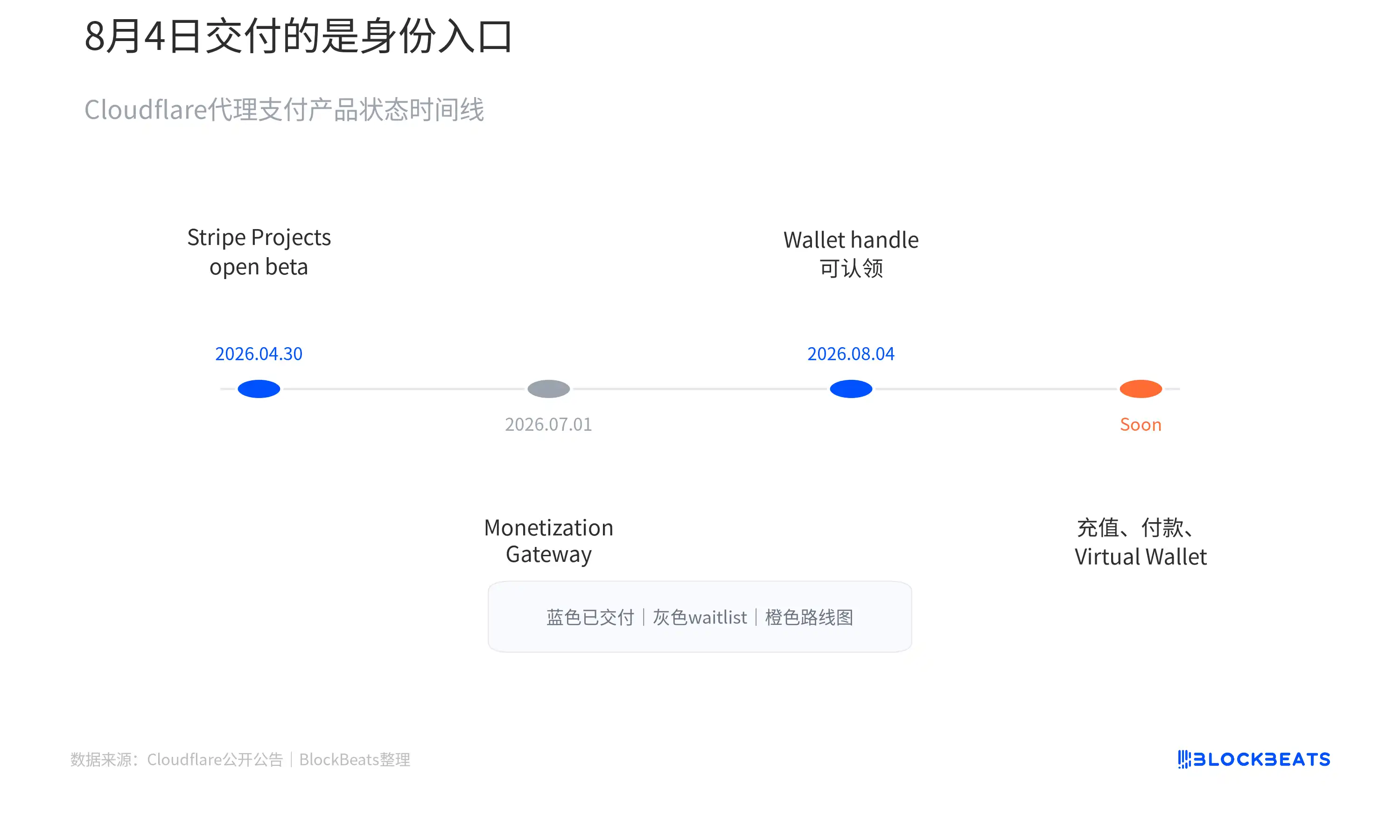
Figure 1 places several of Cloudflare's recent payment product lines together; the sequence is more important than the names. According to Cloudflare's Wallets announcement, what was delivered on August 4th was the handle. Top-ups, payments, and the Virtual Wallet used by agents via an API key are still left for later product descriptions.
This timeline already had two other pieces. According to announcements from Cloudflare and Stripe Projects, Stripe Projects allows agents to open Cloudflare accounts, purchase subscriptions, or domains on behalf of users and is currently in open beta. According to the Monetization Gateway announcement, the merchant-side entry point for receiving payments via x402 is still on a waiting list.
All three coincidentally involve agents and payments, but they are not on the same layer. Stripe Projects is a ready-to-try card-swiping proxy path. Monetization Gateway targets resource owners who want to receive payments. Wallet aims to supplement the payer side with identity, balance, and authorization rules. Looking at them side by side, what Cloudflare delivered this time is more like the payer's account page, not a fully operational payment network.
x402 Has Data, But That Doesn't Mean Cloudflare Has a Report Card
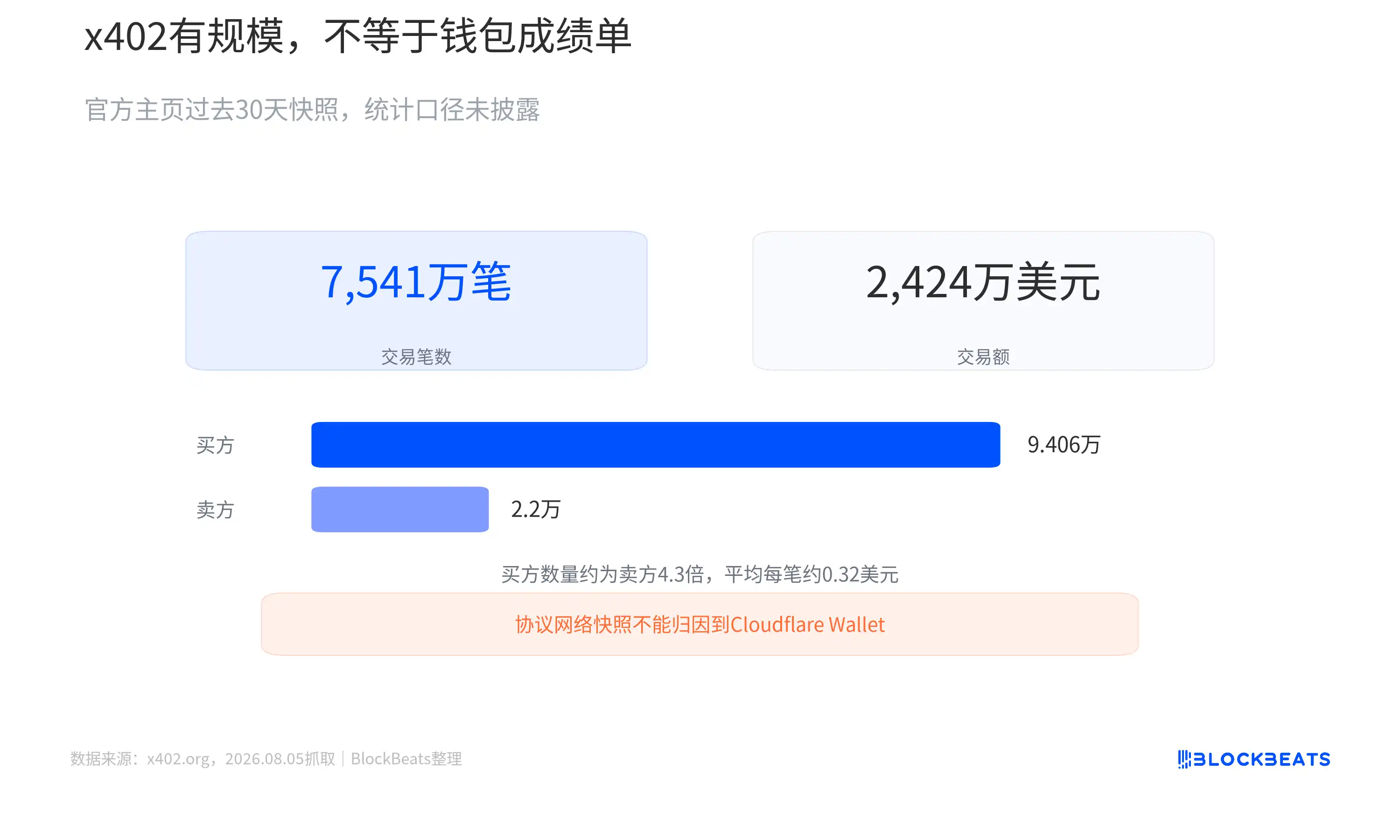
According to a 30-day snapshot displayed on the x402 official website on August 5th, the network recorded 75.41 million transactions and a transaction volume of $24.24 million. Dividing the two gives an average of about $0.32 per transaction. This scale closely aligns with small, frequent payments like API calls and content access, not a single large order.
But Figure 2 needs to be read with another boundary in mind. The website did not disclose how many of these transactions came from Cloudflare, how many were initiated by AI agents, nor did it provide any statistics on enabled Wallet accounts, merchants, or transaction volume. It proves there are vehicles on the x402 protocol road, but it cannot be reversed to deduce how many are registered under Cloudflare Wallet's license.
This distinction directly changes how one reads the news. x402 is an open process using HTTP 402 to initiate payment requests, not a settlement network exclusive to Cloudflare. Public snapshots can illustrate observable activity on the protocol, but they cannot serve as adoption rates for the Cloudflare Wallet, nor can they substitute for statistics on autonomous agent spending volume.
The Reality of One-Cent Calls Involves More Than Just a Wallet

Cloudflare's paid MCP tool example sets a single call at $0.01, but this is just a documentation sample, not the market average. It does break down micropayments quite specifically: the server first returns a 402, the agent signs the payment, the settlement facilitator verifies and settles, and only then does the server return the result.
In the existing developer path, the key is still held by the developer. According to the Agents SDK payment example, confirmation callbacks can be set to automatic, but the example also requires a private key and uses test networks and test USDC. Setting an agent for automatic payment does not equate to handing over the responsibility for spending, the keys, and spending limits to a mature wallet.
The Wallet roadmap is stuck precisely on this buyer side step. Cloudflare plans to separate the Account Wallet used by the account owner from the Virtual Wallet operated by the agent via an API key, and to add limits, whitelists, and per-transaction caps. It's more like a corporate card with approval rules; merchants still need to provide goods, and facilitators still need to complete settlements. Those rules are not yet open for configuration; the planned safety rails cannot be written as current features.
Three Agent Payment Paths Share Only Two Words
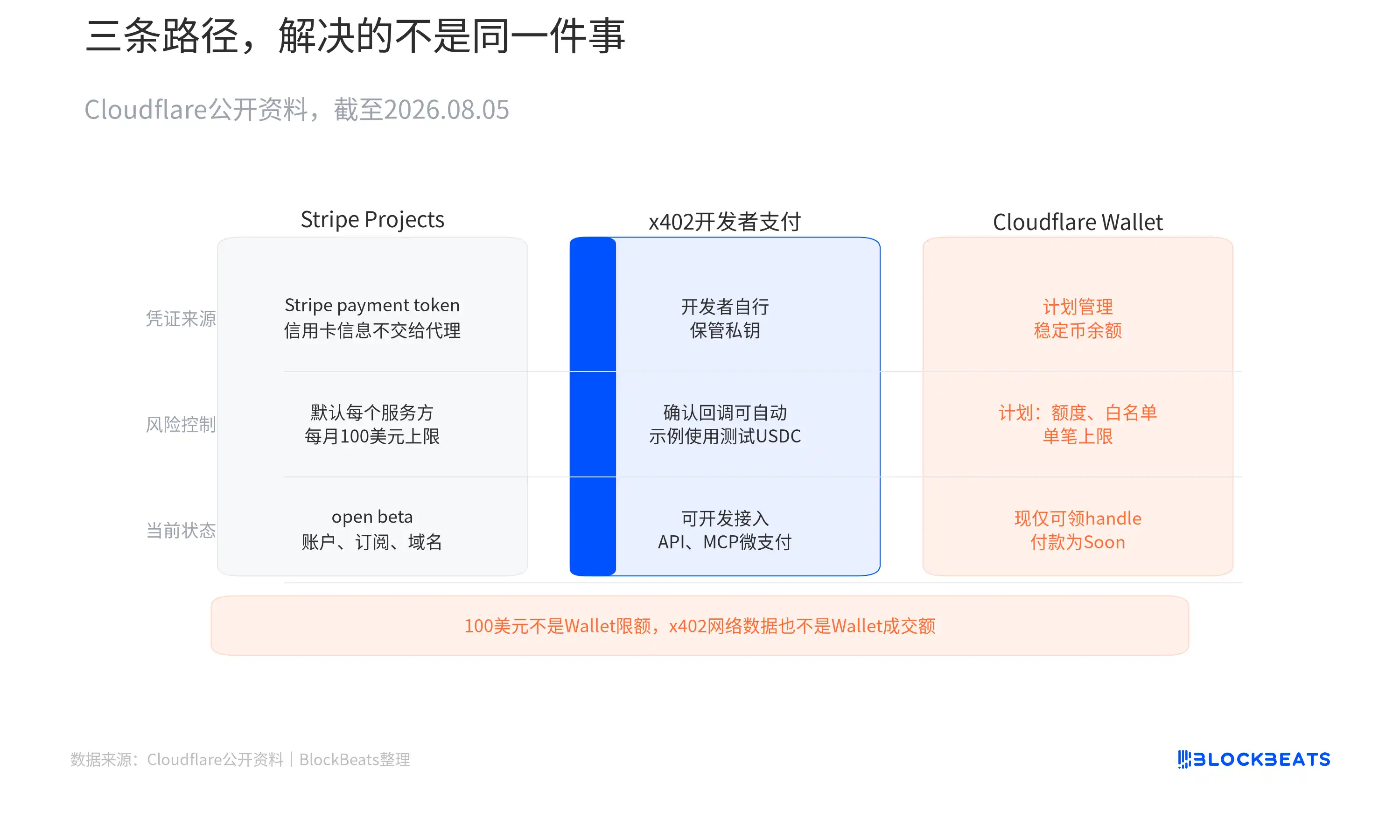
Figure 4 breaks down three easily confused paths into credentials, risk control, and status. Stripe Projects provides payment tokens to the service provider; the original credit card information is not given to the agent. Its default limit is $100 per service provider per month, and according to Cloudflare's announcement, it's still in open beta. This limit belongs to Stripe's card-swiping proxy service and cannot be transplanted as Wallet's spending limit.
x402's developer payment is a different starting point. Developers hold their own private keys and can implement pay-per-call for APIs or MCP tools. For Wallet, currently only the handle is open; stablecoin balance, spending limits, and whitelists have not yet been given practical configuration entry points. As for which stablecoins, which blockchains, in which regions it will be usable, along with KYC, custody, and fees, Cloudflare has also not disclosed these details.