The discussion about whether MSCI should remove MicroStrategy from its index has become a Sword of Damocles hanging over the company.
The market seems to be waiting for the official announcement on January 15th to deliver the final verdict on $MSTR.
How influential is MSCI really? If removed, will MicroStrategy's stock actually fall? I backtested historical data, and the answer is surprising.
Let's state the conclusion first: even if MSCI removes MSTR, it's highly likely that MSTR won't experience a significant drop because of it.
I. Why We Care About MSCI
First, we need to understand why MSCI's decision is so important.
The MSCI index is not just a simple list of stocks; it's the benchmark for trillions of dollars in global asset allocation.
1⃣ Forced Buying and Selling by Passive Funds:
Globally, trillions of dollars in ETFs (like iShares, Vanguard) and index funds strictly track the MSCI USA Index.
Once MSCI announces the removal of a stock, these funds must unconditionally sell that stock on the effective date (usually at the market close on the last day of the month), regardless of cost.
2⃣ A Double Blow to Liquidity and Attention:
Removal typically means the company is kicked out of the "core asset" club. Many actively managed funds, constrained by risk control rules (e.g., only allowed to invest in major index constituents), are also forced to follow suit and reduce their positions. This leads to decreased stock liquidity and a lower valuation benchmark.
II. Echoes from History: The Big Drop Often Happens *Before* the Announcement
However, based on my backtest of data from the last MSCI index review, the decline often doesn't begin on the day of the index adjustment.
The rule in financial markets is: the price always moves ahead of the news.
The most recent MSCI index adjustment occurred this November, removing companies like Whirlpool, Sensata, and ZoomInfo.
The timeline for an MSCI index adjustment is as follows:
November 5th: Announcement of the changes
November 25th: Changes become effective
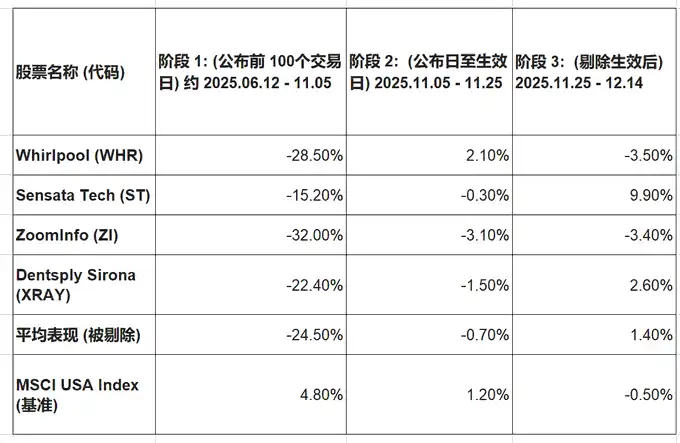
Through calculation, I found that the maximum decline for the removed stocks did not occur *after* the removal took effect, but rather during the anticipation phase *before* the announcement.
The data is shown in the chart below
Phase 1 (Panic Brewing Period, 100 days before announcement):
During this period, stocks that were eventually removed fell by an average of 24.5%. The market anticipated the removal outcome in advance through deteriorating fundamentals and shrinking market capitalization.
Smart money had already front-run the move.
Phase 2 (Bad News Realization Period, Announcement day to Effective day):
When MSCI officially announced the removal list, stock performance was反而 stable, with an average decline of only 0.7%.甚至, individual stocks like Whirlpool (WHR)反而 saw a 2.1% rebound after the announcement.
Phase 3 (Post-Effect Recovery Period):
After the official removal took effect, some oversold individual stocks (like Sensata) even recorded gains of nearly 10%.
Overall, the average decline was 24.5% *before* the announcement, and 0.7% *after* the announcement.
Back to our protagonist 【MSTR】
MSCI announced in October that it was considering removing stocks of MSTR's type from the index.
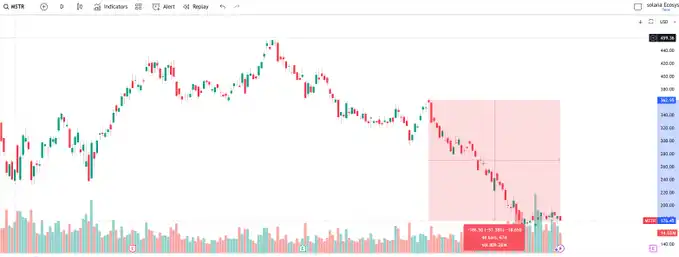
And MSTR's stock price has fallen 51% from its October high, far exceeding the decline in BTC over the same period.
Just like other companies removed from the MSCI index, the market has already started front-running the passive funds *before* MSCI's decision.
III. The Signal from the Nasdaq 100
When analyzing whether MicroStrategy will truly be removed by MSCI,
we cannot ignore a key leading indicator: the Nasdaq 100 index.
Although the Nasdaq 100 and MSCI USA indices have different construction rules, their core logic is highly overlapping: both place extreme importance on market capitalization and liquidity.
This past Friday, the Nasdaq 100 index announced it would retain MicroStrategy's constituent status.
This means that, from an index compilation perspective, MicroStrategy's average daily trading volume and free-float market capitalization still meet the stringent standards for being among the top 100 largest non-financial technology companies in the US.
Since MicroStrategy managed to hold its ground in the Nasdaq 100, it indicates that its fundamentals and liquidity have not deteriorated to an irreparable point.
Although MSCI has its own qualitative industry classification considerations, in terms of hard metrics, MicroStrategy still possesses strong competitiveness.
Conclusion
MSCI potentially removing MSTR from its index is definitely a significant negative.
But negatives are often提前 priced in by the market. According to historical backtesting, the impact on the stock price after the negative news materializes is反而 not significant.
The core variable真正 affecting MSTR's direction right now is still the trend of BTC.
甚至, because MSCI's potential removal of MSTR is still only in the discussion phase, if the announcement on January 15th next year ends up retaining MSTR's constituent status, that would be a major positive. Retention = big rise! Removal = small fall. I believe MSTR presents an opportunity for asymmetric returns in the period ahead.