Original Title:Hyperliquid's RWA perps boom is eating into the revenue that backs HYPE
Original Author:Shaurya Malwa,CoinDesk
Original Compiler:Chopper,Foresight News
While the open interest on the Hyperliquid platform has reached a new all-time high, the portion of trading fee revenue the platform retains is steadily shrinking.
On July 13th, the total size of leveraged positions held by traders on the platform, known as open interest, climbed above $11 billion, setting a new 2026 record for Hyperliquid. Over the past 30 days, the total trading volume for Hyperliquid's perpetual contracts approached $178 billion. Currently, among all centralized exchanges, Hyperliquid accounts for approximately 9% of the global perpetual contracts open interest, a figure that was less than 7% at the end of May.
However, platform revenue has followed the opposite trajectory. Data from DeFiLlama shows that Hyperliquid's protocol total revenue peaked at around $357 million in Q3 2025 and has subsequently declined quarter-over-quarter, dropping to $295 million, then $217 million, and reaching approximately $202 million in Q2 2026. Against a backdrop of persistently high trading volumes, platform revenue is down 43% from its peak.
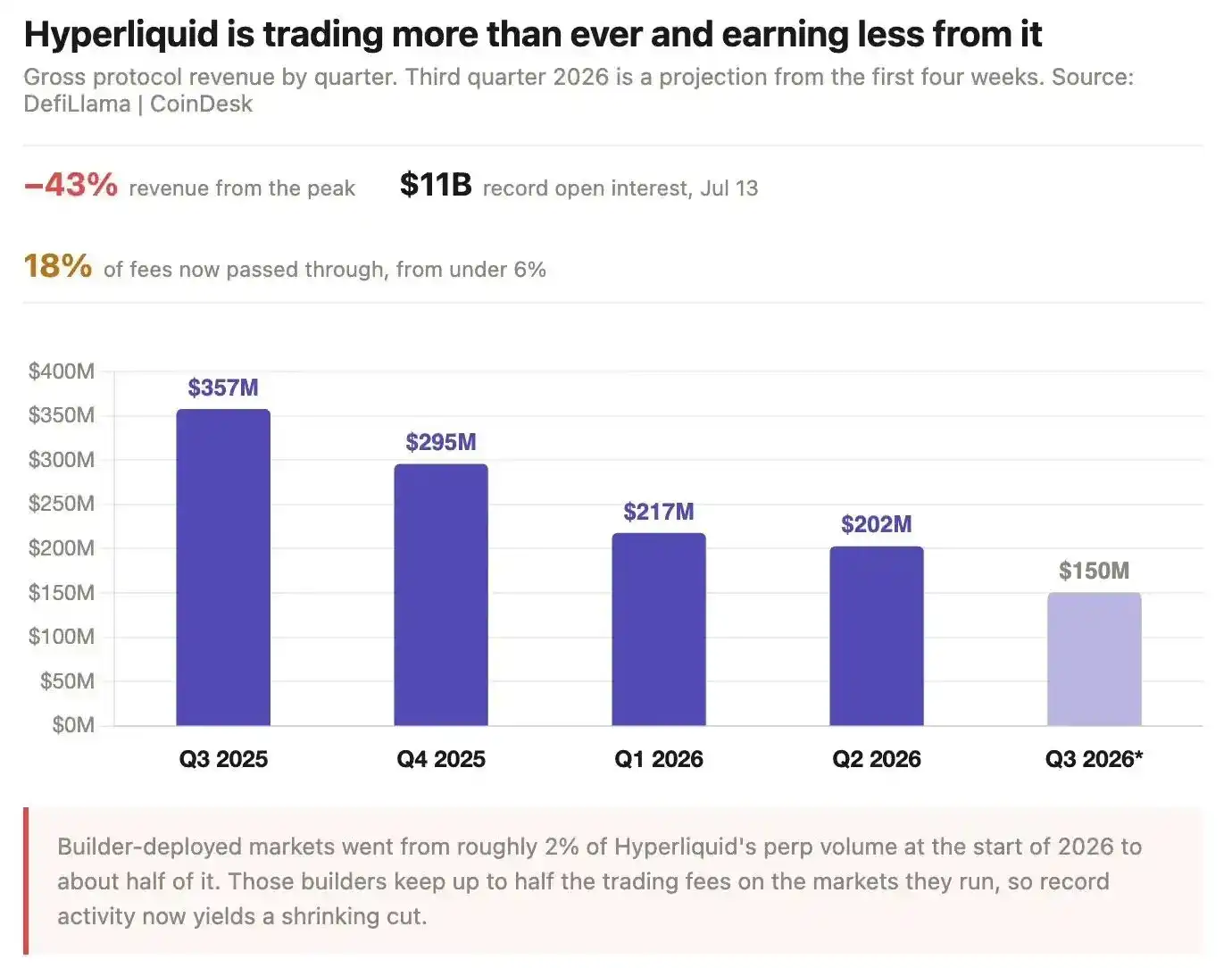
Hyperliquid's platform revenue has declined for four consecutive quarters
Hyperliquid Improvement Proposal HIP-3 explains why the platform cannot retain all the revenue generated by its own operations. Since October 2025, anyone who stakes 500,000 HYPE tokens (worth approximately $28 million at current prices) can deploy their own perpetual contract market on Hyperliquid's order book and can claim up to half of the trading fees.
At the beginning of 2026, such externally-deployed markets accounted for only 2% of Hyperliquid's perpetual contract trading volume; today, that share is close to 50%.
The revenue data clearly reflects the impact of this sharing model. The portion of fees directly returned to developers, market makers, and the platform's liquidity treasury represented only 6% of total revenue in Q2 2025; one year later, that proportion has reached 18%.
In Q2 2026, developer fee revenue generated by frontend routers like Phantom amounted to approximately $16 million. This amount is entirely accounted for as a cost expense, flowing out to external parties without being retained, essentially representing pass-through revenue.
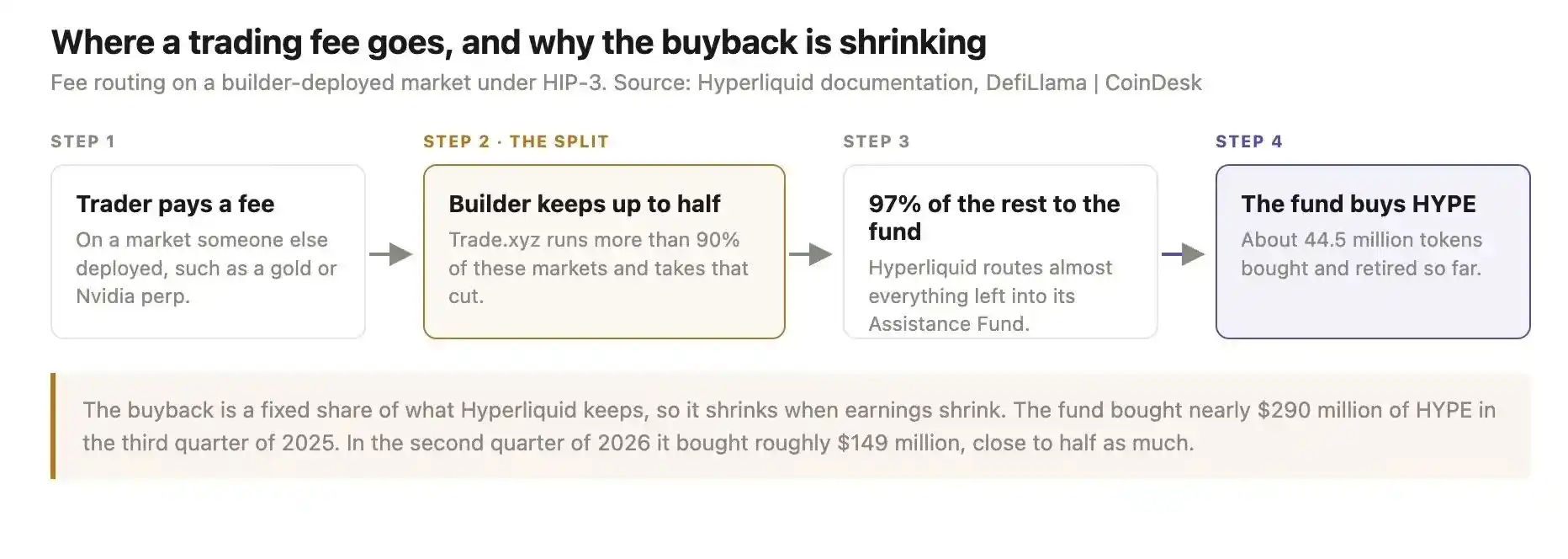
Flow of Trading Fees
The continuous influx of traders is driven by the new product types listed on these third-party markets: Real-World Asset (RWA) perpetual contracts. Contracts for crude oil, gold, Nvidia, Tesla, Nasdaq-100 tracking products, and even for unlisted companies like SpaceX saw their open interest hit a new high of $3.6 billion this month, surpassing Bitcoin to become the platform's largest trading market by volume.
From July 13th to July 19th, the trading volume of tokenized stock and commodity contracts reached $25 billion, accounting for 52% of the total weekly volume and exceeding cryptocurrency perpetual contract volume for the first time. These contracts are settled in stablecoins, have no expiration date, and can be traded even on weekends when the NYSE is closed. For those looking to trade leveraged Nvidia contracts at 2 AM on a Sunday, there are almost no other comparable options in the market.
However, this growth phase is heavily dependent on a single entity. Trade.xyz accounts for over 90% of the open interest under the HIP-3 mechanism. This means Hyperliquid's impressive metrics are highly dependent on this deployer's choice of oracles, margin parameter settings, and risk control capabilities.
Last Monday, the hidden risks of this model were exposed: a large trade executed on a South Korean pre-market exchange with thin liquidity directly caused Trade.xyz's SK Hynix contract to plunge 19%, triggering numerous liquidations. The institution subsequently agreed to compensate affected users.
Hyperliquid allocates approximately 97% of trading fees to a buyback fund, which repurchases and burns HYPE tokens on the open market. To date, it has burned around 44.5 million HYPE from the total supply. The buyback amount is directly tied to platform profits; as profits decline, the buyback scale contracts. In Q3 2025, the fund repurchased nearly $290 million worth of HYPE; in Q2 2026, the repurchase scale was approximately $149 million, almost halved.
CoinDesk data shows that HYPE traded near $55 last Friday, down 5% for the week and about 28% below its all-time high of around $77 on June 16th. Based on an annualized revenue of approximately $785 million, the token's corresponding circulating market cap P/E ratio is about 16x, while the fully diluted P/E ratio is around 70x.
Over the past month, institutional holders such as Multicoin Capital and Bitwise have transferred large amounts of HYPE tokens to exchanges.
The Hyperliquid ecosystem is actually quite thin. Among the 48 Hyperliquid ecosystem tokens tracked by CoinGecko, almost the entire market capitalization is concentrated in HYPE. The second and third largest are Ethena's USDe (approx. $4.5 billion) and USDT0 (approx. $4 billion), both of which are externally issued, cross-chain integrated stablecoins. The largest natively issued token on the platform is PURR, with a market cap of only $53 million, less than 0.5% of HYPE's market cap. The market's valuation of HYPE stems primarily from Hyperliquid's trading platform business model itself, rather than from a rich ecosystem of native applications.
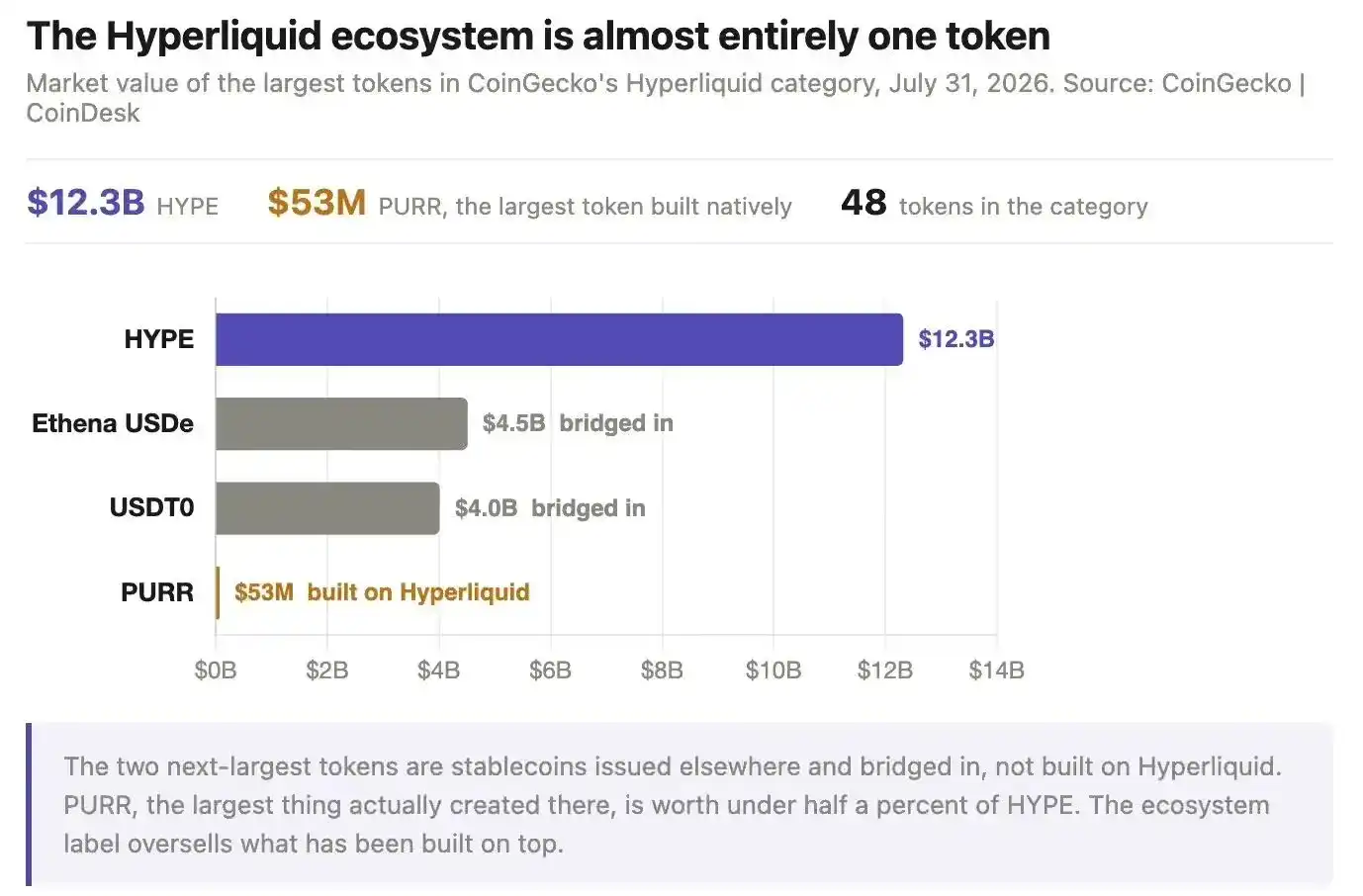
Hyperliquid Ecosystem Value Concentrated in HYPE
Both token supply and regulatory pressure are mounting. On August 6th, nearly 10 million HYPE were unlocked for core contributors, worth about $550 million at current prices; subsequent unlocks will continue monthly until 2027, while the total circulating supply of HYPE is only 222 million tokens.
In the week ending July 17th, the HYPE spot ETF experienced its first weekly net outflow since inception, amounting to about $7 million, ending a streak of nine consecutive weeks of inflows. The Monetary Authority of Singapore (MAS) placed the platform on its investor alert list in late June, following a prior risk warning from the UK; executives from CME and ICE have also urged the U.S. CFTC to review its commodity perpetual contract business.
Competition is also emerging from unexpected places. Just one month after brokerage Robinhood launched Robinhood Chain, daily clearing volume for decentralized exchanges in the meme coin sector has surpassed $600 million. By some metrics, its daily speculative trading activity already exceeds that of Hyperliquid.
Of course, all of the above does not mean the platform is heading for failure. ARK research data shows that as of July 31st, Hyperliquid and Pump.fun together account for 67% of total crypto application revenue. Grayscale has also likened Hyperliquid to Amazon AWS: external developers build products on top of the platform, and the platform takes a share from all transactions.
But this analogy precisely highlights the current problem. In the first four weeks of Q3 2026, Hyperliquid's total revenue was approximately $45 million. If this pace continues, total revenue for the quarter will be close to $150 million, marking a fourth consecutive quarter of revenue decline. Consequently, the buy-side support underpinning the HYPE token will weaken further.