Hyperliquid Launches The First Official S&P 500 Perpetual

bitcoinistPublished on 2026-03-19Last updated on 2026-03-19

Abstract

Hyperliquid has launched the first officially licensed S&P 500 perpetual contract in partnership with S&P Dow Jones Indices, exclusively on its Trade[XYZ] platform. This marks a significant endorsement from traditional finance and underscores Hyperliquid's evolution beyond a typical crypto derivatives exchange. The platform is increasingly used for 24/7 trading of real-world assets like oil and gold, with its RWA framework now accounting for up to 30% of its daily volume. The move is framed as a major step in migrating core global markets onchain, providing non-US investors with continuous, leveraged exposure to the flagship US equity benchmark. Hyperliquid's native token, HYPE, has rallied over 37% in the past 10 days amid this growth.

Hyperliquid has picked up one of its clearest endorsements yet from traditional finance. S&P Dow Jones Indices has licensed the first official S&P 500 perpetual contract to Trade[XYZ] on Hyperliquid, giving the exchange a flagship US equity benchmark just as HYPE extends a rally tied to the platform’s fast-growing role in round-the-clock macro trading.

The deal matters because it lands at a moment when Hyperliquid is no longer being treated as just another crypto-perps venue. In recent weeks, the platform has been pulling in heavy activity around oil, gold and other non-crypto markets while Wall Street is closed.

Hyperliquid processed more than $500 million in oil-linked volume over 24 hours on March 16, with HIP-3, its real-world-asset framework launched in October 2025, now accounting for as much as 30% of daily trading volume. HYPE has moved with that shift: Over the past 10 days, the token price is up more than 37% despite a challenging macro environment.

Hyperliquid Momentum Keeps Building

That is the backdrop for Wednesday’s announcement. S&P DJI said the product is the “first and only officially licensed” S&P 500 perpetual, supported by institutional-grade index data and designed for eligible non-US investors seeking 24/7 leveraged exposure onchain. The release also noted that the S&P 500 sits at the center of a market ecosystem with more than $1 trillion in daily linked exposure across futures, options, ETFs and structured products.

Trade[XYZ] leaned hard into the idea that this is less about a single listing than a change in market structure. “For 69 years, the S&P 500 has been a defining reference point for global finance. Until now, access to that benchmark has been shaped by market hours, intermediaries, and geography. Today, that changes.” In the same thread, the firm said the contract is “anchored by the official index data required for deep liquidity and institutional confidence at scale.”

Hyperliquid founder Jeff Yan framed the launch as validation of the broader thesis. “Seeing official S&P500 perpetual futures launch exclusively on Hyperliquid is a validation of everyone’s past years of hard work: global access to decentralized finance, perpetual futures as 24/7 price discovery, and Hyperliquid upgrading the existing financial stack to house all of finance,” he wrote.

Cameron Drinkwater, chief product and operations officer at S&P Dow Jones Indices, tied the move to a broader push into digital market structure. “This collaboration expands access and utility of our flagship benchmarks within digital trading environments. We believe digitally-native investors should demand the institutional-quality standards that define our indices, and we are thrilled to work with Trade[XYZ] to do so,” he said.

Trade[XYZ] is pitching the deal as part of a larger effort to migrate core global markets onchain. Collins Belton, chief operating officer and general counsel of Trade[XYZ]’s parent company, said, “We developed XYZ with a vision of bringing the world’s most important markets on-chain. The S&P 500 is a natural starting point. It represents the most widely tracked equity index on earth and has been the defining benchmark for global equities for decades.” He added that making the contract accessible “24/7 on Hyperliquid” brings the company “one step closer to that vision.”

That is why the S&P launch looks bigger than a branding win. Trade[XYZ] said its markets have already surpassed $100 billion in volume since October 2025 and are running at an annualized pace above $600 billion. Add an official S&P 500 perpetual to a venue already absorbing weekend macro flow, and the picture sharpens: Hyperliquid is increasingly being used as a 24/7 price-discovery layer for assets traders once assumed would remain on traditional rails.

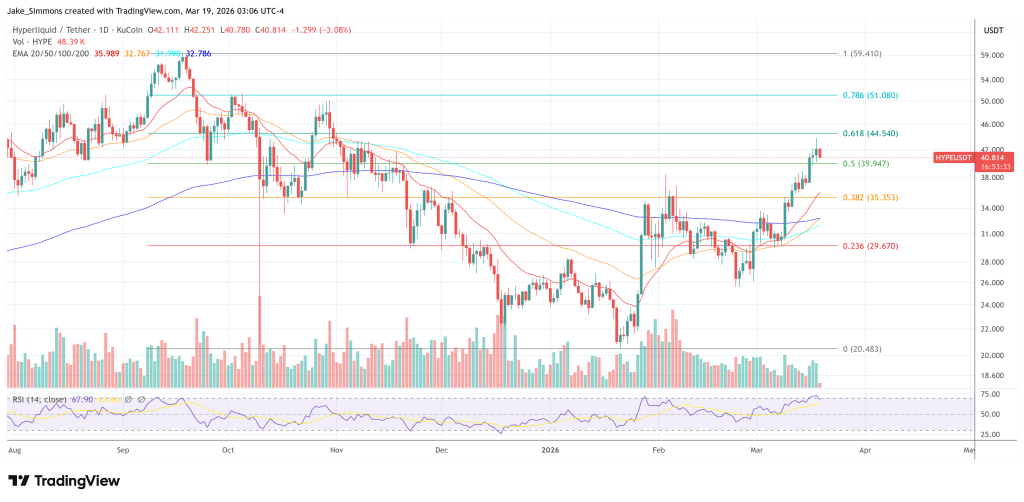
At press time, HYPE traded at $40.814.

HYPE remains above the 0.5 Fib, 1-day chart | Source: HYPEUSDT on TradingView.com

Related Questions

QWhat is the significance of Hyperliquid launching the first officially licensed S&P 500 perpetual contract?

AIt represents a major endorsement from traditional finance (S&P Dow Jones Indices) and signifies Hyperliquid's evolution beyond a typical crypto derivatives venue into a 24/7 platform for trading major traditional market benchmarks.

QHow has Hyperliquid platform's trading activity expanded beyond cryptocurrency markets?

AThe platform has seen heavy trading activity in non-crypto markets like oil and gold, especially outside Wall Street hours. Its real-world-asset (RWA) framework, HIP-3, now accounts for up to 30% of its daily volume.

QWhat did the S&P Dow Jones Indices representative say about the collaboration with Trade[XYZ]?

ACameron Drinkwater, Chief Product and Operations Officer at S&P DJI, stated the collaboration expands access to their benchmarks in digital trading environments and aims to provide digitally-native investors with institutional-quality standards.

QAccording to Trade[XYZ], how does the S&P 500 perpetual contract change market structure?

ATrade[XYZ] stated that it changes access to the benchmark, which was previously limited by market hours, intermediaries, and geography. It now offers 24/7, onchain, leveraged exposure with official index data for institutional confidence.

QWhat broader vision does the parent company of Trade[XYZ] have for this launch?

ACollins Belton, COO and General Counsel of the parent company, stated their vision is to bring the world's most important markets on-chain, and launching the S&P 500 perpetual on Hyperliquid is a major step towards that goal of 24/7 access.

Related Reads

Anthropic Cries Wolf: Is the AGI Threat Real, or Just an IPO Story?

Anthropic has published an article titled "When AI builds itself," discussing the emerging concept of "recursive self-improvement," where AI begins to actively participate in designing, training, testing, and optimizing its own subsequent versions. The company presents internal data showing that by May 2026, over 80% of code merged into its codebase was written by Claude, its AI model. Claude's capabilities have expanded to handling complex, open-ended engineering tasks, achieving a 76% success rate in such areas, and even contributing to research processes, such as optimizing code performance and conducting AI safety experiments. Anthropic outlines an evolution from human-driven development to AI-assisted workflows, culminating in the current stage where AI agents can autonomously write, run, and delegate code. The company cautions that the path toward a "closed loop," where AI continuously improves itself, is becoming visible. It calls for coordinated global mechanisms to potentially slow or pause frontier AI development to allow safety research and societal structures to catch up. However, the timing of this warning coincides with Anthropic's preparations for an IPO, framing the narrative not just as a safety concern but also as a demonstration of Claude's advanced capabilities and its integral role in accelerating Anthropic's own R&D—creating a potential "flywheel" effect for competitive advantage. This contrasts with OpenAI's recent, more policy-oriented discussion of the same risks, highlighting the competitive dynamics in the AI industry as companies position themselves in both the technological and regulatory landscape.

marsbit37m ago

Anthropic Cries Wolf: Is the AGI Threat Real, or Just an IPO Story?

marsbit37m ago

BIT Research: ETF Purchases Have Slowed, Strategy (MicroStrategy) Has Slowed, What Else Can Drive Bitcoin's Rise?

Market Refocus on Inflation and Rate Expectations Weighs on Bitcoin Currently, the market is in a phase of macro-repricing dominated by inflation and interest rate expectations. Bitcoin, which previously benefited from easy liquidity and low inflation, is seeing its core bullish drivers weaken. These drivers were market expectations for interest rate cuts and strong inflows from Bitcoin ETFs and institutions like MicroStrategy (referred to as "Strategy" in the text). The logic has shifted. Recent high inflation data (e.g., CPI hitting 3.8% in a May 2026 report) has caused the market to sharply reduce its rate cut expectations for 2025 and even price in potential hikes. This is a key constraint for Bitcoin, as it lacks cash flows and is highly sensitive to rate expectations. Concurrently, institutional capital flows have slowed significantly. Following the hot CPI data, Bitcoin ETFs saw accelerated outflows, with around $4.3 billion leaving over a period. MicroStrategy's ability to keep adding substantial Bitcoin to its balance sheet is also diminishing. Together, ETF and MicroStrategy holdings total roughly $110 billion, but their momentum as growth engines is cooling. In summary, Bitcoin's current pressure stems not from its own fundamentals but from a changing macro environment. As long as inflation stays elevated, Bitcoin is likely to remain in a consolidating phase. However, historically, inflation eventually peaks. Once it recedes and rate cut expectations rebuild, institutional capital could return, potentially fueling a new and more robust recovery phase for Bitcoin.

marsbit45m ago

BIT Research: ETF Purchases Have Slowed, Strategy (MicroStrategy) Has Slowed, What Else Can Drive Bitcoin's Rise?

marsbit45m ago

Earning 1000 Trillion in Half a Year, 'Pocketing' 20 Million per Capita: This Round of Wealth Creation in the Korean Stock Market is Unprecedented in Scale

The South Korean stock market is experiencing an unprecedented wealth surge in 2026, with household equity and fund asset values soaring by over 1,000 trillion KRW (~$730bn) year-to-date. This translates to an average per capita wealth increase of roughly 20 million KRW, fueled by a historic 109% rally in the KOSPI index. The boom is driven by three converging forces: an AI-driven semiconductor supercycle boosting giants like Samsung and SK Hynix; the government's "Value-Up" market reforms addressing long-standing corporate governance issues; and aggressive real estate regulations that have locked capital within financial markets, preventing profits from flowing back into property. This has triggered a wealth effect, boosting high-end consumption significantly. However, the gains are highly concentrated. The two semiconductor behemoths account for over half the index's value, but retail investors own relatively low stakes in them, systematically missing the biggest rallies. Wealth and consumption benefits are skewed towards luxury goods and imported cars, bypassing mainstream retail. Further risks stem from excessive leverage, with high trading volume in leveraged ETFs, and a market sentiment heavily reliant on the AI sector's fortunes and speculative rumors. While this cycle marks a potential shift from real estate to equities as a primary wealth generator for Koreans, its sustainability, amid structural imbalances and leverage, remains a critical test.

marsbit50m ago

Earning 1000 Trillion in Half a Year, 'Pocketing' 20 Million per Capita: This Round of Wealth Creation in the Korean Stock Market is Unprecedented in Scale

marsbit50m ago

Trading

Spot
Futures

Hot Articles

Discussions

Welcome to the HTX Community. Here, you can stay informed about the latest platform developments and gain access to professional market insights. Users' opinions on the price of S (S) are presented below.

活动图片