How Weakening US Labor Data Could Impact Bitcoin Market — Report

bitcoinistPublished on 2026-03-29Last updated on 2026-03-29

Abstract

A report analyzes how weakening US labor data could negatively impact Bitcoin and broader financial markets. Citing analysis from Alphractal CEO Wedson, the article highlights a steep decline in the US labor force participation rate (LFP), an underrated macroeconomic signal. Historically, a falling LFP—indicating fewer people working, less consumption, and weaker economic output—has preceded downturns in the S&P 500. Similarly, Bitcoin has shown vulnerability to such macro stress, as seen during the 2008 crisis and the 2020 COVID lockdowns. The key risk for Bitcoin is a potential macro shock that triggers a risk-off sentiment, causing investors to flee to safety. Unlike in 2020, there is currently no massive liquidity injection to cushion this blow and propel prices higher. This bearish outlook is further supported by a steadily declining Coinbase Premium, indicating waning demand from US investors. At the time of writing, Bitcoin's price is approximately $66,750, down over 5% for the week despite a minor 24-hour gain.

The global macro environment has been one of the major defining factors in Bitcoin and the broader crypto market so far this year. From the brewing geopolitical tensions in the Middle East to the rising inflation expectations in the United States, the global financial markets have barely caught a break in 2026. A prominent market expert has come forward with interesting US labor data, breaking down how the rising macroeconomic pressure could impact Bitcoin and the broader financial markets.

Macro Shock Could Trigger Risk-Off Behavior Among BTC Investors

In a March 28th post on the X platform, Alphractal founder and CEO shared that the participation of the United States labor force has been in a steep decline over the past few weeks. According to the crypto pundit, the Labor Force Participation is one of the most underrated macroeconomic signals in the current market landscape.

Wedson highlighted the major trends of the Labor Force Participation over the last two decades and its impact on the S&P 500 index. According to the highlighted data, participation reached its peak around 2000, before collapsing during 2008 financial crisis, briefly recovering, and then falling to historic lows during the COVID-19 pandemic.
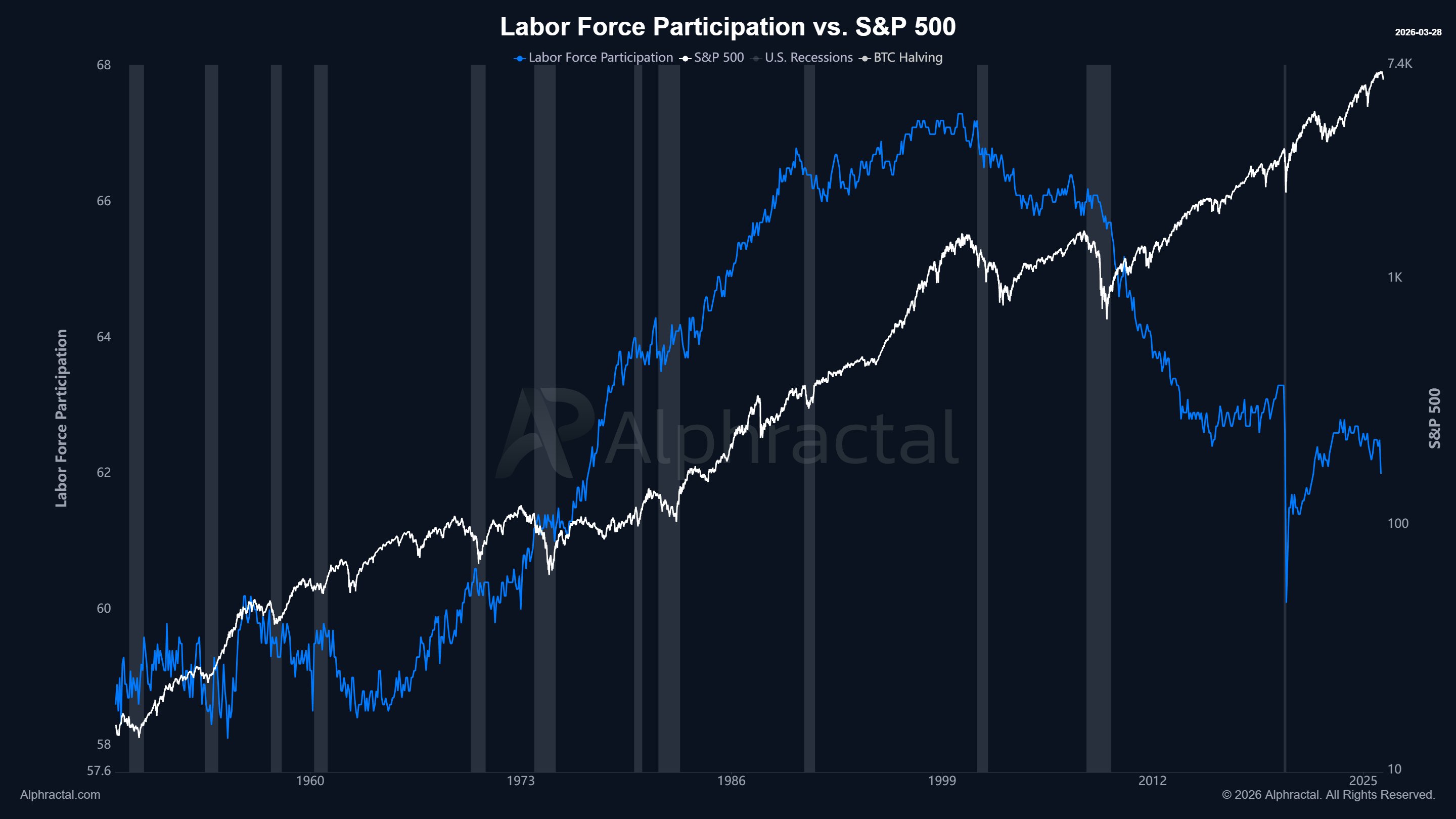
Source: @joao_wedson on X

As the labor force participation rate dwindled, the S&P 500 soon followed despite its initial show of resilience. The same can be seen for Bitcoin in the chart below, which seemed to succumb to the macro stress each time the LFP suffered a nosedive.
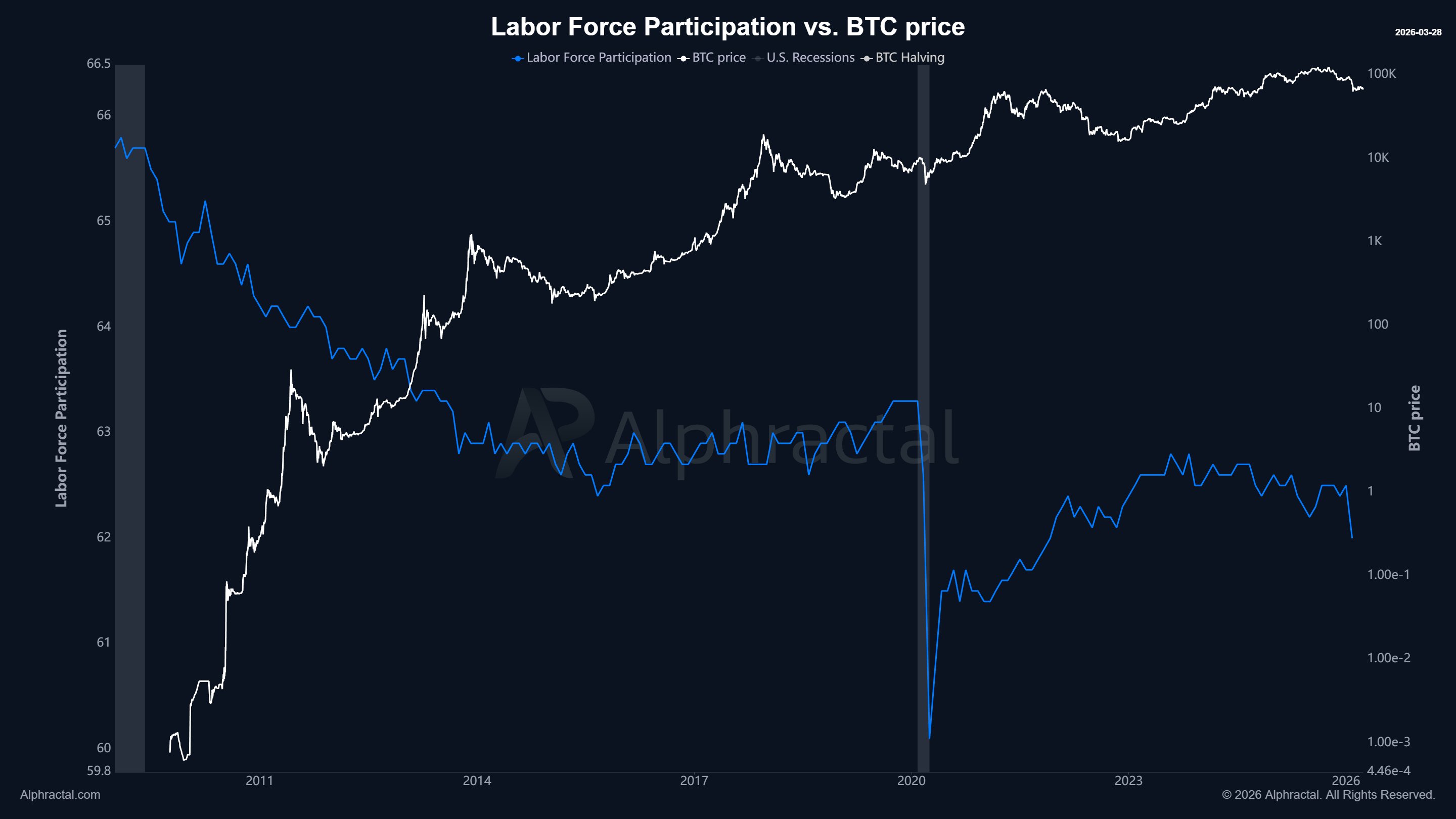
Source: @joao_wedson on X

Wedson noted that, before the “liquidity” flood sent the Bitcoin price to new highs, the market leader initially fell to cycle lows as the labor participation crashed during the COVID lockdown in 2020. What’s different now is that there’s no obvious liquidity fuel to take advantage in the current labor participation plunge.

Wedson wrote in his post:

A falling participation rate means fewer people working, less consumption, weaker real economic output. The stock market can diverge from that reality for a while but not forever.

According to the Alphractal founder, the specific risk for Bitcoin is a macro shock that triggers a risk-off behavior among investors, with most market participants fleeing to safety before the next accumulation phase begins. And, as rightly baked in the steadily-declining Coinbase Premium, the demand for BTC among US investors seems to be in a steady downturn.

Bitcoin Price Overview

As of this writing, the flagship cryptocurrency is valued at around $66,750, reflecting a roughly 1% jump in the past 24 hours. The single-day action has not been enough to wipe out losses from the past week, which still stand at more than 5%.

The price of BTC on the daily timeframe | Source: BTCUSDT chart on TradingView

Related Questions

QWhat is the main macroeconomic factor discussed in the article that could impact the Bitcoin market?

AThe weakening US labor data, specifically the decline in Labor Force Participation, is highlighted as a major macroeconomic factor that could impact the Bitcoin market.

QAccording to the expert, what does a falling labor force participation rate indicate for the economy?

AA falling labor force participation rate means fewer people working, less consumption, and weaker real economic output.

QWhat specific risk does the Alphractal founder identify for Bitcoin in the current market environment?

AThe specific risk for Bitcoin is a macro shock that triggers a risk-off behavior among investors, causing them to flee to safety.

QHow did the article describe the current demand for Bitcoin among US investors?

AThe demand for BTC among US investors is in a steady downturn, as indicated by the steadily declining Coinbase Premium.

QWhat was the price of Bitcoin at the time of writing, and what was its weekly performance?

AAt the time of writing, Bitcoin was valued at around $66,750, reflecting a weekly loss of more than 5% despite a 1% gain in the last 24 hours.

Related Reads

Trading

Spot
Futures

Hot Articles

How to Buy ONE

Welcome to HTX.com! We've made purchasing Harmony (ONE) simple and convenient. Follow our step-by-step guide to embark on your crypto journey.Step 1: Create Your HTX AccountUse your email or phone number to sign up for a free account on HTX. Experience a hassle-free registration journey and unlock all features.Get My AccountStep 2: Go to Buy Crypto and Choose Your Payment MethodCredit/Debit Card: Use your Visa or Mastercard to buy Harmony (ONE) instantly.Balance: Use funds from your HTX account balance to trade seamlessly.Third Parties: We've added popular payment methods such as Google Pay and Apple Pay to enhance convenience.P2P: Trade directly with other users on HTX.Over-the-Counter (OTC): We offer tailor-made services and competitive exchange rates for traders.Step 3: Store Your Harmony (ONE)After purchasing your Harmony (ONE), store it in your HTX account. Alternatively, you can send it elsewhere via blockchain transfer or use it to trade other cryptocurrencies.Step 4: Trade Harmony (ONE)Easily trade Harmony (ONE) on HTX's spot market. Simply access your account, select your trading pair, execute your trades, and monitor in real-time. We offer a user-friendly experience for both beginners and seasoned traders.

3.2k Total ViewsPublished 2024.03.29Updated 2025.06.04

How to Buy ONE

Discussions

Welcome to the HTX Community. Here, you can stay informed about the latest platform developments and gain access to professional market insights. Users' opinions on the price of ONE (ONE) are presented below.

活动图片