How Ethereum’s ‘Lean’ roadmap could reshape ETH over the next 4 years

ambcryptoPublished on 2026-07-05Last updated on 2026-07-05

Abstract

Ethereum has entered a new development phase with the introduction of the 'Lean Ethereum' roadmap, a multi-year overhaul aiming to reshape the network's core protocol over the next 3-4 years. The plan focuses on major technical upgrades to improve scalability, security, and long-term resilience. Key components include implementing recursive STARKs, quantum-safe cryptography to guard against future threats, a multidimensional gas model, and a redesigned state architecture using Verkle trees. These changes aim to significantly increase transaction throughput, lower costs, and improve finality speed while maintaining backward compatibility. Infrastructure development is already underway, with initiatives like post-quantum secure devnets and the Glamsterdam upgrade laying the groundwork. Efforts are also focused on scalable state management and increasing the network's gas limits. The overarching goal is to future-proof Ethereum, enabling it to scale efficiently and securely throughout the next decade with minimal disruption to existing applications.

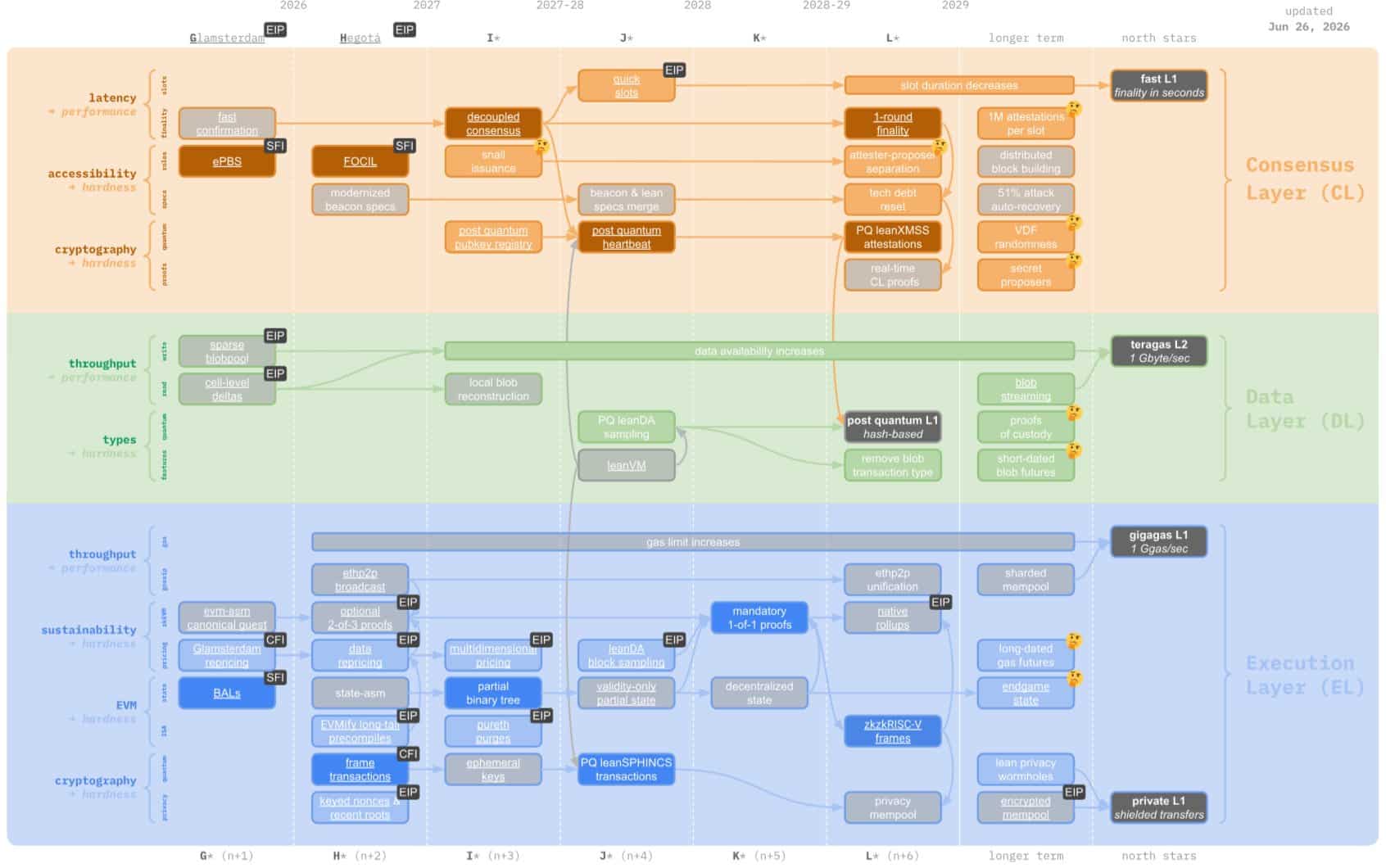
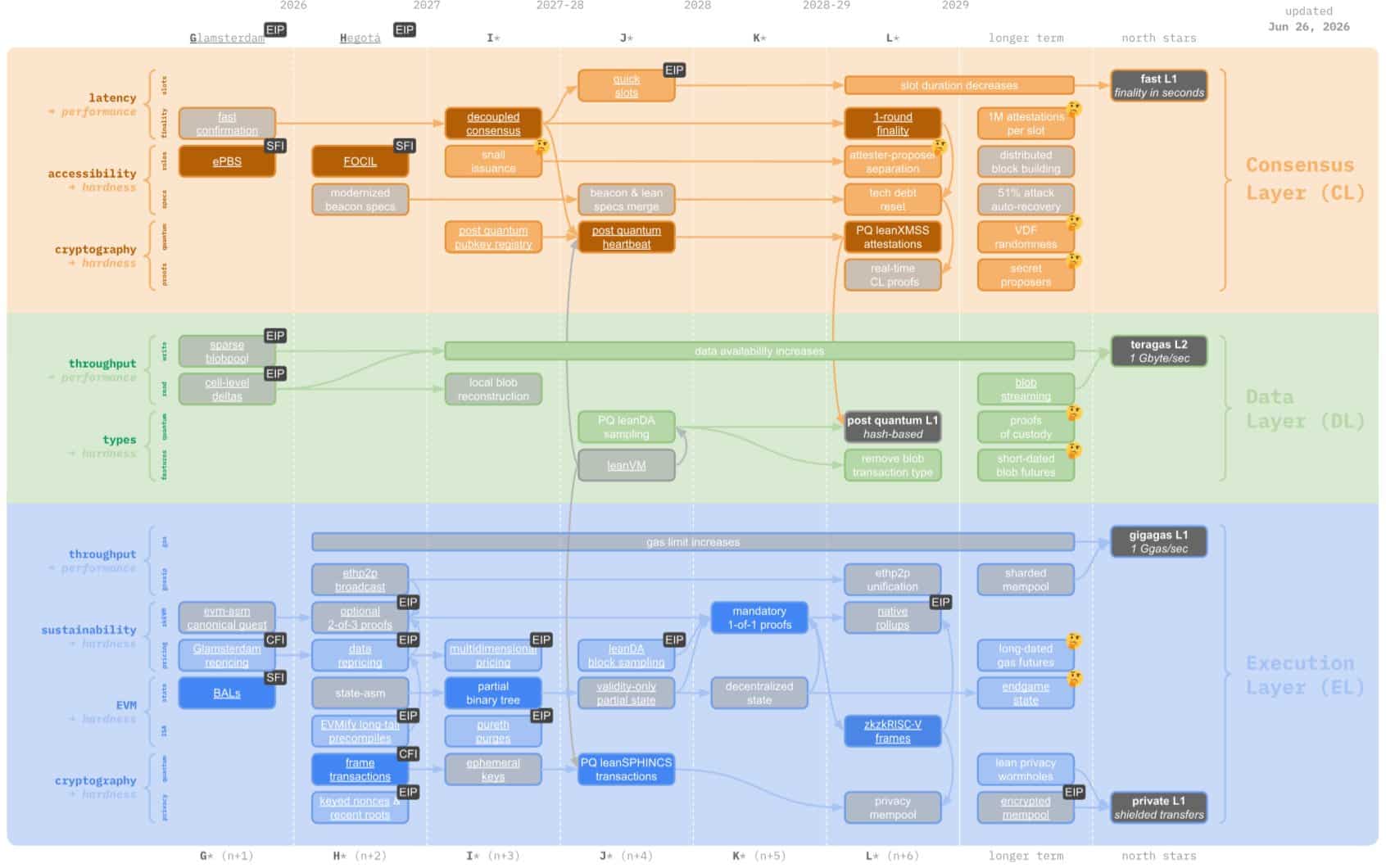
Ethereum’s development has entered a new phase as researchers introduced ‘Lean Ethereum,’ a multi-year overhaul targeting the network’s long-term evolution. Rather than a single upgrade, the plan aims to replace the cores of the Ethereum [ETH] protocol over the course of approximately 3-4 years.

The plan introduces recursive STARKs, quantum-safe cryptography, multidimensional gas, and redesigned state architecture to improve scalability and security. Furthermore, developers expect H-star to become Ethereum’s final pre-Lean fork before broader changes accelerate.
Source: X

The roadmap also anticipates increasing the gas limits on the network. This includes using more scalable state architectures to improve finality speed and lower transaction costs.

Successful implementation of the Lean roadmap may allow it to scale the efficiency of the Ethereum network. Moreover, it will be maintaining backward compatibility, thereby allowing for continued growth throughout the next decade.

The infrastructure behind Lean Ethereum

Building on the Lean Ethereum roadmap, developers are now translating long-term goals into practical protocol upgrades. Currently, development is focused on post-quantum secure protocols as well as scalable state management.

These are two of the most significant long-term technical threats facing Ethereum. Rather than waiting for quantum computing to mature, developers have already launched PQ Devnets 0-4. These will test networks and evaluate quantum-resistant cryptography while preserving compatibility with existing wallets.

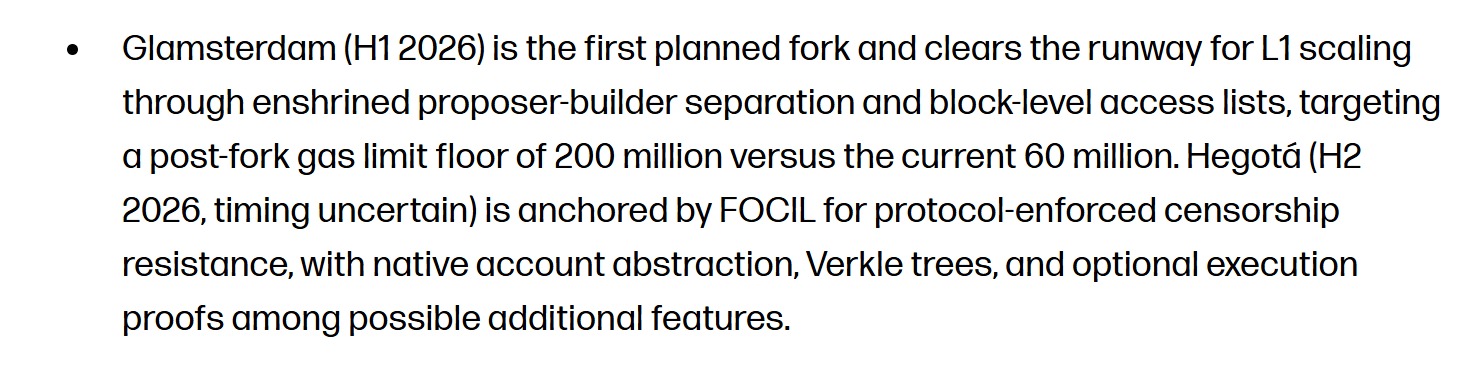
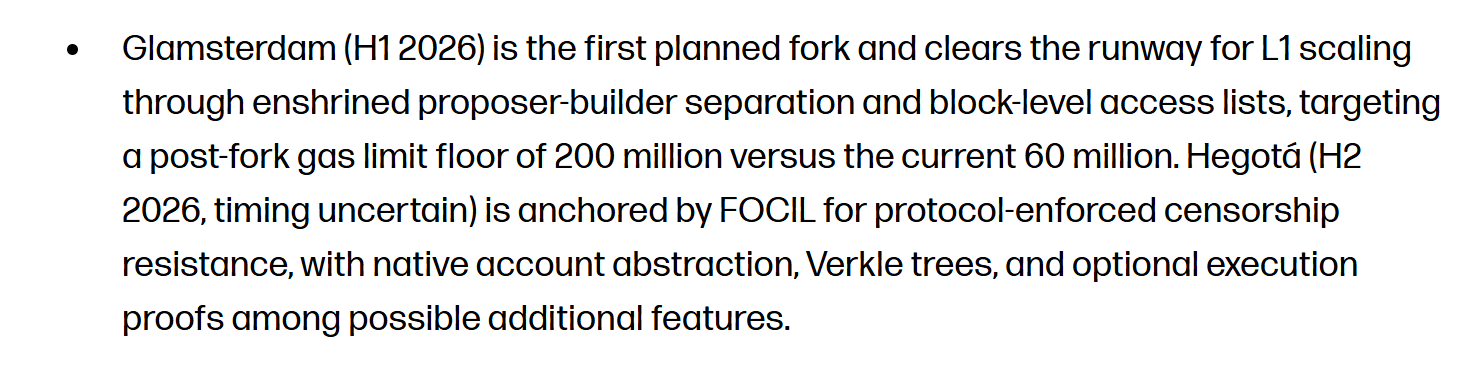
More importantly, Glamsterdam has laid down the technological groundwork for this future-proofing of Ethereum through ePBS, protocol simplification, and increasing gas limits above 200 million.
Source: Galaxy Research

In addition to building the infrastructure needed to provide fast and secure transactions, developers are reworking how state is managed using Verkle trees, state expiration models, and scalable storage models. This involves reducing the cost of validation and shortening the time it takes for nodes to sync, while keeping decentralized functionality intact.

These are logical next steps since the underlying technology needs to mature before Ethereum can safely exapnd its scalability and decrease its costs over the next decade.

Together, both initiatives strengthen Ethereum’s long-term resilience while limiting disruption for existing applications.


Final Summary

  • Ethereum is rebuilding its core protocol to deliver faster scaling, stronger security, and long-term network resilience.
  • ETH aims to future-proof the network through quantum-safe upgrades and more efficient state management.

Trending Cryptos

Related Questions

QWhat is the main goal of Ethereum's 'Lean' roadmap over the next 3-4 years?

AThe main goal is to rebuild the core Ethereum protocol to improve scalability, security, and long-term network resilience by introducing new technologies like recursive STARKs and quantum-safe cryptography, while maintaining backward compatibility.

QWhat are some key technical components mentioned in the Lean Ethereum plan?

AKey components include recursive STARKs, quantum-safe cryptography, multidimensional gas, a redesigned state architecture, Verkle trees, state expiration models, and scalable storage models.

QHow does the Lean roadmap aim to address the threat of quantum computing?

ADevelopers are proactively addressing this by launching PQ Devnets (0-4) to test and evaluate quantum-resistant cryptography, aiming to future-proof the network before quantum computing matures.

QWhat specific improvements are expected from the planned upgrades to Ethereum's state management?

AThe upgrades, involving Verkle trees and new state models, aim to reduce validation costs, shorten node synchronization time, improve finality speed, lower transaction costs, and maintain decentralized functionality.

QWhat role does the H-star fork play in the Lean Ethereum transition?

AH-star is expected to be Ethereum's final pre-Lean fork, after which the broader, more accelerated changes outlined in the Lean roadmap will begin implementation.

Related Reads

Li Fei-Fei's Latest Long-Form Article: When Video Generation, Robotics, and NVIDIA All Call Themselves World Models, We Need a Taxonomy

In a new article, Dr. Fei-Fei Li addresses the widespread and often inconsistent use of the term "world model" in AI. She proposes a clear, functional taxonomy rooted in the classic Partially Observable Markov Decision Process (POMDP) loop (agent → action → state → observation → agent). According to this framework, current systems called "world models" are different projections of this loop, categorized by their primary output: 1. **Renderers**: Output observations (pixels). Their goal is visual fidelity for human consumption (e.g., video generation models like Sora). They are the most commercially mature but are limited by a focus on appearance over physical accuracy. 2. **Simulators**: Output states (geometric, physical, dynamic representations). They provide a structurally accurate world for both human professionals (e.g., architects) and computational agents (e.g., robots for training). Li argues simulators are the crucial, underappreciated bridge, as they can underpin both rendering and planning. 3. **Planners**: Output actions. Given an observation and a goal, they decide what an agent should do next (e.g., robotic action models). This area is highly promising but remains the least mature for real-world deployment. Li highlights a key trend: the boundaries between these three categories are beginning to blur, as they all rely on a shared underlying understanding of geometry, physics, and dynamics. The logical endpoint is a unified world foundation model capable of switching between rendering, simulation, and planning based on downstream needs. This convergence, she concludes, is central to advancing spatial intelligence—enabling machines not just to talk about the world, but to truly understand, imagine, and interact with it.

marsbit6h ago

Li Fei-Fei's Latest Long-Form Article: When Video Generation, Robotics, and NVIDIA All Call Themselves World Models, We Need a Taxonomy

marsbit6h ago

Forbes Feature: Stablecoin Cross-Border Payments Are Faster, But Not Yet Cheaper

A Forbes feature delves into the state of stablecoin-based cross-border payments, noting rapid growth but a key shortfall: while faster and more accessible, they are not yet cheaper. At a recent industry conference in Mexico City, optimism about technology, regulation, and volume was tempered by discussions with practitioners. The core issue is liquidity. Traditional FX brokers charge 60-70 basis points, and stablecoins promise to slash this to 2-5 basis points. However, this theoretical cost advantage cannot be realized until deep liquidity pools are established at scale, requiring significant institutional capital inflow. A major adoption barrier is trust. Businesses often rely on long-standing relationships with traditional brokers, valuing reliability over marginal cost savings. This shift will be gradual. Furthermore, successful companies in the space are not positioning themselves as replacements for legacy systems like SWIFT, but as complements. They leverage stablecoins for speed while using traditional rails for their standardization and reliability in ensuring accurate payment details—a critical factor for supplier payments to avoid customs issues. Companies like Caliza, experiencing high monthly growth, exemplify this hybrid approach. The industry anticipates consolidation, as long-term viability will depend on securing the essential trifecta: proper licensing, robust fiat on/off-ramps, and deep liquidity. Without these, firms risk being mere intermediaries rather than building sustainable businesses.

marsbit6h ago

Forbes Feature: Stablecoin Cross-Border Payments Are Faster, But Not Yet Cheaper

marsbit6h ago

Trading

Spot

Hot Articles

Discussions

Welcome to the HTX Community. Here, you can stay informed about the latest platform developments and gain access to professional market insights. Users' opinions on the price of S (S) are presented below.

活动图片