How AI-Forged Group Photos Became a New Gray Market Tool Targeting Changpeng Zhao?

比推Published on 2026-02-05Last updated on 2026-02-05

Abstract

The founder of Binance, Changpeng Zhao (CZ), recently exposed a fake photo circulating on X platform that depicted him alongside a user claiming to be a "long-term supporter of BNB." CZ identified multiple inconsistencies in the image, including an unfamiliar blue-purple shirt, a non-existent event backdrop, and mismatched resolution between the figures, indicating digital manipulation. The original image was in fact a photoshopped version of a legitimate photo of CZ with Aster CEO Leonard. Notably, the account sharing the fake photo, which has over 863,000 followers, had already blocked CZ. On February 4, CZ publicly dissected the image’s flaws and pointed out that the account had an inconsistent history—initially posting non-crypto content before abruptly shifting to focus on BNB-related activities. He suggested this was not a simple prank but potentially a targeted influence operation. CZ confirmed he did not know the account holder and had previously blocked the user, a decision he now considers justified. He also addressed a fabricated "legal letter" that had been circulated and expressed concern that some media outlets had reported on obviously manipulated or AI-generated content without verification. He warned that failure to identify such forgeries could lead to significant consequences.

Author: Nicky, Foresight News

Original Title: Changpeng Zhao Targeted by Gray Market Operations


Binance founder Changpeng Zhao (CZ) recently encountered "trouble" again.

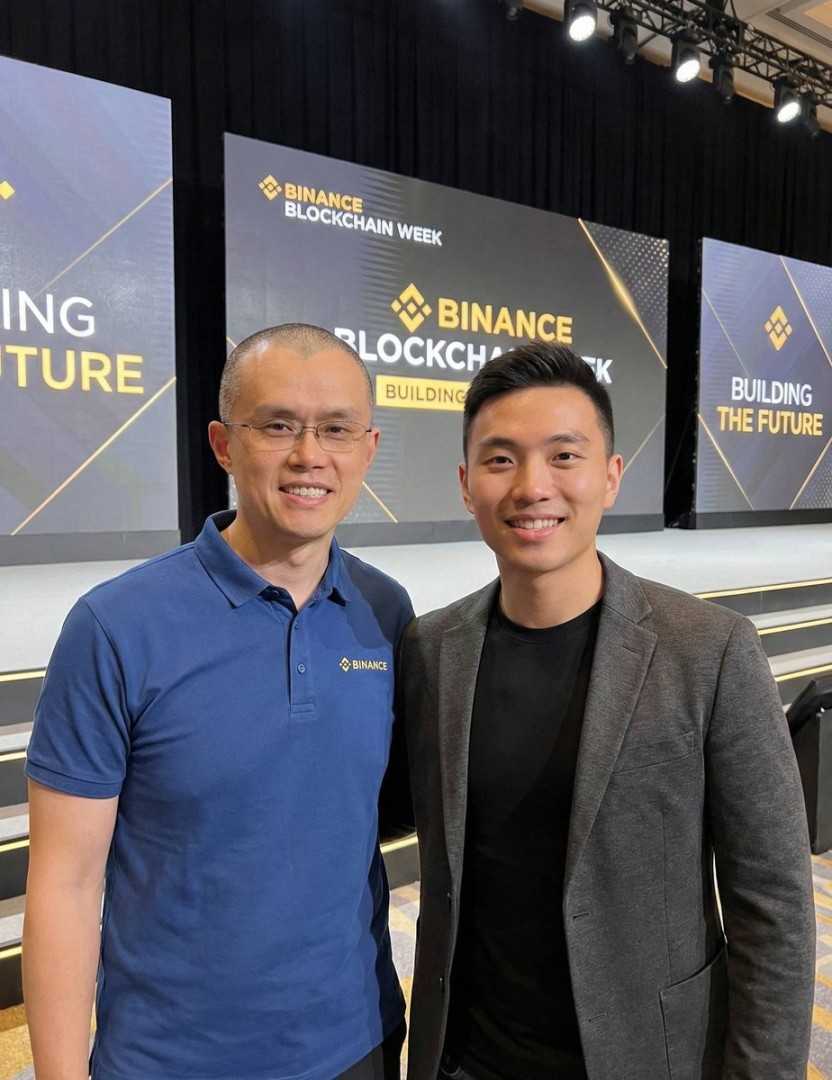
In a photo on the X platform, CZ stands in front of an event backdrop alongside a user who claims to be a "long-term supporter of BNB." However, CZ quickly noticed something unusual—he never owned that blue-purple shirt, the backdrop does not exist, and the resolution of the characters is inconsistent, clearly indicating splicing and editing. Additionally, another photoshopped image was originally a group photo of CZ and Aster CEO Leonard.

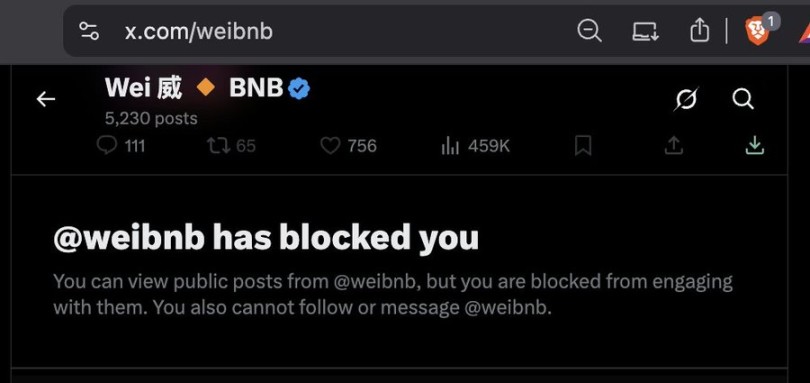
What’s even more intriguing is that this account, with 863,000 followers, had already blocked CZ.

On February 4, CZ publicly dissected the details of the image and pointed out that the account's historical trajectory shows obvious discontinuities: early content had almost nothing to do with cryptocurrency, but later shifted to focus on BNB activities, with an unnatural transition in identity. In his view, such long-standing accounts built on forged materials are not just pranks but more like premeditated image manipulation.

CZ stated that he does not know the account holder and does not remember when he blocked them, but it now seems like the right move. Regarding the previously circulated so-called "lawyer's letter," he initially thought the forgery was too obvious to require clarification, but he noticed some media outlets still reposted and reported on the images. He warned that if even obvious PS or AI-generated content cannot be discerned, one may ultimately pay the price for it.

Meanwhile, some bloggers in the Chinese community have also discovered that a large number of accounts in the English-speaking region, with names or nicknames containing Chinese characters and "

Original link:https://www.bitpush.news/articles/7609077

Related Questions

QWhat was the main issue that Binance founder Changpeng Zhao (CZ) recently encountered on social media?

ACZ encountered a fake AI-generated photo of himself posing with a user claiming to be a long-term BNB supporter, which he identified as fraudulent due to inconsistencies like an unfamiliar shirt and non-existent background.

QHow did CZ identify the image as fake?

ACZ noted that he never owned the blue-purple shirt in the image, the background board did not exist, there were resolution inconsistencies between the subjects, and the image was clearly spliced from an original photo with Aster CEO Leonard.

QWhat suspicious behavior did CZ observe about the account that posted the fake image?

AThe account, which had 863,000 followers, had previously blocked CZ, and its content history showed a sudden shift from non-crypto-related posts to focusing on BNB activities without a logical transition.

QWhat did CZ warn about regarding such fake content?

ACZ warned that if people cannot distinguish obvious PS or AI-generated content, they may end up paying a price for it, emphasizing the risks of falling for manipulated imagery.

QWhat was the original title of the article discussing this incident?

AThe original title of the article was '被灰产盯上的赵长鹏', which translates to 'Changpeng Zhao Targeted by Gray Industry'.

Related Reads

From Return to Resignation: Chen Hang's 437 Days at DingTalk

The 437-Day Return and Departure of Chen Hang at DingTalk This article chronicles the 437-day period from March 31, 2025, to June 11, 2026, when Chen Hang (also known as "No Move") returned as CEO of DingTalk, the enterprise communication platform he originally founded, only to later step down. Chen Hang, the creator of DingTalk in 2015, was brought back by Alibaba in 2025 after the company acquired his subsequent startup, HHO. His return was driven by Alibaba's renewed focus on AI and DingTalk's strategic role as its key to-B AI application. However, his aggressive management style, marked by strict work policies like mandatory clock-ins and extended hours, quickly caused internal friction and was criticized as being at odds with Alibaba's culture. Despite the internal turmoil, Chen Hang drove significant product launches. In August 2025, he unveiled "AI DingTalk 1.0," featuring new products like the AI-native entry point "DingTalk ONE." By March 2026, he announced "Wukong," touted as the world's first enterprise-grade AI-native work platform, representing a fundamental rebuild of DingTalk's architecture. The turning point came in early June 2026. A detailed internal post criticizing DingTalk's work culture went viral, followed by a public critique from a former executive. This prompted an unprecedented public rebuke from the Alibaba Partners Committee, which stated such management was not aligned with company values. One day later, on June 11, Alibaba announced Chen Hang's departure. He was succeeded by Chen Yusen, a 32-year-old technical expert known for founding cybersecurity firm Changting Technology. While Chen Hang's tenure laid the technical foundation for DingTalk's AI transformation with "Wukong," his leadership style ultimately led to his replacement as the company seeks a new direction under younger leadership.

marsbit10m ago

From Return to Resignation: Chen Hang's 437 Days at DingTalk

marsbit10m ago

The 2026 Landscape of Decentralized AI: Why Blockchain is the Inevitable 'Antidote' for AI?

Decentralized AI 2026 Landscape: Why Blockchain is AI's Essential "Antidote" Centralized AI faces structural bottlenecks—expensive compute, concentrated control, unverifiable outputs, and difficult data access—that cannot be solved by capital or code alone. Blockchain offers a path to make intelligence open, verifiable, and economically accessible. The decentralized AI stack comprises: * **Infrastructure:** The foundation with compute, verifiable inference, distributed training, data/storage, and privacy/verification layers. Projects like Akash, Render, and Filecoin provide cheaper, decentralized alternatives for raw resources. * **Middleware:** The coordination layer for agent discovery, identity, and commerce. Key players include Bittensor (a network of specialized AI subnets), Virtuals (an agent economy OS), and frameworks providing agent identity and tooling. * **Applications & Services:** Dominated by Agentic Finance (AI agents executing on-chain actions based on natural language) and Agentic Payments (machine-to-machine transactions using blockchain as a settlement layer). Projects like Giza, Infinit Labs, and x402 are enabling these use cases. Key trends for 2026-2027 show AI demand outgrowing infrastructure, compute becoming an asset class, and tokenomics emerging as a structural advantage for coordinating capital, compute, and data. While still early—with adoption uneven and revenue often trailing token incentives—projects like Bittensor, NEAR, and Venice demonstrate decentralized AI is evolving from a narrative into a new model for coordinating intelligence.

Foresight News30m ago

The 2026 Landscape of Decentralized AI: Why Blockchain is the Inevitable 'Antidote' for AI?

Foresight News30m ago

Trading

Spot
Futures
活动图片