Hong Kong Inland Revenue Department's Latest FAQ: How to Determine Tax Residency for the "Dual-City Lifestyle"?

marsbitPublished on 2026-02-11Last updated on 2026-02-11

Abstract

Hong Kong's Inland Revenue Department (IRD) has updated its Frequently Asked Questions (FAQs) to clarify how the "tie-breaker rules" under the Mainland China-Hong Kong Comprehensive Double Taxation Arrangement (CDTA) determine the tax residency of individuals with dual residency claims. With increasing cross-border work and living between Hong Kong and Mainland China, many individuals may meet the residency criteria of both jurisdictions simultaneously. The CDTA’s tie-breaker rules are essential to resolve such conflicts and prevent double taxation. The FAQ emphasizes that residency is not determined by a single factor, such as holding a Mainland household registration (hukou) or the number of days spent in Hong Kong (over 180 days). Instead, a comprehensive analysis is applied based on the following hierarchical criteria: 1. Location of the individual's permanent home; 2. The jurisdiction with which their personal and economic relations are closer (centre of vital interests); 3. Their habitual abode; 4. Mutual agreement by the tax authorities of both sides if unresolved. Key factors considered include the residence of family members (spouse, children), location of employment and salary payment, social security contributions, and business investments. The update provides practical examples (e.g., individuals under talent schemes, "dual-city" lifestyles) to illustrate how these rules are applied in real-world scenarios, offering clearer guidance for frequent cross-bord...

Recently, the Inland Revenue Department ("Hong Kong") of the Hong Kong Special Administrative Region updated its Frequently Asked Questions (FAQs), providing clarification for individuals who may be considered residents in both Mainland China and Hong Kong on how to determine their tax residency status according to the Tie-breaker Rules under the "Comprehensive Arrangement between the Mainland of China and the Hong Kong Special Administrative Region for the Avoidance of Double Taxation and the Prevention of Fiscal Evasion with respect to Taxes on Income" ("Comprehensive Arrangement").

With increasingly close economic ties between the two regions, cross-border work and dual-location living have become commonplace, with many people leading a lifestyle of "working in Hong Kong, living in the Mainland." When an individual meets the respective residency criteria of both jurisdictions simultaneously, the application of the tax regime and the Tie-breaker Rules play a crucial role. Click here to read the original text.

Overview of the Tax Arrangement between Mainland China and Hong Kong

Mainland China:

A Mainland tax resident individual refers to an individual who has a domicile in China, or an individual who has no domicile in China but has resided in China for an aggregate of 183 days or more in a tax year. Here, "domicile" is defined as the habitual abode within China due to household registration, family, or economic interests. In practice, the Mainland uses habitual abode as the core criterion, and retaining a Mainland household registration is likely to be presumed as having the intention for habitual abode, thus leading to classification as a Mainland tax resident.

Hong Kong:

A Hong Kong tax resident individual refers to an individual who ordinarily resides in Hong Kong, or an individual who stays in Hong Kong for more than 180 days during the relevant year of assessment or for more than 300 days in two consecutive years of assessment. Compared to the Mainland, Hong Kong's determination of tax resident individuals focuses more on the factual state of residence and the closeness of economic ties, rather than legal permanent resident status or household registration details.

Given the objective existence of differences in residency determination, calculation of the year of assessment, and other tax system variations, cross-border workers may simultaneously meet the residency standards of both places, facing the tax conflict issues arising from dual resident status. On August 21, 2006, Mainland China and Hong Kong officially signed the "Comprehensive Arrangement" to avoid double taxation and prevent fiscal evasion. Subsequently, both parties have signed several protocols to update the content, adapting to the development of international tax rules and promoting economic and investment exchanges between the two regions.

Logic of Tax Residency Determination: The Tie-breaker Rule

To resolve conflicts of tax jurisdiction, the "Comprehensive Arrangement" incorporates the Tie-breaker Rule. This rule is widely used in the field of international taxation and is an important mechanism for resolving conflicts arising from an individual's dual tax resident status due to differences in the laws of various tax jurisdictions.

According to the Tie-breaker Rule under the "Comprehensive Arrangement," the tax residency of an individual who meets the tax resident criteria of both Mainland China and Hong Kong is determined in the following order:

1. In which party does the individual have a permanent home available;

2. With which party are the individual's personal and economic relations closer (centre of vital interests);

3. In which party does the individual have a habitual abode;

4. The competent authorities of both parties shall settle the question by mutual agreement to determine of which party the individual shall be deemed to be a resident.

It is particularly important to note that these criteria are listed in order of priority. A subsequent criterion is used only if the preceding one fails to resolve the issue.

FAQ Update: How the Tie-breaker Rule Applies to Real-World Scenarios

The significant importance of this FAQ update lies in its use of more realistic examples (Q17-Q21) to demonstrate how an individual's tax residency should be determined under the Tie-breaker Rule in common scenarios such as "Talent Schemes" and the "Dual-City Lifestyle."
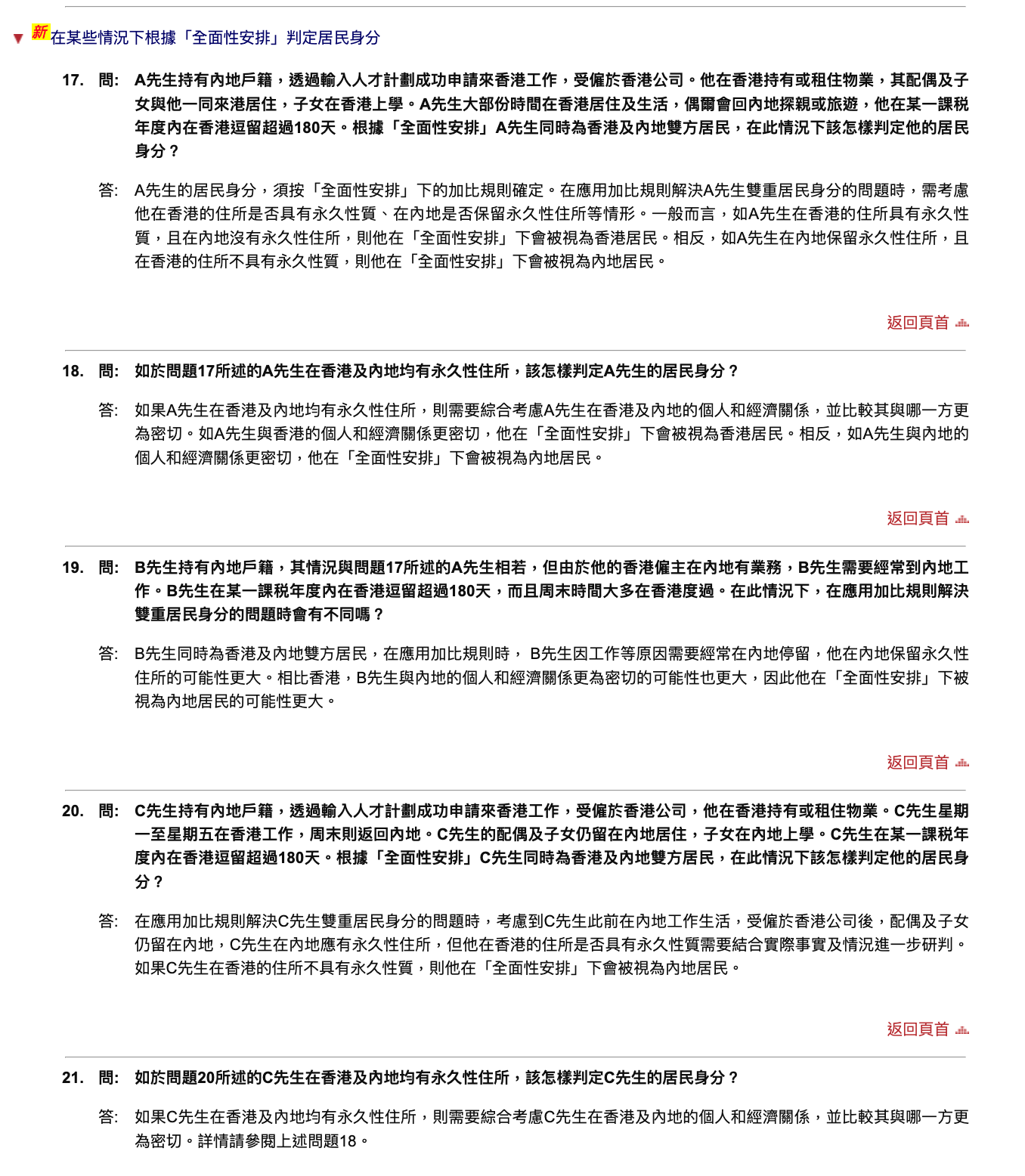
For various scenarios, the Hong Kong Inland Revenue Department does not provide absolute answers regarding tax residency determination but lists factors that may be considered when determining residency status. These include, specifically: the individual's Mainland household registration; the long-term place of living, work, and study of core family members such as a spouse and children; the location of held corporate shares; and the place of salary payment and social security contributions. These factors constitute strong evidence of "close economic ties."

Therefore, single elements such as an individual possessing a Mainland household registration or whether they stayed in Hong Kong for more than 180 days in a tax year are not decisive factors in determining residency status under the Tie-breaker Rule. Under the "Comprehensive Arrangement," such an individual may still be considered a Hong Kong resident. This does not mean that core standards like "number of days of stay" are unimportant; rather, the determination is made by considering multiple factors comprehensively through the Tie-breaker Rule.

Summary

Overall, this update to the Hong Kong Inland Revenue Department's FAQs does not represent a major systemic adjustment but serves as a practical guide—further clarifying the rules for determining tax residency for high-frequency cross-border individuals. As tax regulatory capabilities improve and the transparency of tax-related information increases, the determination of an individual's center of vital economic interests by the tax authorities of both regions will become more precise, and cross-border tax management is developing in a more refined direction.


Trending Cryptos

Related Questions

QWhat is the purpose of the Tie-breaker Rule in the Comprehensive Arrangement between Mainland China and Hong Kong?

AThe Tie-breaker Rule is used to resolve conflicts of dual tax residency for individuals who are considered residents of both jurisdictions under their respective domestic laws. It provides a sequential set of criteria to determine which jurisdiction has the primary right to tax the individual.

QAccording to the updated FAQs, what are the first two criteria in the Tie-breaker Rule for determining tax residency?

AThe first criterion is to determine in which jurisdiction the individual has a permanent home available to them. If this is inconclusive, the second criterion is to determine with which jurisdiction the individual has closer personal and economic relations.

QHow does the Hong Kong Inland Revenue Department define a Hong Kong tax resident individual?

AA Hong Kong tax resident individual is defined as a person who ordinarily resides in Hong Kong, or who stays in Hong Kong for more than 180 days during the relevant year of assessment, or for more than 300 days in two consecutive years of assessment.

QWhat factors might be considered when assessing an individual's 'closer personal and economic relations' under the Tie-breaker Rule?

AFactors may include the location of the individual's immediate family (spouse, children), the place of long-term residence, work, and study, the location of business equity holdings, and the place where salary is paid and social security contributions are made.

QDoes maintaining a mainland Chinese household registration (Hukou) automatically make an individual a tax resident under the Comprehensive Arrangement?

ANo, maintaining a mainland Hukou is not an absolute decisive factor. Under the Tie-breaker Rule, an individual with a mainland Hukou could still be determined to be a Hong Kong tax resident after a comprehensive assessment of all relevant factors, such as the center of vital interests.

Related Reads

Must-Watch Events Next Week|CLARITY Act Could Face Senate Vote; SpaceX, Circle to Report Earnings (8.3-8.9)

**Summary: Key Events and Developments to Watch (August 3-9)** The upcoming week is marked by significant financial disclosures, key legislative deadlines, and notable product updates. **Major Financial Events:** Several companies are scheduled to release their Q2 2026 earnings. American Bitcoin (ABTC) will report on August 3, followed by SpaceX and Hut 8 Mining Corp. on August 4, and Circle on August 5. Notably, a significant portion of SpaceX shares (up to 12% of total shares) will be unlocked on August 6 following their earnings release. **Key Legislative Deadline:** The U.S. Senate faces an August 7 deadline to secure 60 votes for the CLARITY Act, a bipartisan bill aiming to establish a federal regulatory framework for cryptocurrencies. The Senate may hold a full vote on the bill during the week. **Economic Data:** The U.S. July Non-Farm Payrolls report will be released on August 7, providing crucial labor market data. **Technology & Product Updates:** * **Shutdowns:** DeFi portfolio tracker Zapper and wallet app Ctrl Wallet will cease operations on August 3. * **Upgrades:** LayerZero will deprecate its v1 relayers on August 3. XRP Ledger's new version 3.3.0, featuring five new functions, is expected next week. * **AI:** Elon Musk announced that the advanced Grok 4.6 AI model is set for release around August 7. * **Bitcoin:** The BIP-110 forced signaling for a potential Bitcoin network change is scheduled to begin around August 8. **Other Notable Events:** Chinese robotics firm Unitree Tech has set its preliminary price inquiry for its IPO for August 5. South Korean exchange Upbit will delist AQT and AERGO tokens on August 3.

marsbit1h ago

Must-Watch Events Next Week|CLARITY Act Could Face Senate Vote; SpaceX, Circle to Report Earnings (8.3-8.9)

marsbit1h ago

Stocks Are Plummeting More Sharply Than Cryptocurrencies. Where Has the Money Gone?

Stock Markets Plunge Deeper Than Cryptocurrencies: Where Did the Money Go? In late July, Seoul's Kospi index triggered circuit breakers for two consecutive days, plummeting over 40% from its June high. The collapse was led by heavyweight stocks like SK Hynix, whose record profits still disappointed investors, and devastating leveraged ETFs, with one major product losing over 83% of its value. This signaled a global, forced deleveraging targeting the most crowded trades. Interestingly, while stocks exhibited extreme volatility akin to crypto markets, Bitcoin rose nearly 15% in July after a prior steep drop. Analysis shows the money fleeing equities did not flow into Bitcoin. Instead, Bitcoin had already absorbed its sell-off in May-June, when U.S. spot Bitcoin ETFs saw historic outflows. The true safe-haven beneficiary was gold, whose price rose over 20% year-on-year, highlighting a decoupling between Bitcoin and gold as "digital gold." The sell-off was a targeted unwinding of leveraged positions in tech and semiconductors, accelerated by broker-dealer risk management and shifts in the AI narrative, including new competition from Chinese memory chipmakers. The retreat path was clear: from high-valuation tech stocks to cash and U.S. Treasuries, then to gold. For Bitcoin to attract sustained institutional inflows, conditions like eased global liquidity pressure, a "soft-landing" Fed rate cut, and U.S. regulatory clarity via legislation like the stalled CLARITY Act are needed. Currently, Bitcoin is not a safe haven but an already-cleared asset. Its low correlation with tech stocks, however, makes it a potential diversification play for institutional portfolios once the storm passes. The money isn't here yet, but the positioning is underway.

marsbit1h ago

Stocks Are Plummeting More Sharply Than Cryptocurrencies. Where Has the Money Gone?

marsbit1h ago

In Conversation with Ray Dalio: We Are Currently in an AI Bubble, with 1% of My Portfolio in Bitcoin

Ray Dalio, founder of Bridgewater Associates, warns in an interview that the current AI boom shows classic bubble characteristics, which could lead to significant economic downturns as seen in past cycles like 1929 or 2000. He explains that speculative enthusiasm, fueled by debt and overvaluation, often precedes a crash when rising rates or taxation force asset sales, causing widespread losses and recession. Dalio also outlines his "Big Cycle" theory, describing an approximate 80-year pattern where widening wealth gaps, massive government deficits, and shifting geopolitical power (like China's rise) create internal conflict and global instability. He emphasizes that we are in a late-cycle, transitional phase where traditional powers like the US and UK face decline. For personal wealth protection, Dalio advises diversification beyond cash into assets like stocks, bonds, real estate, and particularly gold, which he prefers over Bitcoin. While he holds about 1% of his portfolio in Bitcoin as a non-printable hard asset, he views gold as more secure from technological or governmental threats. Regarding AI's impact, Dalio believes it will disproportionately benefit capital owners, worsening inequality by replacing both physical and cognitive labor. He suggests that human intuition and emotional intelligence, combined with AI, will be key for future workers. On taxation, Dalio argues that wealth taxes are impractical and risk triggering asset sell-offs, reducing productive investment. He points to the UK as a cautionary example of debt, low productivity, and political strife. Geopolitically, Dalio foresees a more regionalized world, with the US showing weakness in prolonged conflicts like with Iran, akin to past imperial declines. The ideal outcome, he suggests, is coexisting powerful blocs (e.g., Americas, China-Asia Pacific) without major war.

marsbit5h ago

In Conversation with Ray Dalio: We Are Currently in an AI Bubble, with 1% of My Portfolio in Bitcoin

marsbit5h ago

Trading

Spot

Hot Articles

Discussions

Welcome to the HTX Community. Here, you can stay informed about the latest platform developments and gain access to professional market insights. Users' opinions on the price of S (S) are presented below.

活动图片














