Hong Kong Greenlights Perpetual Futures in Major Policy Shift, Igniting Need $HYPER

bitcoinistPublished on 2026-02-11Last updated on 2026-02-11

Abstract

Hong Kong's Securities and Futures Commission (SFC) has announced it is exploring the introduction of perpetual futures contracts for licensed crypto exchanges, marking a significant shift in the region’s digital asset strategy. This move aims to position Hong Kong as a leading crypto hub in Asia and meet the sophisticated demands of institutional traders. However, this development highlights a key infrastructure challenge: Bitcoin’s limitations in supporting high-frequency trading due to slow transaction speeds and high costs. In response, projects like Bitcoin Hyper ($HYPER) are emerging as Layer 2 solutions built on Bitcoin but integrated with the high-speed Solana Virtual Machine (SVM). This enables fast, scalable smart contracts and DeFi applications while leveraging Bitcoin’s security. The project has already raised over $31 million in its presale, attracting significant institutional interest. $HYPER aims to bridge the gap between Bitcoin’s security and the performance required for advanced financial products like perpetual futures.

In a landmark move, Hong Kong’s top financial regulator has signaled the city is actively exploring perpetual futures contracts for licensed crypto exchanges. The announcement from Julia Leung, CEO of the Securities and Futures Commission (SFC), at Consensus Hong Kong, marks a profound maturation of the region’s digital asset framework.
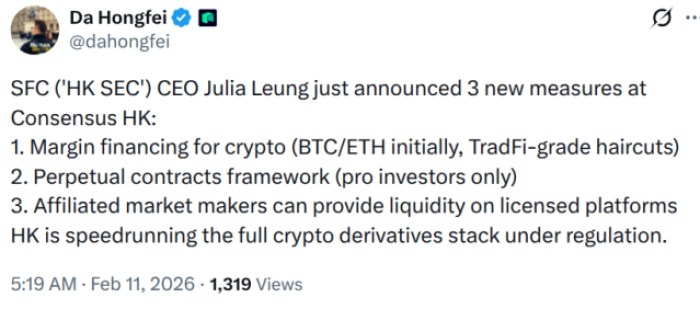
We’re moving far beyond the simple spot ETF approvals that dominated headlines earlier this year. Frankly, this isn’t just a minor regulatory tweak; it’s a foundational shift that acknowledges the sophisticated demands of institutional and professional traders.

Perpetual contracts, which let traders speculate on an asset’s price without an expiry date, are the lifeblood of the global crypto derivatives market (we’re talking trillions in monthly volume). By opening the door to these instruments, Hong Kong is positioning itself as a premier crypto hub in Asia, aiming to capture capital that currently flows offshore.

But what most coverage misses is the second-order effect: this legitimization creates immense pressure on the underlying blockchain infrastructure. Institutional-grade trading demands sub-second execution, low fees, and deep liquidity, capabilities that legacy networks like Bitcoin simply can’t provide on their own.

This creates a paradox. Bitcoin remains the ultimate institutional asset, the digital gold standard. Yet its base layer is too slow and expensive for the high-frequency world of derivatives.

The market is crying out for a solution that bridges Bitcoin’s unparalleled security with the high-performance execution required by modern finance. The question is no longer if institutions will build on Bitcoin, but how.

Bringing Solana-Speed Smart Contracts to Bitcoin

The chasm between Bitcoin’s security and the market’s need for speed is exactly where new infrastructure is emerging. One of the most ambitious is Bitcoin Hyper ($HYPER), a project designed from the ground up as the first Bitcoin Layer 2 integrated with the Solana Virtual Machine (SVM). This isn’t just an incremental improvement. It’s a quantum leap for the Bitcoin ecosystem.
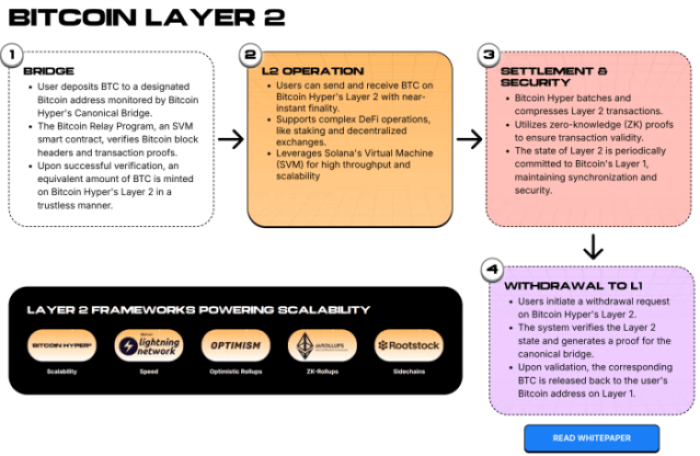
By using the SVM, known for its parallel processing and blistering speed, Bitcoin Hyper aims to deliver transaction finality faster than Solana itself, all while anchoring its security to the Bitcoin mainnet. This architecture directly addresses the very limitations that prevent complex financial apps from running on Bitcoin today.

Developers can build high-speed decentralized exchanges (DEXs), lending protocols, and NFT platforms with familiar tools like Rust, unlocking a wave of innovation previously locked out of the ecosystem.

The project’s design is purpose-built for the future Hong Kong is signaling: Bitcoin for settlement, and a real-time SVM layer for execution. When traders need to execute complex strategies tied to BTC perpetuals, they’ll require an on-chain environment that can actually keep up.

Bitcoin Hyper provides a high-throughput venue for DeFi, payments, and other dApps, all while using wrapped BTC as its core transactional asset.

EXPLORE THE FUTURE OF BITCOIN L2S WITH $HYPER

Smart Money Takes Note as Presale Momentum Builds

So, is there demand for a high-performance Bitcoin L2? The numbers speak for themselves. The Bitcoin Hyper presale has seen a staggering influx of capital, raising over $31M date. With its $HYPER token currently priced at $0.0136754, this level of early-stage funding suggests a broad consensus: solving Bitcoin’s scalability is one of the biggest opportunities this cycle.

And it’s not just retail enthusiasm. Smart money is moving. On-chain analysis shows high-net wallets scooping up as much as $500K in a single purchase. Moves like this often precede wider market recognition, suggesting savvy investors are getting in position.

Delivering a flawless and secure bridge for $BTC is a massive technical challenge, and the project’s success ultimately hinges on its ability to deliver on its ambitious roadmap. We think this is definitely one of the best crypto to watch.

Still, the proposition for investors is compelling. Presale participants can stake their tokens immediately after the Token Generation Event (TGE) to earn a high APY while helping secure the network. This combination of a powerful technical narrative, clear market demand, and serious early funding places Bitcoin Hyper right at the center of the evolving Bitcoin L2 landscape.

BUY YOUR $HYPER HERE

This article is for informational purposes only and does not constitute financial advice. The cryptocurrency market is volatile, and readers should conduct their own research before making investment decisions.


Related Questions

QWhat major policy shift did Hong Kong's financial regulator announce regarding crypto exchanges?

AHong Kong's Securities and Futures Commission (SFC) announced it is actively exploring the approval of perpetual futures contracts for licensed crypto exchanges.

QWhat is the significance of perpetual futures contracts in the crypto market?

APerpetual contracts allow traders to speculate on an asset's price without an expiry date and are the lifeblood of the global crypto derivatives market, representing trillions in monthly volume.

QWhat problem does Bitcoin Hyper ($HYPER) aim to solve for the Bitcoin ecosystem?

ABitcoin Hyper aims to bridge the gap between Bitcoin's security and the market's need for high-speed execution by providing a Bitcoin Layer 2 integrated with the Solana Virtual Machine (SVM) for faster transaction finality and scalability.

QHow much capital has the Bitcoin Hyper presale raised according to the article?

AThe Bitcoin Hyper presale has raised over $31 million.

QWhat is the Bitcoin Hyper project's core transactional asset?

AThe project uses wrapped BTC (wBTC) as its core transactional asset for its high-throughput DeFi, payments, and dApp ecosystem.

Related Reads

$9.4 Billion: The Largest Robotics Funding This Year Has Emerged

Munich-based humanoid robotics company Neura has completed a $1.4 billion (approximately RMB 94.9 billion) Series C funding round, valuing the company at around $7 billion and positioning it among the global leaders in the sector. The investment round is notable not just for its size—reportedly the largest in robotics this year—but also for its strategic backers, which include tech giants like NVIDIA and Amazon, alongside established industrial players such as German engineering firms Bosch and Schaeffler. This mix of investors signals a significant shift in the industry's focus from technological demonstrations and general-purpose narratives toward practical, industrial deployment and commercialization. Neura's approach centers on developing humanoid robots for defined, high-value industrial tasks rather than pursuing a general-purpose model. Its early validation comes from a partnership with BMW, where its robots are being tested on actual production lines. The involvement of Bosch and Schaeffler, companies deeply embedded in global manufacturing, underscores a growing belief that humanoid robots are transitioning from labs to viable factory-floor solutions. The article highlights two converging trends driving investment: advancements in AI and large language models, which enhance robots' perception and decision-making in unstructured environments, and mounting pressure from labor shortages and rising costs in major manufacturing regions. The funding landscape is now bifurcating between companies like Figure AI, focusing on versatile general-purpose robots, and firms like Neura, targeting specific vertical industrial applications with clearer, shorter paths to ROI. While technical hurdles remain, the core challenges for widespread adoption are increasingly seen as engineering and commercial in nature: managing the high integration and customization costs for different factory environments and establishing robust, localized maintenance and service networks. The record investment in Neura, particularly from industrial capital, indicates the industry's growing confidence in moving from proving feasibility to solving the practical problems of scalability, reliability, and building sustainable business models around humanoid robots in real-world settings like automotive manufacturing and hazardous labor environments.

marsbit11h ago

$9.4 Billion: The Largest Robotics Funding This Year Has Emerged

marsbit11h ago

Trading

Spot
Futures

Hot Articles

Discussions

Welcome to the HTX Community. Here, you can stay informed about the latest platform developments and gain access to professional market insights. Users' opinions on the price of S (S) are presented below.

活动图片














