Grayscale: AI Development Will Increase Demand for Public Blockchains

cryptonews.ruPublished on 2026-08-12Last updated on 2026-08-12

Abstract

Grayscale research head Zach Pandl believes that advancements in artificial intelligence (AI) will generate new demand for public blockchain networks. He identifies three primary areas of growth. First, AI agents will require programmable wallets to autonomously hold and spend funds, driving demand for infrastructure supporting micropayments, cross-border settlements, automated trading, and risk management. He cites Ethereum and Solana as suitable open networks for these tasks. Second, as AI assumes more tasks, there will be a need for verifiable records of which models, data, and rules were used in decision-making. Public blockchains could serve as independent ledgers for this information and for managing digital identities and reputations. Third, decentralized networks could offer an alternative to the current concentration of AI computational resources, capital, and control among a few large companies, allowing participants to share resources and governance. Pandl acknowledges the practical benefits of combining blockchain and AI are still debated. Other researchers have noted that while a blockchain can verify data existence, it does not inherently prove the correctness of an AI model's output. His view aligns with other financial firms, like Franklin Templeton, which see AI agents as a potential driver for crypto payments.

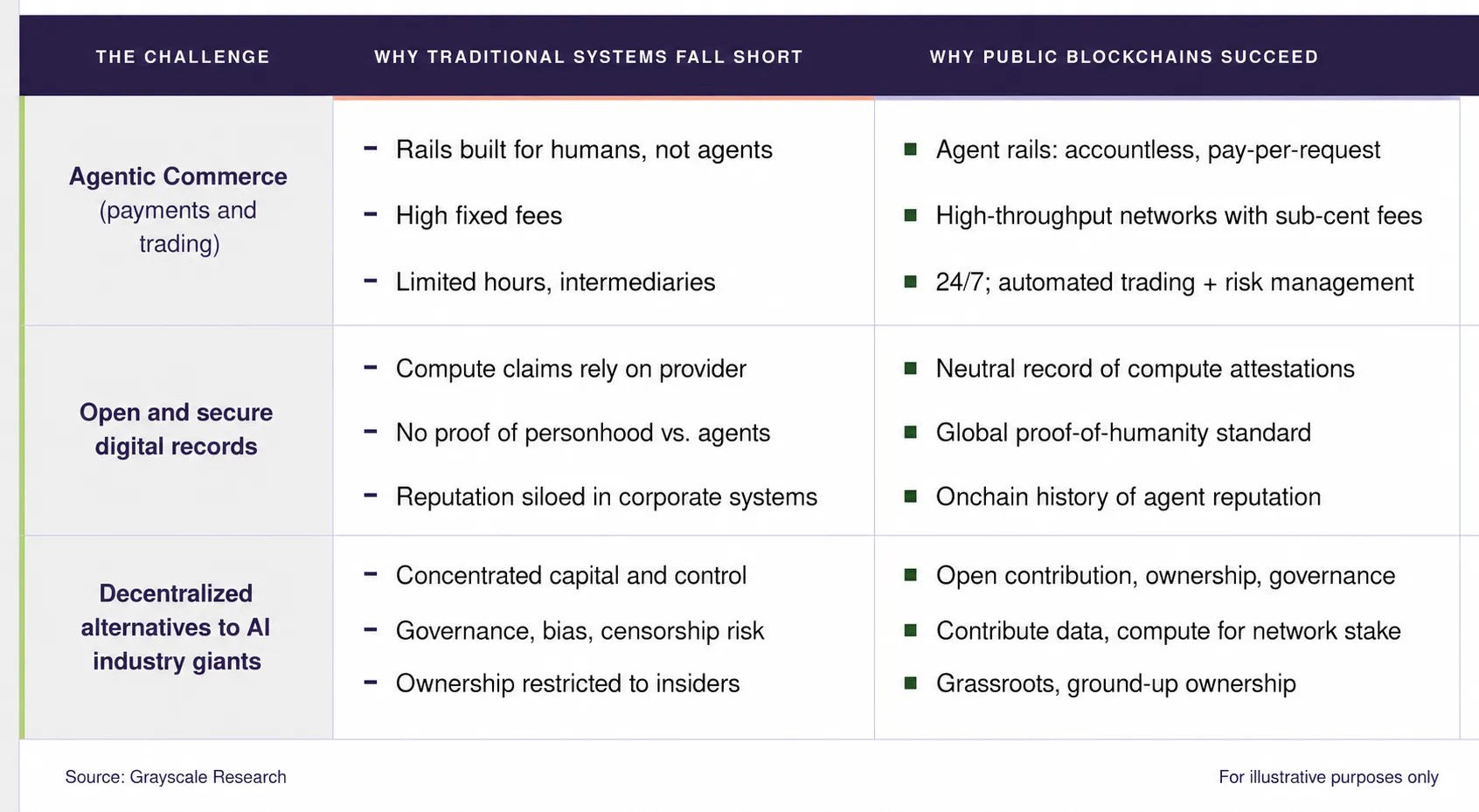
Progress in the field of artificial intelligence will give rise to a number of new use cases for public blockchains—from AI agent transactions to verifiable digital records. This opinion was shared by the head of Grayscale's research unit, Zach Pandl.
Source: Grayscale.

According to his assessment, the most obvious source of new demand is related to payments. Digital assistants that perform tasks on behalf of users need programmable wallets to independently store and spend funds.

The expert believes this will create a need for infrastructure for micropayments, cross-border settlements, automatic trading, and risk management. Pandl named Ethereum and Solana as suitable networks for this: open ledgers allow for programmable transactions 24/7.

Another direction is verifiable records of AI work. As more tasks are delegated to algorithms, companies will need to record which models, data, and rules were used in decision-making. According to the researcher, a public blockchain can serve as an independent ledger for such information.

A similar mechanism can also be applied to identifying people and digital agents and storing their reputation. Pandl named the project World as an example.

He named a third factor as the concentration of computational resources, capital, and control over AI in a small number of companies. An alternative could be decentralized networks where participants provide resources and participate in the ownership and governance of the infrastructure.

However, the practical utility of such a combination remains a subject of debate. In June, researchers from the IC3 consortium noted that many arguments about the benefits of blockchain for AI require additional proof. For example, an entry in a distributed ledger can confirm the existence of certain data at a specific moment, but it does not in itself prove the correctness of a model's operation.

Recall that in July, Franklin Templeton named AI agents as one of the potential drivers of crypto payments. The company noted that blockchain could be used for settlements between autonomous programs without constant human involvement.


Trending Cryptos

Related Questions

QAccording to Grayscale's head of research Zach Pandl, what are the primary new use cases that AI advancements will create for public blockchains?

AThe primary new use cases are AI-agent payments, verifiable digital records of AI work, and the need for decentralized networks as an alternative to the concentration of AI resources and control among a few companies.

QWhy does Zach Pandl believe AI agents will drive demand for programmable payment infrastructure on blockchains?

ABecause digital assistants that perform tasks on behalf of users will need programmable wallets to autonomously store and spend funds, creating demand for micropayments, cross-border settlements, automated trading, and risk management infrastructure.

QWhich two blockchain networks did Zach Pandl specifically mention as suitable for handling the needs of AI agents?

AHe specifically named Ethereum and Solana, stating their open ledgers allow for programmable transactions 24/7.

QWhat is the IC3 consortium's criticism regarding the proposed synergy between blockchain and AI, as mentioned in the article?

AResearchers from the IC3 consortium noted that many claims about blockchain's utility for AI require further proof. For example, while a blockchain can confirm data existed at a certain time, it does not itself prove the correctness of an AI model's work.

QWhich other financial institution, mentioned in the article, has also identified AI agents as a potential driver for cryptocurrency payments?

AFranklin Templeton, which in July stated that blockchain could be used for settlements between autonomous programs without constant human involvement.

Related Reads

Wall Street Begins to Question Tech Giants' AI Narrative

Wall Street Questions the AI Narrative of Tech Giants Wall Street is shifting its focus from the hype surrounding artificial intelligence (AI) to a rigorous financial reality check. Following strong earnings reports from companies like Google and a massive $500 billion financing initiative from Nvidia for AI infrastructure, the market reaction has been mixed and skeptical. The core concern revolves around the massive capital expenditure (CapEx) required for AI development—building data centers and acquiring chips—and whether future cash flows can justify these upfront costs. Investors are now scrutinizing free cash flow (FCF), which measures the cash left after operational expenses and capital investments. A negative FCF, as seen recently with Alphabet (Google's parent company), signals heavy immediate spending, even if profits are growing. The divergent stock reactions highlight this new scrutiny. Microsoft's stock surged after its earnings, supported by strong operating cash flow, growing cloud revenue (Azure), and a large backlog of committed business. In contrast, Alphabet's stock fell despite profit growth because its capital spending caused FCF to turn negative for the first time. Similarly, Nvidia's announcement of a $500 billion financing platform, while potentially expanding its market, raised questions about whether AI build-out has become too expensive for tech companies to fund internally. Analysts are moving beyond simply asking if there is AI demand—which cloud revenue growth confirms—to deeper questions: the speed at which AI investments translate into revenue, profit, and ultimately, cash returns. The market is evaluating the "return on invested capital" (ROIC) over the long term, considering factors like rapid chip obsolescence, energy costs, and future competition. In summary, Wall Street's AI narrative is evolving from grand vision to a detailed financial and operational examination. The key question is no longer if AI is transformative, but whether companies can generate cash returns fast enough to outpace the immense costs of building it. Free cash flow has become a critical first filter in this reassessment.

marsbit1h ago

Wall Street Begins to Question Tech Giants' AI Narrative

marsbit1h ago

An Unexpected Player Enters the Lithography Machine Arena

In the spring of 2026, Elon Musk unveiled the TeraFab chip manufacturing plan, aiming to meet the immense computing power needs of SpaceX and Tesla. He subsequently signaled a move into the photolithography machine market, with speculation centering on a Free Electron Laser (FEL) approach to challenge the dominance of traditional EUV technology. Currently, ASML, utilizing Laser-Produced Plasma (LPP) EUV光源, holds a near-monopoly. However, LPP faces bottlenecks in energy conversion efficiency, tin debris contamination, and a power ceiling. In contrast, FEL technology, pursued by companies like xLight (where former Intel CEO Pat Gelsinger serves as executive chairman), offers a different path. It generates EUV light by accelerating electrons, potentially providing higher power without plasma conversion and its associated contamination, targeting the sub-13.5nm "beyond-EUV" wavelength range. The photolithography landscape shows three main trajectories: ASML's incremental evolution (like High-NA EUV),光源革新 like FEL targeting ASML's core component, and non-EUV alternatives like Nanoimprint Lithography (NIL) or Electron Beam Lithography (EBL). While ASML remains the dominant player with strong financials and产能 expansion plans, new entrants are challenging the status quo. xLight claims its FEL could boost productivity by 50-100%. Other paths include Substrate's particle-accelerator-based X-ray lithography and Chinese research into LPP alternatives. Musk's TeraFab is a high-stakes bet that FEL can move from lab to fab, that "plug-and-play"光源 replacement can circumvent ASML's ecosystem, and that massive future compute demand justifies a new supply chain. His public endorsement of FEL signifies that the photolithography business is no longer ASML's game alone.

marsbit1h ago

An Unexpected Player Enters the Lithography Machine Arena

marsbit1h ago

Trading

Spot

Hot Articles

Discussions

Welcome to the HTX Community. Here, you can stay informed about the latest platform developments and gain access to professional market insights. Users' opinions on the price of AI (AI) are presented below.

活动图片