Goldman Sachs Reveals $152 Million Bet On XRP

bitcoinistPublished on 2026-02-13Last updated on 2026-02-13

Abstract

Goldman Sachs disclosed a $152 million investment in XRP through Spot XRP ETFs, as revealed in a recent SEC filing. The bank holds these positions via products from issuers like Bitwise, Franklin Templeton, and Grayscale, with its largest stake being $39.8 million in the Bitwise XRP ETF. This move, alongside a $108 million investment in Solana Spot ETFs, signals a significant shift toward altcoin adoption by traditional financial institutions. The disclosure comes just before a key White House meeting on stablecoin regulation, leading some analysts to view it as strategic positioning for potential regulatory changes and a major step in institutional crypto adoption.

American multinational investment bank Goldman Sachs recently disclosed its massive altcoin holdings, revealing a substantial stake in XRP. The bank reportedly invested $152 million in Spot XRP ETFs, shocking the broader crypto market. Given the altcoin’s ongoing price slump, many in the crypto community see Goldman Sachs’ new interest as a major bullish development that could help propel the cryptocurrency forward.

Goldman Sachs Unveils Massive XRP Bet

In a recent regulatory filing, Goldman Sachs disclosed a whopping $152 million exposure to XRP. This disclosure became public on February 10, based on the US SEC 13F filing. Many in the crypto space, including popular journalist Eleanor Terrett, shared the story on X, with community members expressing their views on why the traditional Wall Street bank is now dipping its toes into alternative cryptocurrencies.

Terrett clarified that Goldman Sachs does not hold the altcoin directly but has exposure to the cryptocurrency through Spot XRP ETFs. The American bank acquired XRP ETFs from issuers such as Bitwise, Franklin Templeton, Grayscale, and 21Shares. Its largest investment is a 1.9 million-share position in the Bitwise XRP ETF, which is worth $39.8 million.
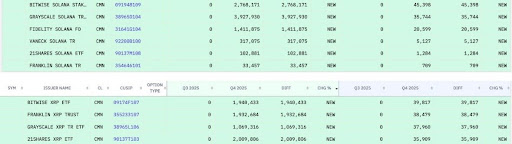
Source: Chart from Goldman Sachs

In addition to the token, Goldman Sachs has also invested heavily in Solana Spot ETFs, highlighting a growing interest in altcoins. The SEC filing shows that the bank purchased approximately $108 million in Spot Solana ETFs from asset management firms such as Bitwise, Franklin Templeton, Grayscale, Fidelity, VanEck, and 21Shares. This recent disclosure of interest in altcoins indicates a strong shift toward broader crypto adoption, particularly from traditional financial institutions, which are typically cautious about digital assets

Exposure Comes Before White House Stablecoin Meeting

According to Terrett, Goldman Sachs’ unexpected XRP disclosure comes as the bank appears as a representative in the latest White House meeting concerning stablecoin yield. Many community members view the bank’s disclosure of its crypto holdings right before the meeting as a bullish sign. One member said, “It felt less like transparency and more like positioning,” suggesting possible preparation for future regulatory changes.

Others have suggested that Goldman Sachs’ XRP bag could signal that the CLARITY Act bill currently under discussion may be passed. On Tuesday this week, the White House held a meeting between banking and crypto stakeholders to discuss stablecoin yield. During the meeting, contrasting opinions were shared. However, Ripple’s CEO Brad Garlinghouse later revealed that bank representatives may finally be coming to a compromise.

With a stablecoin regulatory bill still in the works and globally recognized institutions like Goldman Sachs zeroing in on the cryptocurrency, market uncertainty persists. Crypto commentators say this is a sign that institutions are finally returning to the altcoin. Specifically, market analyst Xaif Crypto stated that Wall Street is no longer watching but is now allocating capital to cryptocurrencies. He added that this marks a notable step for institutional adoption within regulated markets.

XRP trading at $1.35 on the 1D chart | Source: XRPUSDT on Tradingview.com

Related Questions

QHow much did Goldman Sachs invest in XRP according to the article?

AGoldman Sachs disclosed a $152 million exposure to XRP through Spot XRP ETFs.

QWhat is the name of the regulatory filing that made Goldman Sachs' XRP investment public?

AThe disclosure became public through the US SEC 13F filing.

QWhich specific XRP ETF represents Goldman Sachs' largest investment?

AIts largest investment is a 1.9 million-share position in the Bitwise XRP ETF, worth $39.8 million.

QBesides XRP, which other altcoin's Spot ETFs did Goldman Sachs heavily invest in?

AGoldman Sachs also invested approximately $108 million in Solana Spot ETFs.

QWhat significant event was happening around the time of Goldman Sachs' disclosure, as mentioned in the article?

AThe disclosure came as Goldman Sachs was appearing as a representative in a White House meeting concerning stablecoin yield.

Related Reads

MoneyGram: Why Did We Launch Our Own Stablecoin?

MoneyGram, a global leader in cross-border remittances for over 80 years, has launched its own stablecoin, MGUSD. The initiative aims to evolve from single-transaction services to becoming a more integral part of users' financial lives. By allowing customers to hold a stable US dollar balance within the MoneyGram app, MGUSD enables not only remittances but also everyday spending, currency exchange, cash access, and future financial services. Targeting the billions globally who face challenges like currency volatility or lack of bank accounts, MGUSD leverages Stellar blockchain technology with a self-custody wallet architecture. This gives users control over their assets while providing a secure, compliant experience through a trusted brand. The approach focuses on solving existing customer pain points within MoneyGram's established network, rather than competing for broad crypto market liquidity. A key advantage is MoneyGram's hybrid model, combining digital services with the world's largest physical network for crypto-to-cash conversions. The stablecoin also modernizes the company's internal infrastructure, streamlining treasury management and partner settlements, with annual forex volume via stablecoins already reaching $2 billion. The project was delivered in about a year, driven by a reorganization into agile, cross-functional teams that operate with startup-like speed while leveraging decades of institutional expertise. Partners include Stablecoin (issuance), Crossmint (wallet APIs), Fireblocks (enterprise treasury), m0 (smart contracts), and the Stellar network. MoneyGram emphasizes that enhancing direct consumer offerings strengthens its partner ecosystem. The future direction is clear: to provide users worldwide with stable value storage, better financial tools, and greater control over their funds through a trusted, existing network.

Foresight News37m ago

MoneyGram: Why Did We Launch Our Own Stablecoin?

Foresight News37m ago

BIP-110 Controversy Intensifies: Bitcoin May Face Its Most Divisive Hard Fork Battle in Years

Bitcoin is approaching a critical block height of 961,632, which could activate the controversial BIP-110 proposal. This proposal aims to restrict the amount of non-financial data, such as inscriptions and other large data payloads, within Bitcoin transactions. Supporters, including some node operators and Bitcoin purists, argue that BIP-110 is necessary to preserve Bitcoin's core function as a monetary settlement layer by reducing network congestion and node operational burdens caused by non-essential data. They frame it as a correction to keep the network true to its original purpose. However, critics, including prominent figures like Blockstream's Adam Back and developer Jameson Lopp, warn that the proposal's implementation mechanism is dangerously flawed. They highlight that its low 55% miner signaling threshold, coupled with a contentious enforcement mechanism allowing nodes to unilaterally reject non-compliant blocks, significantly increases the risk of a chain split. Opponents argue this sets a dangerous precedent for transaction censorship, undermines Bitcoin's protocol neutrality, and creates excessive uncertainty for developers and businesses, especially since the rule is proposed as a temporary one-year measure. Market analysts, such as those from Bitfinex, suggest a full-scale network split is unlikely due to a lack of broad economic consensus. Major mining pools remain neutral, and adoption of the new rules is minimal. They view the situation more as a governance stress test. The primary risk is operational disruption: if a minority chain persists, major exchanges and custodians may need to temporarily suspend Bitcoin deposits and withdrawals to manage security and liquidity, potentially unsettling newer institutional investors. While BIP-110 is not expected to succeed in overtaking the main chain, its approach has ignited a significant debate about Bitcoin's governance, core values, and resilience.

Foresight News1h ago

BIP-110 Controversy Intensifies: Bitcoin May Face Its Most Divisive Hard Fork Battle in Years

Foresight News1h ago

Trading

Spot
Futures

Hot Articles

What is XRP 2.0

XRP 2.0: A New Frontier in the Cryptocurrency Landscape Introduction to XRP 2.0 In the ever-evolving realm of cryptocurrency, new projects continuously emerge, vying for attention and adoption. One such promising initiative is XRP 2.0, a novel cryptocurrency project designed to leverage advanced blockchain technology and robust encryption methodologies. While the name draws parallels with Ripple’s XRP, it’s crucial to note that XRP 2.0 operates independently, focusing on enhancing transaction security, privacy, and scalability. As the digital financial landscape increasingly embraces decentralized solutions, XRP 2.0 aims to contribute meaningfully to web3 and the overall expansion of crypto projects. What is XRP 2.0? At its core, XRP 2.0 is a cryptocurrency project that aims to create a secure and decentralized digital currency ecosystem. Its foundational technology integrates sophisticated blockchain principles with cutting-edge encryption techniques. The overarching goal of XRP 2.0 is to establish itself as a reliable and efficient platform enabling swift transaction execution while prioritizing enhanced privacy protections for its users. The project is promoted as a solution to many limitations faced by existing cryptocurrencies, proposing a system that can handle a higher volume of transactions with improved speed and privacy. This versatility positions XRP 2.0 as a significant contender in a marketplace riddled with various digital currencies. Who is the Creator of XRP 2.0? The identity of the creator behind XRP 2.0 has been flagged as ‘Wilbur.’ However, comprehensive details regarding Wilbur or their associated entity remain elusive. The anonymity of many cryptocurrency creators is not an uncommon phenomenon in the industry, often designed to maintain a degree of privacy and security. Who are the Investors of XRP 2.0? As of now, specific information related to the investment foundations or organizations supporting XRP 2.0 is not publicly available. In the cryptocurrency sector, the backing by reputed investors can significantly influence a project's credibility and success, yet the transparency regarding the financial supporters of XRP 2.0 has not been established. How Does XRP 2.0 Work? XRP 2.0 stands out by employing a combination of blockchain technology and advanced encryption algorithms that ensures secure and decentralized transactions. Its innovative structure includes unique features designed to foster user engagement and broaden functionalities beyond conventional cryptocurrency transactions. Among these features, XRP 2.0 incorporates AI-powered capabilities, such as text-to-image and text-to-speech functionalities. These additions are designed to enhance the interactive experience for users, promoting broader applicability across various sectors. By bridging technological advancements with user-centered design, XRP 2.0 aims to capture the attention of a diverse range of individuals and enterprises looking to integrate cryptocurrency solutions into their operational frameworks. Timeline of XRP 2.0 Understanding XRP 2.0 requires examining the milestones that have defined its journey thus far: July 23, 2023: XRP 2.0 is introduced as a novel cryptocurrency project, aiming to revolutionize secure and decentralized transaction capabilities in the blockchain domain. September 8, 2023: The launching of another project, XRP20, occurs, marking the emergence of an ERC-20 token on the Ethereum blockchain that remains unrelated to XRP 2.0. November 13, 2023: The XRP Ledger undergoes a significant update with the release of rippled server software version 2.0.0. It is essential to note that this development is disconnected from the XRP 2.0 cryptocurrency project. Key Points About XRP 2.0 To distill the essence of XRP 2.0, several critical factors emerge: Unique Features: The inclusion of features like AI-powered text-to-image and text-to-speech further diversifies the potential applications of XRP 2.0. Blockchain Technology: The framework utilizes advanced blockchain mechanisms and encryption protocols, ensuring a secure and decentralized environment for transactions. Scalability and Privacy: XRP 2.0 prioritizes enhanced privacy protections in transaction processes and the scalability necessary to accommodate a growing user base. No Affiliation with Ripple: Importantly, despite its name, XRP 2.0 does not have any allegiance or collaboration with Ripple’s XRP, distinguishing its operational framework and objectives within the cryptocurrency ecosystem. Conclusion XRP 2.0 represents an ambitious venture into the cryptocurrency sphere, aiming to offer a combination of security, privacy, and efficiency in digital transactions. By integrating sophisticated technologies and user-friendly features, the project sets out to broaden the horizons of what cryptocurrency can achieve in today's digital economy. While the anonymity of its creator and lack of disclosed investors might raise questions for some, XRP 2.0's focus on advanced functionalities and decentralisation enhances its appeal amidst an increasingly crowded crypto market. As the cryptocurrency landscape continues to evolve, XRP 2.0 may yet emerge as a pivotal player in the expansion of secure and scalable blockchain solutions.

942 Total ViewsPublished 2024.04.01Updated 2024.12.03

What is XRP 2.0

Discussions

Welcome to the HTX Community. Here, you can stay informed about the latest platform developments and gain access to professional market insights. Users' opinions on the price of XRP (XRP) are presented below.

活动图片















