Goldman Sachs Research Report Analysis: Chip Shortage to Persist Until 2028, Maintain Buy Recommendations

marsbitPublished on 2026-06-01Last updated on 2026-06-01

Abstract

Goldman Sachs Research Report Summary: Memory Shortage Until 2028, Maintain Buy Recommendations Goldman Sachs' latest Asia-Pacific equities report, "The 720," forecasts a sustained memory chip upcycle extending into 2028, driven by strong AI server demand visibility, limited supply growth, and binding long-term agreements. The firm believes the market significantly underestimates the cycle's duration, as evidenced by low P/E ratios for memory stocks. Key sector calls include raising 12-month price targets for Samsung Electronics and SK Hynix, and upgrading Kioxia from Hold to Buy, citing higher and more sustainable peak profits over the next 2-3 years. The report also highlights the broader AI hardware supply chain benefiting from hyperscaler capex acceleration. Recommendations include: * MediaTek (Buy) for its data center/ASIC pivot. * Eoptolink (Buy) on 1.6T optical module ramp-up. * Biren (Buy) for its AI chip migration. * Huaqin (Buy, newly covered) for its shift from consumer electronics ODM to AI data centers. * Lenovo (Buy) on the AI PC refresh cycle. Other notable mentions include China property developers (under an optimistic scenario), BYD for its affordable city NOA strategy, and select Japanese semiconductor equipment makers. A macro theme notes the divergence between AI-boom beneficiaries (e.g., Korea, Taiwan) and energy-importing economies facing inflationary pressure. The report concludes with standard disclaimers, noting that price targets are f...

Author: Tidal Research

On June 1st, Goldman Sachs released its daily Asia-Pacific stock summary, "The 720," featuring a long list of names on the cover including Samsung, SK Hynix, Kioxia, MediaTek, Lenovo, and BYD. It appears to be a comprehensive shopping list, but a closer read reveals its absolute core: memory chips.
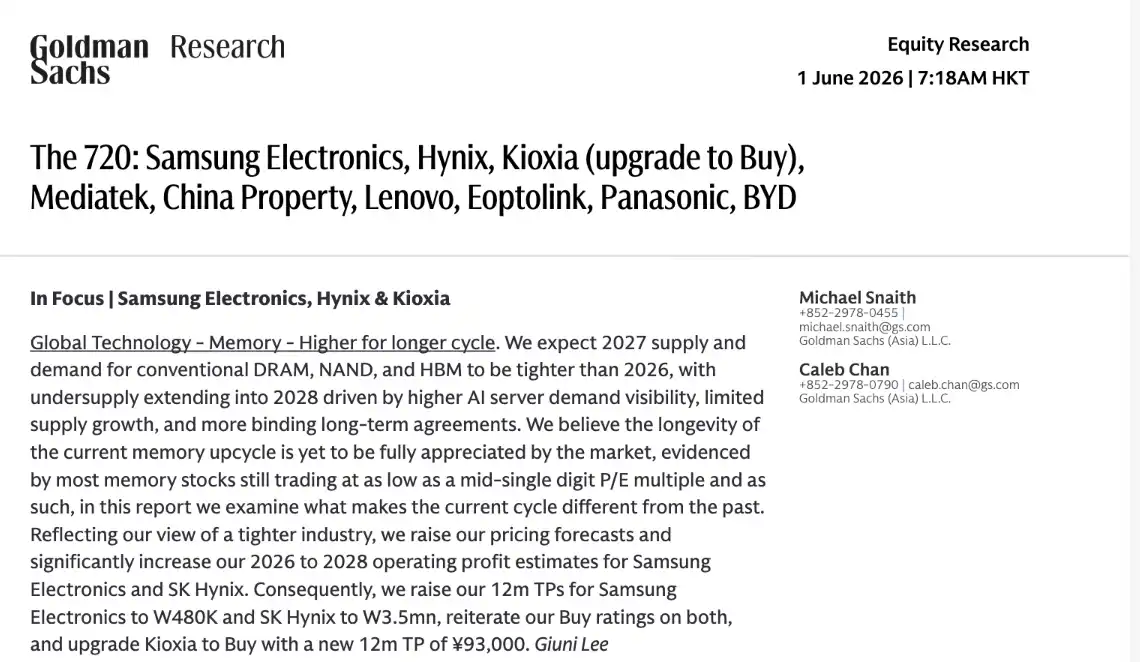
One of the most significant judgments in this Goldman Sachs report is that the current memory upcycle "will last longer" (higher for longer), with the shortage expected to persist all the way until 2028, a length vastly underestimated by the market. The evidence lies in valuations: most memory stocks are still trading at mid-single-digit price-to-earnings ratios, as if the market believes this is just another ordinary cyclical rebound, but Goldman Sachs sees it differently.

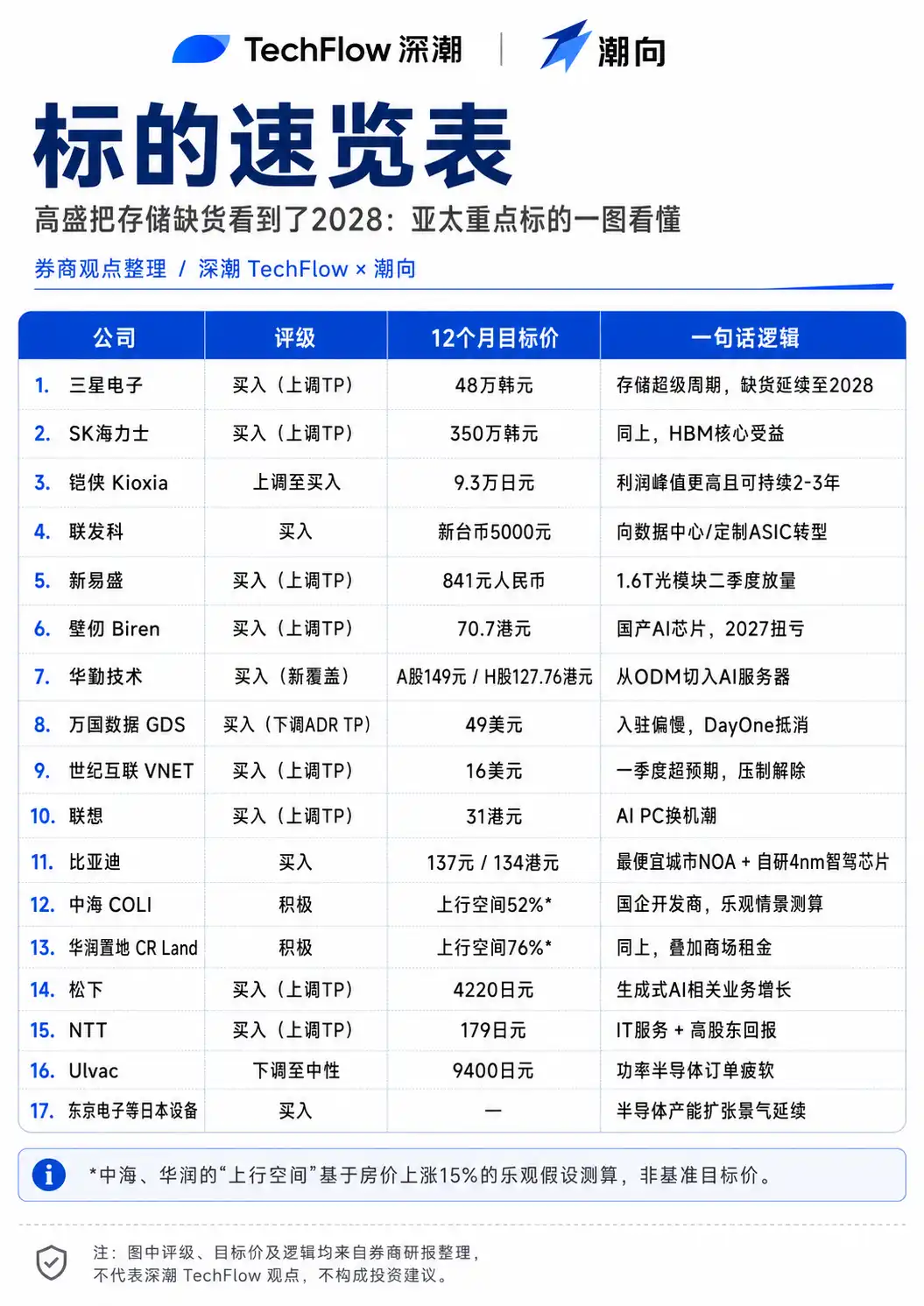
Below, we break it down by importance, concluding with a quick-reference table of targets.

Main Event: Memory Shortage to Last Until 2028, Three Companies Collectively Upgraded

Goldman Sachs compares this cycle to past ones and concludes this time is different. The reasons are threefold: higher visibility of AI server demand, limited supply growth, and increasingly firm long-term supply agreements (locking in orders and prices). Combined, these factors suggest that DRAM, NAND, and HBM supply-demand will be even tighter in 2027 than in 2026, with shortages extending into 2028.

The most intuitive evidence is Goldman's DRAM supply-demand chart. Negative numbers represent supply shortage; the deeper the deficit, the stronger the price support. Goldman has now revised its forecasts for 2026 to 2028 deeper into shortage territory. Specifically, the 2027 forecast was revised from an earlier -2.5% to -5.9%, more than doubling. In plain language: Goldman believes memory manufacturers will face increasing shortages in the next few years, meaning price increases can be sustained longer.

Regarding specific companies, three were collectively adjusted:

  • Samsung Electronics: 12-month price target raised to 480,000 KRW, Buy rating maintained.
  • SK Hynix: 12-month price target raised to 3.5 million KRW, Buy rating maintained.
  • Kioxia: Upgraded from Neutral to Buy, new price target set at 9,300 JPY.

Kioxia is the only rating upgrade in this report, and Goldman's logic is worth noting separately: it believes the profit peak of this cycle is higher than previously anticipated and can be maintained for two to three years, rather than surging and then falling back quickly. Based on this, Goldman has raised its operating profit forecasts for Kioxia for fiscal years 2027 to 2029 by 16% to 48% in one go and expects gross margins to remain at a high level around 80%. Predicting three years of sustainably high profits for a company in the strongly cyclical memory business is a very strong statement.

AI Computing Chain "Full Package": From Chips to Optical Modules to Data Centers

Beyond memory, this report touches upon nearly the entire AI hardware supply chain in China and Asia, unified by one main thread: global cloud hyperscaler capital expenditures are accelerating, and money is flowing down this chain.

  • MediaTek: Buy, price target set at 5,000 TWD. The highlight is its transition from mobile chips to data centers and custom ASICs (AI chips tailor-made for specific clients). The company's target is to achieve $2 billion in data center/AI ASIC revenue by 2026 and capture a 10% to 15% share of the $70-80 billion ASIC market by 2027.
  • Eoptolink: Buy, price target raised to 841 RMB. It manufactures optical modules, critical components for high-speed data transmission in AI data centers. Goldman is bullish on its 1.6T optical modules ramping up starting Q2 and accelerating in the second half, along with capacity expansion in Thailand. It raised profit forecasts for 2027 and 2028 by 5% and 6%, respectively.
  • Biren: Buy, price target raised to 70.7 HKD. A domestic Chinese AI chip manufacturer, its Bili166 product has received a first-tier security and reliability rating. Goldman expects it to turn profitable by 2027 as its product portfolio migrates to higher-performance, more expensive AI chips. Revenue forecasts for 2026 to 2030 were raised by 4% to 28%.
  • Huaqin: Buy, a newly covered target in this report. A-share price target set at 149 RMB, with simultaneous first-time coverage of its H-shares, target set at 127.76 HKD. The logic is its move from consumer electronics ODM into AI data centers, with expected revenue CAGR of 32% from 2025 to 2027.
  • Data Center Duo: GDS maintains Buy rating, but its ADR target is lowered to $49 (due to slower move-in rates, lower monthly service revenue, partially offset by higher valuation for overseas DayOne business); VNET maintains Buy rating, target raised to $16 (due to Q1 earnings beat, strong execution of capacity ramp-up, and removal of strategic investor overhang).
  • Lenovo: Buy, price target raised from 27 HKD to 31 HKD. The bet is on the AI PC refresh cycle. Goldman expects its notebook market share to expand to 28% by 2028, with AI notebook penetration reaching 66%, lifting overall average selling prices. Its profit forecasts for Lenovo's FY2027 and FY2028 are 22% and 25% higher than the Bloomberg consensus, indicating significant divergence.

Stocks Mentioned Outside the AI Main Theme

  • Chinese Real Estate (COLI, CR Land): Goldman is assessing the sustainability of the recent real estate sector rebound. It assumes an optimistic scenario where 15 key cities follow Shanghai and Shenzhen's property price recovery, leading to a 15% price increase by the end of 2028. Under this premise, it estimates cash profits for COLI and CR Land could expand by over 30% and over 50%, respectively, by 2028. Using a sum-of-the-parts valuation, Goldman suggests further upside potential of 52% for COLI and 76% for CR Land, maintaining a positive view on these stronger state-owned developers. Key point: this calculation is based on an optimistic assumption, not the base case forecast.
  • BYD: Buy, price target set at 137 RMB / 134 HKD. The highlight is its "Tianshen Eye B" City Navigation Guided Pilot (City NOA) becoming a 12,000 RMB option across its lineup at its Intelligent Driving Strategy Conference, making its entry-level City NOA-equipped model the cheapest in China at 78,800 RMB. It also unveiled its first self-developed 4nm intelligent driving chip, "Xuánjī A3," which is already in mass production. Goldman believes these engineering capabilities can boost high-end intelligent driving penetration, lower costs, and improve margins.
  • Japanese Semiconductor Equipment: Goldman maintains Buy ratings on Lasertec, Ebara, Disco, and Tokyo Electron. The only contrarian move was downgrading vacuum equipment manufacturer Ulvac (6728.T) from Buy to Neutral, lowering the target to 9,400 JPY, citing weak high-margin power semiconductor orders and slower-than-expected gross margin expansion.
  • Panasonic HD: Buy, price target raised from 4,000 JPY to 4,220 JPY, bullish on generative AI-related businesses (backup power, copper-clad laminate CCL, high-performance capacitors).
  • NTT: Buy, price target slightly raised from 176 JPY to 179 JPY, focusing on domestic IT service demand and the safety margin provided by a shareholder total return rate of around 5%.

A Macro Theme: AI Boom Clashes with Energy Crisis

Stringing together the individual stocks is Goldman's macro judgment: Emerging markets are being pulled in two by two opposing forces. On one side is the AI investment boom, and on the other is energy supply contraction due to the blockade of the Strait of Hormuz.

Tech-exporting economies like South Korea and Taiwan benefit from surging exports and current account surpluses; while energy-importing countries face rising inflation, weaker currencies, and fuel subsidies straining their finances. Goldman expects the Q4 average Brent crude price to be $90/barrel, continuing pressure on heavily oil-import-dependent economies. It recommends overweighting stocks in China, South Korea, Brazil, and South Africa. This line connects with the recent macro background of the Iran situation and oil prices.

Two other points directly affecting A-share capital flows:

Chinese imports surged 23.6% year-on-year in the first four months of this year, but Goldman believes this is a highly concentrated phenomenon, with gold and semiconductors accounting for about 65% of the import growth increment, not indicative of a continuous worsening of the external balance.

Regarding the CSI and CNI index semi-annual rebalancing, Goldman estimates it will trigger over $48 billion in two-way passive fund flows. The technology hardware & semiconductor and capital goods sectors are expected to see the largest inflows (approximately $3.1 billion and $1.4 billion, respectively), while healthcare and banks see the largest outflows. Newly added constituents "expected to receive the largest net passive inflows" include Huagong Tech, Yuanjie Tech, Huahong Semiconductor, GigaDevice, VeriSilicon, etc. For index rebalancing arbitrage funds, this is a clear signal.

Finally, as usual, Goldman left an Easter egg: 2026 World Cup winning probability forecast: Spain leads at 26%, followed by France at 19%, Argentina at 14%, Brazil at 8%, and England at 5%. The model penalized the defending champion Argentina; take it as a bit of fun.

Quick Reference Table of Targets
This article is TechFlow's compilation and interpretation of a third-party brokerage research report. The ratings, price targets, profit forecasts, and related judgments cited herein represent the views of the report's analysts and their affiliated institutions only. They do not represent the views of TechFlow and do not constitute any investment advice.

Please note the following three points when reading:

1. Price targets are analysts' expectations for a future period (typically 12 months). They are forecasts, not promises, and are subject to frequent adjustment based on company performance and market conditions.

2. Sell-side research reports are inherently bullish. It is common for brokerages to issue "Buy" ratings on covered companies, and some covered companies may have investment banking or other business relationships with the brokerage. A list predominantly featuring "Buy" ratings should be read with this inherent bias in mind.

3. The value of a research report lies in its mainline logic and the underlying assumptions it depends on, not any single price target. The logic for related targets holds only if the main theme holds; if the main theme is disproven, the entire chain of targets will come loose together. Focus on the logic, not just the price.

Markets involve risks; decisions should be made independently. This article should not be used as the basis for buying or selling any securities.
Trending Cryptos

Related Questions

QAccording to the Goldman Sachs report, what is the core reason for the prolonged shortage in the memory chip sector until 2028?

AThe report cites three core reasons: higher visibility of AI server demand, limited supply growth, and increasingly binding long-term supply agreements (LTA) that lock in orders and prices. The combination of these factors leads to a projected tighter supply-demand situation for DRAM, NAND, and HBM in 2027 than in 2026, extending the shortage into 2028.

QWhich memory company received a rating upgrade from Goldman Sachs in this report, and what was the key rationale?

AKioxia received a rating upgrade from Neutral to Buy. The key rationale is Goldman Sachs' belief that the profit peak in this cycle will be higher and more sustainable than previously thought, lasting two to three years. Consequently, they significantly raised Kioxia's operating profit forecasts for FY2027 to FY2029 by 16% to 48% and expect its gross margin to remain around a high level of 80%.

QWhat is the primary macro theme Goldman Sachs uses to connect the various stock recommendations in the report?

AThe primary macro theme is that emerging markets are being pulled in two opposite directions. On one side is the AI investment boom, benefiting tech-exporting economies. On the other side is energy supply contraction due to the blockade of the Strait of Hormuz, which pressures energy-importing countries with higher inflation, weaker currencies, and strained finances. This leads to a recommended overweight stance on stocks in China, South Korea, Brazil, and South Africa.

QBesides memory chips, what other major sector or theme did Goldman Sachs focus on for its stock recommendations, and name one related company.

ABesides memory chips, Goldman Sachs focused extensively on the AI compute hardware supply chain. One related company is MediaTek. The report highlights its transition from mobile chips to data centers and custom AI ASICs, with a company target of $2 billion in data center/AI ASIC revenue in 2026 and aiming for a 10%-15% share of the $70-80 billion ASIC market by 2027.

QWhat important disclaimer does the article provide regarding the investment ratings and target prices mentioned from the Goldman Sachs report?

AThe article states that the ratings, target prices, profit forecasts, and related judgments cited are solely the views of the Goldman Sachs analysts and represent the position of their institution. They do not represent the views of the publishing platform (Shenchao TechFlow) and do not constitute any investment advice. It reminds readers that target prices are predictions subject to change, that sell-side research has a natural bullish bias, and that the value lies in the core logic and its underlying assumptions, not just the price targets.

Related Reads

Six Years Later, UNI Finally Welcomes Its Own "Buyback Bull"

After years of debate, Uniswap's UNI token has finally entered a 'buyback bull' phase following the long-awaited activation of its fee-switch mechanism. The UNIfication proposal, executed in December 2025, redirected a portion of protocol fees from select pools and Unichain sequencer revenue into a treasury (TokenJar) dedicated to buying back and permanently burning UNI. Initial market reaction was muted due to modest early burn rates. A significant shift occurred in July 2026 with the launch of Robinhood Chain. Uniswap's immediate deployment there skyrocketed trading volume, making it a top fee-generator. Subsequently, governance votes extended the fee mechanism to v4 pools and Robinhood Chain, causing protocol revenue to nearly triple. Daily funds directed to UNI burns rose sharply, with Robinhood Chain contributing over half. This transitioned UNI's narrative from a governance token to a cash-flow asset backed by a perpetual automatic buyer. UNI's price, which had languished around $2.30 in early June, nearly doubled to approach $4.60 by late July. Analysts credit this to the tangible cash flow from fees rather than mere speculation. Unlike many newer projects where buybacks are offset by large investor unlocks, UNI's six-year history has resulted in a widely distributed and relatively clean supply, allowing the buyback pressure to effectively impact the secondary market. The key test will be whether trading activity, particularly on Robinhood Chain, sustains after its initial gas subsidies expire.

marsbit1m ago

Six Years Later, UNI Finally Welcomes Its Own "Buyback Bull"

marsbit1m ago

Only 153 Venture Capital Firms Invested in July: Is the Crypto VC Industry Experiencing a 'Mass Extinction'?

In July 2026, only 153 unique venture capital firms participated in disclosed crypto funding rounds, marking the lowest monthly count since November 2020. This figure represents an 87% decline from the peak of 1,177 firms in 2022. Overall, the first seven months of 2026 saw crypto projects raise approximately $11.78 billion across 481 rounds. This crypto VC contraction contrasts sharply with the broader venture capital landscape, where global VC investment reached a record $560.4 billion in H1 2026, heavily fueled by major AI company financings. This shift in capital allocation has drawn funds away from the crypto sector. Within crypto, funding is highly concentrated. Trading platforms, prediction markets, and payment sectors absorbed 53% of the total capital. While early-stage deals remain frequent, the largest sums flow to a few late-stage rounds and mergers & acquisitions, which surged to $7.23 billion in Q2 2026. The market is consolidating around top funds like a16z crypto and Dragonfly, which successfully raised new multi-billion dollar funds, while many smaller firms have retreated. Analysts describe this as a "great extinction" for crypto VCs, where capital is becoming more selective, favoring proven business models and assets over early-stage speculation. This raises the bar for project quality, funding efficiency, and viable exit paths.

marsbit22m ago

Only 153 Venture Capital Firms Invested in July: Is the Crypto VC Industry Experiencing a 'Mass Extinction'?

marsbit22m ago

Strategy's Loss in the Second Quarter Reaches $8.22 Billion Amid Bitcoin Decline

Strategy, the largest corporate holder of Bitcoin, reported a net loss of $8.22 billion for the second quarter. This loss was primarily driven by an $8.32 billion unrealized loss on its Bitcoin holdings due to a decline in the asset's price during the period. Despite these paper losses, the company increased its Bitcoin holdings to 843,775 BTC, a 25% growth since the start of the year. As part of a new monetization strategy, Strategy sold approximately $218.4 million worth of Bitcoin, mainly to fund dividends for preferred shareholders, with $216 million of that sold after Q2 ended. The company also built a $3.75 billion cash reserve, which it claims is sufficient to cover over two years of dividend and interest payments, aiming to insulate itself from Bitcoin's volatility while meeting obligations. Following the earnings release, Strategy's stock (MSTR) rose 4.7% in regular trading but corrected slightly after-hours. This pattern reflects how the company's accounting results are heavily tied to Bitcoin's price swings, even as its long-term strategy remains unchanged. The report indicates that Strategy is maintaining its core strategy of accumulating Bitcoin while building a financial buffer. This quarterly loss follows a recognizable pattern, with the company posting significant unrealized losses in previous quarters (e.g., $12.4 billion in Q4 2025 and ~$12.5 billion in Q1 2026) due to fair-value accounting. A key technical shift is its new monetization program, which introduces periodic selling pressure on the market, transitioning Strategy from a pure accumulator to a participant that occasionally adds supply. A critical question remains: how long can the cash reserve cover dividend obligations if a Bitcoin price downturn persists beyond two years?

cryptonews.ru42m ago

Strategy's Loss in the Second Quarter Reaches $8.22 Billion Amid Bitcoin Decline

cryptonews.ru42m ago

Will Terrorist Durov Ban Russian Officials?

Telegram founder Pavel Durov publicly reacted to being labeled a "terrorist" by Russian authorities, stating the designation came after he refused demands for mass surveillance and censorship on the platform. In a Telegram post, he highlighted that this status formally bans him from "publishing information online." Durov concluded with a statement widely circulated: Russian officials "clearly don't understand who can ban whom on the internet." This remark suggests Durov could potentially restrict official Russian government and officials' channels on Telegram, which continue to operate on the platform despite its formal blocking in Russia. The situation parallels previous, slow-moving state directives, like switching officials to domestic cars, contrasted with the current push to migrate all government communication to the Russian-made messenger MAX by 2030. However, reports indicate many officials still use Telegram via workarounds, fearing surveillance on MAX, while alternatives like BiP and KakaoTalk recently became inaccessible in Russia without a VPN. Durov has not specified any immediate actions against state channels. His statement is an initial response, with further developments depending on the authorities' reaction. The dynamic differs from 2020 when Russian regulators lifted a block on Telegram; now, Durov implies control from within the platform itself over the official accounts that persisted through that earlier blockade.

cryptonews.ru42m ago

Will Terrorist Durov Ban Russian Officials?

cryptonews.ru42m ago

Trading

Spot

Hot Articles

How to Buy CHIP

Welcome to HTX.com! We've made purchasing USD.AI (CHIP) simple and convenient. Follow our step-by-step guide to embark on your crypto journey.Step 1: Create Your HTX AccountUse your email or phone number to sign up for a free account on HTX. Experience a hassle-free registration journey and unlock all features.Get My AccountStep 2: Go to Buy Crypto and Choose Your Payment MethodCredit/Debit Card: Use your Visa or Mastercard to buy USD.AI (CHIP) instantly.Balance: Use funds from your HTX account balance to trade seamlessly.Third Parties: We've added popular payment methods such as Google Pay and Apple Pay to enhance convenience.P2P: Trade directly with other users on HTX.Over-the-Counter (OTC): We offer tailor-made services and competitive exchange rates for traders.Step 3: Store Your USD.AI (CHIP)After purchasing your USD.AI (CHIP), store it in your HTX account. Alternatively, you can send it elsewhere via blockchain transfer or use it to trade other cryptocurrencies.Step 4: Trade USD.AI (CHIP)Easily trade USD.AI (CHIP) on HTX's spot market. Simply access your account, select your trading pair, execute your trades, and monitor in real-time. We offer a user-friendly experience for both beginners and seasoned traders.

3.4k Total ViewsPublished 2026.04.21Updated 2026.06.02

How to Buy CHIP

Discussions

Welcome to the HTX Community. Here, you can stay informed about the latest platform developments and gain access to professional market insights. Users' opinions on the price of CHIP (CHIP) are presented below.

活动图片