Gold breaks KEY support with 3.7% drop – Will crypto face pressure next?

ambcryptoPublished on 2026-03-21Last updated on 2026-03-21

Abstract

The latest inflation report, with February's hotter-than-expected PPI, triggered a 3.7% drop in gold, breaking key support. This sell-off is attributed to a stronger U.S. dollar and rising Treasury yields, making traditional safe havens more attractive. Historically, a stronger DXY negatively impacts risk assets like crypto. Bitcoin is currently stagnant near $70k with negative funding rates and declining capital inflows, indicating a bearish bias. The falling Coinbase Premium Index and increased short positions suggest a crypto downturn may already be priced in, especially given macro pressures and the historical inverse correlation between DXY and BTC.

The latest inflation report has clearly shaken things up in this market cycle.

To put it in context, February’s PPI, released on the 18th of March, came in hotter than expected, signaling that U.S. inflation is still sticky. The reaction was almost instant. Gold, for instance, dropped 3.74%, slicing through the $5k support level, a move that caught many traders off guard.

The logic here is straightforward: Historically, during times of geopolitical instability, investors flocked to gold as a hedge against inflation. But what’s interesting now is that this pattern seems to be shifting. So far, this move hasn’t spilled over into crypto, though that doesn’t mean a crash is off the table.
Source: TradingEconomics

To see why, you need to look at a couple of key things.

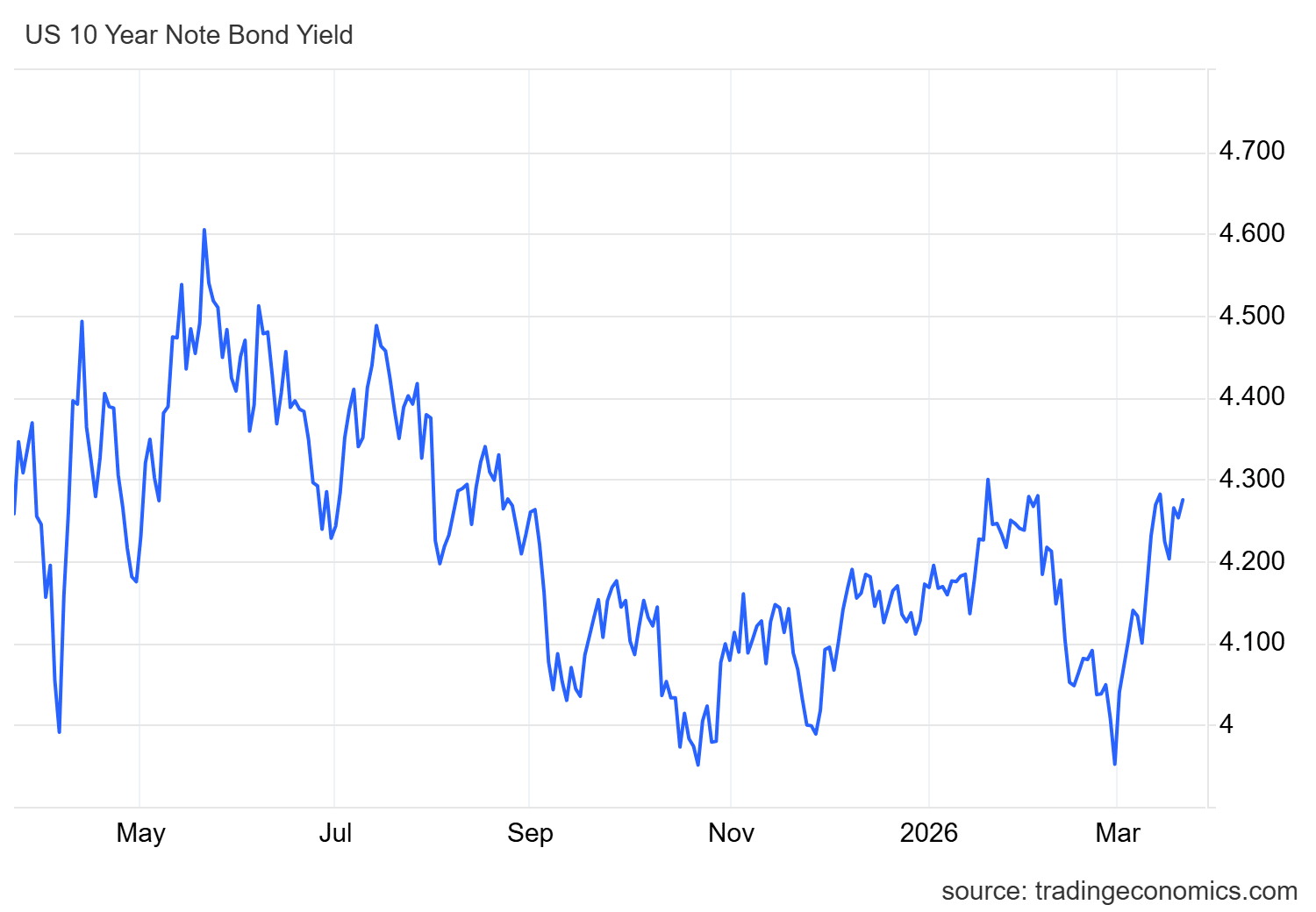
First, the gold sell-off is tied to the U.S. dollar getting stronger. With the Fed keeping interest rates steady and U.S. debt now over $39 trillion, Treasury yields are starting to look a lot more attractive. In fact, yields have jumped nearly 10% since the war kicked off, which is clearly pulling attention away from gold.

On the crypto side, history tells a familiar story. A stronger DXY usually means less love for risk assets. That means when geopolitical tensions rise, risk assets start to feel less appealing. Meanwhile, a stronger dollar pulls capital into bonds, which feel safer and now offer higher returns thanks to rising yields.

In this context, the falling Coinbase Premium Index (CPI) is already hinting at this shift, showing why crypto could eventually follow gold’s lead.

Rising Bitcoin shorts: Is a crypto crash already priced in?

Crowded trades during volatile markets can be a double-edged sword.

Currently, crypto is stuck chopping in a tight range, with Bitcoin [BTC] hovering around the $70k mark and no big capital inflows in sight. Naturally, liquidity clusters are stacking up at different price levels, hinting that traders are gearing up for a potential move.

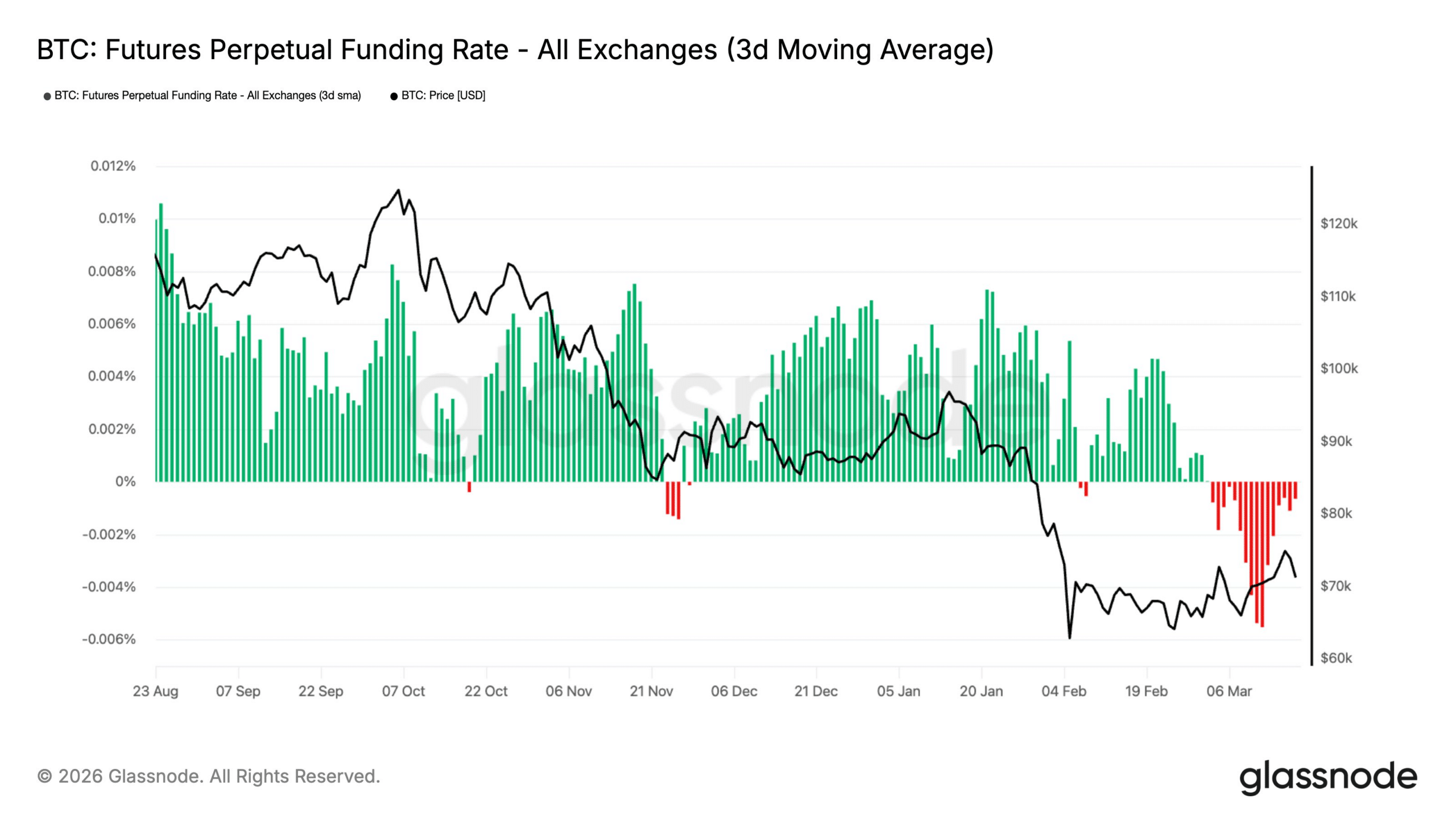
Backing this up, Glassnode data shows perpetual funding is still firmly negative, confirming the bearish bias in directional premium. Put simply, even though BTC has bounced off the lows, traders are still leaning short, which keeps the market primed for a potential squeeze-driven upside.
Source: Glassnode

But here’s where it gets interesting: The recent gold sell-off adds a twist, showing just how exposed the crypto market still is. With rising yields pulling capital back into traditional safe havens, and the Federal Reserve brushing off any talk of interest rate cuts, crypto traders are left navigating a tricky setup.

In this context, the rising Bitcoin shorts don’t feel like a fluke.

Instead, they’re looking more like strategic positioning. With the Coinbase Premium Index falling, limited capital inflows, BTC stuck near resistance, and a shifting macro backdrop, everything points to a bearish bias in both technicals and fundamentals. Bottom line? A crypto crash already looks priced in, and with the historical DXY-BTC correlation, it wouldn’t be surprising if history repeats itself.


Final Summary

  • Rising yields and a firmer DXY are pulling capital into safe havens, shaking confidence in gold.
  • With Bitcoin near resistance, falling CPI, and bearish technicals, a crypto crash may already be priced in.


Related Questions

QWhat was the immediate market reaction to the hotter-than-expected February PPI report released on March 18th?

AThe reaction was almost instant. Gold, for instance, dropped 3.74%, slicing through the $5k support level.

QAccording to the article, what two key factors are pulling attention and capital away from gold?

AThe gold sell-off is tied to the U.S. dollar getting stronger (a firmer DXY) and rising Treasury yields, which have jumped nearly 10% and are now more attractive.

QWhat does the falling Coinbase Premium Index (CPI) signal for the crypto market?

AThe falling Coinbase Premium Index is hinting at a shift, showing that crypto could eventually follow gold's lead downward as capital moves away from risk assets.

QWhat does the negative perpetual funding rate and bearish bias in directional premium indicate about trader sentiment?

AIt confirms a bearish bias, indicating that even though BTC has bounced off lows, traders are still leaning short and positioning for a potential downside move.

QWhy does the article suggest that a crypto crash may already be 'priced in'?

ABecause of the rising Bitcoin shorts, falling CPI, limited capital inflows, BTC being stuck near resistance, and a shifting macro backdrop with a stronger dollar and rising yields, all of which point to a bearish bias.

Related Reads

Anthropic Cries Wolf: Is the AGI Threat Real, or Just an IPO Story?

Anthropic has published an article titled "When AI builds itself," discussing the emerging concept of "recursive self-improvement," where AI begins to actively participate in designing, training, testing, and optimizing its own subsequent versions. The company presents internal data showing that by May 2026, over 80% of code merged into its codebase was written by Claude, its AI model. Claude's capabilities have expanded to handling complex, open-ended engineering tasks, achieving a 76% success rate in such areas, and even contributing to research processes, such as optimizing code performance and conducting AI safety experiments. Anthropic outlines an evolution from human-driven development to AI-assisted workflows, culminating in the current stage where AI agents can autonomously write, run, and delegate code. The company cautions that the path toward a "closed loop," where AI continuously improves itself, is becoming visible. It calls for coordinated global mechanisms to potentially slow or pause frontier AI development to allow safety research and societal structures to catch up. However, the timing of this warning coincides with Anthropic's preparations for an IPO, framing the narrative not just as a safety concern but also as a demonstration of Claude's advanced capabilities and its integral role in accelerating Anthropic's own R&D—creating a potential "flywheel" effect for competitive advantage. This contrasts with OpenAI's recent, more policy-oriented discussion of the same risks, highlighting the competitive dynamics in the AI industry as companies position themselves in both the technological and regulatory landscape.

marsbit50m ago

Anthropic Cries Wolf: Is the AGI Threat Real, or Just an IPO Story?

marsbit50m ago

BIT Research: ETF Purchases Have Slowed, Strategy (MicroStrategy) Has Slowed, What Else Can Drive Bitcoin's Rise?

Market Refocus on Inflation and Rate Expectations Weighs on Bitcoin Currently, the market is in a phase of macro-repricing dominated by inflation and interest rate expectations. Bitcoin, which previously benefited from easy liquidity and low inflation, is seeing its core bullish drivers weaken. These drivers were market expectations for interest rate cuts and strong inflows from Bitcoin ETFs and institutions like MicroStrategy (referred to as "Strategy" in the text). The logic has shifted. Recent high inflation data (e.g., CPI hitting 3.8% in a May 2026 report) has caused the market to sharply reduce its rate cut expectations for 2025 and even price in potential hikes. This is a key constraint for Bitcoin, as it lacks cash flows and is highly sensitive to rate expectations. Concurrently, institutional capital flows have slowed significantly. Following the hot CPI data, Bitcoin ETFs saw accelerated outflows, with around $4.3 billion leaving over a period. MicroStrategy's ability to keep adding substantial Bitcoin to its balance sheet is also diminishing. Together, ETF and MicroStrategy holdings total roughly $110 billion, but their momentum as growth engines is cooling. In summary, Bitcoin's current pressure stems not from its own fundamentals but from a changing macro environment. As long as inflation stays elevated, Bitcoin is likely to remain in a consolidating phase. However, historically, inflation eventually peaks. Once it recedes and rate cut expectations rebuild, institutional capital could return, potentially fueling a new and more robust recovery phase for Bitcoin.

marsbit58m ago

BIT Research: ETF Purchases Have Slowed, Strategy (MicroStrategy) Has Slowed, What Else Can Drive Bitcoin's Rise?

marsbit58m ago

Earning 1000 Trillion in Half a Year, 'Pocketing' 20 Million per Capita: This Round of Wealth Creation in the Korean Stock Market is Unprecedented in Scale

The South Korean stock market is experiencing an unprecedented wealth surge in 2026, with household equity and fund asset values soaring by over 1,000 trillion KRW (~$730bn) year-to-date. This translates to an average per capita wealth increase of roughly 20 million KRW, fueled by a historic 109% rally in the KOSPI index. The boom is driven by three converging forces: an AI-driven semiconductor supercycle boosting giants like Samsung and SK Hynix; the government's "Value-Up" market reforms addressing long-standing corporate governance issues; and aggressive real estate regulations that have locked capital within financial markets, preventing profits from flowing back into property. This has triggered a wealth effect, boosting high-end consumption significantly. However, the gains are highly concentrated. The two semiconductor behemoths account for over half the index's value, but retail investors own relatively low stakes in them, systematically missing the biggest rallies. Wealth and consumption benefits are skewed towards luxury goods and imported cars, bypassing mainstream retail. Further risks stem from excessive leverage, with high trading volume in leveraged ETFs, and a market sentiment heavily reliant on the AI sector's fortunes and speculative rumors. While this cycle marks a potential shift from real estate to equities as a primary wealth generator for Koreans, its sustainability, amid structural imbalances and leverage, remains a critical test.

marsbit1h ago

Earning 1000 Trillion in Half a Year, 'Pocketing' 20 Million per Capita: This Round of Wealth Creation in the Korean Stock Market is Unprecedented in Scale

marsbit1h ago

Trading

Spot
Futures
活动图片




