Original|Odaily Planet Daily(@OdailyChina)
Author|Wenser(@wenser 2010 )
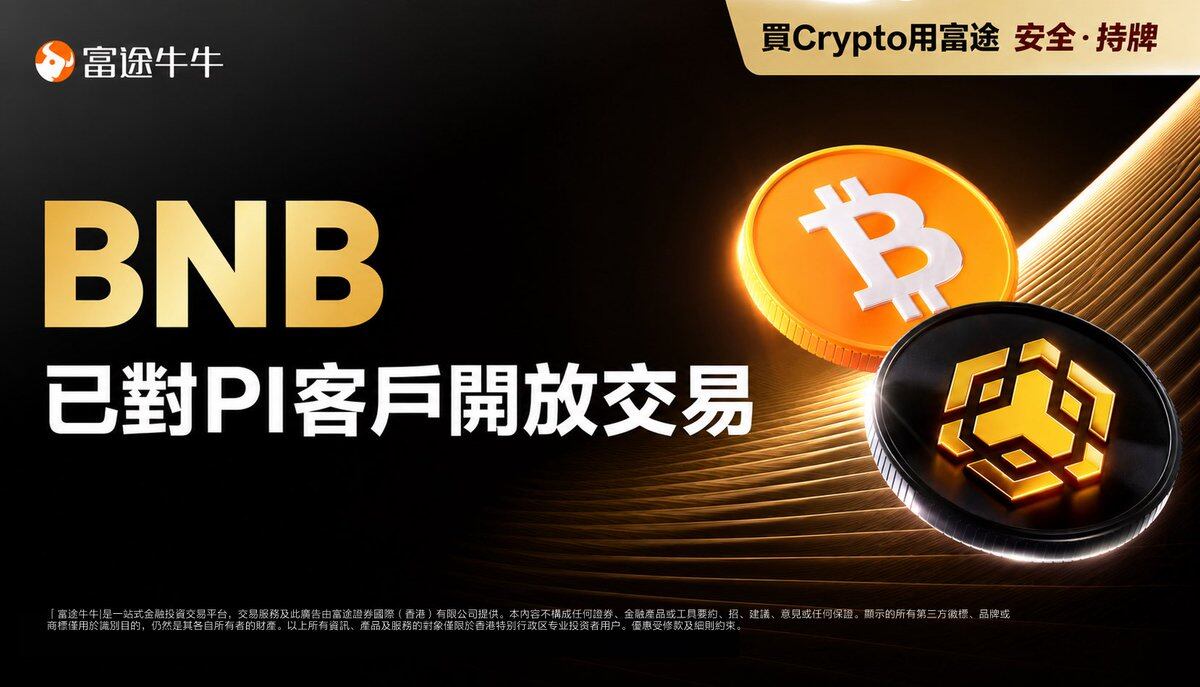
Last night, Futu NiuNiu officially launched BNB real-time trading services for Hong Kong's compliant professional investors.
Futu has thus become the first licensed brokerage in Hong Kong to offer BNB order book trading pairs. The platform's tradable virtual currencies have now expanded to 21 mainstream tokens, including BTC, ETH, SOL, and USDT. Futu stated officially that this addition of BNB trading in Hong Kong relies on its self-built virtual asset platform PantherTrade, listing the token in compliance with the Hong Kong Securities and Futures Commission (SFC) standards, and seamlessly integrates with Futu's securities trading system. This achieves a complete closed-loop process from upstream compliant listing to downstream real-time trading.
After facing class-action lawsuits in the US, partial business suspension orders in Japan, and the liquidation of mainland Chinese clients, the veteran brokerage platform Futu is beginning to seek a breakthrough in the crypto trading field.
Futu's Awkward Phase: Regulatory Pressure Makes Crypto Business a Growth Market
Launching BNB trading for Hong Kong's compliant investors might be one of the few 'growth opportunities' for Futu at present.
In the past three months, Futu has faced regulatory pressure from mainland Chinese authorities, US legal proceedings, and Japan's Financial Services Agency (FSA) over issues such as cross-border illegal operations, insider trading, and false disclosures.
Mainland China's Regulatory Crackdown: Fines of 18.5 Billion Yuan, Phasing Out Cross-Border Investors Within 2 Years
In May of this year, the China Securities Regulatory Commission (CSRC), jointly with the People's Bank of China and the Ministry of Public Security, among seven other departments, formally released the "Implementation Plan for Comprehensive Rectification of Illegal Cross-Border Securities, Futures, and Fund Business Activities" (hereinafter referred to as the "Plan"), initiating a full-scale crackdown on illegal cross-border brokerages. On the same day, the CSRC announced it had filed investigations against three leading cross-border internet brokerages, including Futu, Tiger Brokers, and Longbridge, with plans to confiscate all illegal gains and impose severe penalties. Futu's corporate level faces a proposed fine of 18.5 billion yuan, Tiger Brokers faces confiscation and fines exceeding 4.1 billion yuan, and the founders of both companies each face personal fines of approximately 1.25 million yuan.
Furthermore, according to the requirements of the "Plan", all institutions engaged in illegal cross-border operations must, during the two-year centralized rectification period, retain a one-way channel for existing investors—allowing only selling and withdrawing funds, with no further buying, adding positions, or depositing funds permitted.
Stock Insider Trading Allegations, Market Maker Losses Exceed $70 Million
Affected by the earlier fines and liquidation requirements from Chinese regulators, Futu's stock price once plummeted over 40% in a single day. Alleged insider traders, who reportedly obtained information in advance, profited by approximately $100 million through options bets.
As the counterparty to most of these allegedly insider trades, the market maker SIG (Susquehanna International Group) suffered losses exceeding $70 million. Consequently, on June 29th, SIG filed a lawsuit in the U.S. District Court for the Southern District of New York. The American judge approved SIG's request to freeze the relevant account funds on the same day.
Additionally, investor Yong Hong Tang sued Futu Holdings founder Li Hua and CFO Chen Yu on June 26th in the U.S. District Court for the Southern District of New York, alleging violations of securities fraud and controlling person liability clauses under the U.S. Securities Exchange Act of 1934. The class action lawsuit covers investors who purchased Futu shares between May 24, 2023, and May 27, 2026.
Latest information shows that the three defendants related to the insider trading case filed by SIG have appeared, including Hong Kong resident Yang Jingyao (suspected to be the largest single shareholder of the Hong Kong-listed company Rongzun International). Reports suggest his mother is a wealthy individual in mainland China, potentially serving as a source for insider information.
Japanese Regulatory Order: Part of Futu's Business Suspended for Rectification, New Account Opening Paused for 3 Months
On June 19th, Japan's Financial Services Authority issued a partial business suspension order to moomoo Securities (Futu Holdings' Japanese subsidiary), requiring it to suspend the solicitation and acceptance of new account openings from June 19th to September 18th, for a period of three months, and to formulate a rectification plan.
According to disclosures, moomoo Securities engaged in inappropriate conduct, including providing false explanations to clients regarding the applicability of Japan's Nippon Individual Savings Account (NISA) system. It also had multiple internal management issues, such as long-term deficiencies in suspicious transaction verification and reporting, and insufficient cybersecurity measures.
Traditional Brokerage Seeks New Breakthrough: Virtual Asset Trading and Financing Services Approved in Hong Kong, Real-Time Cryptocurrency Trading Launches
After facing frequent regulatory blows to its traditional brokerage business, Futu subsequently expanded into the crypto sector.
In July 2024, Futu Securities obtained approval from the Hong Kong SFC to provide virtual asset trading services to eligible investors, including retail investors, and officially launched BTC and ETH trading on August 1st, becoming the first licensed brokerage in Hong Kong to offer zero-commission cryptocurrency trading.
In August 2025, according to its official Q2 financial report, Futu's crypto asset balance had reached HKD 40 billion, with the business expanding to Hong Kong, Singapore, and the United States.
In November 2025, Futu's international platform Moomoo listed BNB in the United States and Singapore.
As 2026 arrived, while crypto exchanges listed traditional financial assets like US stocks, Korean stocks, and Hong Kong stocks, traditional brokerages also moved closer to cryptocurrency trading.
June: Approved to Launch Virtual Asset Trading Financing Services in Hong Kong
In June this year, Futu Securities announced that its Type 1 license (dealing in securities) upgrade application had been approved by the Hong Kong SFC, allowing it to launch virtual asset trading financing services for eligible clients in Hong Kong. The collateral for this service must be traditional securities. Previously, credit lines obtained by clients through traditional securities financing could not be used for cryptocurrency trading; this restriction has now been relaxed to allow such use.
The main differentiating selling points of Futu's launch of BNB real-time trading in Hong Kong are in 2 aspects:
Firstly, regarding the client base, Futu Hong Kong targets Professional Investors (PIs), not the entire retail segment or exclusive institutions.
Secondly, regarding the trading system, Futu employs an order book for matching, replacing simple quote-based trading, offering more flexible buying and selling methods.
Additionally, regarding a question many readers may have: "Does Futu Hong Kong support BNB deposits and withdrawals?", current information indicates it does not for now. This may be gradually opened up later, similar to previous cryptocurrencies like BTC, ETH, and SOL.
According to information from Futu's Q1 earnings call, its total transaction volume for Hong Kong brokerage business in Q1 reached HKD 4.15 trillion, a year-on-year increase of 29% and a quarter-on-quarter increase of 4%. US stock trading volume was HKD 3 trillion. By the end of Q1, the company's Assets Under Management (AUM) reached HKD 1,784 trillion, a year-on-year increase of 28%.
The company's executives stated that for the local Hong Kong client base, the company maintains a market share exceeding 50%. For overseas markets, the independent brand moomoo achieved high year-on-year revenue growth rates, with revenue growth exceeding 100% in five countries: Japan, Canada, Australia, the United States, and Malaysia. The number of clients with assets exceeds 2 million, with an average AUM of approximately $18,000.
Combined with previous information indicating that the proportion of its mainland Chinese clients with assets has dropped to 13%, the importance of its Hong Kong cryptocurrency trading business is gradually increasing. This move is also seen as a favorable attempt by traditional brokerages aiming to transform, seize the advantages of Hong Kong licenses, and capture the younger user demographic. From its global market expansion in 2018 to its current focus on the crypto business, despite regulatory pressures and business limitations, Futu continues to strive towards becoming a global one-stop financial services platform.
In a sense, the war of traditional brokerages counterattacking crypto exchanges has begun, with both sides competing for the same single target—global capital liquidity.