Author: Alex Xu
The AI narrative continues to unfold, yet the recent performance of related stocks has been a tale of two extremes: some are in the heat of summer, while others are in the depths of winter.
The former is represented by Circle, the issuer of the largest compliant stablecoin, USDC, while the latter is represented by Tencent.
There are many reasons for Circle's rise, such as its deep correction from 300 to 49, which built up momentum for a rebound. Additionally, the scale of USDC has recently seen a resurgence, hitting new highs again.
But the biggest driver might be the震撼 (shock) after the explosion of openclaw, where people were awed by the wave of Agents. This concrete impact has popularized stablecoins, which are considered highly suitable for Agent settlements, and Circle is currently the only pure-play stablecoin标的 (target) among globally listed companies.
The reason for Tencent's fall is more intriguing. Previously criticized for being slow in the AI era, it has been in a sustained correction from its high of 680. After a strong earnings report and statements about "reducing buybacks and increasing AI investment" during the earnings call, it反而 (instead) fell instead of rising. Market concerns about its AI investments have shifted from "insufficient" to "excessive."
So, in the AI era, who has more certainty, Tencent or Circle?
Charlie Munger once said that investing shouldn't involve tackling hard problems. His exact words were:
“One of our secrets is that we don't try to know too much... I constantly put things into the 'too hard' category. Occasionally, an easy decision comes along, and I make it. That's my system: most things go into 'too hard,' and only a few obvious, simple decisions get handled immediately.”
So, right now, which is the easy question on our investment desk, and which is the hard one, Tencent or Circle?
Let's start with Tencent.
Currently, Yuanbao AI within WeChat actually serves as an experimental form of WeChat's future native Agent:
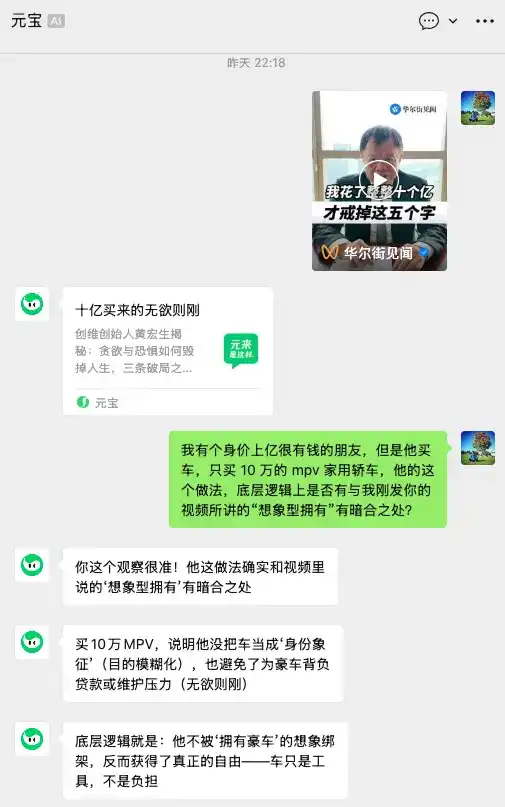
It can already handle most of the highest-frequency tasks that ordinary people use AI for: queries and Q&A.
However, currently, Yuanbao can only interact with content-based information within WeChat, such as text and image messages, Video Channel content, and WeChat Official Accounts. At this stage, it cannot directly interact with Mini Programs.
But predicting the general form of WeChat's own native agent isn't difficult: through natural language对话 (dialogue), we can directly instruct WeChat's Agent to call upon Mini Programs to perform various tasks, including ordering food delivery, booking hotels, summarizing videos and recordings, reminding us of schedules, and reporting on work.
Mini Programs themselves constitute a huge application ecosystem; most of the commonly used apps have Mini Program versions: DiDi Chuxing, Meituan, Pinduoduo, McDonald's, Huolala, WPS, and even Alibaba's Xianyu and Ele.me.
More importantly, WeChat's agent's relationship with Mini Programs is similar to (or stronger than) Apple's relationship with iOS ecosystem software—it has extremely strong system-level permissions. Mini Program development must follow WeChat's specifications. WeChat's agent certainly won't be directly blocked by major apps like Douban's Phone Assistant, kept outside the walled garden. Instead, it will interact system-level with various Mini Programs, and major Mini Program apps will inevitably embrace WeChat's official agent to provide better services to users.
Compared to the currently hot but折磨 (tormenting) for most early adopters and causing many ordinary users to give up from the start openclaw, a WeChat Agent面向 (aimed at) 1.4 billion users will必然 (inevitably) have better usability and practicality. Then it will be the true "nationwide Agent promotion." This form might not be as geeky or cool, but it's the product usable by 90% of the masses.
The launch of this Agent product form at some future point is highly certain. It's just that before it happens and people see it, against the backdrop of Tencent's continuously falling price, Mr. Market is吝啬地 (stingily) not pricing it in.
But for value investors, Mr. Market is someone we use.
We want to invest in things that have a high probability, even near certainty, of happening, but haven't happened yet.
Facing the highly uncertain AI era, is Tencent's operational certainty really that low? I think it's actually quite good.
Is buying/holding Tencent at this time an easy or a hard question?
I think it's much easier than market sentiment suggests.
Now, let's talk about Circle:
Some things, when viewed over the long term, actually have rather模糊 (blurry) certainty.
Will Circle's future business scale smoothly grow to several trillion, or even tens of trillions?
Optimistic bullish voices believe so. Their logic is:
1. AI is the future. In the future, agents will be the main users of the internet and will dominate huge online transaction volumes.
2. AI transactions will require stablecoins based on blockchain settlement.
3. USDC is currently the largest compliant stablecoin. AI's settlement needs will directly drive the growth of USDC's scale.
4. Stablecoins have strong network effects; scaling amplifies and reinforces itself.
5. USDC's scale will grow同步 (synchronously) with AI's transaction volume to several trillion or more.
This chain of reasoning seems tight, but several key links have significant uncertainties:
1. In the future, will agents be the main users of the internet and dominate huge transaction volumes?
Long-term, this has high certainty. Pass.
2. Will AI transactions use stablecoins?
Not necessarily. Everyone sees point 1, but existing payment infrastructure providers, internet giants, and AI giants that control users are also pushing their own standards, many not based on blockchain, like Google's promoted UCP protocol for agentic commerce.
3. Is USDC the largest compliant stablecoin?
Currently, yes. But Tether also has significant influence, is trying to become compliant, and has considerable political resources. There are also more eager tradfi financial groups and payment providers like Paypal.
4. Do stablecoins have strong network effects?
In the face of ruthless agents, the differentiation between stablecoins will be compressed. As long as they can all be used for payment, agents will choose the one with the lowest friction and fees. Whether it's USD1, USDT, USDC, or some bank-issued stablecoin? It doesn't matter. You say USDC currently has more merchant-side resources? Payment通道商 (channel providers) like Visa and Stripe have far larger merchant networks and channels than Circle and can similarly help other stablecoins gain access. As long as settlement is convenient and friction is low, merchants don't care which stablecoin they receive. The network effects of stablecoins might not be that strong in an agent-dominated payment era.
5. Will USDC's scale grow同步 (synchronously) with AI's transaction volume to several trillion?
When assumptions 2-4 all have high uncertainty, combining them to reach conclusion 5 makes the overall uncertainty模糊 (blurry).
Facing the highly uncertain AI era, is Circle's operational certainty really that high? I think it's just okay.
Is buying/holding Circle at this time an easy or a hard question?
I think it's much harder than market sentiment reflects.
Just my personal opinion, for reference only.